Introduction
Sponsored newsletter pricing is hard to get right because the variables that matter most — engagement quality, audience specificity, and format — are different for every publication.
Rates range from $75 for a small-list placement to $50,000+ for flagship newsletter sponsorships at scale, with no universal formula in between.
Two mistakes account for most of the money publishers leave on the table. First, defaulting to follower-count formulas that ignore the engagement data advertisers actually care about. Second, not knowing which pricing model to use — flat rate, CPM, or performance-based — before quoting anything.
This guide covers realistic pricing tiers by newsletter size, the factors that move rates up or down, the main pricing models, and what consistently causes publishers to undercharge — so you can quote with confidence.
Key Takeaways
- Newsletter sponsored content ranges from $75–$250 for small lists to $3,000–$20,000+ for large premium placements — format matters as much as list size
- Open rate, niche specificity, and audience engagement drive prices more than raw subscriber count
- Inline ads, dedicated sends, and sponsored articles each carry distinct price points worth understanding before quoting
- Exclusivity and dedicated sends command 2–5x the base placement rate, not a modest add-on
- No universal formula exists, but your engagement metrics give you everything you need to price with confidence
How Much Does Sponsored Newsletter Content Cost?
There's no fixed price. Rates depend on audience size, engagement quality, content format, and how well the publisher knows their own market position.
What makes newsletters different from display or social inventory is direct inbox delivery — no algorithm filtering, no ad blockers, no banner blindness. That structural advantage justifies a pricing premium. Litmus reported in 2025 that 35% of companies see $10–$36 in email ROI per $1 spent, with another 30% seeing $36–$50 per $1.
Common Pricing Mistakes Before We Get to Numbers
Publishers typically go wrong in three ways:
- Underpricing to win clients sets a low anchor that's nearly impossible to raise later
- Overpricing without data backfires; engagement metrics exist precisely to justify your rate
- Charging flat rates regardless of format treats a dedicated send and an inline text mention as the same product — they're not
Typical Pricing Tiers by Newsletter Size
| Newsletter Size | Typical Rate Range | CPM Guidance |
|---|---|---|
| Under 5,000 subscribers | $50–$250 per placement | ~$15–$35 CPM |
| 5,000–10,000 subscribers | $125–$500 per placement | ~$20–$50 CPM |
| 10,000–50,000 subscribers | $500–$3,000 per placement | ~$20–$50 CPM |
| 50,000+ subscribers | $3,000–$20,000+ per placement | Varies by niche and engagement |
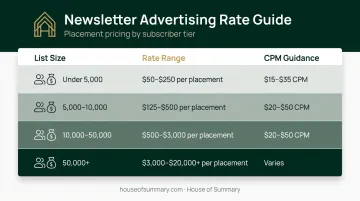
Sources: beehiiv 2025 newsletter cost breakdown; Paved 2026 sponsorship benchmarks
These ranges cover one placement, basic usage, and one revision cycle. They exclude exclusivity, extended content rights, multi-issue runs, and content production — each of which should be priced separately.
Format is the variable most publishers overlook when building rate cards. An inline text mention, a mid-newsletter feature slot, and a full dedicated send are three distinct products. Dedicated sends — where one brand owns the entire email — should be priced at 2–5x the base placement rate on the same list, according to Paved's benchmarks.
Key Factors That Affect Sponsored Content Pricing
Subscriber count is the first number advertisers ask about. It's also the weakest indicator of actual value.
Subscriber Count and Open Rate
List size sets inventory scale, but it doesn't tell sponsors whether anyone's paying attention. A 15,000-person list with a 45% open rate routinely outperforms a 100,000-person list at 18% for brands trying to reach high-intent readers.
Mailchimp's all-industry benchmark (updated December 2023) puts the average open rate at 35.63% and average click rate at 2.62%. Anything consistently above both figures justifies a premium. Publishers with above-average engagement should state that explicitly — with data — rather than hoping advertisers assume it.
One caveat: high open rates don't automatically translate to sponsor revenue. Paved's 2026 data shows History newsletters averaging a 63.2% open rate but only $4 revenue per 1,000 subscribers, while Millennials newsletters with a 44.4% open rate and 7.5% click rate generated $66 per 1,000 subscribers. Audience commercial intent matters more than raw engagement volume.
Niche and Audience Specificity
A general-interest newsletter competes on size. A niche newsletter competes on relevance — and relevance commands higher prices.
beehiiv's 2025 data puts specialized B2B newsletter CPMs at $50–$100+, versus $15–$35 CPM for broader consumer lists. The difference reflects purchase intent: brands pay more to reach an audience that already has decision-making authority or high commercial intent.
Newsletters covering finance, executive leadership, geopolitics, and global business sit in exactly this premium tier. House of Summary's network — Presidential Summary, Geopolitical Summary, London Summary, Dubai Summary — reaches 500,000+ subscribers who skew heavily toward executives, policy professionals, and high-income consumers. That's the profile B2B and luxury brands pay to reach.
Content Format and Deliverable Type
Placement format determines price as much as list size:
- Inline text mention or banner — lowest cost, least attention
- Mid-newsletter feature placement — more prominence, higher rate
- Top-of-newsletter positioning — premium visibility, priced accordingly
- Dedicated send — the entire email promotes one brand exclusively, 2–5x the inline rate
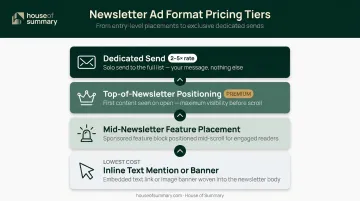
Publishers who charge the same rate for a buried text mention and a dedicated send are giving significant value away.
Exclusivity and Timing
If a brand wants sole-sponsor status in an issue, or wants competing brands restricted for a period, that's a separate line item — not a favor. Paved recommends pricing dedicated emails and exclusive arrangements at 2–5x the primary placement rate. Seasonal demand — Q4, major industry events, product launch windows — drives rates up and should be reflected in your rate card, not negotiated away.
Sponsored Content Pricing Models: Which One Should You Use?
The model you choose determines how you justify your price, how you handle performance expectations, and how revenue scales over time.
Flat Rate Per Placement
The most common model for newsletters — a fixed price per ad slot per issue, regardless of impressions generated. It's predictable and easy to package into 3-issue or 6-issue bundles.
The main limitation: as your list and engagement grow, flat rates don't automatically reflect rising value. Publishers who set a rate card early and never revisit it systematically undercharge as their audience grows.
CPM (Cost Per Thousand Impressions)
CPM pricing ties the rate to how many subscribers receive the email. A $25 CPM on a 20,000-person list equals a $500 placement. Newsletter CPMs run significantly higher than display or social equivalents — the global social media CPM averaged just $6.06 in Q4 2023 (Statista), while newsletter CPMs typically fall in the $10–$75 range, with B2B and niche lists reaching $50–$100+.
Inbox delivery means the ad is seen, not just served — which is why advertisers pay a meaningful premium over web or social placements.
Performance-Based Models (CPC / CPR)
Rather than paying for delivery, CPC and CPR models pay publishers based on actual engagement. This reduces risk for advertisers and rewards publishers whose audiences consistently act on what they read.
The trade-off: it requires solid tracking and genuine confidence in your metrics. Publishers who can reliably deliver clicks often earn more under performance pricing than a flat rate would provide.
Package and Retainer Deals
Multi-issue packages and monthly retainers give publishers a revenue floor while offering brands better per-placement rates. Key dynamics to know:
- Package discounts of 15–25% are standard — you trade rate for volume certainty
- Retainer relationships tend to produce better-performing content over time
- Brand messaging sharpens with each issue as the editorial fit develops
- Guaranteed slots let you plan production and commitments further out
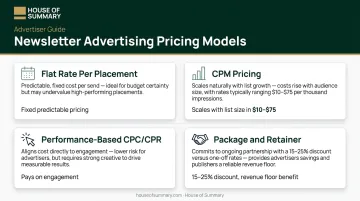
What Most Publishers Get Wrong About Sponsored Content Pricing
These aren't dramatic mistakes. They're consistent habits that add up to significant undercharging over time.
Pricing Only on Subscriber Count
Most publishers start with subscriber count — and rarely look beyond it. The metric advertisers actually care about is whether engaged, relevant readers will see and act on the message. Publishers with smaller but highly engaged lists are leaving money on the table when they ignore open rates, click-through rates, and audience demographics.
Build your rate card around the full picture: list size, average open rate, click rate, and audience profile. That's the conversation sophisticated sponsors are already having.
Not Charging for Exclusivity or Usage Rights
When a brand requests sole-sponsor status in an issue, the publisher gives up the ability to sell other placements in that issue. When a brand wants to repurpose sponsored content in their own marketing channels, they're getting additional commercial value beyond the original placement. Both should be line items on every rate card:
- Dedicated sends: Price at 2–5x the base placement rate (per Paved's benchmarks)
- Usage rights: Negotiate as a separate fee, not quietly absorbed into the base price
- Exclusivity windows: Factor in the lost revenue from unsold placements in that issue
Failing to Revisit Rates as the List Grows
A rate card set once and never updated is one of the quietest revenue leaks in newsletter publishing. Subscriber counts double, open rates improve — and the price stays the same.
Rates should be reviewed at defined intervals — at minimum annually, or after any significant audience milestone. A newsletter that's grown from 10,000 to 50,000 subscribers with improving engagement is not the same product it was two years ago. Price accordingly.
Frequently Asked Questions
What is CPM (cost per 1,000 impressions)?
CPM, or Cost Per Mille, is the price an advertiser pays per 1,000 ad deliveries — in newsletters, that means per 1,000 subscribers who receive the email. Newsletter CPMs run far higher than display ad equivalents because inbox delivery virtually guarantees the ad is seen, not just served to a browser that may never load it.
How much is YouTube sponsorship per 1,000 views?
According to Influencer Marketing Hub's 2026 rates guide, YouTube sponsorship CPMs typically fall between $15–$30 depending on niche, audience geography, and creator demand. Unlike newsletters, YouTube rates fluctuate based on algorithm reach and are affected by ad blockers and skip behavior, which limits true viewability.
What is a good CPM for newsletter sponsorships?
Most newsletters fall between $10–$75 CPM, with consumer lists averaging $15–$35 and specialized B2B or niche publications regularly reaching $50–$100+, according to beehiiv's 2025 benchmarks. Use $20–$50 CPM as a planning anchor for engaged mid-sized newsletters, then adjust based on click rate, sponsor category, and audience fit.
What is the difference between a dedicated send and an inline newsletter ad?
An inline ad is a placement — banner, text block, or feature mention — within a regular editorial issue alongside other content. A dedicated send is an entire email sent to the subscriber list promoting one brand exclusively, with no competing content. Dedicated sends command significantly higher rates — typically 2–5x the inline rate — because they deliver complete inbox attention and share-of-voice.
Should I charge more for exclusivity in sponsored content deals?
Yes. Exclusivity — being the sole advertiser in an issue, or restricting competing brand placements for a defined period — has direct commercial value. Paved's benchmarks recommend pricing dedicated sends and exclusive arrangements at 2–5x the base placement rate. Treating exclusivity as a standard offering rather than a premium add-on leaves measurable revenue on the table.
How often should I review and update my sponsored content rates?
At minimum annually, or after any significant audience milestone — list size doubles, open rate materially improves, or you shift into a more valuable niche. Rates set early and left unchanged are the most common cause of systematic undercharging as a newsletter grows. Build a rate review into your calendar, not your to-do list.