
Introduction
In-text advertising appears constantly across editorial content, blogs, and news sites—readers encounter it every time they hover over a double-underlined keyword that triggers a pop-up ad. This format emerged as banner ad click-through rates plummeted from 44% in 1994 to roughly 0.05–0.1% today, driven by documented "banner blindness" where users unconsciously ignore ad-like elements. Publishers and advertisers needed a format that used reader attention on the content itself rather than around it.
Yet most marketers and media buyers still can't explain how the delivery mechanism actually works—or where the format fits within a broader ad strategy.
This guide covers the three-stage process that turns keywords into ad triggers, how in-text ads differ from other formats, and the real trade-offs for publishers and advertisers in a landscape shaped by ad blockers and shifting user expectations.
Key Takeaways
- In-text advertising turns specific keywords within web content into ad triggers revealed via hover or click
- Ad networks tag keywords automatically, match ads contextually, and deliver them only when users engage
- Publishers monetize existing content without adding visual ad units; advertisers reach readers at contextually relevant moments
- Performance varies widely based on UX impact and technical limitations, so fit depends on your specific goals
- Ad blockers affect 912 million users globally, making this client-side format highly vulnerable to suppression
What Is In-Text Advertising?
In-text advertising is a format where specific words or phrases within editorial content are highlighted—typically with a double underline—and linked to advertiser content that activates when a user hovers over or clicks the keyword. Unlike standard hyperlinks placed by the publisher, these ads are inserted by a third-party ad network, not the content author.
The format solved a specific operational problem: as banner ads lost effectiveness due to declining click-through rates, publishers needed a way to capture attention already focused on the content itself.
Rather than competing for peripheral vision alongside sidebars and headers, in-text ads integrate directly into the content layer of the page.
What In-Text Advertising Is Not
- PPC search text ads — appear in search results, not embedded within editorial content
- Native advertising — functions as a standalone content unit that mimics editorial style
- Publisher-placed hyperlinks — manually inserted by content authors, not dynamically tagged by an ad network
Main Types of In-Text Advertising Formats
- Hover-activated keyword pop-ups (most common) — a tooltip appears after the cursor rests on the keyword for 1–2 seconds, keeping the user on-page
- Auto-hyperlinked anchor text — click-activated links that route users directly to an advertiser's landing page
- Inline text ad blocks — embedded mid-article units that function more like display ads placed within body copy than true in-text placements
Why the Format Persists
In-text advertising continues to exist despite newer formats because it requires no visual real estate, integrates into the content layer, and remains a low-cost option for advertisers seeking contextual placement. Its use has narrowed over time, but it still appears on long-form content sites — think article directories, recipe blogs, and how-to guides — where publishers want additional ad revenue without inserting banner units.
How Does In-Text Advertising Work?
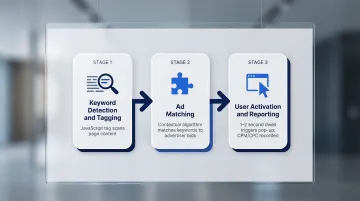
In-text advertising operates through a defined delivery sequence: from keyword identification on the publisher's page, through ad network matching, to the moment a user triggers and sees the ad. The three stages below break down exactly how that sequence runs.
Keyword Detection and Tagging
An in-text ad network—such as Vibrant Media or Infolinks—scans the publisher's page content and identifies words or phrases that match active advertiser campaigns. This happens either at page load via a JavaScript tag or through a server-side integration.
The publisher installs a small script that enables the network to read and tag eligible content. Tagging is applied dynamically during page rendering — the page's source HTML is never permanently altered.
The network's algorithm identifies keywords based on advertiser bids and campaign parameters, much like keyword bidding in search, but applied to on-page vocabulary rather than user search queries.
Ad Matching and Activation
Once keywords are tagged, the ad network matches them to relevant advertiser bids using a contextual algorithm. For hover-based formats, a pop-up or tooltip ad unit appears when the user's cursor rests over the highlighted keyword for a defined dwell time—usually 1–2 seconds.
This dwell threshold is designed to reduce accidental impressions and improve ad relevance signals. When a user clicks through or engages with that triggered unit, the ad network records the interaction. The advertiser pays on a CPM or CPC basis depending on the network's model, and the publisher receives a revenue share.
Revenue and Reporting
Each recorded interaction feeds into the reporting layer. Advertisers see contextual impressions tied to specific keywords and pages; publishers track revenue share credits per qualifying event. Standard reporting covers impressions, hover rates, and clicks.
Critical limitation: Because in-text ad scripts run client-side, they are vulnerable to ad blockers. Global ad-blocking users reached 912 million in 2023, with an average adblock rate of 21% across geographies and verticals. Filter lists like EasyList explicitly target networks such as Vibrant Media and Skimlinks, meaning a significant portion of potential impressions never reach users.
Pros and Cons for Publishers and Advertisers
Publisher Trade-Offs
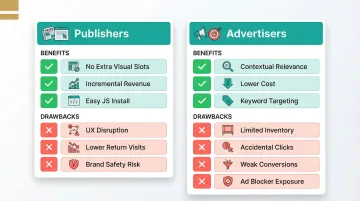
Benefits:
- Monetizes existing content without requiring additional visual ad slots
- Generates incremental revenue from text-heavy pages that may already have standard display units
- Low implementation barrier—typically just a JavaScript tag installation
Drawbacks:
- Risks disrupting the reading experience with hover-triggered pop-ups
- Readers may find the format intrusive, which can affect time-on-page and return visit rates
- Research from Nielsen Norman Group indicates that revealing hidden content too quickly on mouseover can result in accidental activations and creates a jarring user experience
- Premium publishers largely avoid in-text ads due to brand safety concerns and preference for higher-CPM formats
Advertiser Trade-Offs
Benefits:
- Offers contextual relevance—the ad appears alongside content where the target keyword appears organically
- Generally lower cost than display advertising
- Provides keyword-level targeting similar to search, but within editorial content
Drawbacks:
- Inventory is limited to a narrower set of publisher sites
- Click quality can be inconsistent due to accidental hovers
- The format rarely outperforms well-placed display or search advertising on conversion metrics
- Highly vulnerable to ad blockers, reducing effective reach by roughly 21% on average
Alternative: Newsletter Advertising
The ad blocker vulnerability and inconsistent click quality of in-text formats push many advertisers toward environments where these risks don't apply. Newsletter advertising addresses both: messages reach readers directly in the inbox, where browser-based blockers have no effect and attention is undivided.
House of Summary operates a network of human-written newsletters — including Presidential Summary, Geopolitical Summary, Dubai Summary, and London Summary — delivering brand placements to executives and business professionals in an editorial context. Advertisers report click-through rates running 4x higher than Google AdWords, a meaningful contrast to the conversion underperformance typical of in-text formats.
Where In-Text Advertising Is Used
Where In-Text Advertising Is Used
In-text advertising performs best on content-heavy sites with consistent topical focus. Long-form editorial, news commentary, how-to blogs, and review sites provide the keyword density that makes contextual ad matching effective. Thin or fragmented content pages yield lower match quality and lower engagement.
Where It Works — and Where It Doesn't
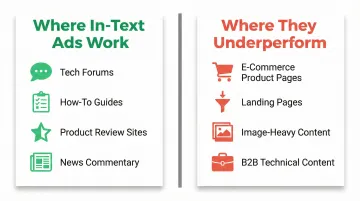
In-text ads thrive in environments where words carry the experience:
- Tech forums and community sites
- How-to guides and tutorial content
- Product review sites with detailed written analysis
- News commentary with consistent topical focus
They underperform where text is thin or incidental:
- E-commerce product pages with short descriptions
- Landing pages optimized for conversion
- Image-heavy content with minimal text
- B2B or highly technical content where keyword matches may feel out of context to professional readers
That split reflects the broader publisher landscape. In-text advertising is most commonly found in consumer media, general interest publishing, and affiliate-heavy content sites. Its use in premium or niche editorial environments is limited — premium publishers prioritize user experience and favor higher-CPM formats like programmatic video and sponsored content.
Conclusion
In-text advertising converts content keywords into contextual ad triggers through a three-stage process of tagging, matching, and user-activated delivery. Understanding this mechanism helps both publishers and advertisers evaluate it with clear expectations rather than treating it as a black-box format.
The format works best in specific conditions:
- High-volume content sites with broad consumer audiences
- Cost-sensitive campaigns prioritizing reach over precision
- Contexts where passive, keyword-triggered exposure is sufficient
It underperforms in premium editorial environments, ad-blocker-heavy audiences, and high-intent B2B contexts where readers expect relevance, not interruption.
In-text advertising still serves a role in a diversified media mix. The decision comes down to whether its reach advantages outweigh its vulnerability to ad blockers and the UX friction it introduces — trade-offs that alternatives with contextual targeting often sidestep.
Frequently Asked Questions
What is inline text advertising?
Inline text advertising and in-text advertising refer to the same format. Keywords within web content are highlighted and linked to advertiser content, typically revealed through hover or click interaction.
What is the 20% text rule?
The 20% text rule was a Facebook advertising guideline that restricted image-based ads from containing more than 20% text. Meta officially retired this rule in September 2020, shifting it to a best practice recommendation. The rule is unrelated to in-text advertising.
Is in-text advertising effective?
In-text advertising can deliver contextual relevance at low cost, but it typically underperforms display advertising on click-through and conversion metrics. It is also vulnerable to ad blockers, which affect over 900 million users globally.
How does in-text advertising differ from display advertising?
Display ads occupy fixed visual placements like banners and sidebars, while in-text ads are embedded within the content layer itself. In-text ads only become visible when a user interacts with a highlighted keyword, making them less visually intrusive but potentially more disruptive to the reading experience.
Do in-text ads get blocked by ad blockers?
Yes. Most ad blockers can detect and suppress the JavaScript tags that power in-text ads, which reduces effective reach by roughly 21% on average. Email-based advertising formats bypass browser-level blocking entirely, delivering messages directly to inboxes without client-side script dependency.
What are the main in-text advertising platforms?
The classic in-text advertising market has contracted significantly. Historically dominant providers included Vibrant Media, Kontera, and Infolinks. Kontera was acquired by Amobee in 2014; Vibrant Media has since pivoted toward AI SEO services; Skimlinks now operates as an affiliate and commerce monetization platform. Research current active networks before committing to any provider.