Introduction
Banner ads are losing ground. According to EMARKETER, 32.8% of users worldwide block ads, and 31% of U.S. adults cite privacy as their primary reason for doing so. Meanwhile, nonvideo display's share of programmatic spending has fallen by more than 15 percentage points over four years. Readers have shorter attention windows, and the formats publishers relied on for a decade are delivering diminishing returns.
This guide is for independent publishers, newsletter operators, content site owners, and media brands looking to diversify revenue without plastering their properties with ads readers will ignore or block. It walks through how native advertising works, the formats publishers can offer, what FTC compliance requires, and how to build it into a dependable revenue stream — without eroding reader trust.
Key Takeaways
- Native ads match the look and feel of editorial content — readers engage and share them far more often than banner ads
- U.S. native display ad spend hit $108.83B in 2024 — 63.1% of all U.S. display advertising
- Newsletter placements bypass ad blockers entirely and reach opted-in, undistracted readers
- Clear disclosure labels ("Ad," "Sponsored," "Paid Advertisement") are required — vague terms like "Presented by" don't satisfy FTC rules
- Niche, engaged audiences consistently outperform raw traffic volume for native ad effectiveness
What Is Native Advertising and Why Publishers Are Paying Attention
Native advertising refers to paid placements designed to match the look, feel, and function of the content surrounding them. Unlike a banner or a pop-up demanding attention, native ads live inside the editorial flow — labeled transparently as sponsored, but written and formatted to fit naturally within the reader's experience.
Banner ads occupy separate real estate: gutters, headers, footers — spaces readers have trained themselves to ignore. Native ads appear where the reader already is, inside the article, the newsletter, the feed. That placement is what makes them work. They earn attention rather than interrupting it.
The market reflects this shift. EMARKETER forecasts $108.83B in U.S. native display ad spending in 2024, accounting for 63.1% of all U.S. display ad spend. That figure includes social native (roughly $80B of the total), but even stripped of social platforms, publisher-side native represents a growing share of advertiser budgets.
Key reasons brands are shifting budget toward native formats:
- Reader attention: Native placements appear inside content, not around it — where eyes already land
- Ad fatigue resistance: Formats that match editorial context sidestep the banner blindness affecting display
- Engagement signals: Native consistently outperforms display on click-through and time-on-content metrics
- Publisher alignment: Brands want environments where editorial quality reflects on their message
Publishers who can offer these placements — with credible editorial context and engaged audiences — are well-positioned to capture a growing slice of that budget.
How Native Advertising Works for Publishers
The Publisher's Role
Publishers bring three things to the native ad equation: a trusted environment, an engaged audience, and inventory within content that readers actually consume. Advertisers — or their agencies — pay for access to that audience through content that fits the publisher's editorial style.
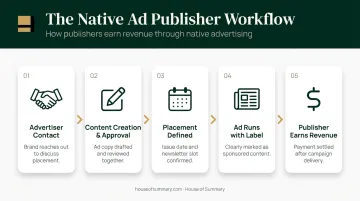
The basic workflow looks like this:
- Advertiser contacts publisher (directly or through a platform) with a campaign brief
- Content is created or approved — either by the advertiser, the publisher, or collaboratively
- Placement is defined — specific newsletter issue, article slot, or content section
- The ad runs within the editorial feed or newsletter with a clear sponsored label
- Publisher earns revenue via impression, click, or flat sponsorship fee
Direct-Sold vs. Programmatic
Publishers generally operate through one of two models, and the difference in revenue is significant:
| Model | Control | CPM | Fit |
|---|---|---|---|
| Direct-sold native | Publisher sets price and editorial standards | Higher — negotiated directly | Best for niche, engaged audiences |
| Programmatic native | Ad network fills automatically via auction | Lower — market-driven | Best for high-traffic, general interest publishers |
Direct-sold placements require a sales function but deliver better rates and full editorial control. Programmatic options — platforms like Taboola, Outbrain, or Nativo — fill inventory automatically and suit publishers without dedicated sales teams, though typically at lower returns.
How Pricing Works
Native ad pricing models vary by format and relationship type:
- Flat-fee sponsorships — common in newsletters; one price for one placement in one issue
- CPM (cost per thousand impressions) — standard for programmatic and some direct deals
- CPC (cost per click) — used by platforms like Taboola and Outbrain for performance campaigns
- Hybrid models — flat fee plus performance bonus, or tiered pricing by engagement
Rate negotiations for direct-sold inventory come down to one factor: how well-defined and attentive the audience is. Advertisers pay a premium when they know exactly who they're reaching and that those readers are genuinely engaged — not passively scrolling.
House of Summary operates on a custom rate card, with pricing determined by placement type, newsletter selection, and campaign scope. Advertisers can contact sales@houseofsummary.com for media kits and CPM details.
Types of Native Advertising Formats Publishers Can Offer
In-Feed Sponsored Articles
The advertiser pays the publisher to place a piece of content — article, video, listicle — that matches the editorial style of the site. Labeled clearly as "Sponsored" or "Paid Content." Most common on news and content sites. Effective because it rewards readers who are already in reading mode.
Newsletter Sponsorships and Inline Placements
Ads embedded within the editorial flow of an email newsletter, appearing between sections of curated content. This format has a structural advantage every other placement lacks: ad blockers don't work in the inbox. The reader has opted in, attention is undivided, and there's no algorithm between the brand and the audience.
House of Summary's newsletter network (Presidential Summary, Geopolitical Summary, Dubai Summary, and London Summary) reaches 500,000+ subscribers with 254,866+ emails opened daily. Inline native placements appear within the reading flow rather than in isolated ad slots. That combination — unblocked delivery, no competing algorithms, opted-in readers — is why brands in these categories actively seek out this format:
- Finance and fintech firms targeting decision-makers
- Luxury brands reaching executives in the USA, UK, and UAE
- Healthcare companies needing credibility-aligned placements
Recommendation Widgets
"You might also like" or "From around the web" content grids placed at the end of articles, powered by platforms like Taboola or Outbrain. These are worth knowing about for their tradeoffs:
- Low implementation effort — plug in a platform, done
- Good for volume, but CPMs run lower than direct-sold placements
- Essentially passive revenue with minimal ongoing sales work
Branded Content Hubs and Custom Series
A brand funds an ongoing editorial series or topic hub on the publisher's site. Higher investment from both sides, but a premium revenue opportunity for publishers with established editorial credibility. These deals tend to run longer, create deeper brand association, and often lead to renewals.
Key Benefits of Native Advertising for Publishers
Revenue Without Reader Disruption
Aggressive display monetization — stacking banners, interstitials, sticky units — yields short-term revenue at the cost of reader experience. Native advertising offers the opposite trade: lower visual clutter, higher reader retention, and advertiser relationships worth renewing. The reading experience is the inventory — damage it, and the premium rates disappear with it.
Advertisers Pay More — and There's Data Behind Why
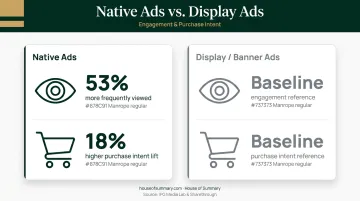
A 2013 study by IPG Media Lab and Sharethrough found that consumers viewed native ads 53% more frequently than display ads, and native registered an 18% higher lift in purchase intent than banner ads. The figures are from 2013, but the underlying dynamic has only strengthened as display fatigue has grown. Advertisers know native performs better, and they price accordingly.
Editorial Control and Brand Safety
Direct-sold native gives publishers something programmatic display never offers: the ability to review, approve, and shape the content that appears on their platform. Publishers can set standards for which advertisers they'll work with and which topics they'll allow. House of Summary, for instance, maintains strict category restrictions — no gambling, no political campaigns, no sensationalist content — preserving the editorial credibility that makes placements worth buying in the first place.
Audience Quality Over Audience Size
A niche newsletter with 50,000 highly engaged subscribers in a defined professional category outperforms a general-interest site with 5 million monthly visitors for native ad effectiveness. The reason is intent: readers who subscribe to a specialized publication on geopolitics, finance, or business are exactly the audience certain advertisers need — and they're willing to pay to reach them precisely.
The IAB's News Trust Halo study found that 84% of news consumers say ads in professionally produced news environments increase or maintain brand trust. Consumers were also 43% more likely to consider trying or buying from a brand seen in a preferred news source.
Publishers who can articulate their audience clearly — who they are, what they read, why they trust the publication — are the ones who attract premium advertisers.
Long-Term Advertiser Relationships
Native advertising builds the conditions for repeat business. When a brand's message genuinely fits a publisher's editorial lane, both sides benefit from continuing the relationship. The result is straightforward:
- Advertisers get consistent access to a warm, familiar audience
- Publishers build recurring revenue instead of hunting new buyers each quarter
- Both sides invest in making the content work — which raises quality over time
FTC Compliance and Disclosure: What Publishers Must Know
The Core Legal Requirement
The FTC is clear: any paid content must be clearly and conspicuously identified as advertising before the reader engages with it. A disclosure buried at the bottom of an article, revealed only after someone clicks through, doesn't satisfy the requirement. The impression created before the click is what the FTC evaluates.
Acceptable disclosure terms include:
- Ad
- Advertisement
- Paid Advertisement
- Sponsored Advertising Content
Terms the FTC flags as ambiguous or insufficient:
- "Promoted" or "Promoted Stories"
- "Presented by [Brand]"
- "Brought to You by [Brand]"
- Brand logos or names without accompanying text disclosure
Where Disclosures Must Appear
Placement matters as much as language:
- Articles: Label must appear near the headline, visible before the reader clicks through
- Newsletters: Sponsored label belongs at the start of the placement, not the end
- Recommendation widgets: Each individual piece of paid content must be labeled — labeling the widget container alone isn't enough
Why This Matters Beyond Legal Risk
The consequences go beyond FTC enforcement. Native advertising's value to publishers rests entirely on reader trust. An undisclosed native ad that deceives readers doesn't just create regulatory exposure — it undermines the editorial credibility that made the placement worth buying in the first place. Disclosure isn't a legal formality; it's what keeps your audience coming back.
Best Practices to Maximize Native Advertising Revenue
Define Your Audience Precisely
The single most important factor in attracting premium native advertisers is being able to articulate who reads you, what they care about, and why they trust your publication. Audience size matters less than audience definition.
A publisher who can say "our readers are senior finance professionals in New York and London who open every issue" is in a stronger position than one pointing to raw traffic numbers.
Align Advertiser Content With Editorial Voice
The best native partnerships feel natural to readers. Set clear guidelines about which advertisers and content categories you'll accept, and turn down placements that feel off-brand — even if the fee is attractive. One jarring placement can signal to readers that the publication's editorial judgment is for sale.
Track Performance and Share It With Advertisers
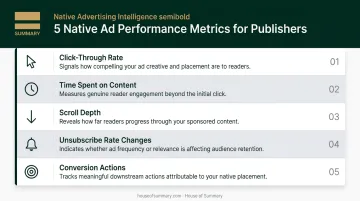
Key metrics to monitor for native placements:
- Click-through rate (CTR) — direct signal of reader engagement with the placement
- Time spent on sponsored content — indicates whether readers consumed the content or bounced
- Scroll depth — shows how far readers got through sponsored articles
- Unsubscribe rate changes — a signal that native placements may be disrupting reader trust
- Conversion actions — where trackable, close the loop between placement and advertiser outcome
Sharing this data demonstrates placement value and builds the foundation for renewal conversations. Publishers who can show campaign results are in a stronger negotiating position than those who can't.
Frequently Asked Questions
How does native advertising work for publishers?
Publishers offer ad placements within their editorial content — articles, newsletters, feeds — where brands pay to reach the publisher's audience through content that matches the publication's style. Each placement is labeled as sponsored so readers know it's commercial before engaging.
What is an example of native advertising for publishers?
Common formats include:
- A sponsored article on a news site labeled "Paid Content" that reads like editorial
- A brand sponsorship block inside a curated email newsletter, placed between editorial sections
- A "recommended for you" content widget at the bottom of an article funded by an advertiser
How much does native advertising cost for publishers?
Pricing depends on format and audience quality. Programmatic native fills at lower CPMs through auction dynamics, while direct-sold placements — newsletter sponsorships, sponsored articles — command flat fees from a few hundred to several thousand dollars per placement, driven by audience size, engagement, and vertical.
What is the difference between native advertising and display advertising for publishers?
Display ads (banners, sidebars) are visually separate from content, frequently ignored, and increasingly blocked by ad blockers. Native ads integrate into the editorial flow and earn reader attention by matching the style and context of the publication, which makes them more effective for advertisers and less disruptive for readers.
How do publishers disclose native advertising to readers?
The FTC requires publishers to label native ads using terms like "Ad," "Sponsored," or "Paid Advertisement," placed prominently near the headline or at the start of the placement. The disclosure must be visible before the reader engages — not buried at the end or revealed only after a click.
What metrics should publishers track to measure native ad performance?
Track CTR, time spent on sponsored content, scroll depth, conversion actions where available, and unsubscribe rate changes following new placements. Drops in engagement or rising unsubscribes are early warnings that a placement is eroding the audience trust native advertising depends on.