

Introduction
Banner ads are invisible to nearly 30% of internet users who use ad blockers — and those who do see them have largely learned to ignore them. Global ad blocker penetration now reaches 29.5%, while the Nielsen Norman Group confirms that users actively filter out peripheral placements through a phenomenon called "banner blindness".
In-content advertising addresses this by placing ads directly within the content readers are already consuming — mid-article, mid-feed, mid-newsletter — rather than competing for attention at the margins. These formats meet audiences at the precise moment they're engaged, delivering brand messages where attention already exists instead of fighting to create it.
TLDR:
- In-content ads sit within editorial content flows, bypassing banner blindness entirely
- Formats include in-article units, social in-feed ads, in-stream video, and newsletter placements
- Email newsletter ads bypass ad blockers entirely and deliver 2.62% average CTR—5x higher than standard web display
- Contextual relevance drives 41% higher brand recall and 2.5x greater purchase intent
What Are In-Content Ads?
In-content ads are advertising units embedded directly within editorial content—articles, social feeds, video streams, or email newsletters—so the ad appears as part of the natural reading or viewing experience rather than interrupting it.
In-Content vs. Traditional Display
While banner ads and sidebar placements compete for attention at the edges of content, in-content ads are encountered at the moment a user is most engaged—mid-scroll, mid-article, or mid-newsletter. That positioning shift shows up directly in the numbers.
Standard display ads average just 0.46% CTR, with historical banner formats yielding as low as 0.05% to 0.10%. Email newsletter in-content placements, by comparison, average 2.62% CTR—more than five times the rate of standard display.
What Qualifies as "In-Content"
To qualify as in-content, the placement must sit within the content column or content flow, not in a header, footer, or sidebar. This includes:
- Native ads and in-feed units within article or social content streams
- In-stream video ads that play before, during, or after video content
- Newsletter body ads positioned between editorial sections
- Sponsored content integrated into editorial feeds
What doesn't qualify: Pop-ups, interstitials, header banners, and floating overlays—these formats disrupt rather than integrate with the content experience.
Why In-Content Formats Have Grown
Those format characteristics also explain why in-content placements have gained ground industry-wide. The IAB State of Data 2024 report finds that 66% of ad buyers are increasing contextual ad spend as third-party cookie deprecation and privacy legislation push the industry away from behavioral targeting. Because in-content placements sit alongside topically relevant editorial, they align naturally with contextual targeting strategies—no cookie required.
Types of In-Content Ads
Web Article In-Content Ads
Banner or native ads inserted between paragraphs of editorial articles. Placement logic is typically automated based on paragraph count, content length, and scroll depth.
Ad density—the ratio of advertising to editorial content—is critical for user experience. The Coalition for Better Ads mandates that desktop ad density must not exceed 50% of the vertical height of the main content portion of a page. Exceeding this threshold creates consumer resentment and triggers ad blocker adoption.
In-Feed Social Ads
Ads that appear natively within social media feeds (Facebook, Instagram, LinkedIn, X) styled to match organic posts. These are the social media version of in-content advertising, designed to blend seamlessly with user-generated content.
Performance by Platform (2024-2025):
| Platform | Average CTR |
|---|---|
| Facebook (Newsfeed) | 1.11% |
| Instagram (Feed) | 0.22% |
| LinkedIn (Sponsored Content) | 0.44% - 0.65% |
| YouTube (In-Feed Discovery) | 1.0% - 3.0% |
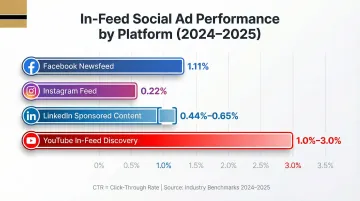
Performance varies dramatically by platform intent, with YouTube discovery and Facebook newsfeed driving the highest engagement.
In-Stream Video Ads
Pre-roll, mid-roll, and post-roll ads embedded within video content on platforms like YouTube. According to the IAB Digital Video Glossary, these ads are "played before, during or after the streaming video content that the consumer has requested."
Unlike standalone video ads, in-stream placements benefit from the viewer's pre-existing engagement with the video content, which reduces mid-ad abandonment compared to interruptive formats.
Newsletter and Email In-Content Ads
Ads placed within the body of an email newsletter, between editorial sections. This format sits directly in the reader's inbox—a highly personal, distraction-free environment with no competing tabs or sidebar clutter.
Unlike web placements, newsletter ads carry three structural advantages:
- Immune to browser-based ad blockers entirely
- Render inside the email client, bypassing platform algorithms
- Delivered deterministically to opted-in subscribers, guaranteeing exposure
Native Sponsored Content
Longer-form branded articles or sponsored sections written to match the editorial style of the publication. Unlike the other formats—where an ad unit sits within content—native sponsored content is the ad itself, crafted to provide value while advancing brand messaging.
How In-Content Ads Work
Placement Triggering
For web content, in-content ads are typically injected by an ad script that scans the HTML structure of the page and inserts ad slots after a defined number of content blocks—paragraphs, images, or divs. Many systems trigger placements dynamically based on scroll depth and content length.
Email newsletters work differently—placements are manually set or templated into specific positions within the send, typically between editorial sections or following featured content blocks.
Targeting Options
In-content ads can be targeted three ways:
- Contextually: Matches ad content to the topic of the surrounding article or newsletter
- Behaviorally: Based on user data (declining as third-party cookies deprecate)
- By audience segment: Reaching specific demographics through trusted publications or platforms
As privacy regulations tighten and third-party cookies disappear, contextual targeting is becoming the default—meaning ad relevance now depends on where the ad appears, not who the user is.
Viewability and Lazy Loading
The MRC Viewable Ad Impression Measurement Guidelines define a viewable display ad as one where at least 50% of pixels are visible in the browser for a minimum of one continuous second.
Many web in-content ads use lazy loading—deferring the load of offscreen elements until the user scrolls near them. This improves page speed and raises viewability scores by ensuring the ad impression is recorded only when a real user is likely to see it.
The IAB's "Anatomy of a Video Impression" mandates that an ad must be loaded and "begin to render" to count as a valid impression.
Email Rendering Dynamics
Email newsletter ads operate differently. They render when the email is opened, giving them guaranteed exposure without scroll dependency. However, tracking is affected by two major factors:
- Gmail Image Proxy: Since 2013, Gmail routes all email images through Google's proxy servers, caching them after the first load
- Apple Mail Privacy Protection (MPP): Introduced in iOS 15, MPP preloads all email images at delivery time, artificially inflating open rates
For this reason, advertisers should evaluate newsletter performance strictly on click-through rates (CTR) and click-to-open rates (CTOR), not open rates.
Benefits of In-Content Ads for Advertisers
Higher Engagement Than Peripheral Formats
In-content ads benefit from the reader's already-engaged state. Standard web display ads average 0.46% CTR, while email newsletters deliver 2.62% CTR—more than five times higher engagement driven by high-intent, opted-in audiences.
Reduced Ad Fatigue and Banner Blindness
The Nielsen Norman Group documents that users have learned to visually filter out sidebars and header banners. In-content placements break this pattern by appearing where the eye is already tracking—within the text or feed itself.
Immunity to Ad Blockers in Email Channels
Web-based in-content ads can still be blocked by browser extensions, but email newsletter ads are delivered directly to the inbox and rendered within the email client. Ad blockers do not intercept them.
For advertisers trying to reach the 45% of US consumers who have installed or used an ad blocker, newsletter in-content placements provide a reliable path to undivided reader attention.
Contextual Relevance Drives Purchase Intent
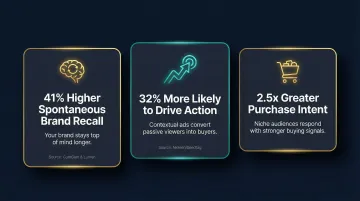
When an ad appears alongside content on the same or related topic, the reader's mindset is already aligned. Key findings from independent research:
- GumGum and Lumen found 41% higher spontaneous recall and 69% higher prompted recall for contextually placed ads
- A Nielsen/Seedtag study of 1,800 consumers found contextual ads are 32% more likely to drive action than demographically targeted ads
- Purchase intent for niche products was 2.5x greater when consumers were reached contextually
Brand Safety Through Editorial Alignment
In-content ads placed within professionally edited publications or curated newsletters are surrounded by quality, verified content, reducing the risk of brand adjacency to misinformation or low-quality pages that can occur with programmatic display buying.
House of Summary's newsletters are written and fact-checked by subject-matter contributors — covering global news, geopolitics, and city-level business — so advertisers reach engaged professionals in a context free of sensationalism or clickbait.
In-Content Ads vs. Other Ad Formats
In-Content vs. Display/Banner Ads
The core distinction comes down to placement: in-content ads sit within the content flow; banner ads live at the periphery.
Banner ads typically carry lower CTRs and suffer from banner blindness. Web display averages 0.46% CTR; in-content email placements average 2.62%.
The gap reflects a straightforward attention advantage: in-content ads appear during active reading, while banners compete for whatever peripheral attention remains.
In-Content vs. Interstitial and Pop-Up Ads
Moving further along the intrusiveness spectrum, interstitials cover content entirely and require active dismissal — in-content ads sit beside or between content without blocking it.
Regulatory implications: Google Search Central explicitly warns that "intrusive dialogs and interstitials make it hard for Google and other search engines to understand your content, which may lead to poor search performance." Google has issued ranking penalties for intrusive interstitials on mobile, making in-content formats the lower-risk long-term choice for SEO.
In-Content vs. Social Paid Ads
Social ads rely on platform algorithms for delivery and are subject to algorithmic reach changes. Newsletter in-content ads bypass algorithms entirely, delivering directly to inbox with no feed competition.
Think with Google (2024) notes that as third-party cookies deprecate, "it will be harder to reach your customers with digital ads," making first-party data like email lists the "foundation for a durable future."
Email provides deterministic delivery — meaning messages reach specific, known recipients — insulating brands from sudden social algorithm shifts.
At a glance — how the formats compare:
| Format | Placement | Blocks Content? | Algorithm-Dependent? | Avg. CTR |
|---|---|---|---|---|
| In-content (email) | Within content flow | No | No | ~2.62% |
| Display/Banner | Page periphery | No | Partial | ~0.46% |
| Interstitial/Pop-up | Full-screen overlay | Yes | Partial | Variable |
| Social paid ads | Feed/algorithm-driven | No | Yes | Variable |
Best Practices for Running In-Content Ad Campaigns
Match Ad Content to Editorial Context
The creative and messaging should feel relevant to the content it sits within. An ad for a financial product placed inside a personal finance newsletter will outperform the same ad placed randomly across an ad network.
Action: Prioritize contextual fit when selecting placements. Align your ad creative with the editorial tone and subject matter of the publication.
Respect Ad Density and Reader Experience
Too many in-content ads within a single piece of content undermines user experience and can reduce individual ad performance.
The Coalition for Better Ads recommends keeping advertising as a non-intrusive element of the reading experience. Their standards flag ad-heavy formats — particularly those where ads occupy more than 30% of visible content — as likely to drive readers away. Fewer, better-placed ads consistently outperform high-density formats on both engagement and conversion metrics.
Action: Audit your placement frequency before scaling. One or two well-placed in-content ads per article or newsletter issue typically deliver better returns than four or five competing for the same reader's attention.
Quick-Reference Best Practices
Before launching an in-content ad campaign, check your approach against these fundamentals:
- Contextual alignment — Ad messaging matches the editorial topic and tone of the surrounding content
- Placement density — No more than one or two in-content ads per content unit
- Creative format — Ad format (image, text, native) suits the publication's layout and audience expectations
- Clear labeling — Sponsored or promotional content is disclosed transparently to readers
- Performance tracking — Click-through rate, dwell time, and conversion data reviewed per placement, not just in aggregate
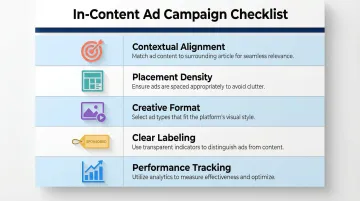
These aren't just best practices for compliance — they're what separates campaigns that build brand trust from ones that generate one-time clicks and reader drop-off.