Introduction
Newsletter advertising has exploded into a $3.6 billion market in 2024, projected to grow at 14.2% annually through 2033. Yet most advertiser guides still default to web-based thinking—where banner ads and native ads behave very differently inside an inbox than they do on a webpage.
The core tension is straightforward: banner ads are faster to produce and easier to standardize across campaigns, but native ads match the editorial voice readers already trust. This distinction matters especially in a newsletter, where subscribers opted in to receive content and arrive with high expectations.
According to HubSpot's 2025 email benchmarks, average newsletter open rates sit at 42.35%—significantly higher than web ad viewability. Unlike web advertising, where ads compete with infinite scroll and algorithmic feeds, newsletter ads reach a captive, opted-in audience who chose to be there.
For that opted-in audience, format choice shapes performance more than most advertisers expect. The real question is which format respects the relationship readers already have with the newsletter.
Key Takeaways
- Native ads blend with editorial content, earning higher engagement from readers who actively chose to subscribe
- Banner ads offer visual impact but face rendering challenges when email clients block images by default
- For brand awareness, banners establish immediate visual presence; for clicks and conversions, native typically wins
- Newsletters reach readers without ad blockers or algorithms, making format selection more consequential than in web or social campaigns
- Brands that match their ad format to a newsletter's editorial tone consistently outperform those that don't
Native Ads vs Banner Ads in Newsletters: Quick Comparison
Format and Appearance
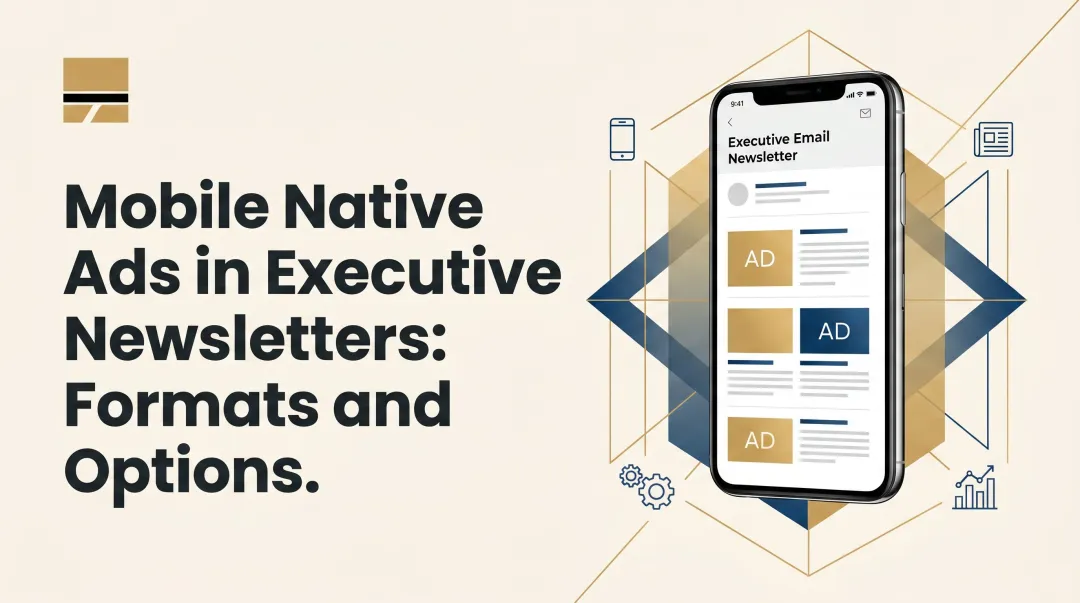
Native ads match the newsletter's font, layout, and editorial style — appearing as sponsored paragraphs, recommended reads, or editorial segments written in the publication's own voice. To the reader, they feel like part of the content they subscribed to receive.
Banner ads work differently. They're visually distinct images or graphics placed in header, footer, or mid-email positions, relying on visual contrast rather than content fit to capture attention.
Engagement and CTR
Native ads consistently outperform on click-through rates. LiveIntent reports that publishers using native ads in newsletters see 44% higher CTRs compared to display ads, along with 10x greater CPMs — driven by contextual fit and reader trust.
Banner ads, by contrast, post lower average CTRs and are prone to scroll-past behavior. Readers reflexively skip visual elements they recognize as ads — a phenomenon known as banner blindness.
Rendering and Deliverability Risk
This performance gap becomes more pronounced when you factor in deliverability. Native ads are text-based, so they render reliably across all email clients — no images to block, no broken layouts, no load delays.
Banner ads carry real rendering risk. Email clients including Outlook, Office 365, and AOL Mail block images by default. Unless the reader manually enables images, a banner ad may display as nothing but blank space.
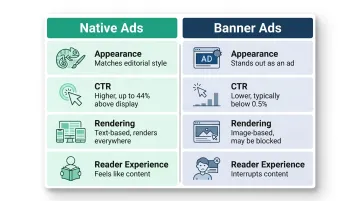
At a Glance
| Native Ads | Banner Ads | |
|---|---|---|
| Appearance | Matches editorial style | Visually distinct graphic |
| CTR | Higher (up to 44% above display) | Lower; prone to banner blindness |
| Rendering | Text-based; renders everywhere | Image-dependent; may be blocked |
| Reader Experience | Feels like content | Clearly identified as an ad |
What Are Native Ads in a Newsletter?
Native ads in newsletters are sponsored content segments written to match the editorial voice and format of the publication itself. Unlike web-based native ads that mimic news feeds, newsletter native ads typically appear as sponsored paragraphs, short editorial segments, or "recommended reads" integrated directly into the content flow.
The newsletter environment amplifies native ad strengths. Readers have opted in, they already trust the publication's editorial judgment, and a well-written sponsor segment feels like a recommendation rather than an interruption. This trust transfer is critical—when a newsletter's editorial team endorses a product or service in their own voice, it carries more weight than a standard display ad.
Key creative elements for successful newsletter native ads include:
- Headlines that sound editorial, not promotional
- Body copy that provides real value or relevant context
- Calls-to-action that invite rather than demand
- Clear "Sponsored" or "Partner" disclosure that doesn't disrupt reading flow
In email specifically, native ads have a structural edge: they're text-based and render perfectly across all email clients. No image blocking, no broken layouts, no load delays. When Outlook blocks images by default, native ads still appear exactly as intended.
How Native Ads Work Inside a Newsletter
Typical placement options include inline within article body, as a "sponsor spotlight" section, or as a short mid-newsletter break written in the editor's voice.
Readers consume newsletter content linearly, unlike scrolling a website. A well-placed native segment captures attention at a natural reading pause, increasing dwell time and click intent. According to Newsletter Operator benchmarks, newsletter ad CTRs of 1% are considered good, 2% excellent, and 3% exceptional. That's a stark contrast to web display's average of 0.05%.
What Are Banner Ads in a Newsletter?
Banner ads in newsletters are static or animated image-based ads placed in fixed positions—typically at the header (above main content), footer (after editorial), or as a mid-email visual break. Unlike native ads, banners make no attempt to blend in. They rely on strong visuals and clear CTAs to drive action.
The format follows direct-response principles: a compelling image, minimal copy, and an action-driven CTA designed to interrupt and convert.
The key challenge unique to email is image blocking. According to Litmus, several major clients block images by default unless the user changes settings:
- Outlook 2007–2019
- Outlook for Mac
- Office 365
- AOL Mail
Outlook alone accounts for roughly 5.67% of email opens — and that figure likely undercounts real usage, since Outlook also blocks the tracking pixel used to measure opens. For B2B advertisers targeting corporate inboxes, that's a meaningful blind spot.
How Banner Ads Work Inside a Newsletter
Standard newsletter banner placements include:
- Header banners: Highest initial attention but readers may skip them reflexively
- Mid-body banners: Capture engaged readers mid-scroll
- Footer banners: Only seen by highly engaged readers who scroll to the end
Banner ads are most effective when the visual does the heavy lifting — think luxury products, event promotions, or retargeting campaigns where readers already recognize the brand. In those scenarios, the goal isn't click volume; it's reinforcing a visual impression that carries past the inbox.
Which Ad Format Performs Better Inside a Newsletter?
In the newsletter environment, the factors that typically favor banner ads on the web—visual pop, immediate brand recognition—are weakened by email rendering limitations. Meanwhile, the factors that favor native ads—editorial trust, opted-in audience, text reliability—are amplified.
LiveIntent's publisher data shows native ads in newsletters achieve 44% higher CTRs compared to display ads in the same environment. For context, web display averages 0.05% CTR while native web ads average 0.2% CTR. In newsletters, both formats outperform their web counterparts — and native's advantage over banner is even more pronounced than it is on the open web.
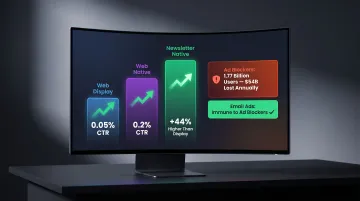
Unlike web advertising, newsletter ads bypass ad blockers entirely. An estimated 1.77 billion internet users worldwide use ad blocking tools, costing publishers $54 billion annually. Email ads are immune because ad blockers operate at the browser level, not the email client level.
However, banner ads still face the image-blocking problem. When a significant portion of your audience uses Outlook or other image-blocking clients, banner ads lose reach before they even compete for attention.
When Banner Ads Still Win
Banner ads remain the stronger choice for:
- Brand awareness campaigns where visual memorability matters more than immediate clicks
- Established brands with high recognition that can leverage a quick visual cue
- Time-sensitive offers where a bold visual acts as an instant reminder
- Visually-driven categories like luxury goods, fashion, and consumer products
In newsletters like House of Summary, banner ads reach a focused, high-intent audience of decision-makers and executives. Even a lower CTR carries more value than the same banner on a generic website, because the audience quality is higher.
Situational Decision Guidance
Choose native ads when clicks, conversions, or trust-building are the priority. The format works because it respects the editorial relationship readers already have with the newsletter — it earns attention rather than interrupting it.
Choose banner ads when brand visibility or a short promotional window is the goal. The format relies on visual memory and works best when recognition matters more than the immediate click.
Some advertisers run both formats in the same issue to capture different reader behaviors: native for readers actively seeking recommendations, banner for visual recognition. House of Summary offers both placement types across a subscriber base of over 500,000 readers — and native placements consistently outperform industry web CTR benchmarks in this environment.
Conclusion
Inside a newsletter, native ads hold a structural performance edge — higher engagement, stronger brand recall, better fit with editorial tone. That said, banner ads still earn their place when the goal is visibility at scale or when a campaign needs rapid recognition across a large list.
Unlike web advertising where banner blindness and ad blockers erode performance across the board, newsletter advertising gives both formats a real opportunity to perform. The audience is there by choice. The format that earns its place in that inbox — rather than interrupting it — is the one that delivers.
Frequently Asked Questions
What is the difference between native and banner ads?
Native ads match the look and feel of surrounding content, appearing as editorial-style sponsored segments in newsletters. Banner ads are visually distinct image-based placements in fixed positions like headers or footers.
Are banner ads still effective?
Yes, banner ads remain effective for brand awareness and visual impact. Their main limitation in newsletters is email client image-blocking — particularly in Outlook — which can reduce visibility for visually-driven campaigns.
What type of ad works best for brand awareness in a newsletter?
Banner ads are better suited for brand awareness due to their visual prominence. Native ads excel at driving clicks and conversions. Running both formats together covers awareness and action goals simultaneously.
How do I measure ad performance in a newsletter?
Track click-through rate (CTR), open rate, and downstream conversions on your landing page. Email has no ad blockers, so impression data is more accurate than web — though image-blocking in certain clients can still affect banner visibility tracking.
What makes newsletter advertising different from web advertising?
Newsletter readers have opted in, there are no ad blockers, and no algorithms decide who sees your message. Readers engage with one piece of content at a time — no tabs, no feeds, no competing placements pulling attention in different directions.
Can I run both native and banner ads in the same newsletter?
Yes, many advertisers run both in the same issue — typically a banner near the header for visibility and a native placement mid-content for clicks. Sequencing them this way means readers encounter your brand twice, in two different contexts, within a single send.