Introduction
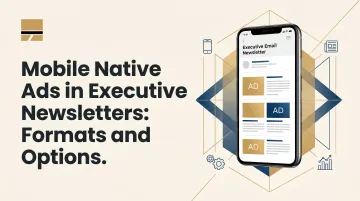
Executive professionals now read newsletters primarily on mobile devices — a shift that has transformed how advertisers reach decision-makers. Mobile native ads in newsletters are paid placements designed to match the publication's editorial look, feel, and tone, making them appear as a natural part of the reading experience rather than an interruption.
The performance numbers back this up. Newsletter native ads:
- Bypass ad blockers that affect 29.5% of internet users
- Reach readers in a distraction-free inbox with 98% delivery rates
- Generate click-through rates 4x higher than Google AdWords, per House of Summary's network data
What follows covers the main mobile native ad formats available in executive newsletters — and the practical differences that determine which one fits your campaign.
Key Takeaways
- Newsletter native ads blend into editorial content, mirroring the publication's tone so they read like content — not ads
- More than 55% of emails are opened on mobile — formatting that ignores this loses reach before a single word lands
- The three core formats are inline editorial native, native display block, and dedicated sponsorship send
- Choosing the right format comes down to campaign goals, budget, creative resources, and how prominently the brand needs to appear
- Newsletter ads reach opted-in, high-intent readers with no algorithms or ad blockers interfering
What Are Mobile Native Ads in Executive Newsletters?
Mobile native ads in executive newsletters are paid placements designed to match the publication's visual style, tone, and structure. Rather than disrupting the reading experience, they blend into the editorial flow.
These are curated publications delivered via email and consumed heavily on mobile devices. Native ads here are formatted for vertical scrolling, small screens, and single-column layouts — not app feeds or browser pages.
What separates newsletter native ads from other mobile native formats — in-app, social feed, paid search — is audience intent. The reader chose to be there. According to the FTC's definition, native advertising is "content that bears a similarity to the news, feature articles, product reviews, entertainment, and other material that surrounds it online." In newsletters, that similarity lands in a higher-trust environment than anything algorithmically surfaced.
The IAB Native Advertising Playbook 2.0 identifies three core native ad types:
- In-Feed/In-Content ads — integrated directly into the editorial stream
- Content Recommendation widgets — suggested content placements, typically at article end
- Branded/Sponsored Content — publisher-produced content funded by an advertiser
Newsletter native ads fall primarily into that first category, sitting inside the editorial flow rather than beside it.
Why Mobile Native Ads Work Differently in Newsletter Environments
Newsletter native ads don't compete on the same playing field as social or display advertising — they operate with structural advantages those channels can't replicate.
Reach That Doesn't Depend on Algorithms
Email newsletters achieve 98% delivery rates, meaning your message reaches nearly every subscriber. Social media offers nothing close: Facebook organic reach sits at 1.37%–2.2% per post, while LinkedIn company pages reach only 1.6% of followers. Display advertising faces its own ceiling — 29.5% of internet users globally use ad blockers, rising to 37% on desktop in the US. Newsletter ads bypass all of this.
How Mobile Shapes the Executive Reader Experience
Over 55% of emails are opened on mobile devices, with 81% of those opens on smartphones rather than tablets. Executive readers are high-intent and time-limited — they scan quickly and commit to what earns their attention. In that environment, an ad that matches the editorial tone gets read; one that doesn't gets skipped.
The Engagement Gap Is Hard to Ignore
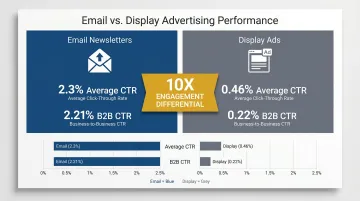
The performance difference between email and display is significant:
| Channel | Average CTR | B2B Services CTR |
|---|---|---|
| Email newsletters | 2.3% | 2.21% |
| Display ads | 0.46% | 0.22% |
That's roughly a 10x engagement differential. House of Summary's network — spanning Presidential Summary, Dubai Summary, London Summary, and Geopolitical Summary — reports click-through rates 4x higher than Google AdWords, reflecting what happens when ads reach focused readers rather than distracted ones.
The Main Formats of Mobile Native Ads in Executive Newsletters
Newsletter native ads are not a single format. They vary in depth of integration, creative requirements, and level of brand presence. Choosing the right format requires understanding how each one works and what it is optimized for.
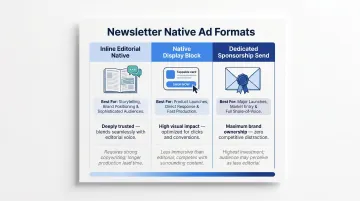
Inline Editorial Native (Sponsored Segment)
A written ad placed within the editorial flow of the newsletter, composed in the publication's voice and style. It reads like a short article, analysis piece, or curated recommendation, typically labeled "Sponsored" or "Partner" to maintain transparency. On mobile, it appears between content sections as a seamless continuation of the reading experience.
Unlike display-style placements, this format requires the publisher (or advertiser, with editorial guidance) to write content that genuinely matches the newsletter's tone. The ad is text-driven and integrates into the reading flow rather than visually breaking from it.
Best suited for:
- Campaigns requiring storytelling or product education
- Brand positioning with sophisticated audiences
- Financial services, B2B technology, luxury brands
- Offerings that benefit from explanation rather than a simple CTA
Strengths and trade-offs: Highest contextual relevance of all newsletter formats — readers engage with it as content rather than skimming past, which builds brand credibility through association with editorial quality. The trade-off: it demands strong copywriting aligned with the publication's standards. Poor tonal match can generate negative brand association rather than a positive one.
Native Display Block (Sponsor Card)
A clearly marked, self-contained block within the newsletter, typically featuring the brand name or logo, a headline, one to three lines of supporting copy, and a call-to-action link. Styled to match the newsletter's fonts and design language rather than using generic banner aesthetics. On mobile, it renders as a clean, tappable card.
Where the inline editorial format blends into the reading experience, the sponsor card sits between those two extremes — more visually distinct than a fully integrated segment, but more cohesive with the newsletter's design than a traditional display banner. It signals "sponsored" clearly while still respecting the mobile reading experience.
Best suited for:
- Product launches and event promotions
- Time-sensitive offers or direct-response campaigns
- Advertisers needing fast production turnaround
Strengths and trade-offs: Easier to produce than editorial native content, and it renders cleanly across mobile email clients. The limitation is depth — readers engage with it more like a traditional ad than editorial content. Impact depends heavily on headline quality and CTA clarity.
Dedicated Sponsorship Send
An entire newsletter issue — or a special standalone edition — is sponsored by a single advertiser. The brand receives full share-of-voice within that send, with its messaging woven throughout or prominently featured as the sponsoring entity. The publication maintains editorial control to preserve reader trust.
Rather than occupying one placement within a normal issue, the advertiser owns the full context of a send. This is the highest-investment, highest-visibility format and functions as a premium content partnership, not a traditional ad unit.
Best suited for:
- Major product launches or brand repositioning
- Market entry campaigns targeting executive audiences
- Brands with the budget and creative resources to sustain a full-issue presence
Strengths and trade-offs: Maximum share-of-voice with no competitive distraction, and the format allows richer storytelling across the full issue — leaving a distinct brand impression that single-placement ads rarely achieve. On the other side, the cost is higher, close publisher collaboration is required to maintain editorial integrity, and it's less suited to frequency-based campaigns or brands testing newsletter advertising for the first time.
How to Choose the Right Native Ad Format
The right format depends on what the campaign needs to accomplish, not on which format sounds most impressive. A mismatch between format and goal wastes budget regardless of audience quality.
Four factors should shape your decision: campaign objective, creative resources, budget, and how familiar your target audience already is with your brand.
Campaign objective drives format selection:
- Brand awareness and storytelling: Inline editorial native
- Direct response and product promotion: Native display blocks
- High-impact market entry or repositioning: Dedicated sends
Creative resources and timeline matter:
- Editorial native requires skilled copywriting aligned to the publication's voice
- Native display blocks can be produced quickly with a headline, two lines of copy, and a CTA
- Dedicated sends require the most creative coordination and lead time
Budget considerations: According to Paved's 2026 newsletter benchmarks, revenue per 1,000 subscribers varies by category:
- Human Resources: $43 RPM
- Startups: $35 RPM
- Marketing: $31 RPM
- Business: $15 RPM
- Tech: $13 RPM
- Finance: $11 RPM
Native display blocks are typically the most accessible entry point. Editorial native sits in the mid-range, and dedicated sends carry premium pricing reflecting their exclusivity.
Audience familiarity with your brand:
- New brands entering a market benefit from editorial native's softer introduction
- Established brands with a clear offer can convert effectively with a native display block
For advertisers targeting senior decision-makers across business and geopolitical topics, House of Summary's newsletter network — covering international news, Gulf business, and London-focused content — lets you match format to the specific readership segment that fits your campaign.
What to Check Before Finalizing a Newsletter Native Ad Placement
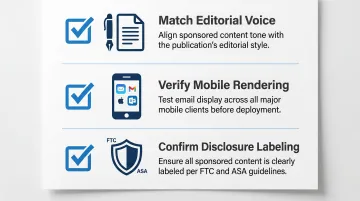
Run through these three checks before committing to any placement:
- Match editorial voice to your brand. Confirm the newsletter's tone, subject matter, and readership profile align with your positioning. A mismatch in audience quality or editorial voice undermines even well-produced native ads.
- Verify mobile rendering standards. Ask whether the publisher tests formats across major email clients. Litmus reports that Apple email clients hold 45.51% market share, Gmail 23.54%, and Outlook 5.67%. Each client handles HTML and CSS differently — Outlook uses Microsoft Word's rendering engine rather than a browser engine, which breaks image-heavy layouts. Poor rendering on mobile wastes the placement entirely.
- Confirm disclosure and labeling practices. Reputable publishers label native ads clearly. The FTC requires "clear and prominent" labels — "Ad," "Advertisement," "Paid Advertisement," or "Sponsored Advertising Content" — visible before consumers click and on landing pages. The UK's ASA/CAP guidance considers "Sponsored" insufficient when the advertiser has editorial control, preferring "Ad" or "Advertisement."
Undisclosed native ads risk regulatory penalties, but the more immediate cost is reader trust. Research finds that header-disclosed sponsored posts receive 34% more likes on average — clear labeling can actually improve engagement rather than suppress it.
Conclusion
Mobile native ads in executive newsletters come in distinct formats — inline editorial native, native display blocks, and dedicated sponsorship sends — each suited to different campaign goals, creative capacities, and budget levels.
The inbox environment of an opted-in executive newsletter audience is structurally different from social feeds or app placements. With 98% delivery rates, no ad blocker interference, and engagement rates 10x higher than display advertising, newsletters offer a direct path to decision-makers.
Those numbers only hold, though, when the format fits the context. Understanding which format aligns with your campaign goal is what separates placements that get skipped from ones that get clicked.
Frequently Asked Questions
What is native advertising and how does it work?
Native advertising matches the look and feel of the platform it appears on, making it less disruptive than traditional display ads. In newsletters, this means ads are styled to resemble editorial content and labeled transparently as sponsored.
What is a mobile native ad?
A mobile native ad is any native ad unit formatted and optimized for mobile screen consumption. In the newsletter context, this means single-column layouts, tappable CTAs, and content that renders cleanly across mobile email clients like Apple Mail, Gmail, and Outlook mobile.
How much does a native ad cost?
Newsletter native ad costs vary by publication reach, audience seniority, and format. Paved's 2026 benchmarks show revenue per 1,000 subscribers ranging from $11 (Finance) to $43 (Human Resources) for B2B categories. Display blocks typically represent entry-level investment, while dedicated sends carry premium pricing.
How do you spot native advertising?
Native ads are typically labeled "Sponsored," "Partner," or "Advertisement." In newsletters, they match the editorial design closely but carry a disclosure label near the headline or at the top of the placement. The FTC requires clear and prominent disclosure that appears before you click.
What are native mobile ads in feed social?
Social feed native ads appear within social media scrolls (LinkedIn, Instagram, etc.) styled to match organic posts. Unlike newsletter native ads, they reach users through algorithmic targeting rather than a subscriber's opted-in inbox — meaning audience intent and editorial context work very differently.
What are native ads in a mobile app?
In-app native ads are placements within mobile applications that match the app's UI design. Unlike newsletter native ads, they rely on device ID tracking and are delivered through ad networks rather than the publisher directly — and unlike email, they remain vulnerable to ad blockers.