Native advertising offers a credible answer. By matching ad content to editorial format, native placements reduce friction, keep readers on-page longer, and — critically — generate higher click-through rates than standard banners. According to EMARKETER, US native display ad spending is expected to reach $147.98 billion in 2026, up 13.1% year over year, signaling that advertisers are already moving budget in this direction.
This guide covers the top native advertising networks publishers should evaluate in 2026, what distinguishes each one, and how to choose the right fit for your content format, audience size, and revenue goals.
Key Takeaways
- Native ad networks place ads that match your content's look and feel — driving stronger engagement than banner formats
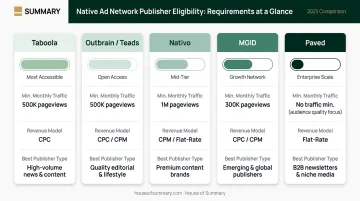
- Top networks for 2026: Taboola, Outbrain/Teads, Nativo, MGID, and Paved — each suited to different publisher types and traffic tiers
- Evaluate networks on revenue model (CPM vs. CPC), traffic thresholds, ad quality controls, and advertiser category fit
- Newsletter publishers have a built-in edge: inbox placements bypass ad blockers and reach opted-in audiences directly
- The right network depends on your traffic volume, content format, and whether you prioritize scale or brand alignment
What Are Native Advertising Networks for Publishers?
A native advertising network acts as the intermediary between publishers and advertisers, placing ads that visually and editorially integrate with surrounding content rather than interrupting it. For publishers, this means monetizing article pages, newsletters, or video feeds without the banner blindness and user experience costs of traditional display.
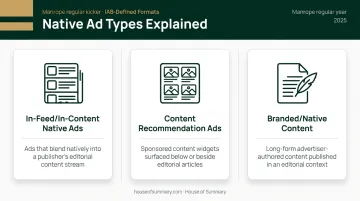
The IAB Native Advertising Playbook 2.0 identifies three core native ad types publishers encounter:
- In-Feed/In-Content Native Ads — placements that appear within editorial streams, styled to match surrounding content
- Content Recommendation Ads — the "recommended content" widget format popularized by Taboola and Outbrain
- Branded/Native Content — sponsored editorial or storytelling content that lives inside a publisher's templates
A fourth channel — newsletter-native placements — doesn't map neatly to IAB taxonomy but has emerged as a high-performing format for email publishers. Inbox placements reach opted-in subscribers with no algorithmic interference and no ad blockers, making them a structurally different opportunity from web-based native formats.
EMARKETER's data shows native accounted for 63.1% of US display ad spend in 2023 — more than three times the share held by standard display. For publishers still running banner-heavy inventory, that gap represents a direct revenue opportunity worth closing.
Best Native Advertising Networks for Publishers in 2026
Each network below was evaluated on publisher revenue potential, eligibility requirements, ad quality, and fit for specific content types — not advertiser-side reach alone.
Taboola
Taboola is one of the largest content discovery networks operating at publisher scale, powering "recommended content" widgets placed alongside or below articles. With 9,000+ publisher partners, roughly 600 million daily active users, and 15,000+ advertisers on the demand side, it offers publishers some of the highest fill rates available in native.
What distinguishes Taboola for publishers is the combination of demand density and tooling. Its AI-driven yield optimization improves revenue per session over time, and its Newsroom product gives publishers content performance insights alongside ad revenue data — useful for editorial teams managing content strategy and monetization in parallel.
The scale translates to real revenue: Taboola has generated more than $2.5 billion for publisher partners from 2020 through 2023, and a case study with The Independent showed a 43% increase in editorial CTR after integrating mid-article recommendations.
| Factor | Detail |
|---|---|
| Best Publisher Type | High-traffic news, lifestyle, and entertainment sites with strong article consumption |
| Revenue Model | CPC-based revenue share (specific percentage not publicly disclosed) |
| Minimum Requirement | Not publicly stated in official sources — contact Taboola directly for eligibility |
Outbrain / New Teads
Outbrain completed its acquisition of Teads on February 3, 2025, and the combined company now operates under the Teads brand. The merged entity directly partners with 10,000+ publishers globally, reaches 2.2 billion consumers, and reported approximately $1.7 billion in combined FY2024 advertising spend — making it one of the most significant consolidations in open-internet advertising.
For publishers, the post-merger Teads represents access to a large pool of brand-safe advertiser demand across the open web, particularly from brands that prioritize premium editorial environments over social media placements. Outbrain's official publisher documentation states it works with publishers of any scale provided they meet its publisher guidelines, with no fixed minimum traffic threshold published in current official help materials.
| Factor | Detail |
|---|---|
| Best Publisher Type | Premium editorial publishers in news, finance, health, and B2B content |
| Revenue Model | CPC revenue share (specific percentage not publicly disclosed) |
| Minimum Requirement | No fixed public threshold — compliance with publisher guidelines required |
Nativo
Nativo takes a different approach from widget-style networks. Rather than placing recommendation units at the end of an article, Nativo enables publishers to host in-feed sponsored articles and branded content that live inside their editorial templates. The ad reads like part of the publication because it visually is.
This format delivers two concrete advantages for publishers:
- In-feed branded content commands higher advertiser CPMs because engagement runs deeper — readers scroll further and spend more time with the content
- Nativo's privacy-first delivery uses first-party data infrastructure, reducing dependence on third-party cookies as that ecosystem shifts
Nativo's publisher advertising guidelines require clear disclosure that native ads have been paid for, which protects editorial trust.
Specific CPM ranges, revenue share percentages, and traffic thresholds are not publicly documented by Nativo — publishers should contact them directly for eligibility terms.
| Factor | Detail |
|---|---|
| Best Publisher Type | Mid-to-large publishers focused on brand content, magazines, trade media, and niche verticals |
| Revenue Model | CPM and CPC hybrid (specific rates not publicly disclosed) |
| Minimum Requirement | Not publicly stated — contact Nativo directly |
MGID
MGID is the most accessible of the major native networks for mid-sized publishers who haven't yet reached enterprise-level traffic thresholds. Its publisher network spans 32,000+ content websites across 200+ countries, supports 70+ languages, and operates on a CPC model with variable CPM determined by real-time bidding.
The minimum requirement is clear: publishers need a stable traffic flow of 5,000 unique daily visitors, HTTPS, original content, and at least 30 articles of 500+ words each. That's a notably lower bar than Taboola or Outbrain, making MGID the practical starting point for publishers building toward larger network eligibility. MGID's publisher terms include a revenue share component of 40% of Adjusted Revenue, though CPM varies by placement, category, and pricing auction outcomes.
| Factor | Detail |
|---|---|
| Best Publisher Type | Mid-tier publishers, niche content sites, and international or multilingual publications |
| Revenue Model | CPC with variable CPM; 40% of Adjusted Revenue in publisher TOS |
| Minimum Requirement | 5,000 unique daily visitors, HTTPS, 30+ original articles of 500+ words |
Paved
Paved operates in a different channel entirely: newsletter-native advertising. It connects email publishers — from independent newsletter creators to major media brands — with advertisers seeking sponsored placements inside high-attention inboxes. The network includes 3,000+ premium newsletters and 253 million+ subscribers, making it the largest marketplace of its kind.
The inbox format offers publishers a structural advantage over web-based native. Email audiences are opt-in, algorithm-free, and unaffected by ad blockers. Paved's own rate guidance benchmarks a healthy newsletter CPM at $10–$30, with performance-based pricing available at $0.05 per open. Their benchmark metrics for publisher eligibility include open rates above 25% and CTRs above 2%.
Publishers covering global news, geopolitics, business, and lifestyle topics tend to attract the high-intent readership that commands rates at the upper end of that range. For example, House of Summary's four-newsletter network reaches 500,000+ subscribers with a readership profile of executives and decision-makers — the kind of audience that justifies premium sponsorship pricing on Paved.
Eligibility requirements for Paved are subscriber-based rather than traffic-based: 25,000 subscribers for a featured marketplace profile, and 50,000 subscribers for full Paved Ad Network access.
| Factor | Detail |
|---|---|
| Best Publisher Type | Newsletter publishers and media brands with engaged email subscriber bases in business, finance, news, or lifestyle verticals |
| Revenue Model | CPC and flat-rate sponsorship; CPM benchmark of $10–$30 |
| Minimum Requirement | 25,000 subscribers (marketplace); 50,000 subscribers (Ad Network) |
How We Selected These Networks
The selection process prioritized publisher-side value over advertiser-side name recognition. Criteria included:
- Revenue model transparency — does the network clearly explain CPM, CPC, or revenue share terms?
- Realistic eligibility thresholds — are the minimum requirements achievable for publishers at different growth stages?
- Ad quality and brand safety — does the network protect editorial reputation with quality controls?
- Audience and vertical fit — does the network's advertiser mix actually match your reader base?
One mistake publishers consistently make: choosing a network based on brand recognition rather than actual fit. A publisher with 80,000 monthly visitors applying to a network that informally requires 10x that traffic will see low fill rates, poor revenue, and irrelevant ad content — which erodes reader trust over time.
The fix is straightforward: match your current traffic tier to a network's documented eligibility range before applying.
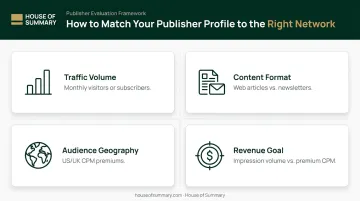
Traffic tier is just one variable, though. The right network depends on your full profile as a publisher:
- Traffic volume — how many monthly visitors or subscribers you bring
- Content format — web articles vs. newsletters require different network types
- Audience geography — some networks pay dramatically higher CPMs for US/UK readers
- Revenue goal — impression volume and premium CPM rates often point to different networks
Conclusion
The best native advertising networks in 2026 are those that align with your content format and audience quality — not the platforms with the most name recognition. A poor-fit network delivers low fill rates, irrelevant ads that erode reader trust, and revenue that doesn't justify the integration effort.
Start by testing one or two networks that match your current traffic tier. Run a 60–90 day evaluation using RPM and engagement metrics (time on page, CTR, scroll depth) as your benchmarks. Expand or pivot based on results rather than committing exclusively to a single partner early.
That framework applies to web publishers. For newsletter publishers, the calculus shifts.
Direct inbox sponsorship models can outperform web-native networks on a per-subscriber basis — particularly when your audience skews toward executives, professionals, or high-income consumers. Ads land in the inbox with no ad blockers, no algorithm filtering what gets seen, and no competing visual clutter on the page. House of Summary operates a network of specialized newsletters built around exactly that kind of reader. Reach out at sales@houseofsummary.com to explore what inbox sponsorship looks like for your brand.
Frequently Asked Questions
What is a native advertising network and how does it work for publishers?
Native ad networks act as intermediaries between publishers and advertisers, placing ads that match the visual and editorial format of your content. Publishers earn revenue each time a reader clicks or views a placement, depending on whether the network uses a CPC or CPM pricing model.
How much can publishers earn from native advertising networks?
Newsletter-native platforms like Paved benchmark CPMs at $10–$30, while most web-based content recommendation networks keep RPM data private. Niche audiences with higher engagement consistently command better rates across both formats.
Do you need a minimum amount of traffic to join a native ad network?
Most major networks have minimum eligibility thresholds, ranging from 5,000 daily unique visitors (MGID) to undisclosed requirements for Taboola and Outbrain. Newsletter-native platforms like Paved focus on subscriber count and engagement quality rather than raw web traffic volume.
Are native ads better than display ads for publisher revenue?
Native ads typically generate higher CTRs and better user experience than banner formats, which translates to stronger RPMs — especially in premium or niche content environments. For newsletter publishers, inbox native placements also bypass ad blockers entirely, recovering revenue that standard web display permanently loses.
Can newsletter publishers monetize through native advertising networks?
Yes. Newsletter-specific platforms like Paved give email publishers access to sponsored placements and native ads that integrate directly with editorial content. These inbox formats reach readers without algorithms or display clutter, driving engagement rates that web-based alternatives rarely match.
How do publishers evaluate whether a native ad network is a good fit?
Evaluate networks across four criteria:
- Revenue transparency — clear CPM or CPC terms, no hidden rev-share cuts
- Advertiser quality — category relevance to your readers' interests
- Eligibility thresholds — traffic or subscriber minimums relative to your current scale
- Format fit — compatibility with your content layout and reader experience