Introduction
Newsletter businesses have gained serious momentum over the past few years. Substack surpassed 5 million paid subscriptions in early 2025, while beehiiv reported a 96% year-over-year increase in active newsletters on its platform. Readers are pulling away from algorithm-driven social feeds and gravitating toward content they actually chose to receive.
The appeal cuts across solo writers, journalists, subject matter experts, and corporate teams alike. The barriers to entry are low, the revenue potential is real, and — critically — you own your audience. No platform update can tank your reach overnight.
That ownership distinction matters more than most new newsletter operators realize. It's the foundation every subscription model in this guide is built on.
This guide walks through the core subscription models, how to price and structure them, what drives subscriber growth, and where most newsletters stall out before they become sustainable businesses.
Key Takeaways
- Newsletter businesses earn revenue through subscriptions, advertising, sponsorships, or a mix of all three
- Your subscription model—free, paid, freemium, or ad-supported—shapes your entire monetization and content strategy
- A large audience isn't required to launch, but a defined niche and a clear reader value proposition are non-negotiable
- Expect several months before revenue becomes consistent—plan your runway accordingly
- Sustainable growth depends on content consistency, reader insight, and solid operational systems built before you scale
What Is a Newsletter Business?
A newsletter business is one where a creator or publisher sends content—news, analysis, curation, or commentary—to a subscribed audience on a regular schedule, then monetizes that audience through one or more revenue streams.
Readers subscribe because the newsletter saves them time, delivers insight they can't easily find elsewhere, or offers a perspective they trust. House of Summary was built on exactly this premise — starting as a single news digest before expanding into specialized titles like Presidential Summary and Geopolitical Summary as readers sought that same clarity across more areas of life.
Common newsletter formats include:
- Solo-creator newsletters: one writer, one niche, a distinct personal voice that readers follow directly
- Media-style newsletters: team-produced with broader topic coverage and a more editorial, professional tone
- Brand newsletters: published by companies to build audience relationships, drive commerce, or foster community
What to Know Before You Start a Newsletter Business
The operational side of a newsletter business goes well beyond writing. Running one means managing:
- List hygiene and deliverability monitoring
- Subscriber communications and onboarding sequences
- Sponsor relationships and ad placement logistics
- Payment processing and subscription management
- Platform upkeep and technical troubleshooting
Address time and income expectations honestly. In the early months, most newsletter businesses operate at zero revenue while the creator invests significant weekly hours. Starting from zero, it typically takes 12 to 16 months of consistent publishing to reach 1,000 subscribers organically. A realistic benchmark for early-stage growth is aiming for 200-300 subscribers by month three, and 500-600 subscribers by month six.
Newsletters succeed or fail on content quality and consistency, not technical complexity. Building the platform takes a weekend. Showing up every week for two years is the harder part — and the part most people don't plan for.
Why Start a Newsletter Business? (When It Makes Sense)
A newsletter business can be genuinely sustainable — but only when the right conditions are in place.
Key advantages:
- Reaches readers directly in their inbox — no algorithms, no ad blockers, and a 32:1 ROI in media and publishing
- Builds a subscriber list you own outright, independent of any platform
- Generates predictable, recurring revenue that compounds as your audience grows
- Commands strong advertising rates — engaged lists typically earn $10–$75 CPM depending on niche and open rates
This model works best when three things are true:
- You have genuine expertise or a distinct editorial voice in a defined niche
- You're willing to commit to a consistent publishing schedule
- You accept that audience trust is built slowly, not overnight
If you're looking for a quick win, this isn't it.
Choosing the Right Subscription Model for Your Newsletter
The subscription model is the structural backbone of a newsletter business. It determines how readers access your content, how you generate revenue, and how you grow. Choosing the wrong model early creates friction that's hard to undo.
Free Newsletter with Advertising or Sponsorships
This model builds a larger subscriber base quickly but requires meaningful volume before it generates worthwhile ad revenue. CPM or flat sponsorship rates depend on niche, open rates, and audience demographics.
Newsletter CPMs typically range from $10 to $75 per 1,000 opens, with B2B niches commanding $50-$100+ and broader consumer lists averaging $15-$35. For context, 1440—a curated news newsletter—generates approximately $0.70 per subscriber per month from advertising.
Paid Subscription (Paywall)
Charging directly for access produces higher-quality, more committed subscribers. However, conversion rates from free to paid are typically low. Substack reports that writers typically see 5% to 10% of their free subscribers convert to paid subscriptions, with 10% being a high-end target.
This means total list size matters less than the depth of the niche and perceived value. A newsletter with 500 subscribers converting at 10% earns from 50 paid members, potentially $400-$500 monthly if priced at $8-$10/month.
Freemium (Free Tier + Paid Tier)
This is the most common model for newsletter businesses at scale. It uses free content to build the funnel and premium content or community access to drive upgrades.
What typically sits behind the paywall:
- Deeper analysis or research
- Full archives and searchable content
- Exclusive issues or bonus content
- Q&A sessions or community access
- Ad-free reading experience
The freemium model gives you a growth lever and a revenue lever at the same time — making it a practical starting point before you know exactly where your paying audience sits.
Ad-Supported Hybrid (Free with Optional Paid)
Some newsletters use sponsor revenue to keep content free while offering paid tiers for readers who want an ad-free experience or additional perks. The challenge is balancing sponsor obligations against reader experience — lean too far toward advertisers and you'll see churn.
Choosing the Right Model
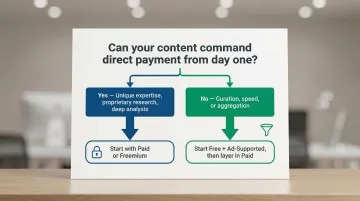
Each model above serves a different starting position. The deciding factor is whether your value proposition can command direct payment from day one.
- Unique expertise, proprietary research, or deep analysis → start with paid or freemium; readers will pay for access they can't get elsewhere
- Curation, speed, or aggregation → build scale first with free and ad-supported content, then layer in paid tiers once the audience trusts the product
How to Start a Newsletter Business – Step by Step
These steps are meant to be executed in sequence. The most common failure point is skipping validation and building a platform before confirming that readers actually want what you plan to produce.
Step 1 – Define Your Niche and Value Proposition
Identify the specific topic, audience, and unique angle your newsletter will own. Not "business news," but "what mid-market CFOs need to know each week." Be specific enough that a potential subscriber immediately understands why this newsletter is for them.
Clarify what makes your newsletter different:
- Is it curation speed?
- A specific geographic focus?
- A unique analytical lens?
- Access to expertise readers cannot easily find elsewhere?
A tight value proposition also makes pricing, positioning, and content decisions considerably easier to act on.
Step 2 – Validate Demand and Willingness to Pay
Before building anything, validate that your niche has an audience that's reachable and engaged.
Practical validation methods:
- Post content on Reddit, LinkedIn, or Quora in your target niche and observe response quality
- Survey a small group of potential subscribers
- Create a landing page with a sign-up form and drive traffic to it via social posts or ads
Test willingness to pay separately from interest — sign-ups for a free version don't confirm readers will pay. To test the paid model before committing to platform setup:
- Launch a waitlist with a stated future price
- Offer early access at a discounted rate to gauge real purchase intent
Step 3 – Choose Your Model, Set Pricing, and Build Your Platform
Based on validation findings, finalize the subscription model and set pricing that reflects the value delivered and covers your operating costs.
Typical newsletter subscription pricing:
- The average monthly price for a paid newsletter is approximately $11, with most ranging from $5 to $20
- The average annual price is roughly $100
- Substack notes that a standard offering is $5/month or $50/year, though many successful writers find a "sweet spot" at $8/month or $80/year
Platform comparison:
| Platform | Revenue Model | Best For |
|---|---|---|
| Substack | 10% of paid subscription revenue; free to publish regardless of list size | Simplicity and built-in discovery through Substack Network |
| Ghost | 0% transaction fee; flat monthly fees starting at $18/mo for up to 1,000 members | Ownership and customization; full control over design and data |
| beehiiv | 0% fee on paid subscriptions; free up to 2,500 subscribers, then $43/mo | Growth-focused operators; integrated Ad Network and referral tools |
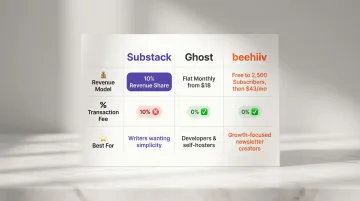
All three platforms charge standard Stripe fees (2.9% + $0.30 per transaction). The decision should factor in revenue share or platform fees, email deliverability, and long-term flexibility.
Step 4 – Set Up the Business and Legal Basics
Cover the minimum business setup required:
- Register a business entity if operating as more than a sole creator
- Understand tax obligations on subscription income
- Set up a payment processor (Stripe is standard across platforms)
- Ensure compliance with email regulations like CAN-SPAM and GDPR depending on audience geography
Many newsletter founders skip this step early and face complications later. Basic compliance and business registration protect both the creator and the subscriber relationship.
Step 5 – Launch, Build Your First Subscribers, and Establish Cadence
Start with a warm audience if one exists — existing contacts, social followers, community members. Use a lead magnet to drive early sign-ups, and establish a consistent publishing cadence before announcing publicly. Showing up reliably from day one sets the tone for retention.
The first 100 subscribers are the hardest and the most important. They validate the concept, provide direct feedback, and signal — if retained — that the content delivers real value. Prioritize early engagement (replies, surveys, click tracking) over raw subscriber counts.
Step 6 – Grow Systematically and Add Monetization Once Stable
Primary growth channels for newsletters:
- Referral programs — Incentivize existing subscribers to share
- Content distribution — Repurpose issues as social posts or articles
- Cross-promotion — Partner with complementary newsletters
- SEO-driven archive content — Make past issues discoverable via search
Layer these channels gradually rather than activating all at once — each one compounds the others over time.
Introduce monetization only after your publishing cadence is stable and open rates are consistent. Approaching sponsors too early, before readers trust the newsletter, accelerates churn. The threshold that matters to sponsors depends on engagement rate and niche quality, not just subscriber count.
Step 7 – Monitor, Improve, and Stabilize Before Scaling
Core metrics that indicate newsletter health:
| Metric | Industry Benchmark |
|---|---|
| Open Rate | 34-45% for media/publishing |
| Click-Through Rate | 4.37% for media/publishing |
| Monthly Churn Rate | 3-5% is good; under 2% is great |
| Free-to-Paid Conversion | 5-10% |

Use the first three to six months to fix content gaps, improve deliverability, and understand which topics drive the strongest engagement. This is the foundation for scaling confidently rather than growing on an unstable base.
Conclusion
Starting a newsletter business is achievable without a large team or big upfront investment, but it demands clarity on niche, discipline in content production, and patience with monetization timelines.
The newsletters that grow into durable businesses—whether solo operations or multi-publication networks—are the ones built on genuine reader value and consistent execution, not short-term growth tactics. Before you send your first issue, nail down three things: who you're writing for, what they can't get elsewhere, and how you'll sustain the work when early subscriber numbers are still modest. Everything else — monetization, growth, partnerships — builds on that foundation.
The newsletters that grow into durable businesses—whether solo operations or multi-publication networks—are the ones built on genuine reader value and consistent execution, not short-term growth tactics. Before you send your first issue, nail down three things: who you're writing for, what they can't get elsewhere, and how you'll sustain the work when early subscriber numbers are still modest. Everything else — monetization, growth, partnerships — builds on that foundation.
Frequently Asked Questions
Is newsletter business profitable?
Profitability depends on model, niche, and audience size. Solo newsletters can range from a few hundred to tens of thousands of dollars monthly. At scale, the numbers are significant — Morning Brew generated ~$50 million in revenue in 2021, and The Hustle sold for $27 million.
How much do newsletters make per subscriber?
It depends on your monetization model. Paid newsletters earn $5–$20/month per paying subscriber directly. Ad-supported newsletters earn based on open rates and CPMs — 1440, for example, generates roughly $0.70 per subscriber per month.
Do you need an LLC for a newsletter?
An LLC is not legally required to start a newsletter but can provide liability protection and tax advantages once revenue is consistent. Requirements vary by country. Consult a local professional to determine the best structure for your situation.
How long does it take to grow a newsletter to 1,000 subscribers?
Timeline varies based on existing audience, growth channels, and publishing frequency. Most newsletters without an existing platform take three to twelve months to reach 1,000 engaged subscribers organically, with consistent publishing being the key factor.
What is the best subscription model for a newsletter?
The right model depends on whether your content can command direct payment or needs audience scale first. For most new newsletters, freemium is the most practical starting point — it builds an audience while letting you test paid conversion over time.
Can you start a newsletter with no existing audience?
Yes, and it's common. Most successful newsletter founders started from zero, growing through consistent content, lead magnets, and community participation. The first 100–500 subscribers are the hardest — and the clearest proof your concept works.