Community newsletter advertising has emerged as a direct answer to that problem. Newsletters reach opted-in readers in a channel that ad blockers don't touch, with no algorithm standing between your message and the audience.
This guide covers everything you need to start: how newsletter advertising works, how to pick the right publication, which ad formats suit which goals, how to write copy that converts, and how to track results properly.
Key Takeaways
- Community newsletters deliver ads directly to opted-in readers, bypassing algorithms and ad blockers entirely
- Audience specificity matters more than list size; a tightly matched newsletter beats a massive generic one
- Ad formats range from display placements and sponsored content to full-issue takeovers, each suited to different campaign objectives
- Segmented, audience-matched email campaigns drive 50% more click-throughs than untargeted sends
- Success depends on choosing the right publication, matching the editorial tone, and using UTM tracking to measure what's working
What Is Community Newsletter Advertising and Why Does It Work?
Community newsletter advertising means paid placements — text, image, or sponsored content — inside newsletters that serve a defined audience. That audience might be geographic (a city, a neighborhood) or interest-based (global business, geopolitics, personal finance, lifestyle).
The core mechanism is straightforward: readers have actively subscribed to receive this content. Their attention isn't stolen — it's offered willingly. That's a fundamentally different dynamic from social or display advertising, where brands compete against content the user actually wants to see.
The Ad Blocker Problem Is Real
GWI reports that nearly 1 in 3 global consumers use ad blockers, with rates even higher in the United States. These tools are specifically designed to filter web-based experiences — pop-ups, banners, pre-rolls, interstitials, tracking scripts.
Email newsletters operate on a fundamentally different surface. When an ad arrives as part of newsletter content a reader requested, it bypasses the technical mechanisms that block web advertising entirely. Brands like BSH Hausgeräte have tested this advantage directly: a campaign running through House of Summary's Dubai Summary newsletter delivered click-through rates 4x higher than Google AdWords — a result the CEO attributed to the editorial environment and audience quality.
The Trust Advantage
Readers extend credibility to the publications they choose. In newsletters where editorial voice is consistent and authoritative — particularly specialized publications covering business, geopolitics, or professional topics — that credibility transfers to adjacent advertising.
This is why editorial environment matters. House of Summary operates a network of human-written, fact-checked newsletters — Presidential Summary, Geopolitical Summary, Dubai Summary, and London Summary — each held to the same standard: accuracy, no sensationalism, nothing unverified.
Advertisers placing campaigns in that environment benefit from the trust readers already have in the publication. Brands like Zoho, Gaggenau, and Autio aren't buying ad space — they're borrowing credibility. That distinction shows up in results:
- No bidding wars or auction-driven placement costs
- No visual clutter competing for reader attention
- Messages delivered in a focused reading environment readers chose
How to Choose the Right Newsletter for Your Brand
Audience alignment is the single most important selection criterion. A luxury finance brand placed in a general lifestyle newsletter burns budget on unqualified readers. That same brand in a newsletter reaching senior executives and policy professionals — where content directly informs decisions — earns high-intent impressions that convert.
Evaluating Audience Quality
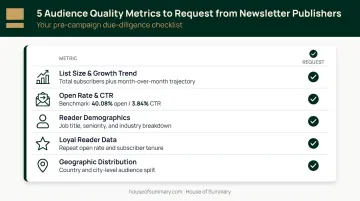
Ask publishers for:
- List size and subscriber growth trend — a growing list signals an engaged, active audience
- Open rates and click rates — GetResponse's 2024 benchmark puts newsletters at a 40.08% open rate and 3.84% CTR, useful context when evaluating a publisher's numbers
- Reader demographics — seniority, geography, industry, household income where available
- Loyal reader data — readers who open multiple times per month are a stronger signal than raw subscriber counts
House of Summary, for instance, shares network-level metrics (500,000+ subscribers, 254,866+ emails opened daily) as well as publication-specific data covering geographic distribution, gender breakdown, and ad click activity — available to advertisers on request.
Geographic vs. Interest-Based Targeting
| Targeting Type | Best For | Example |
|---|---|---|
| Geographic | Local businesses, city-level brand awareness | Neighborhood newsletter, city guide |
| Interest-based | Professional services, B2B, premium brands | Geopolitics, finance, executive briefings |
| Tri-market | Globally mobile, affluent professional audiences | Publications spanning US, UK, UAE |
The interest-based category is where audience quality compounds. Presidential Summary and Geopolitical Summary, for example, reach decision-makers whose work requires staying informed globally — 66% US-based, concentrated in New York and Los Angeles, with significant readership in London and Dubai.
That density in high-income metros makes publications like these a natural fit for B2B campaigns and premium brand advertising targeting professionals with purchasing authority.
Red Flags to Avoid
- No stated open rate or engagement data
- Publishers who can't explain how their list was built (bought vs. organic opt-in)
- High ad-to-content ratio — a cluttered newsletter signals low editorial standards and fatigued readers
- Stale lists: as Campaign Monitor notes, permission can go stale if subscribers haven't been emailed in over a year
Types of Newsletter Ad Formats
Most newsletter publishers offer three core formats. Which one you choose should depend on your campaign objective, not just availability.
The Three Main Formats
1. Display or banner ads — Image-based placements at the top, middle, or bottom of the newsletter. Best for brand awareness campaigns where reach and recognition are the goal. Unlike web display, these aren't subject to ad blockers, which meaningfully improves actual delivery.
2. Sponsored content / native ads — Short editorial-style blocks written in the newsletter's voice, clearly disclosed as sponsored. These work best when your product or service needs context — a fintech product, a supplement, a professional service that requires a brief explanation before a reader acts.
Publishers like House of Summary integrate sponsored content within the editorial flow of each issue — a format that tends to outperform display for brands that need a sentence or two of setup before asking for a click.
3. Full-issue takeovers — The entire newsletter edition runs under your brand's sponsorship, giving exclusive advertiser presence across multiple placements. The investment is significant, but so is the impact — best suited for product launches, major announcements, or campaigns where frequency and undivided attention are the priority.
Matching Format to Objective
| Campaign Goal | Best Format |
|---|---|
| Brand awareness | Display / banner |
| Product explanation or consideration | Sponsored content |
| Product launch or major announcement | Full-issue takeover |
| Sustained brand frequency | Multi-week campaign package |
Ask publishers what formats have historically performed best for brands in your category. One with solid tracking data can tell you what's driven results for comparable advertisers — and that context is worth more than any rate card.
How to Create a Newsletter Ad That Actually Converts
The bar for a newsletter ad is different from a social ad. Readers have chosen this content. An ad that feels forced, generic, or incongruent with the publication's editorial voice gets noticed — for the wrong reasons.
Structural Elements That Work
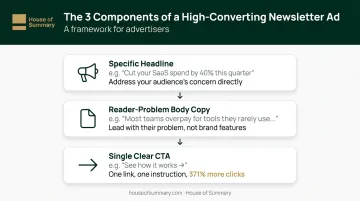
Every high-performing newsletter ad needs three things:
A specific headline — Not a brand slogan. Something that addresses what this audience cares about, immediately. "Protect your assets from geopolitical risk" performs better in a geopolitics newsletter than "Leading wealth solutions since 2005."
A short body that leads with the reader's problem — Not the brand's feature list. What does this reader worry about? Start there. A cybersecurity firm in a geopolitics newsletter should lead with the threat angle, not a generic pitch.
One clear call-to-action — Campaign Monitor reports emails with a single CTA receive 371% more clicks than those with multiple CTAs. Pick the action you want. One link, one instruction.
What Not to Do
- Multiple CTAs — they split attention and reduce total conversions
- Heavy image-only creative — images may not render in all email clients; text-forward ads are more reliable
- Generic copy pasted from other channels — a social ad written for a 25-year-old scrolling Instagram will feel wrong in an executive briefing newsletter
- Promotional language that reads as spam — superlatives and urgency clichés undermine the editorial trust you're borrowing
These aren't abstract cautions. BSH Hausgeräte ran a campaign in Dubai Summary and achieved 4x the CTR of Google AdWords. The ad worked because it matched the publication's editorial voice — specific, direct, and written for that reader. Getting there requires deliberate copy decisions, not just a budget.
How to Measure the Success of Your Newsletter Ad Campaign
Without proper tracking, you're flying blind. Newsletter traffic won't attribute itself correctly in your analytics platform — you have to set it up deliberately.
Core Metrics to Track
- Open rate — measures newsletter reach; context for how many eyes saw your ad
- Click-through rate — measures ad engagement directly
- Conversion rate on landing page — measures whether the ad-to-page experience is working
- Cost per click or cost per acquisition — allows fair comparison against other paid channels
House of Summary supports UTM parameter tracking and unique landing page URLs, which means advertisers can isolate newsletter traffic precisely in Google Analytics or any comparable platform.
Setting Up UTM Tracking
Google's Campaign URL Builder lets you tag links with:
utm_source— the newsletter name (e.g.,dubai-summary)utm_medium—emailutm_campaign— your campaign nameutm_content— differentiates multiple links within the same issue
Every link in your newsletter ad should carry these parameters. Without them, newsletter traffic disappears into "direct" in your analytics, invisible and impossible to attribute.
Setting Realistic Expectations
Newsletter advertising is a multi-touch channel. A single placement may not produce immediate conversions — readers in specialized publications consider decisions carefully. Treat early placements as building familiarity; conversions often follow in later issues or when readers encounter your brand through another channel.
Sustained presence matters. Multi-week packages build the recognition and trust that single placements simply can't replicate.
Frequently Asked Questions
Are newsletters still relevant in 2026?
Yes. Radicati projects the global email user base will grow from 4.48 billion in 2024 to nearly 5 billion by 2028, and Pew Research found 30% of U.S. adults get news from email newsletters often or sometimes. The inbox remains one of the few truly direct, algorithm-free paths to an engaged reader.
How much do newsletter ads cost?
Pricing varies by list size, audience quality, format, and publication. Digiday reported 1440 Media charged a combined CPM of roughly $50 in 2025. Request a media kit directly from publishers. House of Summary provides custom rate cards through sales@houseofsummary.com.
What types of ads can I place in a newsletter?
The three standard formats are display/banner ads, sponsored content (native ads), and full-issue takeovers. Most publishers offer at least one of these. House of Summary offers all formats across its four publications, with multi-week packages available for sustained campaigns.
How do I know if a newsletter's audience matches my target customer?
Request the media kit and review open rates, click rates, reader seniority data, and demographic breakdowns — then read several issues before committing. House of Summary publishes publication-specific analytics including geographic distribution and monthly ad click activity for prospective advertisers.
What makes a newsletter ad effective?
Three factors matter most: audience-message alignment, a single clear call-to-action, and copy written for that specific readership — not recycled from another channel. Ads that feel native to the publication consistently outperform those that feel dropped in from elsewhere.
How do I measure the ROI of newsletter advertising?
Use UTM parameters on every link and a unique landing page URL to isolate newsletter traffic in your analytics platform. Compare cost per click or cost per acquisition from newsletter placements against your benchmarks from paid social or search to establish a fair channel comparison.