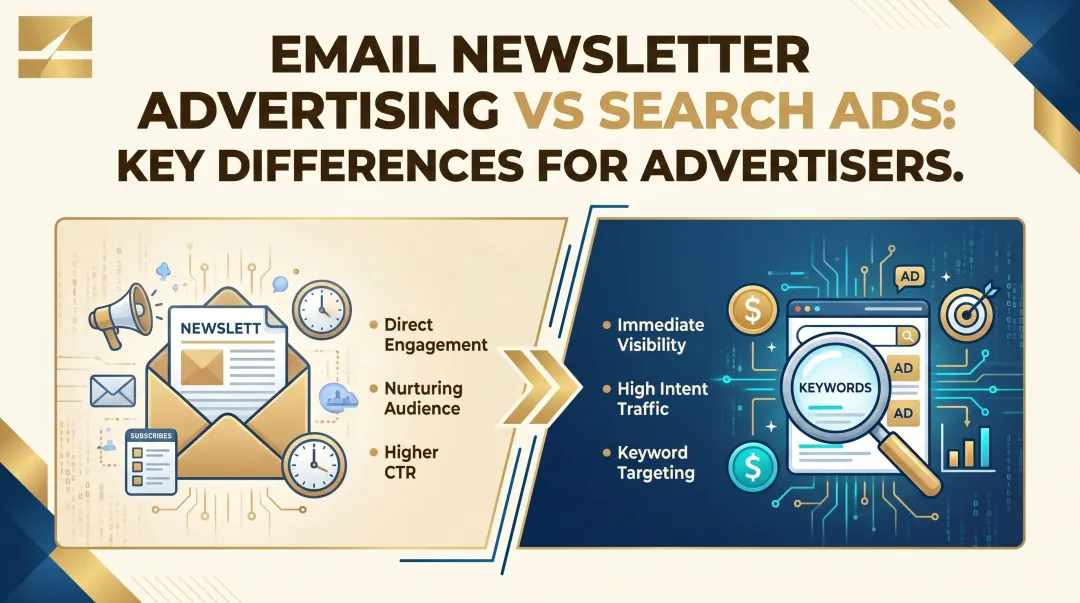
Both options use email as the delivery mechanism. But they work differently, serve different goals, and carry meaningfully different price tags.
Choosing the wrong format doesn't just waste budget — it misaligns your message with reader intent at a critical moment. A conversion-focused campaign buried as one of three ads in a newsletter won't perform like a dedicated send. An awareness play disguised as a full-brand takeover often overspends for what it actually needs.
This article breaks down both formats clearly, compares them across five key dimensions, and gives you a practical framework for deciding which fits your campaign goals.
Key Takeaways
- Newsletter advertising = paid placement inside a third-party newsletter; best for brand awareness and reaching niche audiences efficiently
- Sponsored emails = a dedicated send where one brand owns the entire email; best for full creative control and maximum reader focus
- Newsletter ads cost less; dedicated sends command a 2–5x price premium due to exclusivity
- Awareness campaigns favor newsletter ads; conversion campaigns favor dedicated sends
- Audience quality drives ROI for both formats: high-intent readers consistently outperform larger, passive lists
Newsletter Advertising vs Sponsored Emails: A Quick Comparison
Here's how the two formats stack up across the dimensions that matter most to brand decision-makers.
| Dimension | Newsletter Advertising | Sponsored Email (Dedicated Send) |
|---|---|---|
| Format | One ad unit among editorial content | Entire email devoted to one brand |
| Cost | CPM $10–$100+; flat fees vary by list size | Typically 2–5x a standard placement rate |
| Creative Control | Limited — publisher sets the style frame | High — brand controls subject line, copy, CTA |
| Share of Voice | Shared with editorial and other ads | 100% — no competing content |
| Best Suited For | Brand awareness, budget testing, niche reach | Product launches, lead gen, complex offers |
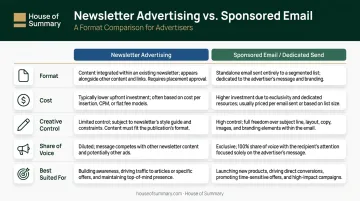
According to Paved's 2026 rate guidance, dedicated emails should be priced at 2–5x the primary sponsored placement rate. A publisher rate card reinforces this: Professional Mariner's 2025 media kit lists a newsletter leaderboard ad at $942 and a dedicated email blast at $2,648 — roughly 2.8x the standard placement cost.
What Is Newsletter Advertising?
Newsletter advertising means buying a paid placement — a native ad, display unit, or sponsored content block — that appears inside a publisher's regular issue, alongside the editorial content subscribers opened it to read.
The mechanics are straightforward. A reader opens their trusted newsletter for the articles. Your brand's message appears within that context, benefiting from the credibility the publication has already built.
Why the Editorial Context Matters
This is the trust transfer effect. When readers opt into a newsletter for its editorial quality, ads within that issue inherit real goodwill — something display and social formats can't replicate.
The engagement numbers back this up. According to Paved's email advertising research, newsletters average a 22% open rate, compared to Facebook's 0.07% engagement rate — a stark difference in what "reaching an audience" actually means.
For CTR benchmarks, the data varies by category and newsletter quality:
- 1440 Media reports a 1.20% average ad CTR for CPG brands across its 4M-subscriber list
- High-engagement newsletter platforms cite 3–5% CTR as a strong target for sponsored link placements
- Social display comparison: LinkedIn image ads average roughly 0.22% CTR, Facebook newsfeeds around 1.11%
Newsletter ads won't universally outperform search ads — Google search ads average 6.42% CTR because of intent matching. But against passive social formats, quality newsletter placements in tightly matched editorial environments compete well.
Ad Formats Available
Most newsletter publishers, including House of Summary, offer several placement types:
- Native ads — written in the newsletter's editorial voice, blended into content flow; the format that most naturally overcomes banner blindness
- Display/banner ads — visual units at fixed positions (header, mid-content, footer); familiar format but position matters significantly for performance
- Sponsored content — branded editorial pieces written to match the publication's tone, giving brands room for narrative and category education
- Full-issue takeovers — a single brand sponsors an entire issue with multiple integrated placements and no competing advertisers
When Newsletter Advertising Works Best
Newsletter advertising performs well when you need:
- Sustained brand visibility with a niche professional audience over multiple issues
- Consistent impressions without paying exclusivity premiums every time
- A low-risk way to test messaging, audience fit, and offer appeal before committing to a larger campaign
- Promotion of content offers — reports, webinars, tools — with a low-friction CTA
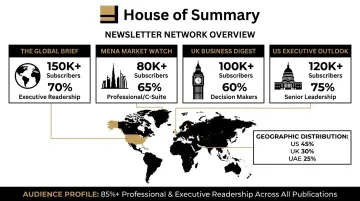
House of Summary's network shows what tight audience matching looks like in practice. Across Presidential Summary, Geopolitical Summary, Dubai Summary, and London Summary, ads reach 500,000+ subscribers concentrated in the US (66%), UAE (18%), and UK (10%) — C-suite executives, founders, senior professionals, and high-net-worth individuals. These ads land directly in the inbox: no ad blockers, no algorithmic filters, no competing visual noise.
What Is a Sponsored Email (Dedicated Send)?
A sponsored email — also called a dedicated send — works differently. Instead of placing one ad among editorial content, the brand effectively rents the entire issue. The publisher sends a full email to their subscriber list on the advertiser's behalf, with the brand's message as the only content.
The email typically carries the publisher's sender name for deliverability and trust, but everything inside belongs to the advertiser.
The Undivided Attention Advantage
The reader opens an email with nothing else to read, click, or scroll past. No editorial competing for attention. No other sponsors sharing the page. This matters when conversion — not just visibility — is the primary goal.
A standard newsletter ad asks readers to notice your message among several others. A dedicated send starts with a subject line you wrote, unfolds with copy you structured, and ends with a CTA you designed. The entire reader journey is yours to control.
This level of narrative control is why dedicated sends are the preferred format for:
- Complex offers that need more than a headline and a logo to explain
- Time-sensitive campaigns where every element of the messaging matters
- B2B brands targeting senior buyers who need proof, context, and specifics before acting
Cost and the Premium Justification
Dedicated sends cost materially more than standard newsletter placements — and that premium is real. Paved's benchmark data puts dedicated emails at 2–5x the primary sponsored email rate. Using the Professional Mariner rate card as a concrete reference: $942 for a newsletter leaderboard ad versus $2,648 for a full dedicated blast.
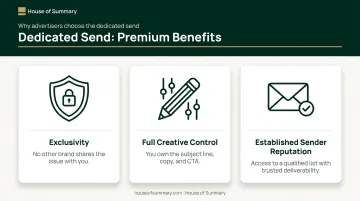
That premium buys three things:
- No other brand shares the issue — full exclusivity
- You control everything: subject line, copy, and final CTA
- Access to an established sender reputation and a qualified list you couldn't build yourself
Whether the premium is justified depends entirely on your campaign objective. For awareness, it rarely is. For a product launch, a high-value lead gen offer, or a conversion event with a clear downstream value, the exclusivity can earn its cost.
When Dedicated Sends Win
Choose a sponsored email when:
- Launching a product that requires detailed explanation before a reader converts
- Running a time-limited promotion where urgency messaging needs precise control
- Your offer is high-value and B2B — senior buyers need proof and context, not just a CTA button
- Testing subject lines with a cold but qualified audience before scaling spend
- Audience alignment is tight enough that the entire list maps to your ICP
Audience alignment is what determines whether the premium pays off. A dedicated send to a misaligned list wastes every dollar of it. The entire email needs to feel relevant to every recipient — which is only achievable when the publisher's subscriber base closely matches your target customer.
Newsletter Advertising vs Sponsored Emails: Which Fits Your Brand's Goals?
There's no universally superior format. The right choice comes down to three factors: campaign objective, budget, and audience alignment.
Awareness vs. Conversion: The Core Dividing Line
This is the clearest distinction between the two formats.
If the goal is brand recognition — staying present in the minds of a relevant professional audience across weeks or months — newsletter advertising offers repeatable, cost-efficient impressions within trusted editorial content. Repeated placements build frequency and familiarity without requiring the reader to take a high-stakes action on every exposure.
beehiiv's 2025 data supports this: 12-week sponsorships perform 40% better than one-off placements, because repeated exposure compounds recognition over time.
If the goal is driving a specific action — a sign-up, a download, a purchase — the dedicated send's undivided attention and full CTA control is worth the premium.
Budget: A Guide for What to Test First
Your budget determines how much risk you can absorb before validating that an audience actually converts.
- Smaller or experimental budgets: Start with newsletter ad placements. Test audience fit, messaging resonance, and offer appeal before committing to exclusivity pricing.
- Larger budgets with validated offers: Lead with a dedicated send for maximum impact, or use a sequenced approach (newsletter ads for warmup, dedicated send for conversion).
Why Audience Intent Matters More Than Volume
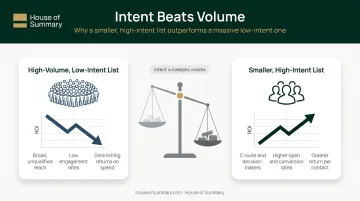
A newsletter read by passive general consumers delivers fundamentally different ROI than one read by decision-makers actively seeking information in a specific domain. Audience intent shapes what each format can realistically deliver — and often matters more than raw subscriber count.
For a network like House of Summary — where the readership skews toward C-suite executives, UHNWIs, policy experts, and senior professionals across US, UAE, and UK markets — the intent level of the audience changes what each format can deliver. Even a single newsletter ad placement in front of the right executive can generate pipeline value that a cheaper, lower-intent placement couldn't match.
Situational Recommendations
Choose newsletter advertising if:
- You want consistent brand visibility with a niche audience over time
- You're testing a new audience segment or creative approach
- Your offer is content-based or has a low-friction CTA
- You're working within a limited or experimental budget
Choose a sponsored email if:
- You're launching a new product that needs full narrative treatment
- You're running a time-sensitive promotion with specific urgency mechanics
- You need full creative control and maximum share of voice
- Your offer is complex and requires more than a single ad unit to explain
Consider using both in sequence: Run newsletter ad placements for 3–4 issues to build audience familiarity, then follow with a dedicated send at the moment of highest intent. This structure works well for product launches: awareness first, conversion second. It also validates audience fit before you commit to the dedicated send premium.
Frequently Asked Questions
What is the difference between a newsletter and a promotional email?
A newsletter is regular editorial content a subscriber opted into for its informational value, sent by a publisher on a recurring schedule. A promotional email is a marketing message sent by a brand directly from its own list to drive a specific action. The key differences are sender relationship, content type, and what the subscriber expects when they open it.
Are sponsored emails more expensive than newsletter ad placements?
Yes. Dedicated sends typically cost 2–5x a standard newsletter placement, with real-world publisher rate cards showing premiums around 2.8x. That premium reflects exclusivity and full share of voice. It's worth paying for conversion-focused campaigns; for awareness objectives, standard newsletter placements usually deliver better value.
Which format performs better for brand awareness?
Newsletter advertising wins for awareness. Repeated placements within trusted editorial content build frequency and familiarity without requiring readers to take high-stakes action. The 40% performance improvement seen in 12-week vs. one-off placements reflects how consistent exposure compounds over time.
How do I measure the ROI of newsletter advertising?
Track publisher-reported open rate, CTR, and cost per click, then use UTM parameters to attribute downstream conversions in Google Analytics. Note that open rates can be inflated by Apple Mail Privacy Protection — CTR and conversion data are more reliable benchmarks. Quality publishers provide post-campaign reports as standard.
Can I run both newsletter ads and sponsored emails at the same time?
Technically yes, but sequencing is more effective. Use newsletter ads first to build audience familiarity, then follow with a dedicated send to convert readers who've already seen your brand. Running both at once can create message confusion and squanders the familiarity built through early placements — the very thing that makes a dedicated send convert.
What should I look for when choosing a newsletter to advertise in?
Prioritize three factors:
- Audience alignment — do the demographics and professional roles match your ICP?
- Engagement quality — open rates and CTR, not just raw subscriber count
- Editorial credibility — does the publisher's content reflect the trust and brand context you want attached to your name?
If you're looking to reach high-intent readers across global news, geopolitics, UAE, or London markets, House of Summary offers both newsletter advertising and sponsored email options across its network of four specialized publications. To explore campaign options and request a media kit, contact sales@houseofsummary.com.