
Newsletter advertising has existed for decades. What's changed is the strategic case for it at the enterprise level. This channel is frequently treated as a niche tactic when it deserves a serious allocation in enterprise media plans — particularly for brands targeting professional, high-intent audiences in competitive sectors like finance, luxury, and global business.
This article covers what newsletter advertising actually offers enterprise brands, what it costs to ignore it, and how to run it well.
Key Takeaways
- Newsletter ads reach opted-in subscribers in their inbox — no algorithm filters, no ad blockers
- Editorial newsletters regularly report 40–60% open rates, far above the ~20% industry average
- Guaranteed delivery means you know exactly how many subscribers received each send
- Clean KPIs (open rate, CTR, conversions) map directly to enterprise reporting frameworks
- Best results come from audience fit, editorial alignment, and consistent measurement — regardless of budget size
What Is Newsletter Advertising?
Newsletter advertising is the practice of placing paid brand messages — sponsored placements, native editorial content, or full-issue takeovers — inside an email newsletter with an actively subscribed audience.
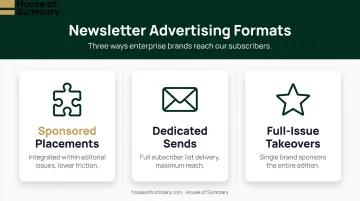
For enterprise brands, this typically takes three forms:
- Sponsored placements within curated editorial issues (integrated, lower friction)
- Dedicated sends to a publisher's full subscriber list (highest deliverable reach)
- Full-issue takeovers where a single brand sponsors an entire edition
The channel exists to solve a specific problem: reaching a high-intent audience at a moment of focused attention. A subscriber opening their morning briefing on global economics is in a different mental state than someone encountering a banner ad mid-scroll.
Networks like House of Summary make this practical at scale for enterprise brands — offering access to professional readers across focused publications (Presidential Summary, Geopolitical Summary, Dubai Summary, and London Summary) rather than a single undifferentiated list. Advertisers can choose a single publication for geographic or contextual precision, or bundle across the network for consistent reach across the US, UK, and UAE markets.
Key Benefits of Newsletter Advertising for Enterprise Brands
Three advantages matter most for enterprise marketing teams: audience quality, guaranteed delivery, and attributable performance. Each addresses a structural weakness in programmatic and social channels.
Advantage 1: Direct Access to High-Intent, Self-Selected Audiences
Newsletter subscribers opted in. They chose a specific topic area — global news, geopolitics, city business coverage — and actively return to it. That's a different starting point than someone served an ad based on behavioral targeting parameters.
For enterprise brands, the audience match is built in — not constructed through behavioral segments that erode as cookies expire. When a financial services or luxury brand advertises in a publication with a verified editorial focus and a verified reader profile, that fit is structural, not approximated.
Why this matters in practice:
- Lead quality over impression volume. Enterprise brands with long sales cycles don't benefit from broad reach. They benefit from reaching decision-makers already consuming content relevant to their buying context.
- Reduced spend waste. You're not paying CPM for reach and hoping the targeting holds. The audience self-selects before the ad is placed.
- B2B-specific fit. Demand Gen Report found that 48% of B2B buyers are willing to register for serial content delivered regularly — newsletters included — and 78% use email to share content assets with colleagues.
Relevant KPIs: Lead quality scores, conversion rate, cost per qualified lead, CTR, audience match rate to ICP
When this matters most: Campaigns targeting senior professionals, C-suite executives, or geographically specific audiences — UAE, London, US financial hubs — where demographic precision via programmatic is both expensive and unreliable. House of Summary's combined network of 500,000+ subscribers skews toward decision-makers, executives, and high-net-worth professionals across New York, Los Angeles, London, and Dubai, covering what the company describes as three of the world's wealth-densest metros.
Advantage 2: Algorithm-Free, Ad-Blocker-Resistant Delivery
A newsletter ad goes to every subscriber who receives that edition. No reach penalty for low engagement history. No content moderation unpredictability. No bidding dynamics that erode delivery after budget is committed.
The ad-blocker problem is larger than most enterprise media plans account for. Blockthrough/PageFair reported 912 million active ad-blocking users worldwide by Q2 2023, up 11% from Q4 2021 — with projected losses to publishers of around $54 billion in 2024. Display and pre-roll inventory takes the biggest hit. Newsletter placements, delivered inside an email client, are not subject to browser-level blocking.
The second issue is attention. When a subscriber opens their inbox, the newsletter is the only content in view. Compare that to a social feed where your brand's ad competes simultaneously with posts, stories, notifications, and other paid placements.
KPIs impacted: Guaranteed reach, effective CPM (eCPM), ad delivery rate, viewability, share of attention
When this matters most:
- Brand safety-sensitive campaigns where ad context quality is non-negotiable
- Luxury and premium brands where placement environment affects brand perception
- Campaigns targeting demographics with above-average ad blocker usage — tech professionals, finance executives, senior decision-makers
House of Summary's editorial standards reinforce this: all content is human-written and fact-checked, with a stated policy of not publishing until every claim is confirmed. For enterprise brands evaluating brand safety, that context matters.
Advantage 3: Measurable Engagement and Attribution Clarity
Newsletter advertising produces a direct, timestamped data trail: impression (send) → open (engagement with the issue) → click (engagement with the brand message) → conversion (tracked via UTM parameters).
This is not modeled attribution. It's direct-response data that holds up in quarterly performance reviews.
Benchmark context:
| Channel | Engagement Metric | Benchmark |
|---|---|---|
| Editorial newsletters | Open rate | 40–60% (Digiday, publisher-reported) |
| General email (all categories) | Open rate | 21.5% (Campaign Monitor, 2022) |
| Media/Publishing email | CTR | 2.9% (Campaign Monitor, 2022) |
| Google Ads Search | CTR | 6.42% (WordStream, 2024) |
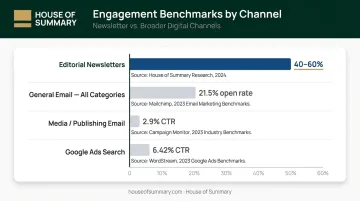
Note: these are category benchmarks, not newsletter ad placement benchmarks. Actual sponsor performance varies by publication, audience, and creative quality — request placement-level historical data from any publisher before committing budget.
BSH Hausgeräte's CEO, Faik Serkan Ergun, reported that a campaign in Dubai Summary produced click-through rates 4x higher than Google AdWords. That's one advertiser's outcome from one placement — but it shows what's possible when the audience and message are well-matched.
House of Summary supports UTM parameter integration, monthly ad click reporting, and geographic/demographic breakdowns post-campaign, making it easy to integrate newsletter performance into standard enterprise marketing dashboards.
KPIs impacted: CTR, open rate, conversion rate, cost per click, revenue attributed per send
When this matters most: Enterprise brands with defined quarterly goals, conversion-oriented messaging, or reporting requirements where channel-level ROI needs to be defensible.
What Enterprise Brands Lose by Overlooking Newsletter Advertising
Over-reliance on programmatic and social channels creates three compounding problems that erode media spend quietly:
- Unprotected programmatic campaigns achieved just 59% authentic viewable display rates, according to DoubleVerify — meaning nearly half of purchased impressions never reached a viewable screen.
- Global post-bid fraud ran at 1.1% in 2023 for protected advertisers, with new fraud schemes growing 23% year-over-year.
- Made for Advertising (MFA) inventory increased impression volume 19% year-over-year while delivering 28% less attention on video and 7% less on display than standard media.
IAB research found that 84% of consumers say advertising within news increases or maintains brand trust. For executives specifically, ads placed in news environments produced a +7 percentage point trust lift — and 63% of executives said an ad in news makes a brand more trustworthy. Newsletter advertising in verified editorial publications captures that trust context. Programmatic inventory doesn't.
There's also a timing cost. Enterprise brands that establish newsletter sponsorship presence build reader familiarity over time — repeated exposure in a trusted editorial context compounds. Single-impression programmatic buys don't build that sponsor recognition. Waiting means competitors claim presence in the newsletters your target audience reads first.
Best Practices to Maximize Newsletter Advertising ROI
High-performing enterprise newsletter campaigns share two traits: the right audience fit and consistent execution. Budget alone doesn't determine results.
Choose Publications with Verified, Specialized Audiences
Raw subscriber counts are not a reliable proxy for value. Evaluate:
- Audience composition (does the readership match your ICP?)
- Editorial focus (does the content context align with your category?)
- Engagement metrics — open rate, CTR, historical sponsor performance
- Geographic concentration if market-specific reach matters
A specialized, high-engagement newsletter will typically outperform a larger but generic list for enterprise goals. Request a media kit with verified audience data before committing budget. House of Summary provides detailed analytics by publication, including geographic breakdowns and demographic composition, available via their sales team at sales@houseofsummary.com.
Align Creative to the Publication's Editorial Tone
Display creative repurposed from social campaigns underperforms in newsletter placements. Subscribers chose the newsletter for its editorial quality — ads that match that voice read as relevant rather than intrusive.
Treat newsletter copy as editorial-adjacent: substantive and respectful of what the reader came for. House of Summary's supported formats include native editorial content written in the newsletter's natural voice, which is well suited for brands in financial services, luxury, and global business where category education matters.
Define KPIs and Attribution Before the First Send
Set up UTM parameters, dedicated landing pages, and CRM tagging before the campaign launches. Multi-channel enterprise reporting requires clean, attributable data from day one. Reconstructing attribution after the fact costs time and produces unreliable numbers.
Test Placement Type Before Scaling
Sponsored placements within editorial content, dedicated sends, and full-issue takeovers produce different results depending on audience and message type. Run a controlled pilot — single publication, defined timeframe, consistent creative — and use that data to inform scaling decisions.
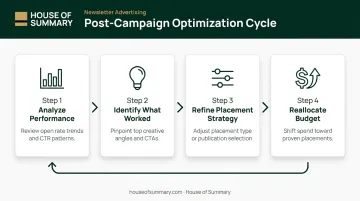
Review and Optimize After Each Campaign Cycle
Consistent optimization is what separates a one-off sponsorship from a channel that reliably produces results:
- Analyze open rate trends and CTR patterns after each send
- Identify which creative angles and calls to action drove the most clicks
- Adjust placement type or publication selection based on evidence
- Reallocate budget toward placements and publications with demonstrated results, even if that means departing from the original plan
Conclusion
The advantages enterprise brands get from newsletter advertising — opted-in audiences, inbox delivery that bypasses ad blockers, and direct-response data that holds up in performance reviews — are becoming genuinely difficult to replicate in other channels.
These advantages compound when the channel is managed with consistency — selecting publications whose audiences mirror your buyer profile, writing creative that respects the editorial context, and measuring results across campaign cycles rather than single placements.
Brands that treat newsletter advertising as a one-off test rarely see what the channel is capable of. The compounding effect comes from repeated, trusted exposure — in an environment readers chose, open regularly, and pay attention to. That's the position worth building.
Frequently Asked Questions
How is newsletter advertising different from social media or programmatic advertising?
Newsletter ads reach opted-in subscribers directly in their inbox, bypassing algorithm filtering, ad blockers, and crowded ad environments. Programmatic and social delivery depends on platform bidding dynamics and suffers significant reach loss — newsletter advertising is more predictable and typically more relevant for high-value professional audiences.
How much does newsletter advertising typically cost for enterprise brands?
Pricing varies by publication, audience size, and placement type. Premium newsletter networks typically operate on custom rate cards based on placement scope and campaign duration. Contact publishers directly for a media kit and pricing details.
What KPIs should enterprise brands track for newsletter advertising campaigns?
Core metrics: open rate (overall newsletter reach), CTR (engagement with the brand message), conversion rate via UTM-tracked links, cost per click, and cost per qualified lead. These map cleanly to standard enterprise marketing reporting frameworks and feed directly into multi-channel dashboards without modeled attribution.
What ad placement types work best for enterprise brands?
Sponsored placements within editorial content offer brand familiarity at lower cost; dedicated sends deliver maximum reach and impact at higher cost; full-issue takeovers provide exclusive presence. Match placement type to campaign goal — sponsored placements for awareness and category education, dedicated sends for direct-response objectives.
How should an enterprise brand choose which newsletters to advertise in?
Start with audience composition and editorial focus — does the readership match your ICP? Then evaluate engagement metrics (open rate, CTR) and contextual brand fit. Request a verified media kit before committing budget. Subscriber volume alone is a poor selection criterion.
Is newsletter advertising effective for B2B enterprise brands specifically?
B2B enterprise brands are well-positioned for this channel. Professional newsletters attract decision-makers and senior executives who are actively consuming relevant content — the same audience B2B brands spend significantly to reach through LinkedIn and event sponsorships, often at higher cost per qualified contact.