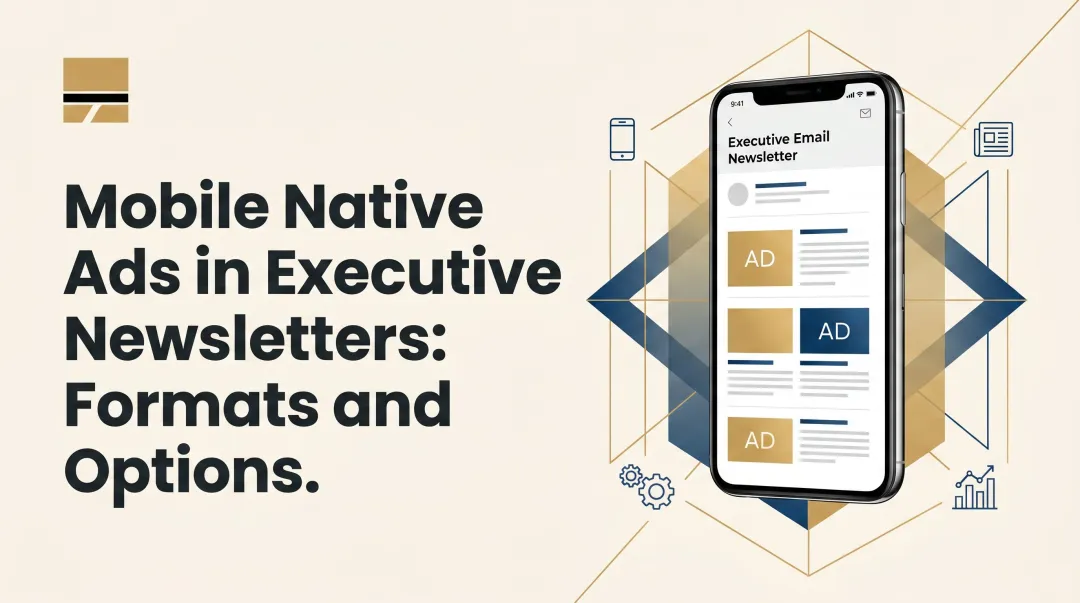
Introduction
Banner ads are losing the battle for mobile attention — and the numbers confirm it. Users scroll past them reflexively, ad blockers strip them out, and click-through rates on mobile banners average around 0.4% — a number that tells you everything about how little interruption advertising moves people on their phones.
Mobile native advertising started from a different premise: instead of forcing an ad into a space where it doesn't belong, build it to match the environment it lives in. When the format fits the content flow, you reach people who are already engaged — not people trying to skip past you.
This article breaks down how mobile native advertising works, which formats deliver the strongest results, and why US native display ad spending hit $108.83 billion in 2024 — representing 63.1% of total display ad spend, according to eMarketer.
Key Takeaways
- Mobile native ads match the visual style of their environment, making them feel like organic content rather than interruptions
- Delivery follows five steps: creative development, platform integration, audience targeting, disclosure labeling, and performance optimization
- Top-performing formats include in-feed ads, vertical video and stories, rewarded in-game ads, and in-map placements
- Key benefits: higher engagement, stronger purchase intent, and reduced ad fatigue
- Newsletter native ads bypass ad blockers entirely, a structural advantage web-based formats cannot match
What Is Mobile Native Advertising?
Mobile native advertising is paid promotional content designed to match the visual style, interaction patterns, and user experience of the mobile environment where it appears. Rather than sitting in a dedicated ad slot that signals "advertisement," native ads mirror the layout, aspect ratios, and content flow of surrounding organic content.
The IAB defines native advertising as paid ads that match the form, feel, function, and quality of the surrounding media. On mobile, this definition carries extra weight.
Why Mobile Changes the Native Equation
Mobile screens are small, sessions are short, and attention is competed for constantly. A banner that might be ignorable on desktop becomes actively disruptive on a 6-inch screen. Native formats avoid that friction by following the same visual grammar users already understand.
Context also matters: US adults spend more than four hours daily with mobile internet, and 88% of that time happens inside apps — not browsers. Native ads built for app environments reach people where they already spend the vast majority of their mobile time.
The 2024 numbers show how dominant this channel has become:
- $108.83 billion in total US native display spending
- $80.39 billion of that went to social media native placements — in-feed ads on platforms users interact with daily
- Social native alone accounted for nearly 74% of all native display spend
How Mobile Native Advertising Works
The process has five connected stages. Each one matters — skip any of them and the ad stops feeling native and starts feeling like exactly what users are trying to ignore.
Step 1 — Content Creation
Brands create ad content that mirrors the tone, format, and visual style of the target platform. That means matching headline length, image dimensions, copy density, and interaction patterns to the platform's organic content — not repurposing the brand's standard creative assets.
Step 2 — Platform Integration
Once built, native ads are placed into the content flow: social feeds, news apps, game interfaces, map results, or email inboxes. The ad appears as a natural element of the user's experience rather than a separate unit inserted beside it.
Step 3 — Audience Targeting
Advertisers layer multiple targeting inputs to reach users most likely to find the ad relevant:
- Behavioral data — past browsing, purchase signals, and in-app activity
- Location signals — city-level or proximity-based targeting
- Content context — matching ad topic to the surrounding editorial content
- Demographics — age, income, job function, or industry
This alignment is what separates native ads that feel useful from those that merely look native but still feel random.
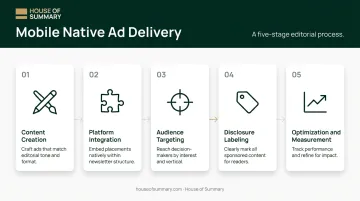
Step 4 — Disclosure Labeling
Compliant native advertising always includes a clear disclosure — "Sponsored," "Promoted," or "Ad" — near the headline or primary visual. The FTC requires that advertising never suggest or imply it's anything other than an ad, with disclosures that are clear, conspicuous, and unambiguous.
This isn't just a regulatory requirement. Users who recognize sponsored content and choose to engage anyway are far more likely to convert than users who feel deceived.
Step 5 — Optimization and Measurement
After launch, advertisers track on-platform signals — CTR, scroll depth, engagement rate — alongside post-click quality data like bounce rate and time on page. A high CTR that leads to immediate exits signals the wrong audience or a misleading headline, not genuine interest. Testing creative variables against these combined signals is what turns a launch into a learning loop.
Most Effective Mobile Native Ad Formats
The best-performing mobile native formats have one thing in common: they mirror what users are already doing — scrolling, swiping, gaming, or navigating — so the ad feels like part of the experience rather than an interruption to it.
In-Feed Ads
In-feed ads are the most familiar native format. They appear within scrolling content streams on social platforms, news apps, and commerce sites — visually indistinguishable from organic posts except for a disclosure label.
This format works because it reaches users already in a content consumption mindset. The ad slot fits so naturally into the feed that engagement feels seamless. There's no context switch, no jarring visual break.
Story and Short-Form Video Ads
Vertical, full-screen story and short-form video formats on Instagram, TikTok, and Snapchat are native placements that match the swipe-based interaction model users expect on those platforms.
The performance data reflects this fit. A Nielsen case study on TikTok advertising found that TikTok in-feed paid media delivered ROAS 66% higher than total digital benchmarks in the Food and Beverage category — making short-form vertical formats one of the most efficient placements available.
In-Game Native Ads
Mobile gaming reaches over 3.2 billion players worldwide, and the ad formats native to that environment produce engagement rates that standard display can't approach.
Key stats from Unity's research:
- 70% of mobile gamers opt in to rewarded video ads regularly
- 85% average completion rate for rewarded video formats
- 79% of players prefer rewarded video over other ad formats
- 71% of developers use rewarded video as a primary monetization method
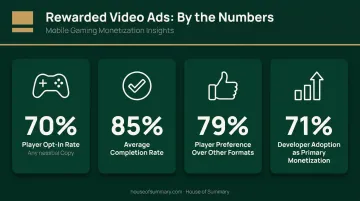
Rewarded ads work because they offer a genuine value exchange: watch an ad, earn in-game currency. That opt-in mechanic changes the dynamic entirely — players are choosing to engage, not tolerating an interruption.
In-Map and Location-Based Ads
Map apps like Google Maps and Waze integrate native ads as branded pins, promoted search results, and sponsored location suggestions. These feel native because they deliver the same type of information as organic map results — business name, hours, directions — just with a sponsored label attached.
What makes them especially effective is intent alignment. Users searching a map have an immediate local need — they're not browsing, they're deciding. Key advantages of this format:
- Reaches users at the moment of local intent
- Delivers actionable information (directions, hours, offers) in a familiar format
- Sponsored results blend naturally with organic listings
At that decision point, a well-placed ad isn't an interruption. It's exactly what the user needed.
Key Benefits of Mobile Native Advertising
Higher Engagement and Reduced Ad Fatigue
Native ads earn more attention because they don't force a disruptive context switch. Earlier research from Sharethrough and Nielsen found that mobile native ads garner roughly twice the visual focus of standard banner ads — and while that data is now a decade old, the directional finding holds up in platform performance data across every major channel.
Fatigue resistance is a related advantage. Native formats blend into content flow rather than repeating as obvious interruptions. Rotating creative hooks — problem-first, proof-first, offer-first — within the same native format extends campaign lifespan far better than increasing frequency on traditional placements.
Stronger Purchase Intent
Native ads lift purchase intent above display for two structural reasons:
- The ad appears in a context the user is already engaged with, so intent is already present
- The familiar format means users don't have to decode a new UI before deciding to act
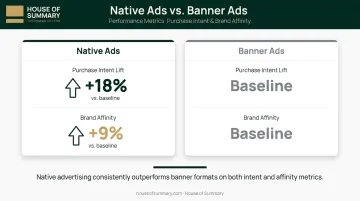
Research from IPG Media Lab and Sharethrough (now older benchmark data) found native ads registered 18% higher purchase intent lift and 9% higher brand affinity than banner ads. More recent platform-level data consistently shows the same advantage.
Ad Blocker Resilience
US adults using mobile ad blockers rose from 29% in 2020 to 37% by August 2024, with 68% of US mobile users reporting they were likely to install one. That trajectory makes ad blocker resilience a practical performance consideration, not just a theoretical one.
In-app native ads are less exposed to traditional browser-based blocking because they are served within the app environment rather than through browser display calls. Newsletter native ads go further — they bypass blockers entirely, since email delivery is structurally separate from web ad-serving infrastructure.
Improved Experience for All Parties
The incentive alignment is worth naming directly:
- Users get less disruptive ad experiences
- Advertisers get higher engagement at comparable or lower CPM
- Publishers earn higher eCPMs because users are more receptive to content-integrated ads
That three-way alignment explains why native ad spending keeps growing year over year. The format delivers for users, advertisers, and publishers alike — which makes it structurally durable, not just fashionable.
The Mobile Inbox: Why Newsletter Ads Are a Native Format Worth Considering
Email newsletters — especially on mobile, where the majority of email is consumed — function as native advertising channels by the core definition of the term. A sponsored placement within a curated newsletter matches the editorial format, tone, and voice of the surrounding content. The structural advantages over web and in-app native are meaningful:
- Newsletter ads bypass ad blockers entirely — email delivery is immune to the browser and app-layer blocking that affects web placements
- No algorithmic suppression means every subscriber the sender has built is reachable
- An uncluttered inbox creates focused attention that crowded social feeds don't offer
Mailchimp reports average email click rates of 2.62% across all senders. Newsletters serving high-intent readers in business, geopolitics, and finance tend to perform above that baseline — the audience self-selects for the content category.
House of Summary's network of four specialized newsletters — Presidential Summary, Geopolitical Summary, Dubai Summary, and London Summary — reaches 500,000+ subscribers with over 254,000 emails opened daily.
The readership skews toward executives, founders, policy professionals, and high-net-worth individuals across the US, UAE, and UK. That demographic is genuinely difficult to reach through programmatic or social channels at equivalent quality.
A well-crafted sponsorship within House of Summary's editorial flow matches the newsletter's voice directly, making it feel like a natural recommendation rather than an interruption. For advertisers who need to reach decision-makers without competing against ad blockers or feed algorithms, that combination is worth taking seriously.
Best Practices for Running Mobile Native Ads
Three principles consistently separate high-performing mobile native campaigns from ones that just blend in:
Match the environment's content rules first. Before designing an ad, study what organic content looks like in the specific placement — headline length, image style, copy density, pacing. Build ads that follow those patterns, then introduce brand elements. Ads that feel native earn attention before users decide whether the offer is relevant.
Disclose clearly, always. "Sponsored" or "Ad" labeling is non-negotiable — both from an FTC compliance standpoint and a performance standpoint. Users who feel misled bounce immediately, don't convert, and damage retargeting pools. Clear labeling protects both trust and campaign efficiency.
Measure with a full metric stack, not just CTR. CTR alone misleads. A complete measurement approach tracks two layers:
- On-platform engagement: CTR, watch time, completion rate
- Post-click quality: landing page view rate, engaged sessions, conversion rate, CPA/ROAS
Together, these distinguish real performance from cheap curiosity clicks.
Frequently Asked Questions
What is the difference between native and non-native ads?
Native ads match the visual format, style, and content flow of the environment they appear in — making them feel like part of the surrounding content. Non-native ads (banners, pop-ups, standard display) sit in dedicated ad slots that visually separate them from surrounding content, making them easier to ignore or block.
What is mobile native advertising?
Mobile native advertising is paid ad content designed to blend into the layout, interaction patterns, and visual style of mobile apps or websites. It appears within feeds, stories, games, or maps in a way that feels like a natural part of the user's experience rather than an inserted advertisement.
How do native ads avoid ad blockers?
In-app native ads are less exposed to traditional browser-based blocking because they are served within the app environment. Newsletter native ads bypass blockers entirely — since they are delivered directly to the inbox, standard ad-blocking technology doesn't apply.
What are the most effective mobile native ad formats?
In-feed ads, short-form vertical video and story formats, rewarded in-game ads, and in-map placements consistently lead on performance. The best format depends on user context — scrolling, gaming, or navigating — and the campaign's specific objective.
How do you measure the success of mobile native advertising?
Track CTR and engagement rate to gauge attention, then use landing page view rate and conversion rate to assess post-click quality. CPA or ROAS tells you whether that engagement actually drives business outcomes — CTR alone is a misleading standalone metric.
Is email newsletter advertising considered native advertising?
Yes — when a sponsored placement matches the editorial tone, format, and voice of the newsletter, it qualifies as native advertising. On mobile, where most email is read, this format reaches audiences in a distraction-free environment without ad blocker interference.