
Traditional paid media is getting harder to justify at scale. CPMs keep climbing, organic reach keeps shrinking, and the audiences brands actually want to reach have learned to tune out the noise.
Sponsored content offers a different path. Not because it's a trend, but because it works through a different mechanism entirely — one that earns attention rather than forcing it. This article breaks down exactly how, with specific metrics, use cases, and practical guidance for getting the most out of it.
Key Takeaways
- Sponsored content integrates brand messages into editorial environments readers already trust and chose to engage with
- Publisher credibility transfers to featured brands, reducing audience skepticism and lifting purchase consideration
- Newsletter-based placements bypass ad blockers entirely — the message arrives inside inbox content, not a web ad slot
- 14% higher purchase intent and 4x higher unaided brand recall — the measurable lift from contextually aligned placements over out-of-context ads
- Consistent placements in the right editorial context compound over time, converting initial awareness into lasting brand trust
What Is Sponsored Content?
Sponsored content is paid media where a brand's message is embedded inside a publisher's editorial format — articles, newsletters, videos, or podcasts — rather than placed alongside it. The audience encounters the brand within content they already chose to read or listen to.
The IAB defines this category as branded or native content: paid brand content published in the same format as full editorial, typically developed in collaboration with the publisher's content team. Unlike display advertising, the format integrates into editorial rather than interrupting it.
Where It Appears
- Newsletter placements — sponsored editorial or native ads inside email publications with opted-in readership
- Branded articles on publisher sites — editorial-format content that provides genuine reader value alongside brand context
- Podcast sponsorships — host-read or produced segments woven into show formats audiences trust
- Video branded content — publisher-produced video that features a brand's perspective or product within editorial storytelling
The common thread across all of these: the publisher's credibility carries the message. That's what separates sponsored content from a banner ad or a paid search listing. The format creates proximity to editorial; the credibility transfer is what creates value.
The FTC requires clear disclosure when sponsored content isn't readily identifiable as advertising. Terms like "Sponsored," "Paid Advertisement," or "Ad" must appear clearly. This transparency is also commercially smart — audiences who feel deceived don't convert.
Key Advantages of Sponsored Content for Business Growth
The advantages here are tied to outcomes marketing teams actually track: engagement rates, traffic quality, audience relevance, and conversion lift. They're strongest when the publisher, placement, and brand are well-matched — the right editorial context is what separates a placement that converts from one that blends into the noise.
Advantage 1: Trust and Credibility Transfer
When a reader encounters a brand inside a newsletter they open every morning, or a publication they rely on for industry news, they don't evaluate that brand in isolation. They evaluate it through the lens of the publisher they already trust.
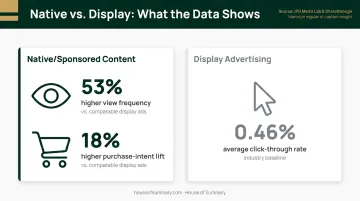
This is credibility transfer, and it's the primary reason sponsored content outperforms interruption-based advertising. An IPG Media Lab and Sharethrough study found that consumers viewed native ads 53% more frequently than display ads, and native formats produced an 18% higher purchase-intent lift than banner advertising. The mechanism is straightforward: readers extend their existing trust in a publication to the brands that appear within it.
Why this matters for business outcomes:
- Credibility transfer reduces audience skepticism — one of the primary barriers between brand exposure and purchase consideration
- Trust built through a publisher's editorial environment is more durable than impressions from display or social, because it's anchored to a relationship the reader chose
- Brand recall in editorial contexts outperforms pre-roll advertising, according to Nielsen's branded content research
KPIs this moves: brand recall, purchase consideration lift, share of voice within a niche audience, referral signals, return visitor rates
When it matters most: Entering a new market, launching in a category where buyer trust is critical (finance, health, B2B SaaS), or repositioning a brand that needs third-party validation rather than self-promotion.
Advantage 2: Higher Engagement and Ad-Blocker Resistance
Email newsletter sponsorships are structurally different from web-based display ads in one critical way: they travel inside content, not inside an ad slot. Browser-based ad blockers work by identifying and blocking ad-serving scripts and resources on web pages. They don't intercept inbox content.
Eyeo and Blockthrough reported 912 million active ad-blocking users worldwide as of Q2 2023, with projected publisher revenue loss of $54 billion in 2024 alone. For brands running display-heavy campaigns, that's a meaningful share of their target audience that never sees the ad at all.
Newsletter placements sidestep this entirely. A reader who opened an email, is reading through it, and encounters a sponsored placement is in a fundamentally different attentional state than someone passively scrolling a feed while a display ad loads in the margin.
The engagement gap is measurable:
- Google Display Network average CTR: 0.46%
- Mailchimp's December 2023 benchmarks show business and finance newsletters averaging 2.78% click rates — already 6x higher than display
- House of Summary's placements reach opted-in readers in finance, business, and global affairs through inbox-first delivery, where engagement reflects an audience that actively chose to be there
KPIs this moves: CTR, open-to-click ratio, time on page post-click, bounce rate on landing pages, cost-per-engaged-visitor
When it matters most: Brands that have experienced reach loss from ad blockers, B2B and premium consumer brands where high-intent traffic quality matters more than raw volume, and campaigns designed to drive qualified traffic to a specific offer.
Advantage 3: Precise Audience Alignment
Niche publishers have done something ad platforms cannot replicate: they've assembled highly specific audiences around shared professional interests, geographic contexts, or subject-matter focus. Programmatic targeting approximates these audiences through demographic signals; editorial publishers define them through content itself.
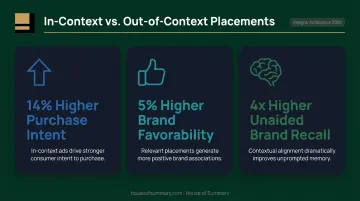
Integral Ad Science's 2022 research found that consumers exposed to in-context ads showed:
- 14% higher purchase intent
- 5% higher brand favorability
- 4x higher unaided brand recall compared to out-of-context placements
That lift isn't from the ad creative changing — it's from the surrounding context. A finance brand placing sponsored content in an executive-focused business newsletter reaches readers who are professionally motivated to engage with financial insights, not a demographic guess based on browsing history.
Why audience alignment improves ROI:
Every impression carries more potential value when the audience is pre-qualified by their content subscription. Broad CPM buys generate wasted impressions at scale; niche editorial placements reduce waste by starting with relevance.
A specialized newsletter with 50,000 highly engaged subscribers in a target category will typically outperform a broad-reach placement with ten times the audience and no contextual fit. Relevance is the multiplier — not volume.
| KPI Category | What Audience Alignment Moves |
|---|---|
| Efficiency | Cost-per-relevant-impression, customer acquisition cost |
| Quality | Lead quality metrics, pipeline contribution |
| Targeting | Audience relevance score |
When it matters most: B2B brands, luxury and premium consumer brands, businesses in regulated categories (finance, legal, healthcare), and any campaign where reaching a specific professional or demographic segment matters more than maximizing raw reach.
What Happens When Sponsored Content Is Ignored
Brands that rely entirely on display, paid search, and social paid media face a compounding set of problems — none of which resolve on their own.
The practical consequences:
- Ads are immediately identified as ads and discounted. Without a credibility mechanism outside the brand's own spending, every message starts by fighting audience skepticism
- Ad blockers eliminate reach: 52% of global consumers have installed or used one, meaning a substantial portion of any target audience never sees web display campaigns. Budget spent, impressions never delivered
- CPMs keep climbing: Tinuiti's Q1 2025 benchmark data shows Meta CPMs rose 4% year over year, with more than half of brands in the study seeing increases above 10%. US internet ad revenue hit $259 billion in 2024, up 15% — more advertisers competing for the same shrinking attention
- Clicks from non-contextual placements tend to produce high bounce rates and low conversion. Traffic arrives without context or intent — and without the trust that makes audiences act
Sponsored content doesn't replace these channels. It addresses what they can't do: deliver brand messages inside trusted, opted-in editorial environments where audiences are primed to engage.
How to Get the Most Value from Sponsored Content
Sponsored content delivers when three conditions align: the right audience, real value to the reader, and disciplined performance tracking. Miss any one of these, and even well-produced content underperforms.
Selecting the Right Publisher
Choose publishers based on audience quality signals, not raw reach:
- Opt-in readership (not scraped or bought lists)
- Demonstrated engagement rates (open rates, click rates, loyal reader metrics)
- Editorial standards that protect the reader relationship
- Niche specificity that matches the brand's target segment
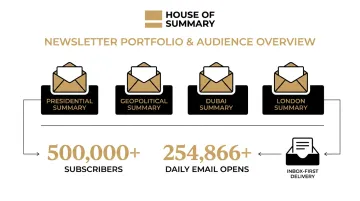
Publishers like House of Summary build advertising value on verified editorial quality and direct inbox delivery — reaching 500,000+ subscribers across Presidential Summary, Geopolitical Summary, Dubai Summary, and London Summary, with 254,866+ emails opened daily across a readership of executives, decision-makers, and high-income professionals. That audience composition matters specifically for brands in finance, professional services, luxury, and premium consumer categories.
Tracking Performance Rigorously
- Use unique tracking links or UTM parameters for every placement
- Measure CTR, then traffic quality post-click: time on page, bounce rate, and downstream conversion events
- Compare cost-per-engaged-visitor across channels, not just cost-per-click
Committing to Consistency
One placement generates awareness. Repeated placements in the same editorial environment build familiarity and recognition — and that accumulated exposure is what moves readers from noticing a brand to acting on it. Multi-week campaigns in a consistent editorial context deliver frequency advantages that single-issue placements simply can't replicate.
Conclusion
Sponsored content works because it stacks three advantages that most formats can't replicate: publisher credibility, high-attention environments that bypass ad blockers, and audiences already engaged with the subject matter before your message appears.
Those advantages compound when placements stay consistent, publisher relationships are maintained, and performance data actually informs the next campaign. Brands that treat sponsored content as a recurring channel — rather than a one-off test — tend to see measurably better recall and click-through over time than those cycling through display formats.
For advertisers looking to reach serious, high-intent readers, newsletter placements with publishers like House of Summary offer that consistency by design: a fixed editorial voice, a verified audience, and inbox delivery that no algorithm can suppress.
Frequently Asked Questions
What are the benefits of sponsored content for a business?
Sponsored content delivers three core advantages: credibility through publisher association, higher engagement rates than conventional digital ads, and access to niche audiences that programmatic targeting can't replicate. Each directly lifts brand consideration, traffic quality, and conversion efficiency.
What are the benefits of content marketing for a business?
Content marketing builds organic reach through owned channels (blog posts, SEO articles, newsletters) with compounding returns over time. Sponsored content works differently — it borrows an established publisher's audience immediately, delivering qualified reach now rather than months from now.
What is the 3-3-3 rule in content marketing?
The 3-3-3 rule is a content distribution framework — typically interpreted as reaching audiences at three funnel stages, through three content types, across three channels. Sponsored content fits naturally as a top-of-funnel awareness and trust-building tactic within this structured distribution approach.
How is sponsored content different from traditional advertising?
Traditional advertising interrupts the audience's experience and is immediately recognizable as promotional. Sponsored content integrates into editorial formats the audience already trusts and chose to engage with. The result is lower resistance and higher engagement — audiences process brand messages differently when they arrive inside content they value rather than alongside it.
How do you measure the ROI of sponsored content?
Track CTR, post-click quality signals (bounce rate, time on page), and downstream conversions — using unique UTM parameters per placement for clean attribution. Cost-per-engaged-visitor is a more useful benchmark than cost-per-click when comparing sponsored placements to other channels.
What types of businesses benefit most from sponsored content?
B2B brands, luxury consumer brands, and businesses in high-trust categories — finance, professional services, healthcare, technology — see the strongest returns. In these sectors, audience credibility and contextual alignment matter more than raw impression volume, and reaching the right reader directly affects conversion rates.