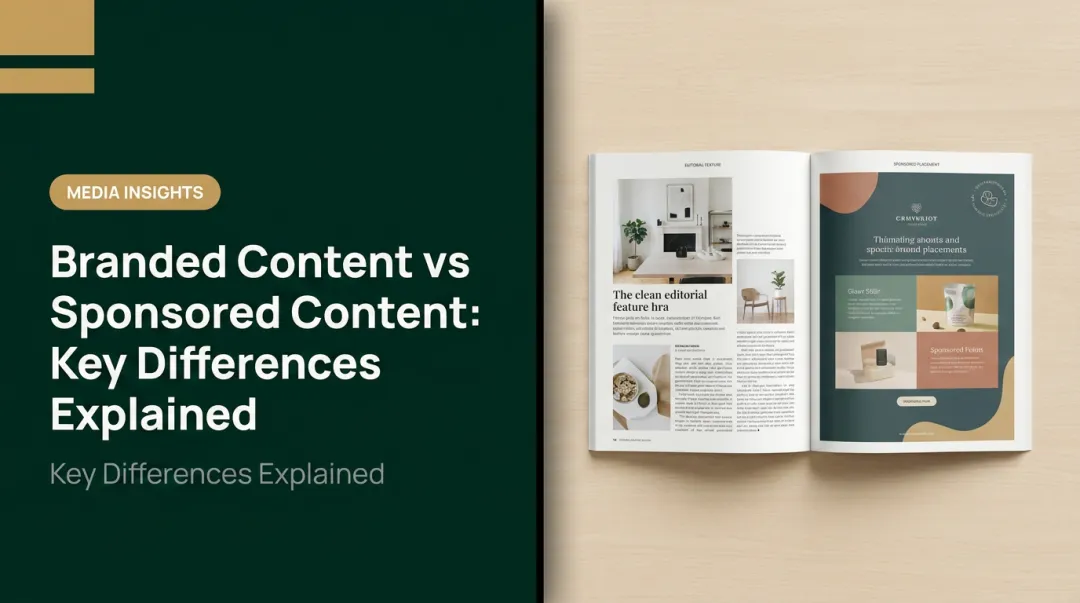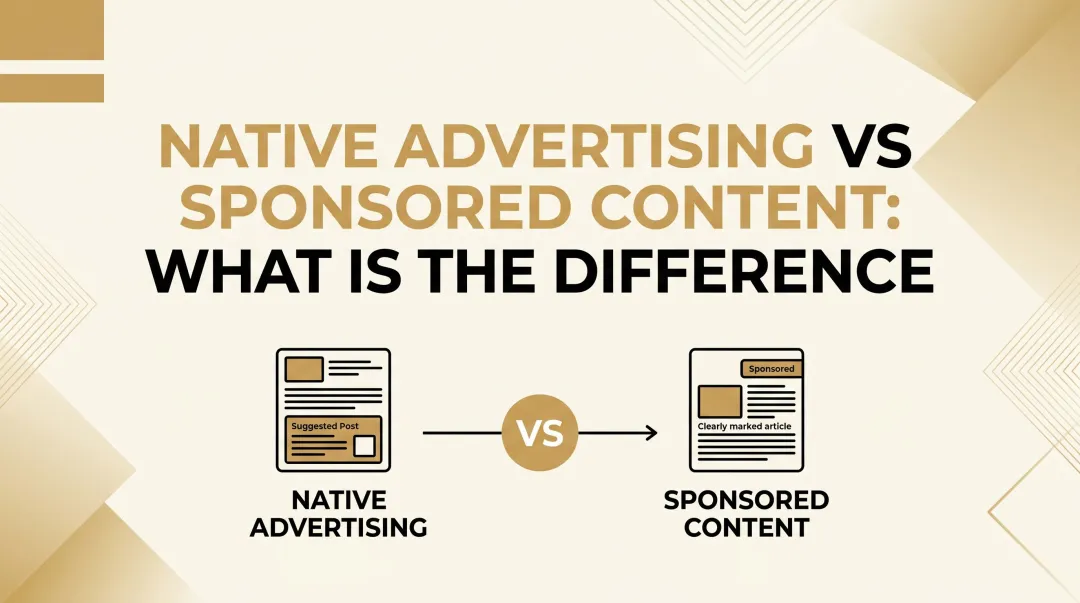

The core distinction is straightforward: sponsored content is paid media you control; PR is earned media you pitch for. One guarantees placement; the other doesn't. One requires legal disclosure; the other doesn't. Understanding this difference determines which tool belongs in which part of your communications strategy.
Key Takeaways
- Sponsored content is paid placement — you control the message, format, and timing
- PR is earned media — journalists and editors decide whether your story gets covered
- Sponsored content guarantees visibility; PR earns credibility that no paid placement can manufacture
- FTC regulations require disclosure for sponsored content; PR coverage carries no such obligation
- Use sponsored content for controlled reach; use PR for trust-building — combined, they cover what neither can achieve alone
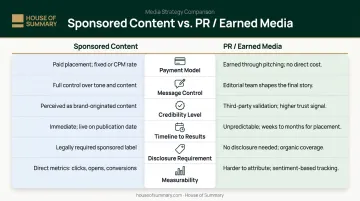
Sponsored Content vs. PR: Quick Comparison
| Factor | Sponsored Content | PR |
|---|---|---|
| Payment model | Paid placement | No payment to publisher |
| Message control | Brand controls fully | Editor controls fully |
| Credibility level | Moderate (disclosed as paid) | High (independent validation) |
| Timeline to results | Immediate and guaranteed | Months of relationship-building |
| Disclosure requirement | Legally required (FTC) | Not applicable |
| Measurability | Impressions, CTR, conversions | Share of voice, sentiment, referral traffic |
The measurability gap is where most marketing decisions actually get made. Sponsored content gives you numbers on day one — impressions, clicks, conversions. PR builds credibility that accumulates over months and rarely shows up in a clean attribution report. Knowing which outcome you need first determines which channel earns your budget.
What Is Sponsored Content?
Sponsored content is paid media placed within a publication, platform, or newsletter, written to match the surrounding editorial style but funded and controlled by the brand. The label "Sponsored," "Promoted," or "Branded Content" signals the paid relationship to readers — this disclosure isn't optional.
The FTC's native advertising guidance defines this format as advertising that resembles the content surrounding it and requires clear identification when its format could otherwise mislead consumers about its commercial nature. The FTC updated its Endorsement Guides in 2023 to add a stricter definition of "clear and conspicuous" disclosure, and the Lord & Taylor enforcement case established that undisclosed paid editorial content carries real legal and reputational consequences.
Key Formats
- Sponsored articles — brand-funded pieces placed within editorial publications, written to match the publication's voice
- Native advertising — in-feed placements on digital platforms designed to match surrounding content (defined by the IAB Native Advertising Playbook as cohesive with page content and consistent with platform behavior)
- Newsletter sponsorships — one of the fastest-growing formats, placing brand messages directly in subscriber inboxes, bypassing ad blockers and algorithm-driven feeds entirely
What Brands Actually Control
- The message angle and brand framing
- Timing of publication
- The call-to-action and destination
- Format choices within the publication's guidelines
Publishers typically require content to meet editorial standards. Effective sponsored content educates or informs about a category or problem — it rarely reads as a direct sales pitch, and better-performing placements don't try to be one.
When to Use It
Sponsored content is the right tool when guaranteed placement and message control matter more than independent validation:
- Product launches with a specific campaign window
- Entering a new audience segment efficiently
- Reaching a targeted readership that's difficult to access through programmatic
- Campaigns where timing is non-negotiable
A financial services brand reaching business executives through a curated newsletter network, for example, can guarantee its message lands in front of verified, engaged readers on a specific date — precision that organic PR rarely delivers.
House of Summary's newsletter network illustrates this in practice. Spanning global news, geopolitics, and market-focused publications for UK and UAE audiences, it reaches 500,000+ subscribers with 254,866+ emails opened daily. Sponsored placements appear inline with editorial content, targeting executives, policy professionals, and high-income consumers across the US, UK, and UAE.
What Is PR?
PRSA defines public relations as "a strategic communication process that builds mutually beneficial relationships between organizations and their publics." The CIPR frames it as being fundamentally about reputation — shaped by what an organization does, says, and what others say about it.
The operative word in both definitions is relationship. PR professionals pitch stories, build connections with journalists and editors, and work to shape how a brand or executive is talked about in the media. No one writes a check to the journalist. The editor decides what runs and how.
Core PR Activities
- Media relations and press release distribution
- Thought leadership and bylined article pitching
- Executive spokesperson positioning
- Crisis communications
- Award submissions and speaking opportunity targeting
None of these guarantee placement. That limitation is also the source of PR's credibility: when an independent editor covers your brand, readers interpret it as validation, not promotion.
The Credibility Premium
Nielsen's 2021 Trust in Advertising study found that 88% of global respondents trust recommendations from people they know more than any other advertising channel — a figure that has held relatively steady since Nielsen first reported it at 84% in 2013. Third-party editorial coverage operates in the same trust register: readers see it as an independent voice, not a purchased one.
Timeline Reality
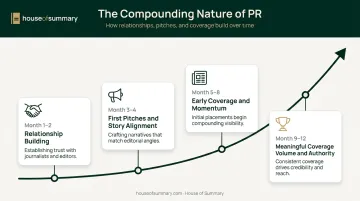
PR compounds over time rather than delivering immediate results. Relationships with journalists take months to develop. Story angles need to align with news cycles. A brand entering a new market through PR alone should plan for 6–12 months of consistent pitching and relationship-building before expecting meaningful coverage volume.
That's the fundamental difference between PR and sponsored content: one is an investment in credibility that accrues over time, the other is a channel you can activate on demand.
When to Use It
- Building long-term executive thought leadership
- Entering a market where trust is the primary purchase barrier
- Amplifying genuinely newsworthy events — funding rounds, research releases, product launches with strong narrative angles
- Crisis response, where third-party credible voices matter more than more paid promotion
Sponsored Content vs. PR: Which Should You Choose?
Two factors drive the decision: how much control you need over the message, and whether your primary objective is immediate reach or long-term credibility. These factors point clearly toward different tools.
Situational Decision Guide
Choose sponsored content when:
- You have a specific campaign window with a hard deadline
- You need to reach a new audience segment that requires targeting precision
- Message framing is critical and can't be left to editorial interpretation
- Immediate, measurable results are required to justify budget
Choose PR when:
- You're building executive thought leadership over the long term
- You're entering a trust-sensitive market where independent validation accelerates adoption
- You have a genuinely newsworthy story with compelling angles for editors
- You need to manage or shape brand reputation through third-party voices
Using Both Together
The strongest communications strategies treat sponsored content and PR as complementary, not competing. Sponsored content provides controlled reach; PR provides the independent validation that makes every other channel more credible.
A few ways they reinforce each other:
- A major press mention can be amplified through sponsored newsletter placements, extending its reach to new audiences
- Consistent PR coverage builds the brand trust that audiences bring to sponsored placements — making readers more receptive
- Sponsored content can prime an audience for earned media by building category familiarity before a PR push
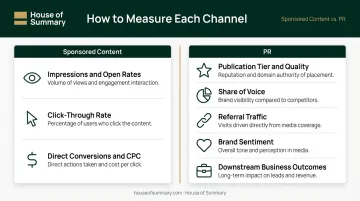
How to Measure Each
Sponsored content ROI is trackable from day one:
- Impressions and open rates
- Click-through rates (Mailchimp's 2023 benchmarks report a 2.78% average CTR for Business & Finance email, compared to native web ad CTRs that Outbrain data shows can be well under 0.1% in most categories)
- Direct conversions and cost-per-click
PR measurement requires a longer lens, aligned with AMEC's Barcelona Principles, which specifically caution against using ad equivalent values (AVEs) as a proxy for PR impact:
- Publication tier and editorial quality
- Share of voice relative to competitors
- Referral traffic from media placements
- Brand sentiment trends
- Downstream business outcomes: sales cycle length, inbound opportunities, category authority
Why Audience Quality Beats Volume
A sponsored placement reaching 50,000 engaged business executives will outperform a banner campaign reaching 5 million passive scrollers. The ROI gap between a targeted, engaged list and a mass display buy is rarely competitive.
GWI's research shows regular ad-blocker users are 14% more likely than average to be higher-income — exactly the audience many B2B and premium brands want most. Reaching that segment through web display becomes progressively harder as blocking rates climb toward 1 in 3 global internet users.
Newsletter sponsorships sidestep this problem entirely. Email ads don't interact with browser-based ad blockers, opt-in audiences have already demonstrated interest in the content, and when the editorial environment matches the advertiser's category — say, a fintech brand in a global executive news newsletter — engagement rates reflect genuine reader intent.
House of Summary's network reaches decision-makers across Presidential Summary, Geopolitical Summary, Dubai Summary, and London Summary — executives in New York, Los Angeles, London, and Dubai who are actively reading, not passively scrolling. For brands targeting this audience, the inbox remains one of the few channels where full attention is still reliably available.
Conclusion
Sponsored content and PR aren't rivals — they operate in different lanes with different strengths. Sponsored content buys guaranteed, controlled reach with measurable outcomes. PR earns credibility that no budget can purchase outright.
The practical framework: use sponsored content when timeline, message control, and targeting precision matter; use PR when you're building authority that compounds over years. The brands that grow fastest treat both as tools in the same kit, not competitors for the same budget line.
Take 20 minutes to audit your current channel mix. If you're spending heavily on PR without the controlled reach to amplify wins, sponsored content can close that gap. If your paid placements aren't backed by earned credibility, you're paying full price for half the impact.
Frequently Asked Questions
Is sponsorship a form of PR?
Sponsorship and PR are distinct disciplines. Sponsorship is a paid arrangement — it falls under paid media, not earned media — and involves payment in exchange for visibility or association. PR is about earning coverage through editorial relationships, without payment to the journalist or publisher.
What is the main difference between sponsored content and PR?
The fundamental difference is payment and control. Sponsored content is paid for and fully controlled by the brand. PR relies on pitching journalists who retain full editorial authority over whether and how the story gets published.
Does sponsored content require disclosure?
Yes. FTC regulations require sponsored content to be clearly labeled as paid or promoted across publications, newsletters, and digital platforms. The FTC updated this guidance in 2023 to tighten "clear and conspicuous" standards — non-disclosure is both a legal and reputational risk.
Can sponsored content and PR work together?
Sponsored content can amplify an earned media win by extending a press mention to new audiences, while consistent PR coverage builds the brand trust that makes sponsored placements more effective over time. Used together, they reinforce each other at every stage of the funnel.
Which is better for brand awareness: sponsored content or PR?
Sponsored content delivers faster, more predictable brand awareness because placement is guaranteed. PR builds deeper, more credible awareness over time because it carries independent editorial validation — and that third-party credibility is difficult to replicate through paid placements alone.
How do you measure the ROI of sponsored content vs. PR?
Sponsored content ROI is tracked through impressions, CTR, and conversions from day one. PR ROI is measured through publication tier, share of voice, and referral traffic — plus downstream outcomes like inbound leads and sales cycle changes, typically assessed over a 6–12 month window.