Introduction
Most marketers use "native advertising" and "sponsored content" interchangeably — but they are not the same thing, and choosing the wrong one can mean misaligned goals, wasted budget, or a message that fails to land.
Each format serves a distinct purpose at a distinct funnel stage. Native advertising drives traffic and builds awareness quickly; sponsored content builds trust, authority, and deeper brand storytelling.
Understanding the difference helps you spend smarter — and pick the format that actually matches what your campaign needs to achieve.
Key Takeaways
- Native advertising is paid content designed to look and feel like organic content (in-feed ads, promoted search results, recommendation widgets)
- Sponsored content is brand-funded editorial — articles, videos, or newsletter features on a third-party platform that inform or entertain
- Native ads function like ad units; sponsored content functions like editorial
- Native ads drive traffic and reach new audiences; sponsored content builds trust and authority over time
- Both require disclosure ("Sponsored," "Promoted," or "Ad") under FTC guidelines
Native Advertising vs. Sponsored Content: At a Glance
| Element | Native Advertising | Sponsored Content |
|---|---|---|
| Format | In-feed ads, promoted listings, search ads, recommendation widgets | Long-form articles, videos, newsletter features |
| Primary Goal | Drive traffic, clicks, impressions, and awareness at scale | Build trust, authority, and deep brand storytelling |
| Who Creates It | Brand creates headline, image, copy; distributed via platform or network | Publisher's editorial team creates or collaborates with brand |
| Where It Lives | Distributed programmatically across thousands of sites or platforms | Published directly on publisher's platform (site or newsletter) |
| Typical Cost | Lower per impression; scalable via programmatic buying | Higher; bought directly from premium publishers with custom production |
| Best Used For | Performance campaigns, lead generation, broad audience targeting | Building brand credibility, educating niche audiences, entering new markets |
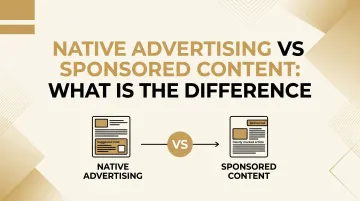
Technically, sponsored content is a subset of native advertising: it matches the form and feel of its host platform. In practice, the two are treated as distinct strategies because their mechanics, costs, and outcomes differ significantly. Marketers who conflate them often overspend on broad distribution when deep credibility is the goal — or underinvest in reach when scale is what moves the needle.
What is Native Advertising?
Native advertising consists of paid ad units designed to match the visual style, tone, and format of the platform they appear on — so they feel like part of the editorial experience rather than an interruption.
The Interactive Advertising Bureau (IAB) defines native ads as "paid ads that are so cohesive with the page content, assimilated into the design, and consistent with platform behaviour that the viewer feels the ads belong there."
The core mechanic is straightforward: native ads typically include a headline, image, and short description. They are clickable and usually drive users to a landing page, branded article, or product page. They carry a label ("Sponsored," "Promoted," or "Ad") but are designed to minimize friction.
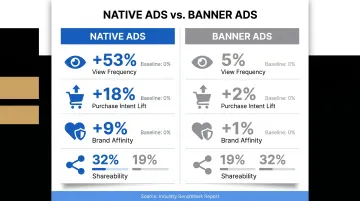
Performance data supports their effectiveness. Research by Sharethrough and IPG Media Lab found that consumers looked at native ads 53% more frequently than display or banner ads, registered 18% higher lift in purchase intent, and showed 9% higher brand affinity. Native ads also proved more shareable: 32% of respondents said they would share a native ad with friends or family, compared to 19% for banner ads.
Types of Native Advertising
The IAB originally identified six core native ad formats, which remain the widely referenced framework:
- In-feed ads - Promoted posts that appear within social feeds or editorial content streams (e.g., Facebook, Instagram, LinkedIn news feeds)
- Paid search units - Sponsored results at the top of search engine results pages (e.g., Google, Bing)
- Recommendation widgets - "Recommended for You" or "You May Also Like" content links at the bottom of articles (e.g., Outbrain, Taboola)
- Promoted listings - Sponsored products on e-commerce platforms that appear alongside organic results (e.g., Amazon, Etsy)
- In-ad with native elements - Standard banner containers housing contextually relevant native-style content
- Custom/non-standard units - Platform-specific formats like Snapchat filters or Spotify playlists
Two examples illustrate how this works in practice. A promoted listing on Amazon carries a "Sponsored" label but uses the same format as organic results — product image, title, price, and reviews — so it reads as a relevant option rather than an intrusion.
Facebook in-feed ads work the same way. Meta labels them with an "Ad" designation, but the format mirrors organic posts: image or video, caption, engagement buttons, and a call-to-action.
What is Sponsored Content?
Sponsored content is long-form, value-driven content — typically articles, videos, or newsletter features — that lives directly on a publisher's platform and is produced either by the publisher's editorial team or collaboratively with the brand. Unlike native ad units, it does not function as a clickable ad; it functions as editorial.
Key characteristics that distinguish it:
- Deeply integrated with the publisher's voice and style
- Informs, educates, or entertains first
- Builds trust rather than driving an immediate click
- Reaches the publisher's established, high-trust audience directly
Pros:
- Builds brand authority and earns reader trust
- Leverages publisher's editorial credibility
- Engages audiences skeptical of traditional ads
- Delivers more in-depth, reader-serving content
Cons:
- Costs more, especially when bought from premium publishers
- Takes longer to produce than standard ad units
- May not drive immediate conversions
- Limited scale compared to programmatic distribution
How Sponsored Content Works
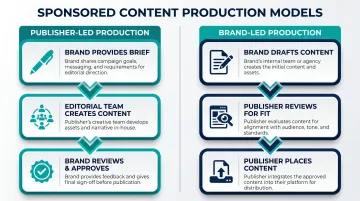
Sponsored content typically follows one of two production models:
Publisher handles production — The editorial team creates content on behalf of the brand, as with The New York Times' T Brand Studio or Forbes BrandVoice. The brand benefits from the publication's voice; the audience gets content that genuinely fits the platform.
Brand creates, publisher approves — The brand drafts the content; the publisher reviews and places it. Either way, the content must serve the publisher's audience first — the brand's message comes second.
Real-world examples:
In 2015, Netflix sponsored an interactive WSJ piece titled "Cocainenomics" to promote the series "Narcos." The multimedia article featured reporting, video interviews with DEA agents, graphics, and an interactive map exploring the economics of the global cocaine trade. Produced by WSJ Custom Studio, it was labeled as sponsor content but delivered genuine editorial value — readers would have found it worth reading even without the Netflix tie-in.
The same principle works at a lighter register. Wendy's published BuzzFeed quizzes that entertained first and mentioned the brand only lightly — using BuzzFeed's signature personality format to integrate the brand into an experience readers were already seeking out.
Newsletter-based sponsored content operates on the same principles but with a distinct delivery advantage: content reaches subscribers directly in their inboxes — no algorithm filtering, no ad blockers, and no competing content for attention. For brands targeting high-intent, niche audiences, that combination of editorial credibility and direct delivery is difficult to replicate elsewhere.
Key Differences Between Native Advertising and Sponsored Content
Intent and Funnel Position
Native advertising is primarily a top-of-funnel and mid-funnel tool — it drives traffic, impressions, and clicks. Taboola describes it as "best suited for top-of-funnel initiatives to gain brand awareness and credibility."
Sponsored content sits further down the funnel. It builds familiarity, trust, and brand authority over time. It's less about immediate clicks and more about sustained engagement with the publisher's audience.
Content Creation and Control
The two formats also differ in who controls the message:
- Native advertising: The brand produces the creative (headline, image, copy) and distributes it through a platform or network. The brand controls the message but must adapt it to fit each platform's format.
- Sponsored content: The publisher's editorial voice shapes the piece. The brand buys access to an audience and editorial credibility simultaneously, but has to give up some creative control in exchange for content that genuinely serves readers.
Cost and Scale
Native advertising can be distributed programmatically across thousands of publisher sites, making it more scalable and often cheaper per impression. Brands can launch campaigns quickly, test variants, and optimize in real time.
Sponsored content is typically bought directly from individual publishers, making it more expensive but more targeted and contextually relevant. The pricing reflects that. Forbes BrandVoice Premium requires a $100,000/month minimum with a six-month commitment. T Brand Studio campaigns involve custom production by a 21-person team of former journalists, designers, and technologists.
Disclosure Requirements
Both formats must be clearly labeled under FTC guidelines. Acceptable disclosure terms include:
- "Ad" or "Advertisement"
- "Paid Advertisement"
- "Sponsored Advertising Content"
The FTC warns that labels like "Promoted" or "Presented by [Brand]" may mislead readers into thinking the content is endorsed by the publisher rather than paid for by the brand. Unclear labeling damages trust in both the brand and the publication, which is why disclosure isn't optional for either format.
Which One Should You Choose?
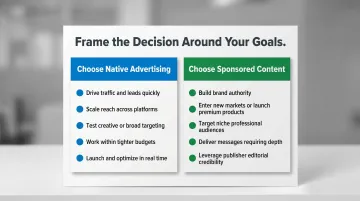
Frame the decision around goals, not just format:
Choose native advertising when:
- Your primary goal is driving website traffic or generating leads quickly
- You need to scale campaign reach across multiple platforms
- You're testing creative or targeting broad audience segments
- You're working with a tighter budget and need cost efficiency
- You want to launch campaigns quickly and optimize in real time
Choose sponsored content when:
- Your goal is building brand authority or educating a specific audience
- You're entering a new market or launching a premium product
- You're targeting a niche professional audience (executives, decision-makers)
- Your brand message requires depth and context to land effectively
- You want to leverage a publisher's editorial credibility and trust
The two formats work well together as part of a combined strategy: sponsored content builds the trust and story; native advertising amplifies that content to a wider audience.
That combined approach works especially well in email. For brands targeting business professionals, executives, or luxury consumers, newsletter-based sponsored content pairs the editorial depth of traditional sponsored content with inbox delivery that bypasses algorithms and ad blockers entirely. House of Summary, for example, places sponsored content across a network of specialized newsletters with over 500,000 opted-in subscribers — reaching readers who chose to be there, not ones served an impression by an algorithm.
Frequently Asked Questions
What is the difference between native advertising and sponsored content?
Native advertising is a broad category of paid ads designed to match the look and feel of their host platform, including in-feed ads, promoted listings, and recommendation widgets. Sponsored content is a specific type — long-form editorial content produced with or by a publisher that informs or entertains the audience. Native ads function like ad units; sponsored content functions like editorial.
What is native advertising and is it paid content?
Yes, native advertising is paid content — brands pay to place it. However, it is designed to look and feel like the organic content around it rather than a traditional ad. It must still be labeled with a disclosure term like "Sponsored" or "Ad" under FTC guidelines to ensure transparency.
What is the difference between sponsored content and advertising?
Traditional advertising is overtly promotional and interrupts the user experience, while sponsored content is built to inform or entertain the reader within a publisher's editorial environment. The brand's message is embedded in content the audience actually wants to read or watch.
What are examples of native ads and sponsored content?
Native ads include promoted listings on Amazon, in-feed ads on Instagram, sponsored search results on Google, and recommendation widgets at the bottom of news articles. Sponsored content examples include Netflix's interactive WSJ feature for "Narcos," Wendy's quiz on BuzzFeed, and brand-funded articles published in newsletter editions from premium independent publishers.
Do native ads and sponsored content require disclosure?
Both formats require clear disclosure under FTC rules. Common labels include "Sponsored," "Paid Post," "Promoted," and "Ad." Failing to disclose paid content can mislead readers and expose the brand and publisher to regulatory risk.
Which format is better for brand awareness?
Native advertising builds awareness at scale through reach and impressions; sponsored content builds deeper awareness through editorial credibility and sustained engagement. The right choice depends on whether the goal is broad exposure or a meaningful connection with a specific audience.