

Introduction
Wealth management is one of the few industries where a single wrong impression — a generic email, an unpolished website, a missed follow-up — can cost you a client relationship worth millions in lifetime fees. The stakes are rising.
Cerulli Associates projects that $124 trillion in wealth will transfer through 2048, with the bulk flowing to heirs rather than charity. The catch? Capgemini's World Wealth Report 2025 found that 81% of next-gen HNWIs plan to switch from their parent's wealth management firm within one to two years of inheritance. Advisors who aren't actively marketing to younger, digitally native clients are already losing ground they don't know they've lost.
Capturing that wealth requires more than a polished pitch deck. This article covers the strategies that drive real growth: defining your niche, choosing the right marketing channels, building trust through content, structuring referral relationships, and staying compliant throughout.
Key Takeaways
- Generic messaging fails with HNWIs — niche specificity drives better targeting and lower acquisition costs
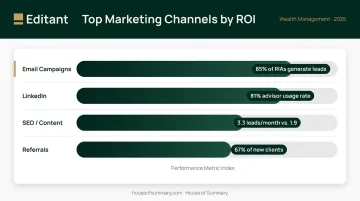
- Email, LinkedIn, SEO, and referrals tend to deliver the strongest ROI for wealth managers — pick two channels and go deep before expanding
- Consistent thought leadership builds trust before the first meeting — prospects arrive pre-sold
- Documented referral plans with business partners generate 3x more new clients than informal approaches
- Every marketing tactic must clear SEC and FINRA compliance review before going live
Why Wealth Management Marketing Is Uniquely Challenging
High-net-worth clients don't respond to mass marketing. They are selective, relationship-driven, and expect personalization before they'll give you 30 minutes of their time.
The competitive environment reflects this. The Investment Adviser Association reported a record 15,870 SEC-registered investment advisers in 2024, collectively managing $144.6 trillion in assets. With that many firms chasing a limited pool of qualified prospects, standing out on credentials alone isn't enough — advisors need to be distinctly recognizable in a specific niche.
Most firms fall into one of three common traps:
- Over-reliance on informal referrals with no documented strategy to systematize or scale them
- A weak digital presence — an outdated website or no content — that fails to convert visitors who found the firm through a recommendation
- Unclear channel attribution — spending time on activities that feel productive but don't actually drive client acquisition
The switching intent data makes this urgent. PwC's U.S. HNW Investor Survey found that 46% of HNW investors planned to change or add a new wealth management relationship within 12 to 24 months. For advisors who assume existing client relationships are stable, this is a significant exposure. For firms actively pursuing new relationships, it signals a window that most competitors aren't prepared to act on.
Start Here: Know Your Audience and Define Your Niche
The most common marketing mistake in wealth management is targeting "affluent investors." That's a category, not a niche. Effective marketing starts much earlier, with a decision about who specifically you serve best.
Build a Real Buyer Persona
A useful HNW buyer persona goes well beyond income level. Consider:
- Psychographics: What keeps them up at night? Inflation, estate planning complexity, equity compensation concentration risk, business succession timing
- Media habits: Do they read financial publications, follow LinkedIn thought leaders, listen to business podcasts?
- Trigger moments: When do they actually start looking for a new advisor?
Inheritance is one of the most quantified triggers, and one of the most predictable. Cerulli found that more than 70% of heirs are likely to fire or change advisors after inheriting. Business exits, retirement transitions, and major liquidity events carry similar switching behavior.
These same trigger moments are also when prospects go looking — online, not by phone. 71% of wealth management executives say next-gen HNWIs prefer digital-first services, per Capgemini. If your firm's marketing relies exclusively on in-person referrals, you're invisible to the segment most likely to move their money in the next five years.
Choose a Specific Niche
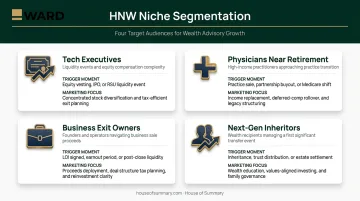
Niche examples that produce focused, efficient marketing:
- Tech executives managing pre-IPO equity compensation
- Physicians within 10 years of retirement
- Business owners planning a succession or exit in the next three to seven years
- Inheriting next-gen clients who want alternative investments alongside traditional portfolios
Specificity sharpens every downstream decision: which keywords to target, which events to host, which newsletters to sponsor, and what your website says in its opening sentence.
The Marketing Channels That Drive Real Growth
Prioritize Channels by ROI, Not Popularity
Broadridge's fifth annual advisor marketing survey found that 46% of U.S. advisors cite lack of time as a primary barrier to marketing consistently. The advisors who do market spend an average of just 2.5 hours per week on it. You can't execute six channels on two and a half hours a week — so channel focus isn't optional.
Start with one or two channels that match where your target clients already spend time. Build systems around those before adding more.
LinkedIn for HNW Client Acquisition
LinkedIn outperforms every other social platform for wealth managers because it concentrates the right audience. Pew Research Center data shows 53% of Americans with a bachelor's degree use LinkedIn — a strong proxy for the professional and executive demographics most advisors target.
The channel dynamics that matter:
- 81% of advisors use LinkedIn for business, per Putnam's Social Advisor Survey — making it the dominant professional social network for the industry
- Personal advisor accounts consistently outperform company pages because trust attaches to people, not logos
- Market commentary and genuine professional observations outperform templated promotional content
LinkedIn works as a prospecting tool too. Connecting with executives, joining industry groups, and engaging with content from target-niche professionals builds visible presence well before any direct outreach.
Email and Newsletter Marketing
Email consistently ranks as the top lead-generation channel in wealth management. Schwab's 2024 RIA Benchmarking Study reported that 85% of participating RIA firms generated leads from email campaigns — the highest of any channel measured.
Financial services email achieves a 27.1% average open rate, per Campaign Monitor's 2022 benchmarks. That's meaningfully higher than most digital advertising alternatives and reflects the intent-driven nature of an opted-in subscriber list.
Sponsored placements in third-party newsletters are another strong option for reaching executives and investors. Publications targeting decision-makers and HNWIs — like those in the House of Summary network, which delivers 254,866+ opens daily across 500,000+ subscribers — offer inbox access with no algorithm exposure or ad blockers.
Native editorial placements integrated into the reading flow consistently outperform display units. Readers are already engaged with content when they encounter the message, which changes the dynamic entirely.
SEO and Content Marketing
SEO compounds. Advisors who publish consistent, keyword-optimized educational content build organic visibility for the searches HNW prospects make when they start looking — searches like "wealth manager for tech executives San Francisco" or "financial advisor for physicians retirement planning."
Broadridge found that advisors using personalized content marketing generate an average of 3.3 website leads per month, compared to 1.9 for advisors who don't. That gap widens over time as content accumulates.
A practical starting point for SEO:
- Update your Google Business Profile with city-level keywords — costs nothing but time
- Target long-tail niche phrases (specialty + location) where national competitors don't compete
- Publish educational content answering the questions HNW clients search before they engage an advisor
Content and Thought Leadership: Building Trust Before the First Meeting
Thought leadership does one job well: it signals expertise before a prospect makes contact. A blog post explaining how to manage a concentrated stock position, a white paper on estate planning for blended families, or a webinar on tax-efficient wealth transfer tells a prospective client something no sales pitch can — that you actually understand their situation.
What Content to Produce
Build content around what your niche is actively concerned about, not what you want to sell. Capgemini's 2025 data provides clear direction:
- 88% of relationship managers say next-gen HNWIs show more interest in alternative investments than baby boomers
- Estate planning ranks as the second-highest financial priority among next-gen HNWIs
- 68% of baby boomers want financial education for younger generations managing inherited wealth
These are content topics, not just product opportunities. An educational series on alternative investment basics, or a guide to estate planning for multi-generational families, directly addresses documented demand.
Once you know what to cover, the next question is how to make that content work harder.
One Piece, Multiple Formats
One long-form piece of content has multiple lives:
- White paper or webinar as the anchor piece
- Two to three blog posts drawing on the same research
- An email sequence walking subscribers through the key points
- LinkedIn posts sharing individual insights with a link back
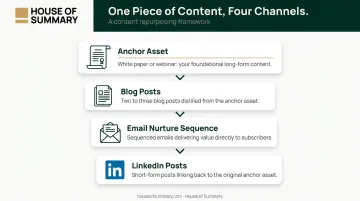
This multiplies production value without requiring constant original creation. For advisors running a business while also trying to market it, that efficiency matters.
Webinars as a Dual-Function Tool
Schwab's 2024 benchmarking data shows 73% of RIA firms generated leads from webcasts or webinars. The mechanism is simple: attendees self-select based on genuine interest in the topic, which means every registrant is a warm prospect who arrived already screened by genuine interest.
Referrals, Networking, and Centers of Influence
Referrals remain the dominant client acquisition source in wealth management. Schwab's data shows referrals accounted for 67% of new clients and new client assets in 2023 among participating RIA firms.
The delta between documented and undocumented approaches is stark:
| Referral Approach | Performance |
|---|---|
| Documented plan for existing clients | 1.4x more new clients |
| Documented plan for business partners (COIs) | 3.0x more new clients |
| No documented referral plan | Baseline |
Centers of Influence Are Underutilized
Attorneys, CPAs, estate planners, and real estate professionals regularly interact with HNW clients at high-stakes decision moments. A relationship with a trusted estate planning attorney — built on co-hosted events, shared educational content, and reciprocal referrals — can deliver a steady flow of pre-qualified introductions.
The 3x multiplier for documented COI referral plans reflects a simple reality: structure converts goodwill into results. Most advisory relationships with CPAs and attorneys stay informal — and informal rarely scales.
That said, referrals alone won't close every prospect — particularly next-gen clients. Capgemini found that 46% of next-gen HNWIs planning to switch firms cited lack of services on preferred digital channels. A personal recommendation from a trusted CPA helps — but if the firm's website looks like it was built in 2014, that referral may not convert.
Marketing Compliance: What Wealth Managers Need to Know
Financial advisors are permitted to advertise — on social media, through paid campaigns, via email, with client testimonials — but the rules matter.
Two primary frameworks govern wealth management marketing in the US:
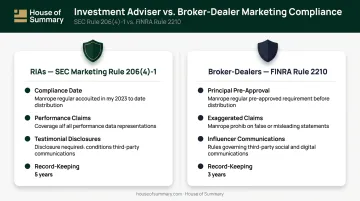
- RIAs: The SEC Marketing Rule (Rule 206(4)-1), compliance date November 4, 2022, covers performance claims, testimonials, endorsements, and disclosures. Testimonials and third-party ratings are permitted but require specific disclosures — cherry-picked or misleading data is prohibited.
- Broker-dealers: FINRA Rule 2210 governs all public communications, requiring principal pre-approval of certain materials and prohibiting exaggerated or unsubstantiated claims.
What the Enforcement Record Looks Like
Recent enforcement cases show regulators are watching closely:
- Titan Global Capital Management (August 2023): The SEC charged Titan for misleading hypothetical performance advertising — extrapolating a 2,700% annualized return from three weeks of data. Penalties totaled $850,000 in civil fines plus disgorgement.
- Nine RIAs (September 2024): The SEC charged nine registered investment advisers for Marketing Rule violations involving unsubstantiated claims, with combined penalties of $1.24 million.
- M1 Finance (March 2024): FINRA fined M1 Finance $850,000 for failures around paid social media influencer communications, ruling that influencer posts constituted retail communications subject to Rule 2210.
Record-Keeping Requirements
All marketing materials must be archived, including social media posts:
- RIAs: Five years from the end of the fiscal year in which the ad was last disseminated, with the first two years in an accessible office location
- Broker-dealers: Three years total under SEA Rule 17a-4(b), with the first two years readily accessible
Social posts carry the same archiving obligations as any other client-facing communication — treat them accordingly.
Frequently Asked Questions
Are financial advisors allowed to advertise?
Yes. Financial advisors can advertise across digital and traditional channels. RIAs must comply with SEC Marketing Rule 206(4)-1, and broker-dealers must follow FINRA Rule 2210. Both rules govern performance claims, testimonials, and required disclosures — but do not prohibit advertising.
What is the 80/20 rule for financial advisors?
The Pareto Principle holds that roughly 80% of revenue comes from 20% of clients. In marketing terms, most qualified leads come from just one or two channels — so identify which ones drive real results and concentrate there.
Is $200,000 enough to work with a financial advisor?
Many wealth management firms set minimum investable asset thresholds between $250,000 and $1 million or more. Advisors should state their minimums clearly in their marketing — it pre-qualifies prospects and filters out mismatched inquiries before they start.
What is the most effective marketing channel for wealth management firms?
The right channel depends on niche and geography. That said, email campaigns, LinkedIn, and referral programs consistently rank highest for ROI in Schwab's benchmarking data — particularly when used together rather than in isolation.
How long does it take to see results from wealth management marketing?
Paid advertising can generate leads within weeks. SEO and content marketing typically produce measurable organic traffic in three to six months. Referral programs and thought leadership compound more slowly but tend to deliver clients with higher lifetime value and lower acquisition costs.