Introduction
There are 23.4 million high-net-worth individuals in the world, collectively controlling $90.5 trillion in wealth. Most marketing aimed at them misses the mark — not because brands lack budget or sophistication, but because they apply mass-market logic to a segment that doesn't respond to it.
Typical consumers respond to promotions and price signals. HNWIs respond to trust and the quality of the relationship behind an offer. They don't evaluate features first — they evaluate whether the brand is worth their time at all. And unlike most audiences, they have both the means and the inclination to simply ignore what doesn't meet that bar.
This guide builds that approach from the ground up. You'll find a clear breakdown of who HNWIs actually are, why standard tactics backfire with this segment, and the specific strategies — from brand positioning to channel selection — that earn their attention and their business.
Key Takeaways
- HNWIs think, decide, and trust differently—standard consumer marketing frameworks don't translate
- Build brand authority and intellectual credibility before launching campaigns or promotional outreach
- Select channels for precision and quality over reach: premium newsletters, exclusive events, professional networks, strategic content
- Success looks like engagement depth, meeting requests, and relationship advancement—not impressions or raw clicks
Who Are HNWIs—And What Makes Them Hard to Reach
The Three Wealth Tiers
The HNWI market segments into three distinct categories based on investable assets (excluding primary residence, collectibles, and consumables):
- HNWIs ($1M–$5M): The largest segment by population, representing entry-level high-net-worth status
- Very-HNWIs ($5M–$30M): Mid-tier millionaires with significant wealth complexity
- Ultra-HNWIs ($30M+): Representing just 1% of the HNWI population but controlling 34% of all HNWI wealth
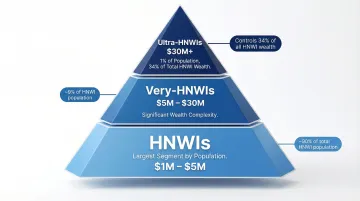
In 2024, the global HNWI population reached 23.4 million individuals holding $90.5 trillion in wealth. In the United States alone, approximately 16 million families—slightly more than 12%—have a net worth exceeding $1 million.
Core HNWI Psychology
HNWIs operate on decision frameworks fundamentally different from mass-market consumers:
- Reputation, professionalism, and honesty outrank product quality or performance when evaluating advisors and brands
- Relationship depth and communication quality matter far more than price points or promotional offers
- Privacy isn't a preference—it's a requirement; HNWIs actively avoid brands that don't treat discretion as a given
- Exclusive access to expertise, networks, and experiences often holds more appeal than material possessions
HNWIs have been pitched constantly throughout their lives. They've developed sophisticated radar for inauthenticity, which is why generic outreach—no matter how polished—gets ignored or actively rejected.
The Generational Shift: The Great Wealth Transfer
An estimated $124 trillion in wealth will transfer through 2048, with $105 trillion flowing to heirs and $18 trillion to charity. This represents the largest intergenerational wealth transfer in history.
For marketers, the transition point is where relationships break. Among next-generation HNWIs who have already received an inheritance, only 20% maintained the relationship with their benefactor's managing advisor. 81% plan to switch from their parent's wealth management firm within 1-2 years after inheritance.
That loyalty gap signals a channel shift, not just a client roster change. 76% of Gen Z and 65% of millennials already seek financial advice online or via social media rather than traditional institutions. Younger HNWIs expect different content formats, digital touchpoints, and engagement models — and brands that don't adapt will lose them at the handoff.
The HNWI Brand Blueprint: Build Authority Before You Build Campaigns
Establish Intellectual Authority, Not Promotional Presence
HNWIs evaluate brands and advisors based on intellectual credibility and demonstrated expertise—not features, pricing, or promotional messaging. 73% of decision-makers say thought leadership content is a more trustworthy basis for assessing capabilities than marketing materials. Another 60% report that thought leadership led them to begin working with an organization they hadn't previously considered.
Thought leadership must precede any sales conversation:
- Market commentary that demonstrates deep understanding of economic conditions, regulatory shifts, and wealth preservation strategies
- White papers addressing complex topics like multi-generational wealth planning, tax optimization, and philanthropic structuring
- Speaking appearances at industry conferences and exclusive forums
- Strategic briefings that offer genuine insight rather than thinly veiled sales pitches
Authentic brand authority requires a consistent point of view, a specific area of expertise, and genuine fluency in HNWI complexity. That means engaging with legacy planning, tax strategy, cross-border wealth issues, and philanthropy—not broad, generic messaging that could apply to anyone.
Create Real Exclusivity—Not a Marketing Façade
Scarcity and restricted access are more compelling to HNWIs than broad availability. Invite-only events, gated insights, private briefings, and limited-access offerings tap into the HNWI desire for differentiation and elite status.
The distinction matters: manufactured scarcity with no real substance reads as hollow, while genuine exclusivity is built around real access and thoughtful curation.
Exclusivity in action:
- Private roundtable dinners with notable industry experts or thought leaders
- Pre-publication access to proprietary market research or strategic forecasts
- Invitation-only advisory sessions offering personalized guidance in intimate settings
- Closed-door networking events connecting HNWIs with peers in similar wealth or professional situations
Done well, these touchpoints build the kind of trust that no advertising placement can manufacture.
Personalization That Reflects Complexity, Not Just a Name
Superficial personalization—inserting a first name into an email template—doesn't work with HNWIs. They recognize template messaging instantly and interpret it as disrespect.
Genuine HNWI personalization means addressing specific financial and life complexity:
- Understanding behavioral signals (recent liquidity events, business sales, inheritance)
- Recognizing life-stage markers (succession planning, philanthropic foundation establishment)
- Acknowledging philanthropic interests and causes they support
- Tailoring language to generational dynamics (Baby Boomers vs. Gen X vs. Millennials)
Mass-market language damages credibility. Phrases like "retirement planning" or "budget-friendly" signal a fundamental lack of understanding to someone with $20 million in net worth. Language must match the audience's reality: wealth preservation, legacy structuring, tax-efficient strategies, philanthropic impact.
True personalization requires data infrastructure that tracks engagement patterns and life-stage indicators. That intelligence should shape every touchpoint—not sort contacts into broad demographic buckets and call it segmentation.
Build Referral Infrastructure as a Marketing Asset
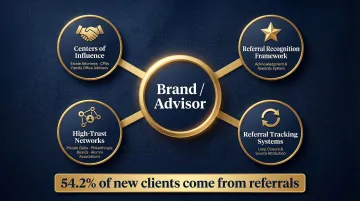
Peer recommendations and trusted professional networks drive more HNWI acquisition than most paid channels. Referrals from clients, friends, or family members account for 54.2% of new clients for advisors. Contacts from centers of influence (COIs)—CPAs, estate attorneys, family office advisors—represent another 13.9%.
Marketing-induced word of mouth generates more than twice the sales of paid advertising. A high-impact recommendation from a trusted friend is up to 50 times more likely to trigger a purchase than a low-impact recommendation.
A structured referral ecosystem includes:
- Formal partnerships with centers of influence (estate attorneys, family office advisors, accountants)
- A referral recognition framework for existing clients that acknowledges and rewards introductions
- Deliberate cultivation of presence in high-trust networks (private clubs, philanthropic boards, alumni associations)
- Systems that track referral sources and close the loop with acknowledgment and updates
Channels and Content That Actually Reach HNWIs
Premium Content Formats: Insight Over Information
HNWIs don't respond to generic educational content. They respond to insight-driven material that speaks to their specific complexity and challenges.
High-performing formats:
- Strategic market commentary analyzing economic conditions, policy shifts, and wealth implications
- White papers on estate and tax strategy addressing multi-jurisdictional issues or regulatory changes
- Private briefing documents offering proprietary research or forecasts
- Case studies demonstrating deep expertise in legacy planning or complex family wealth scenarios
The standard is simple: content that reads like a briefing from a trusted advisor, not a marketing asset. Tone, depth, and specificity are what separate content that earns HNWI trust from content that gets ignored.
54% of decision-makers and 52% of C-level executives spend an hour or more per week reading and viewing thought-leadership content. For that time to land on your content, it needs to match how they think — not how marketers write.
Newsletter and Inbox Advertising: The Channel That Bypasses the Noise
Inbox placement has become one of the most valuable channels for reaching high-intent, high-value audiences. There are no algorithms to suppress distribution, no ad blockers to dodge, and the reader is in an active, reading mindset.
Premium specialized newsletters—like those in the network published by House of Summary, serving global executives and serious readers across geopolitical, financial, and international topics—offer direct, undivided access to exactly the type of reader that luxury and financial brands want to reach. In the Business + Finance sector, email open rates average 31.35% and click rates average 2.78%. By comparison, Google Display Ads average a 0.46% CTR.
Email marketing delivers $36–$45 return per $1 spent and drives conversion rates of 4.24%, compared to social media conversion rates of just 0.59%. Newsletter advertising works because it's permission-based, algorithm-immune, and reaches readers when they're actively engaged.
That engaged mindset extends beyond the inbox. Before any direct outreach, HNWIs are already vetting brands in another critical channel.
LinkedIn and Professional Platforms: Where HNWIs Vet Brands
LinkedIn serves as the primary platform where HNWIs—particularly in business, finance, and professional services—conduct pre-engagement research. 83% of a typical B2B purchasing decision happens before a buyer engages directly with a provider.
Why LinkedIn matters for HNWI marketing:
- Thought leadership content builds discoverability and positions brands as credible voices before any direct contact
- Targeting by job title, company size, and seniority means campaigns reach the right tier without wasted spend
- The professional context frames messaging in a business environment, not a consumer feed — which matters to how HNWIs receive it
Four out of five LinkedIn members drive business decisions, and the platform hosts 65 million decision-makers and 10 million C-level executives. For HNWI marketers, LinkedIn is where credibility is established or undermined before the first conversation ever happens.
Digital channels build the foundation — but some relationships only move forward in a room.
Exclusive Events: High-Touch Environments That Accelerate Trust
Exclusive events create contexts where trust can be built through direct, human engagement—something that cannot be replicated digitally. In-person private dinners, invite-only roundtables, and curated networking evenings signal both exclusivity and genuine investment in the relationship.
Why events work:
- Face-to-face interaction in curated environments signals that the brand understands what HNWIs value
- Hosting positions a brand as a convener — someone who brings the right people together, not just another vendor
- Incremental, low-pressure contact across multiple touchpoints builds the kind of trust that a single sales meeting never could
Examples from the luxury sector illustrate the model: Cartier hosted a dinner in the courtyard of Doge's Palace in Venice for top clients. Mytheresa invited select clients to a masquerade ball at the Belvedere palace in Vienna. Emerging jewelry designer Tabayer hosted a $10,000 two-day event in Beverly Hills for 25 wealthy guests to foster genuine, immersive relationships.
Virtual equivalents—closed-access briefings, private Q&As with experts—can extend this model with greater scale. The principle holds in either format: the event is not the pitch. It's the environment that makes the pitch unnecessary.
Messaging and Tone: Sound Like a Peer, Not a Pitch
The single most common mistake in HNWI marketing is using mass-market language at a premium level. Promotions, urgency tactics, performance claims, and aggressive calls-to-action all trigger distrust in HNWIs.
What resonates instead: perspective, clarity, professional confidence, and strategic thinking—language that sounds like a conversation between equals rather than a sales floor.
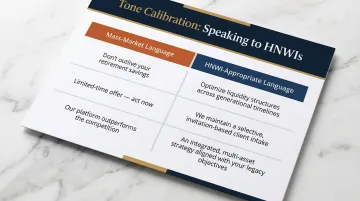
Tone calibration framework:
- Consultative, not instructional — Offer perspective and context; let HNWIs draw their own conclusions
- Insight-forward, not feature-led — Lead with strategic thinking and market awareness, not product specifications
- Understated, not superlative — Avoid "world-class," "revolutionary," or "game-changing"
Contrasting examples:
| Mass-Market | HNWI-Appropriate |
|---|---|
| "Start planning for retirement today!" | "Structuring liquidity for the next chapter requires foresight" |
| "Limited-time offer—act now!" | "We're accepting a limited number of new client relationships this quarter" |
| "Our advanced platform delivers better outcomes than the competition" | "Our approach integrates tax strategy, estate planning, and portfolio construction" |
Regional and Cultural Nuance
Tone calibration doesn't stop at word choice — it extends to geography. Messaging that works in North America (sustainability, philanthropy, impact) may land differently elsewhere. In Asia, innovation, technology, and modernity resonate more strongly. In Europe, heritage, craftsmanship, and legacy carry greater weight.
Regional wealth trends reflect these differences. In 2024, North America led global HNWI wealth growth with an 8.9% increase. The Asia-Pacific region saw a 4.8% increase. Europe recorded a modest 0.7% increase in wealth but a 2.1% decline in HNWI population due to economic stagnation.
These dynamics matter for messaging because growth markets have different priorities than mature ones. A brand expanding into Asia-Pacific needs forward-looking, innovation-driven language. A brand serving European HNWIs earns more trust by anchoring to provenance and permanence.
Creative Quality as a Trust Signal
High-end photography, precisely edited video, and restrained visual design—every aesthetic element signals whether a brand belongs in the HNWI world or is reaching upward from outside it. The creative must match the audience's existing standard of living.
Mediocre design signals mediocre service. HNWIs read visual quality as a direct indicator of operational quality — a brand that cuts corners on its own presentation will be assumed to cut corners everywhere else.
How to Measure HNWI Marketing Success (Beyond Impressions)
Standard performance metrics—impressions, reach, raw clicks—are misleading for HNWI campaigns where the goal is precision over volume. A campaign that reaches 10,000 unqualified viewers is far less valuable than one that reaches 200 highly qualified HNWIs.
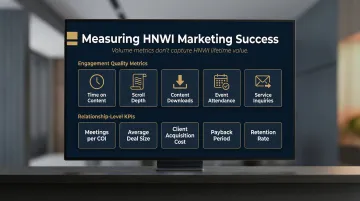
For HNWI campaigns, the right KPIs measure engagement quality, not volume:
- Time spent on content (genuine interest, not just clicks)
- Scroll depth (whether readers engaged with full articles or briefings)
- Content download completions (white papers, research reports, strategic guides)
- Event registrations and attendance (exclusive webinars, private dinners)
- Premium product or service inquiries (high-value, qualified leads)
Combine behavioral engagement data with CRM signals to identify high-intent prospects and separate them from lower-intent visitors. For HNWI audiences, a single converted relationship can represent substantial lifetime value — sometimes millions of dollars over decades. Standard volume metrics simply don't capture that reality.
Alongside engagement indicators, track these relationship-level KPIs:
- Meetings per center of influence (COI)
- Average deal size
- Client acquisition cost
- Payback period
- Retention rate
Word-of-Mouth as a Measurable Outcome
HNWIs heavily influence one another through peer networks, making referral signals a critical — and often undertracked — campaign metric. Track referral sources, social mentions from qualified accounts, and direct introductions alongside your owned-channel data.
Retention ties directly into this: a 5% increase in retention can boost profits by 25–95% in premium and luxury categories. For top-tier clients, full value calculations should include the number of network members that client referred and the lifetime value of each one.
Frequently Asked Questions
How to target high net worth clients?
Target HNWIs through precision over volume: use behavioral data, wealth indicators, and professional network mapping. Select channels like premium content, exclusive events, and specialist media. Focus on reaching the right individuals through contextually relevant environments rather than broadcasting to broad demographics.
How to advertise to high net worth individuals?
Advertise to HNWIs in premium, contextually relevant environments: inbox placements through specialist newsletters like those published by House of Summary, LinkedIn professional targeting, and exclusive media partnerships. Avoid mass display or programmatic channels that lack the quality signal HNWIs associate with trusted brands.
How to pitch to high-net-worth individuals?
Pitching to HNWIs works best when it doesn't feel like a pitch. Use a consultative, insight-led approach grounded in genuine understanding of their specific complexity. Convey authority and peer-level respect rather than sales urgency. Lead with perspective, not product features.
How to reach out to high-net-worth individuals?
Initial outreach to HNWIs is most effective through warm channels: referrals from trusted professionals (CPAs, attorneys), introductions via exclusive events, or valuable content that establishes credibility before any direct contact. Cold outreach with generic messaging rarely works and often damages brand perception.
What percentage of Americans have a net worth of $1,000,000?
According to the Federal Reserve's 2022 Survey of Consumer Finances, approximately 16 million American families (slightly more than 12%) had a net worth of $1 million or more. That wealth remains heavily concentrated at the top, which is precisely why broad demographic targeting rarely converts — and why channel selection matters as much as message.