Introduction
Reaching high net worth individuals (HNWIs) is a context and credibility problem, not a media spend problem. Mass reach means little when the audience is not paying attention or does not trust the environment. Luxury brands know their advertising effectiveness depends on who sees the message, where they see it, and whether they are in a receptive state of mind when it arrives.
HNWIs are typically defined as individuals with investable assets above $1 million, excluding primary residence. That definition matters less than what it implies about behavior.
These consumers are information-selective, time-scarce, and resistant to interruption advertising. They favor curated, expert environments over algorithmic feeds — and their purchase motivations require an entirely different strategy than mass consumer marketing.
What follows covers the channels luxury brands actually use to reach this audience, how they craft messaging that resonates, and the pitfalls that consistently derail campaigns.
TLDR:
- HNWIs actively avoid traditional advertising and prioritize quality context over mass reach
- Luxury advertising works best in curated environments: premium newsletters, high-end print, and experiential events
- Messaging must emphasize aspiration, heritage, and exclusivity, never price
- Multi-channel consistency is essential; single-channel strategies fail with affluent audiences
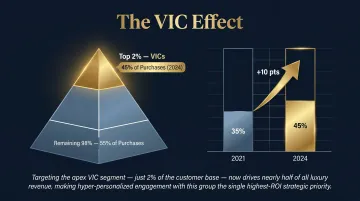
- The top 2% of luxury customers now drive 45% of purchases, making precision targeting critical
Why High Net Worth Audiences Require a Different Advertising Approach
HNWIs are not simply "rich consumers" — they represent a distinct advertising challenge. Research reveals that these consumers actively resist traditional advertising tactics that work on mass audiences. Only 19% of HNW consumers engage with promotional tactics like sweepstakes, compared to 25% of the general population. Digital advertising faces the same resistance: roughly 29.5% of internet users globally use ad-blocking tools, with usage skewing toward younger, more affluent demographics.
Even when ads reach these audiences, they face banner blindness. Standard display banner ads achieve only 0.05-0.10% click-through rates — a performance so poor it renders impression-based strategies nearly worthless for luxury brands.
The Luxury Buyer's Motivational Profile
Affluent consumers buy status and identity, not products. Jean-Noel Kapferer's foundational research on luxury consumer psychology shows these purchases are driven by identity signaling and aspiration — price and specifications are secondary. His framework holds that "the greater the inaccessibility — whether actual or virtual — the greater the desire."
Advertising must therefore speak to self-image and aspiration rather than features or value propositions. Recent data confirms this: 60% of HNW consumers rate brand names as important for luxury items, and 24% are willing to "stay ahead of the curve" versus only 13% of the general population. The purchase decision is about what the brand says about the buyer, not what the product does.
Curated Media Consumption Patterns
HNWIs consume media in different environments than mass audiences — favoring curated, expert, and context-rich sources — specialist publications, premium newsletters, financial news, lifestyle media — over algorithmic feeds. Research shows that 42% of HNW consumers plan to follow financial news in the next six months, compared to 31% of those earning under $250,000.
Luxury brands must therefore appear in prestige environments that reinforce their premium positioning — not chase reach through promotional gimmicks. Being adjacent to credible, serious, or prestigious editorial content transfers authority to the brand. Research from ComScore demonstrates that premium publishers drive higher brand lift effectiveness, a lift the researchers attribute to the halo effect of surrounding editorial content.
The Generational Luxury Shift
While luxury has traditionally skewed older, millennials now account for approximately 45-46% of global luxury spending, creating a significant generational shift in channel selection and tone. Yet the overall customer base contracted — from 400 million in 2022 to roughly 350 million in 2024 — with Gen Z satisfaction falling 25-30 NPS points below millennials.
The top 2% of luxury customers (VICs) now drive 45% of purchases, up from 35% in 2021. That concentration shifts the strategic priority away from broad reach — toward high-touch, personalized outreach to this narrow apex segment.
Where Luxury Brands Advertise: The Key Channels
Effective luxury advertising uses a deliberate multi-channel approach: precise presence in the right environments at the right moment, not broad reach. The channel mix reflects where HNWIs give their attention and which contexts reinforce luxury positioning.
High-End Print and Out-of-Home
Print still holds relevance for luxury because it demands investment and provides a tactile, unhurried context. High-end magazines like Vogue, Wallpaper*, and FT Weekend provide environments where readers engage deeply with advertising rather than scrolling past it. The physical presence of a full-page ad in a prestigious publication signals seriousness and commitment in ways digital formats cannot replicate.
Out-of-home advertising in premium locations — international airport lounges, financial districts, luxury retail corridors — maintains physical brand presence where HNWIs pass through. These placements work not because of frequency but because of location-based exclusivity: being present in spaces that require wealth or status to access.
Premium Newsletter and Email Advertising
Newsletter advertising is increasingly favored by luxury brands because it delivers the message directly into the inbox with no algorithm, no ad blocker, and no visual competition. Unlike social media feeds where attention is fought for, the newsletter reader has actively chosen to receive this content, which means attention is given rather than captured.
Newsletter advertising achieves click-through rates of approximately 1.5-1.7% — roughly 15-30 times higher than standard display banner ads at 0.05-0.10%. This dramatic performance gap reflects a fundamental difference in context: newsletter readers are in a high-attention, low-distraction state.
Premium newsletter networks serving business professionals, global executives, and serious news readers represent a particularly valuable environment. Publications like House of Summary's network — covering global news, geopolitics, and city-specific summaries for markets like Dubai and London — deliver undivided attention in a trusted editorial context.
With 500,000+ subscribers and 254,866+ daily email opens concentrated in wealth-dense metros, these placements connect luxury brands with decision-makers who consume content for work and personal relevance, not entertainment.
The editorial environment matters. Human-written, verified content creates brand-safe adjacency that programmatic placements cannot guarantee. For luxury advertisers, this means their message appears alongside serious journalism rather than user-generated content or algorithmically curated feeds.
Visual Social Media and Influencer Partnerships
Instagram and Pinterest serve as key luxury advertising environments where aspirational imagery, curated aesthetics, and lifestyle storytelling perform well. Effective luxury social media advertising distinguishes between celebrity mega-partnerships (broad awareness) and micro-influencer campaigns (higher trust and engagement with niche affluent audiences).
Data from documented luxury influencer partnerships shows measurable performance. Dior's collaboration with Leonie Hanne achieved 23% higher engagement than generic brand-owned content, generating an estimated $2.8 million in earned media value per season. Louis Vuitton's partnership with Emma Chamberlain drove a 40% increase in brand favorability among Gen Z in year one.
Luxury houses prefer multi-year ambassadorships over rotating influencer campaigns, with 83% of marketers considering Earned Media Value (EMV) the key metric for prestige campaigns. Category exclusivity contracts typically mandate 3-6 months of competitor lockout, ensuring the association remains exclusive.
Experiential and Event-Based Advertising
Luxury brands use private events, VIP launches, brand experiences, and cultural sponsorships to reach HNWIs in person. Experiential advertising builds emotional memory and brand association in ways no digital format can replicate.
Leading luxury houses operate dedicated arts foundations and cultural sponsorship programs. Notable examples include:
- Chanel Culture Fund: supports global cultural innovation, including Frank Wang Yefeng's installation on New York's High Line
- Fondation Louis Vuitton: a Frank Gehry-designed cultural institution in Paris
- Fondazione Prada: multidisciplinary exhibition spaces in Milan and Venice
The European sponsorship market is valued at EUR 32.9 billion, with cultural sponsorship set to increase as brands diversify beyond sports. Research confirms this resonates: 13% of HNW consumers attended an in-person brand event in the past month versus 8% for the general population.
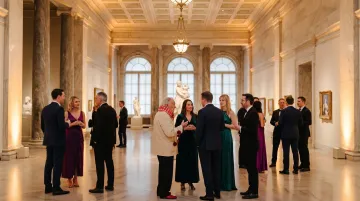
These are decade-long commitments, not campaign-cycle decisions. The goal is sustained association with prestige cultural institutions, transferring authority through proximity over time.
Premium Digital Placements and Programmatic Targeting
Luxury brands use targeted programmatic advertising on premium publisher networks to reach HNWIs based on behavioral data, income signals, and content adjacency. Quality of context matters more than impression volume — a placement on FT Digital or a specialist business publication outperforms broad display at scale.
The challenge with programmatic is brand safety. Industry experts argue that "legacy brand safety tools are broken" and that programmatic's "complex and fragmented supply chain" gives advertisers limited visibility into where ads actually appear. For luxury brands, prestige context is non-negotiable — overly broad programmatic strategies risk placements in low-prestige environments that quietly erode brand positioning.
How Luxury Brands Craft Their Advertising Message
Luxury advertising deliberately avoids price and functional claims. Instead, it leads with heritage, craft, scarcity, and the life the product represents. This messaging approach reflects the understanding that HNWIs are buying identity and status, not specifications.
Identity and Emotion Over Specifications
Rolls-Royce positions vehicle ownership as a "statement of success, accomplishment, and refined taste" rather than emphasizing engineering specifications. The brand's advertising strategy focuses on creating deep emotional connections where the car is treated as a statement piece reflecting the owner's personality, status, and aspirations.
Specific campaigns illustrate this approach:
- "The Best Car in the World" — legendary tagline earned by the Silver Ghost (1906), still used to anchor brand identity
- "The Black Badge Experience" — experiential campaign inviting select customers to test-drive in prestigious, curated locations
- Wraith Kryptos — campaign centered on mystery and cryptography, with hidden messages woven into the car's design
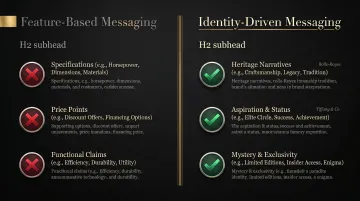
Tiffany & Co. follows similar principles. Campaigns like "What Makes Love True" use photographs with personal stories attached, creating emotional connections rather than showcasing product features. The focus is always on the meaning and identity the product confers, not its attributes.
Creative Quality as a Brand Signal
These campaigns only land when the production matches the promise. Underproduced creative damages brand perception regardless of channel. Luxury executions rely on cinematic direction, restrained copy, and imagery that feels aspirational without being alienating. The production quality itself signals positioning — weak execution contradicts the luxury message before a viewer reads a single word.
Storytelling and Brand Heritage
Luxury brands communicate why they exist and what they stand for before they communicate what they sell. HNWIs respond to this because they are buying into a worldview, not just a product.
Each brand anchors its narrative in a distinct tradition:
- Rolex — watchmaking heritage linked to personal achievement
- Hermès — craftsmanship passed across generations
- Louis Vuitton — travel, exploration, and cultural patronage
The product is the conclusion of the story, not the opening.
Personalization by Wealth Segment
Luxury brands use data and segmentation to tailor messaging across HNWI sub-groups. Generational divergence is sharp: established wealth values craftsmanship, legacy, and recognition, while younger consumers prioritize identity expression and experience.
More than 50% of consumers now consider luxury brands "overpriced," with Gen Z driving that shift. Messaging to younger segments must address value perception differently — not through price, but through authenticity, sustainability, or cultural relevance.
Personalization also extends to the product itself. Rolls-Royce's Bespoke Program lets clients customize every detail, ensuring no two cars are identical. That level of individuality becomes part of the narrative, not a footnote in a spec sheet.
Consistency Across Touchpoints
Luxury advertising works because every element — ad creative, website, packaging, customer service tone — reinforces the same positioning. Inconsistency breaks the luxury illusion. A beautifully shot print ad means nothing if the website looks generic or the email follow-up feels automated.
This is why luxury brands invest heavily in brand strategy before spending on paid media. The advertising expresses a fully built brand identity — it does not create one on its own.
The 4 E's of Luxury Marketing Explained
The 4 E's framework developed by luxury marketing expert Michel Chevalier provides a practical lens for evaluating whether a luxury advertising campaign is well-constructed: Emotions, Exclusivity, Experiences, and Extension.
- Emotions — Narrative-driven creative that connects a product to identity, aspiration, and personal values rather than functional features
- Exclusivity — Scarcity signals, invite-only access, and personalized services that communicate status recognition to the buyer
- Experiences — Immersive retail environments, personalized offerings, and event-based advertising that create memories rather than impressions
- Extension — Content partnerships, cultural sponsorships, and branded collaborations that carry brand values into new lifestyle contexts
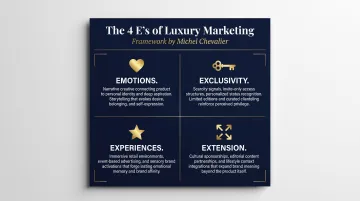
Luxury marketers can use this framework as a balance test, not a checklist. Campaigns addressing only one or two E's often miss the full psychological profile of the HNWI buyer — building desire without creating lasting brand attachment.
Research validates the experience component: more than 3 in 4 millennials prefer spending money on experiences rather than products, and 56% of millennials and Gen Z globally state that "prioritizing experiences over material possessions is important to their personal life."
Common Mistakes Luxury Brands Make When Advertising to HNWIs
Leading with Price or Promotions
Discounting or price-led advertising actively damages luxury brand perception with affluent audiences. Kapferer's research establishes that luxury must maintain inaccessibility as a deliberate barrier. "The greater the inaccessibility, the greater the desire." Removing these obstacles through discounting causes "the disappearance of the very waiting time that sustains luxury."
Real-world examples prove the damage. Burberry's iconic check pattern suffered severe brand dilution when over-licensing and overexposure caused it to become associated with counterfeit goods and non-luxury consumer demographics. BBC News reported: "Their distinctive beige check, once associated with A-listers, has now become the uniform of a rather different social group." The brand required a multi-year rehabilitation effort including reduced licensing and repositioned advertising.
Data confirms affluent consumers are less price-driven: only 28% of HNW consumers are more loyal to discounts than brands, versus 34% for the general population. Price-led tactics don't just fail to convert HNWIs — they signal that a brand doesn't understand them.
Over-Relying on a Single Channel
A single-channel luxury advertising strategy fails because HNWIs move across multiple premium environments. Consistent presence across relevant touchpoints, not dominance on a single platform, is what builds brand recognition and recall.
Each channel serves a distinct function in the HNWI media day:
- Social media: broad reach, but shallow attention and low trust context
- Newsletters: narrow reach, but deep attention and high reader intent
- Premium print: prestige context that transfers to advertisers
- Experiential: emotional memory and direct brand association
The concentration of spending among VICs (the top 2% who drive 45% of luxury purchases) amplifies this further. These individuals move through curated media environments throughout the day — the financial newsletter at breakfast, the airport lounge in transit, the cultural institution on the weekend. A brand absent from any of these moments loses ground to one that isn't.
Prioritizing Broad Reach Over Context Quality
Luxury brands that chase impressions and audience scale at the expense of editorial context end up in low-prestige environments that dilute brand positioning. The right 10,000 readers in a credible, curated context will always outperform 1,000,000 generic impressions.
This is particularly relevant in programmatic advertising, where automated bidding optimizes for cost per impression rather than context quality. A luxury watch ad that appears on a clickbait site or next to user-generated content undermines the brand message regardless of how many people see it.
Quality context creates a halo effect: the prestige of the editorial environment transfers to the advertiser. This is why luxury brands pay premium CPMs for placements in publications like the Financial Times, The Economist, or curated newsletter networks serving verified affluent audiences. Paying for context is not inefficiency — it is the mechanism through which luxury positioning is either reinforced or quietly eroded.
Frequently Asked Questions
How do luxury brands advertise?
Luxury brands advertise through a mix of premium channels — high-end print, social media, newsletter placements, influencer partnerships, and experiential events — with placement decisions driven by context and credibility over mass reach. Messaging emphasizes aspiration, heritage, and exclusivity rather than price or product features, with creative production quality matching the brand's positioning.
Where do luxury brands advertise?
Luxury brands advertise in high-end print publications (Vogue, FT Weekend, Wallpaper*), premium digital newsletters serving executives and HNWIs, Instagram and Pinterest for visual storytelling, out-of-home placements in affluent locations, and sponsored cultural or experiential events. All channels are chosen for their ability to reach HNWIs in high-trust, low-distraction contexts.
What is the focus of a luxury brand?
The focus of a luxury brand is exclusivity, quality, and the identity it confers on the buyer. Luxury brands sell belonging to a rarefied world, not just a product, which is why their advertising leads with aspiration and emotional resonance rather than functional value.
What are the 4 E's of luxury marketing?
The 4 E's of luxury marketing are Emotions, Exclusivity, Experiences, and Extension. Attributed to Michel Chevalier, the framework guides brands to balance emotional storytelling, scarcity signals, experiential touchpoints, and lifestyle extension across every customer interaction.
What are examples of branded content in luxury advertising?
Common examples include a watchmaker producing a heritage documentary series or a fashion house publishing editorial-style content inside a premium newsletter. In both cases, the content builds brand association and prestige without overt selling.