
Introduction
Luxury D2C brands face a fundamental paradox: they must earn the trust of High Net Worth buyers—some of the world's most time-scarce, choice-saturated consumers—entirely through content, without the sensory theater of a flagship store or the reassurance of a personal stylist.
These buyers expect the same exclusivity signals traditionally delivered through marble floors, white-gloved service, and invitation-only appointments. Yet the D2C model offers none of this. Every blog post, email, and product image must carry the credibility weight that physical retail would otherwise provide.
According to Capgemini's 2025 World Wealth Report, the global HNWI population grew 2.6% in 2024, with wealth increasing 4.2%. Ultra-HNWIs (those with over $30 million in investable assets) grew even faster at 6.2%, now numbering over 626,000 individuals globally. These buyers control more than one-third of privately held wealth worldwide—and they evaluate luxury purchases entirely differently than mass-affluent consumers.
This article covers how HNW buyers differ from general luxury consumers, which content strategies resonate with this audience, and how to choose distribution channels that reinforce brand prestige rather than erode it.
Key Takeaways
- HNW buyers distrust promotional content and respond to expertise and narrative, not product features or urgency tactics
- Content becomes the brand experience for D2C luxury, replacing physical retail cues entirely
- Effective content leads with provenance, craft, and story rather than product specifications
- Distribution matters as much as content quality: HNW audiences occupy curated, low-noise channels, not algorithmic feeds
What Makes Luxury D2C Content Marketing Different
Traditional luxury marketing benefits from physical infrastructure: the weight of a door handle, the scent of a boutique, the attentiveness of trained staff. D2C brands have none of this. Content becomes the brand experience itself. Every visual, every sentence, every editorial choice must convey quality and legitimacy where no tangible proof exists.
This challenge intensifies when targeting HNWIs specifically rather than the broader affluent segment. Bain & Company's 2024 Luxury Study found that Very Important Clients—just 2% of luxury customers—accounted for 45% of global luxury purchases in 2024, up from 35% in 2021. Meanwhile, the luxury market lost approximately 50 million customers between 2022 and 2024, largely among aspirational buyers. The market is consolidating around the highest tier.
Mass-market content tactics fail with HNW buyers for structural reasons:
- Volume posting signals mass appeal—daily social content suggests wide availability, contradicting exclusivity
- Promotional language signals desperation—discount triggers and urgency copy feel transactional, not prestigious
- Broad targeting undermines selectivity—HNW buyers define luxury by who it excludes, and indiscriminate reach destroys that signal
These tactical failures point to a deeper structural problem: credibility. Without retail intermediaries or physical presence, D2C brands lack third-party validation entirely.
When a Cartier boutique on Bond Street displays a watch, the location itself vouches for the product. A D2C brand at the same price point has no such shortcut—it must build that authority entirely through content: editorial quality, visual standards, storytelling depth, and source credibility.
Who Are HNW Buyers and What Content Do They Respond To?
The HNW Audience Profile
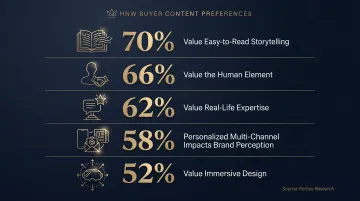
Forbes Research surveyed 250 U.S.-based HNW consumers (households with $2 million+ in investable assets) in early 2026 and found that this group is time-compressed, digitally selective, and story-driven:
- 70% value storytelling that is easy to read
- 66% value a human element in content
- 62% value real-life expertise
- 52% value immersive design experiences
- 58% report personalized multi-channel marketing significantly impacts brand perception
These buyers aren't searching for deals or viral products. They're confirming that a brand belongs in the same category as their identity. Content that educates, contextualizes, or deepens understanding of craft and provenance—without a hard sell—is what earns attention.
That preference for substance shows up clearly in the numbers. HNW buyers show significantly higher interest in luxury-specific content (51%) compared to mass affluent consumers (15%), according to the same Forbes study. This 36-point gap confirms that dedicated luxury content strategies outperform general premium messaging with this audience.
What HNW Buyers Distrust
eMarketer reports that 93% of consumers skip or block ads, with ad blocker adoption skewing toward younger, male, and higher-income demographics. YouGov found that 52% of consumers across 48 global markets use ad blockers on browsers or mobile devices.
HNW buyers specifically distrust:
- Intrusive digital ads that follow them across platforms
- Influencer content that feels transactional or paid
- Brands that over-explain their exclusivity rather than demonstrate it through restraint
Trust Signals That Resonate
HNW buyers respond to validation from sources they respect, not volume-based social proof. Trust signals include:
- Editorial coverage in respected publications
- Peer validation within their network (private, not public)
- Provenance stories that reveal material sourcing or artisan relationships
- Content that treats them as intelligent insiders, not aspirational outsiders
Understanding who holds this trust calculus is shifting, too. Next-generation HNWIs (Gen X, Millennials, Gen Z) represented approximately 85% of the 6,472 HNWI investors surveyed by Capgemini in 2025. This cohort shows a strong preference for digital-first engagement, with 61% willing to take investment risks for growth — which signals real openness to newer or emerging brands that demonstrate credibility through content.
Content Strategies That Work for Luxury D2C Brands
Lead With Story, Not Product
HNW buyers purchase meaning, identity, and access—not features. Every content piece should open with narrative: the artisan, the raw material source, the design philosophy, or the problem the product was created to solve at the highest standard.
Forbes Research found that 70% of HNW consumers value storytelling and 66% value a human element—both ranking above immersive design (52%). Narrative-driven approaches outperform feature-focused content in brand perception among this segment.
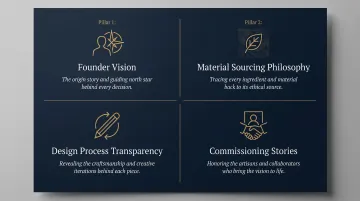
How to build narrative for a D2C luxury brand without multi-decade heritage:
- Founder vision and personal journey
- Material sourcing philosophy (where materials come from and why that matters)
- Design process transparency (decision-making criteria, iterations, rejections)
- Commissioning stories (who the product was made for and why)
Fashion Strategy Weekly highlighted Brunello Cucinelli's 12.7% revenue growth in early 2024, driven by content emphasising Italian craftsmanship heritage and the founder's humanistic philosophy. Hermès invested in long-form atelier storytelling, including a CBS 60 Minutes feature showcasing artisan craft processes, alongside YouTube behind-the-scenes content.
Demonstrate Craft and Provenance Visually
For D2C luxury brands, visual content carries the full weight of the in-store experience. The product image is a proxy for quality in the absence of physical touch—it must communicate material weight, finish quality, and attention to detail.
Content formats that demonstrate craft effectively:
- Slow-format video (process documentation, atelier footage, artisan profiles)
- Still photography with intentional negative space and lighting that reveals texture
- Behind-the-scenes editorial showing what most brands hide (material waste, rejected prototypes, quality control)
Rolls-Royce's "Inspiring Greatness" platform features cinematic short films, behind-the-scenes footage of artisans at Goodwood, and sections on craftsmanship techniques including 3D ink layering, 3D marquetry, and 24-carat gold leafing. The platform treats craft documentation as editorial content, not product marketing.
HubSpot research indicates that 76% of marketers report authentic content outperforms highly polished material, suggesting luxury D2C brands benefit from genuine craft documentation over overly produced commercial imagery.
Create Content That Signals Selectivity
The paradox: wider reach dilutes perceived exclusivity, but D2C requires discoverability. Successful brands solve this by producing content that feels curated and rare even when distributed.
Tactics that signal selectivity:
- Limited article series (quarterly essays, not daily posts)
- Invitation-only email content (application-gated access)
- Low-volume publishing cadence (one exceptional piece per month communicates more luxury than daily posting)
- Gated editorial requiring email subscription
Use Peer-Level Social Proof, Not Influencer Volume
HNW buyers respond to validation from peers they respect—domain experts, private collectors, independent critics, recognised professionals—not celebrity endorsements or high-follower personalities.
How to generate peer-level social proof:
- Bylined editorial featuring credible voices (architects, collectors, historians)
- Case studies framed as expert testimonials
- Earned media from respected niche publications
- Guest contributors who bring authority and audience alignment
Miu Miu generates 83% of its earned media value, 84% of impressions, and 85% of engagement via Instagram through creative collaborations with figures like Stefano Pilati and Kate Moss—peer-level validation through respected creative voices rather than transactional influencer posts.

Invest in Editorial-Quality Long-Form Content
That same peer credibility extends to the content format itself. HNW buyers are well-read and engage deeply when the subject warrants it. Long-form content—in-depth articles, brand essays, founder interviews, topic-driven guides—signals intellectual seriousness and positions the brand as a curator of ideas, not just a seller of products.
Cartier operates an editorial hub under "Stories," with categories including Savoir-Faire and The Maison. Rolls-Royce publishes both the "Inspiring Greatness Series" online and "R" magazine in print, distributed quarterly to 10,000+ recipients across UK, EMEA, and APAC, covering art, travel, fashion, and architecture.
Backlinko's analysis of 912 million blog posts found that content longer than 3,000 words earns an average of 77.2% more referring domain links than content under 1,000 words. Long-form content also aligns with the intent-driven search behaviour of serious buyers researching high-consideration purchases. Beyond SEO, it distributes naturally through premium channels—curated newsletters, private members' platforms, editorial partnerships—that reach HNW audiences without algorithmic interference.
Which Channels Actually Reach HNW Audiences
HNW audiences are systematically harder to reach through standard digital channels. They use ad blockers at higher rates, scroll social media less frequently than the general population, and are targeted by so many competing luxury brands that noise is constant.
The Ad-Blocking Problem
Higher-income consumers show elevated ad blocker adoption, particularly among millennials, according to Sourcepoint and comScore research. When 52% of global consumers use ad blockers (YouGov, 2024) and adoption skews toward affluent demographics, display advertising and social ads face structural disadvantages in reaching HNW buyers.
Channels That Over-Index for HNW Reach
Premium email newsletters bypass ad blockers, land directly in the inbox without competing with feed algorithms, and deliver undivided attention. Mailchimp's 2023 benchmarks show Business + Finance newsletters achieve 31.35% open rates and 2.78% click rates, with a notably lower unsubscription rate (0.15%) versus all users (0.22%)—indicating higher engagement and retention among professional audiences.
Curated newsletter environments offer luxury D2C brands direct access to HNW readers in contexts that already signal intelligence and discernment. House of Summary, for example, operates a network of specialized newsletters read by global executives, business professionals, and finance-sector decision-makers — 500,000+ subscribers concentrated in New York, London, and Dubai. The network records 254,866+ daily email opens and click-through rates 4x higher than Google AdWords.
Its editorial positioning — clear, factual, no sensationalism — creates a brand-safe environment where sponsored content integrates within the reading flow rather than interrupting it. Placement formats include native ads, sponsored features, and dedicated email sponsorships.
Newsletter environments aren't the only option. Several other channels consistently over-index for HNW reach:
- Search-driven long-form content targeting high-intent queries from serious buyers
- Private community platforms with application-gated, member-only access
- Sponsorships within niche high-trust publications such as Robb Report and Elite Traveler
Evaluating Channel Appropriateness
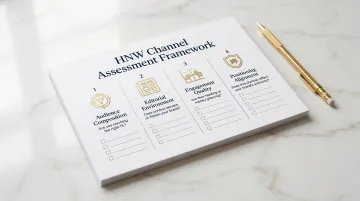
Assess potential channels using these criteria:
- Prioritize audience composition over volume — 10,000 HNW readers outperforms 100,000 general consumers
- Evaluate editorial environment — does the context elevate your brand or flatten it alongside mass-market advertisers?
- Measure engagement quality — click-through depth and time spent matter more than raw impressions
- Check positioning alignment — does the channel reinforce the prestige your product commands?
How to Measure Content Performance for Luxury D2C
Standard content marketing KPIs—page views, social reach, follower growth—measure volume, not quality. For HNW-focused brands, the goal is depth of engagement and conversion quality.
Metrics That Matter
Depth of engagement:
- Time on page and scroll depth (indicating long-form content consumption)
- Return visitor rate (indicating brand affinity)
- Email open and click-through rates for curated content (Business + Finance benchmark: 31.35% open, 2.78% click)
Conversion quality:
- Average order value (AOV)
- Customer lifetime value (CLV)
- Repeat purchase rate
Bain's VIC data shows 2% of customers drive 45% of purchases. That means content ROI should be measured through CLV-linked attribution focused on top-tier segments, not aggregate traffic.
Content-assisted conversions:
- Track content viewed before purchase
- Segment buyers by content touchpoints to identify which editorial pieces correlate with high-value customers
- Use post-purchase surveys to understand discovery and evaluation paths
HubSpot reports that automated email flows generate up to 30x more revenue per recipient than one-off campaigns. For luxury D2C brands, this makes lifecycle-triggered content one of the most directly measurable channels in the mix.
Frequently Asked Questions
How much do luxury brands spend on marketing?
Luxury brands allocate 20-30% of annual revenue to marketing initiatives, with luxury fashion sometimes exceeding 30%. This compares to 5-10% for mid-tier or high-street brands. Spending prioritises content quality and channel selectivity over volume.
How do you write content for a luxury brand?
Lead with story, craft, and emotional resonance rather than product features or promotional language. Tone should be authoritative but never distant. Every piece should reinforce brand identity—not just products—and treat the reader as an intelligent insider.
How to advertise a luxury brand?
Prioritise context and audience quality over reach. Avoid platforms or placements that feel mass-market or intrusive. Use channels where HNW audiences encounter content they trust—premium editorial, curated newsletters, and private networks—rather than algorithmic feeds.
What are the 7 P's of luxury brand marketing?
For D2C luxury brands, the two most consequential P's are Place and Physical Evidence. Without a retail environment to convey prestige and atmosphere, content carries both jobs: it signals where the brand belongs and makes the experience feel tangible before purchase.
What is the 70/20/10 rule in content marketing?
The framework allocates 70% to proven core content, 20% to innovative formats, and 10% to experimental work. Luxury D2C brands should weight toward fewer, higher-quality core pieces—publishing cadence is itself a brand signal to HNW audiences.