This article covers what separates luxury advertising from standard marketing, who today's luxury consumer actually is, six proven strategies, how to choose channels that protect brand prestige, and the mistakes that quietly erode it.
Key Takeaways
- Luxury advertising sells identity and aspiration, not products or prices
- Millennials now account for ~46% of luxury spending; Gen Z follows at ~20%
- Six core strategies covered: storytelling, scarcity marketing, influencer partnerships, experiential campaigns, personalization, and aspirational content
- Channel choice is itself a brand signal — where you advertise communicates what you are
- Common pitfalls to avoid: competing on price, over-broadcasting to the wrong audiences, and letting media placement undercut the brand
What Makes Luxury Brand Advertising Different
Mass-market advertising sells products. Luxury advertising sells identity — and that distinction shapes every creative, channel, and messaging decision a luxury brand makes.
The message is rarely about price. Heritage, craftsmanship, and rarity do the work instead. Research from ScienceDirect confirms what luxury marketers know intuitively: luxury products function as social signals, communicating wealth and achievement precisely because they are expensive and exclusive. Price, when mentioned at all, is incidental.
Exclusivity as Strategy, Not Limitation
Scarcity isn't a supply constraint. It's a deliberate marketing lever. Limited editions, invitation-only communications, and restricted availability protect perceived value by making access feel earned rather than purchased. When Bain reported that more than 50% of consumers now consider luxury overpriced, the underlying problem wasn't price; it was that exclusivity had been diluted by over-distribution.
That erosion of exclusivity is precisely why luxury brands need a coherent strategic framework — not just a set of tactics.
The 4E Framework
Luxury brand strategist Daniel Langer's 4E model provides one:
- Emotion — Every touchpoint should create a felt response, not just an impression
- Experience — The interaction with the brand matters as much as the product itself
- Engagement — Sustained relationship-building over transactional campaigns
- Exclusivity — Access must feel selective and meaningful at every level
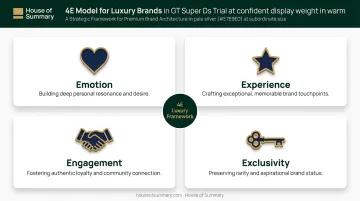
The 4E model replaces the traditional 4P framework because affluent consumers don't respond to price-place-product logic. They respond to meaning.
Understanding the Modern Luxury Consumer
The luxury buyer base has shifted. While high-net-worth individuals remain the core, the next wave is younger and more digitally native than most heritage brands anticipated.
According to Bain's 2025 research, Millennials accounted for approximately 46% of total luxury spending in 2025. Statista places Gen Z's contribution at 20% — meaning these two generations together now represent the majority of the market. That's a structural shift, not a trend.
What Motivates Affluent Buyers
GWI's affluent consumer data reveals motivations that go beyond product quality:
- Want visible differentiation — they buy to stand out, not just to own
- Are 27% more likely (GWI) to purchase a product specifically to access the community around it
- Respond to premium access — exclusive content and services matter as much as the goods themselves
- Prioritize experience over ownership, especially among younger affluent segments
Generational Differences That Shape Messaging
Those motivations don't land the same way across age groups. The same premium positioning that resonates with a 55-year-old executive can fall flat — or even backfire — with a 28-year-old Gen Z buyer:
- Older affluent buyers — Value craftsmanship, heritage, and proven quality
- Millennials — Status-conscious but increasingly purpose-driven; respond to brand values alongside aesthetics
- Gen Z — Digitally native, experience-first, and skeptical of traditional luxury signaling. Bain notes that luxury NPS scores run 25 to 30 points lower among Gen Z than Millennials — a credibility gap brands must address
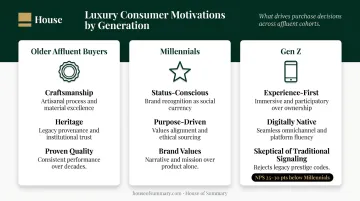
That 25-to-30-point NPS gap is a channel and messaging problem as much as a product one. Reaching Gen Z requires different creative, different platforms, and a fundamentally different value proposition than what works for older cohorts.
Core Advertising Strategies for Luxury Brands
1. Brand Storytelling and Identity
Heritage is a luxury brand's most defensible asset, but only when it's communicated consistently. Every creative execution — from packaging to digital copy to event design — should reinforce the same narrative. Chanel's origin story, built around Coco Chanel's rejection of constraint, appears in everything from fragrance campaigns to runway presentations. The story doesn't change; only the medium does.
Consistency matters more than creativity here. A single off-brand execution — a tone-deaf social post, a discount email, a low-production visual — can break trust with an audience that has high expectations.
2. Exclusivity and Scarcity Tactics
Scarcity creates urgency without requiring a price promotion. Louis Vuitton's Paris 2024 Olympics partnership is a textbook example: the house created two Medals Trunks and two Torches Trunks for the Olympic and Paralympic Games, each meticulously crafted to carry up to 468 medals. The trunks weren't for sale. They existed purely as an expression of craftsmanship at the highest possible stage — the global broadcast of the Games. The commercial value came entirely from the cultural statement.
Tactics that work at smaller scale:
- Limited-edition product releases with defined quantities
- Invitation-only launches or previews for existing clients
- Early access programs for top-tier loyalty members
3. Influencer and Celebrity Partnerships
Celebrity endorsements reach broadly but can feel transactional. The more effective approach for many luxury categories — particularly watches, jewellery, and niche fashion — is partnerships with genuinely knowledgeable, highly engaged voices.
Luxury watch brands, for example, have shifted toward Millennial and Gen Z influencers to build more personal consumer relationships, according to Launchmetrics research. The key criterion isn't follower count — it's whether the partner's existing content, values, and audience genuinely align with the brand's world. An authentic collector with 80K engaged followers often delivers more credibility than a celebrity with 10 million passive ones.
4. Experiential Marketing
Luxury consumers increasingly measure brand affinity through what they experience, not what they own. VIP dinners, private previews, and pop-up activations create emotional imprints that no banner ad replicates.
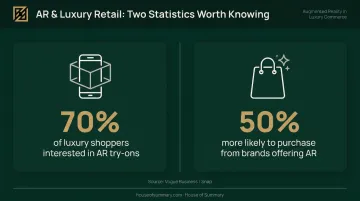
Digital extensions — AR try-ons, virtual showrooms, and immersive online brand environments — carry the same logic into digital spaces. Vogue Business and Snap research found that 70% of luxury shoppers are interested in using AR to try on products, with 50% saying they'd be more likely to purchase from a brand offering AR experiences.
The invitation-only nature of offline events also amplifies social sharing organically. Attendees post because they want to signal access, not because they were prompted to.
5. Personalization
Where experiential marketing creates shared moments, personalization creates individual ones. Affluent consumers don't want to feel like a segment — they want to feel known. Personalization at the luxury level means:
- Made-to-order or bespoke product options
- Purchase history used for individualized recommendations, not mass email blasts
- Communications that reference a customer's specific preferences and history
This signals respect for the customer's taste. It also deepens loyalty — because once a brand demonstrates it understands you, switching to a competitor that doesn't feels like a step down.
6. Aspirational Content Creation
The goal is to invite audiences into a world where the product belongs, not simply to show the product. Bentley's content doesn't sell specifications — it sells a vision of who drives a Bentley and where they go. Louis Vuitton's campaigns sell the journey, not the luggage.
Production quality is non-negotiable. Amateur-looking content actively undermines brand equity. High-net-worth consumers have finely tuned visual taste; anything that looks cheap reads as cheap, regardless of the product's actual quality.
What this means in practice:
- Invest in professional photography, cinematography, and art direction
- Maintain consistent visual language across every channel
- Treat every content touchpoint as a brand impression, not just a conversion opportunity

Choosing the Right Channels for Luxury Advertising
Where a brand advertises says as much about its quality as what it advertises. Appearing alongside low-quality, algorithmically chaotic content dilutes prestige — even if the creative itself is exceptional.
Traditional and High-Prestige Environments
Premium print placements, out-of-home in affluent neighborhoods, and broadcast alongside trusted editorial content all carry a trust halo. The IAB found that 84% of consumers say advertising within news increases or maintains brand trust, with perceived brands rated 46% higher on quality in news environments versus other contexts.
Digital Presence Without Brand Compromise
McKinsey's research shows that nearly 80% of luxury sales are digitally influenced, making digital presence essential. But the risk is real: GWI data shows affluent consumers are 14% more likely than average to block ads regularly. Programmatic display and social feeds expose brands to poor adjacency, ad-blocker invisibility, and algorithmic unpredictability.
The answer is selective: choose curated, high-intent digital environments rather than broad reach.
Newsletter Advertising as a Premium Channel
Newsletter advertising is underused by luxury brands, but the logic for it is strong. Newsletters like those in the House of Summary network cover global politics, business, and city-specific content across the US, UK, and UAE. Brand messages reach subscribers who opted in — in an inbox environment free from:
- Ad blockers and algorithm filtering
- Competing visual noise from adjacent content
- Algorithmic unpredictability around placement
House of Summary's network reaches 500,000+ subscribers, generating 254,866+ emails opened daily, with readership concentrated in New York, Los Angeles, London, and Dubai — four of the highest luxury-spending markets globally. The audience skews toward C-suite executives, HNWIs, and senior decision-makers: exactly the profile luxury brands need to reach efficiently.
Email also delivers measurably stronger engagement than display. Mailchimp benchmarks average email click rates at around 2.62%, compared to roughly 0.46% for Google Display Ads — a gap that compounds across a sustained campaign. BSH Hausgeräte's CEO reported click-through rates 4x higher than Google AdWords from their Dubai Summary campaign, attributing the result to editorial alignment and audience quality.
Cross-Channel Integration
No single channel carries a luxury campaign alone. The most effective approaches stack touchpoints with intent:
- Print and OOH for prestige and scale
- Premium editorial and newsletter for high-intent engagement
- Experiential for emotional imprint
- Social for cultural visibility and organic reach
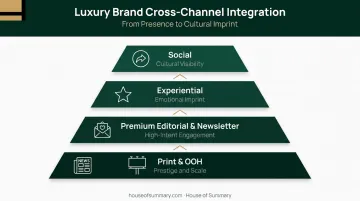
Each channel reinforces the same brand story. Consistency across those contexts is what converts recognition into trust.
Common Mistakes in Luxury Brand Advertising
Competing on price. Discounts signal to the market that a product isn't worth its full price. Bain estimates the luxury sector lost approximately 50 million customers between 2022 and 2024, partly because price increases outpaced perceived value gains. Stronger creative that justifies the premium is what closes that gap — not lower prices.
Leading with product features. Affluent buyers aren't reading spec sheets. They're buying into a feeling, a lifestyle, a sense of who they are when they use this brand. Advertising that leads with technical details misses the emotional driver entirely.
Over-broadcasting across every platform. Appearing everywhere cheapens exclusivity. Luxury brands should be selective enough about where they advertise that being featured in that environment feels like a curation decision, not a media buy. Over-saturation on low-quality platforms is as damaging as inconsistent quality.
Ignoring sustainability and values alignment. Gen Z and Millennial luxury buyers actively evaluate brand ethics. Stella McCartney built sustainability into its brand identity from the start, and the resonance with younger buyers is measurable. Brands that ignore this dimension risk losing the segment that will dominate luxury spending going forward.
Emerging Trends Reshaping Luxury Advertising
Four shifts are redefining how luxury brands reach audiences — and where the growth is actually coming from.
- Technology as a creative tool. Etro's SS24 campaign, developed with digital artist Silvia Badalotti, used AI imagery around the concept of "Nowhere" — treating technology as a creative device, not a production shortcut.
- Experiential spending outpacing products. Bain reports luxury experiences grew 5% in 2024, with luxury cruise up 30% and fine dining up 8%. By 2025, luxury hospitality reached €251 billion. Brands building experiences are capturing demand that products alone can't hold.
- Online luxury finding its floor. Bain places online luxury share at 21% in 2025, with steady growth ahead. Digital channels are adding reach without eroding the exclusivity that defines the category.
- Culture and sport as brand stages. Louis Vuitton's Olympic partnership showed how global moments can amplify a luxury brand — provided the execution is grounded in craft rather than logo visibility.
Frequently Asked Questions
What makes luxury brand advertising different from regular marketing?
Luxury advertising sells identity and aspiration rather than product features or price points. The goal is emotional resonance — creating desire through storytelling, curated experiences, and exclusive access rather than through value propositions or promotional offers.
How do luxury brands maintain exclusivity while advertising at scale?
Through deliberate scarcity: limited editions, invitation-only events, selective channel choices, and curated digital content. Privilege needs to be embedded in how audiences encounter the brand — in the channels, the tone, the access — not only in what's available for sale.
Which advertising channels work best for luxury brands?
High-prestige editorial environments — premium print, trusted news broadcast, and curated email newsletters — consistently outperform programmatic display for luxury. Channel choice itself communicates brand quality, making context as important as creative.
How important is storytelling in luxury brand advertising?
Luxury consumers buy into a heritage, a world, and an identity — not a product spec sheet. Advertising without a compelling narrative generates impressions, but impressions don't convert in this category. Connection does.
What are the biggest mistakes luxury brands make in advertising?
The most common mistakes include:
- Competing on price instead of perceived value
- Over-distributing across non-premium or misaligned platforms
- Leading with product features rather than brand experience
Each of these undercuts the exclusivity and emotional weight that luxury advertising requires to be effective.
How can luxury brands reach Gen Z and Millennial consumers effectively?
Through experiential and phygital marketing (blending physical and digital touchpoints), micro-influencer partnerships with genuinely aligned audiences, sustainability messaging, and digital content that speaks to experience-first values. Traditional status signaling alone doesn't resonate with these audiences.