
The stakes are high. Fintech customer acquisition costs average $200–$300 per user through paid channels, and in competitive verticals like lending or investing, that figure climbs considerably higher. Meanwhile, dozens of apps compete for the same users with near-identical feature sets.
This article covers what separates fintech campaigns that convert from those that just generate impressions — from the regulatory constraints that shape creative decisions, to the specific campaigns worth studying, to the channels that deliver results for different audience types.
Key Takeaways
- Fintech marketing operates under strict regulatory constraints (FTC, CFPB, YMYL) that limit creative freedom but reward transparency
- Education-led content, referral programs, and community activation outperform pure awareness plays
- The best campaigns anchor a real product truth to a cultural moment or shared frustration, letting the product speak for itself
- Multi-channel execution is non-negotiable; no single tactic wins alone
- Every tactic — from referral incentives to compliance-forward copy — ultimately exists to earn and hold customer trust
What Makes Fintech Marketing Uniquely Challenging
The Trust Deficit
Financial products ask something no consumer goods brand ever does: hand over your money and your data to a company you probably encountered through an ad. That's a fundamentally different ask, and it raises the bar for every creative decision.
When a new shampoo brand overpromises, the downside is a bad hair day. When a fintech brand overpromises — on returns, fees, security, or approval rates — the consequences are financial and sometimes legal. Users know this, which is why skepticism is the default.
This trust gap means a compelling headline won't move a fintech prospect. Users need to feel confident the brand is legitimate, regulated, transparent about costs, and competent to handle their money — before they'll take any action at all.
The Regulatory Layer
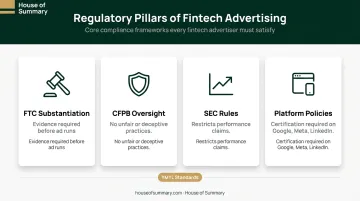
Fintech advertising falls under YMYL (Your Money or Your Life) standards, which means every marketing claim is held to a higher evidential threshold. In practice, this involves:
- FTC substantiation requirements — all advertising claims must be backed by reliable evidence before the ad runs
- CFPB oversight on unfair, deceptive, or abusive practices in financial promotion
- SEC rules for investment-related advertising, including restrictions on performance claims
- Platform-specific policies on Google, Meta, and LinkedIn that require certification for financial ad categories and restrict certain claim types entirely
Superlatives, performance guarantees, and comparison claims all require substantiation. Disclaimers are mandatory. This doesn't eliminate creativity, but it channels it — fintech brands that win tend to focus on emotional resonance and brand identity rather than unverifiable product claims.
The Differentiation Problem
When dozens of apps offer payments, lending, and investing with equivalent feature sets, marketing must do identity work, not just product communication. Features can be copied; brand personality is harder to replicate. This is why campaigns from Revolut, Klarna, and Cash App invest heavily in cultural positioning — their campaigns define how users feel about money, not just which app they use to move it.
Proven Fintech Advertising Strategies
Educating to Convert: Content and Financial Literacy Marketing
In fintech, education is the primary conversion mechanism. Users who don't understand a product — or don't trust the company offering it — won't sign up regardless of how compelling the ad is. The friction lives upstream of the signup page, which is where content marketing operates.
Leading fintechs build content programs designed to reduce that friction before a user ever encounters a CTA:
- Explainer content that demystifies complex products (how index funds work, what APR actually means)
- Comparison pages that help users evaluate options honestly — including competitors
- Financial literacy guides that position the brand as a resource, not just a vendor
- Webinars and live Q&A that demonstrate expertise and build personal connection
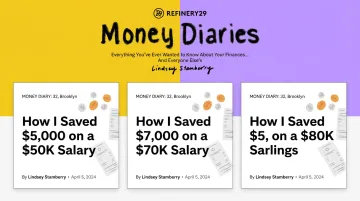
Wealthsimple executed this better than most. Their Money Diaries series and editorial magazine didn't explain their investment products — they humanized financial anxiety. The content covered how real people think about money, the emotions around debt and wealth, and the cultural narratives that shape financial behavior. By normalizing money conversations for a millennial audience, Wealthsimple built emotional connection before the product conversation even started. Users arrived at the signup page already aligned with the brand's values.
Influencer Partnerships and Celebrity Campaigns
Celebrity and influencer marketing works differently in fintech than in consumer categories. The goal isn't reach — it's borrowed credibility. When a trusted or recognizable figure vouches for a financial product, they're lending their reputation to reduce the skepticism that new fintech brands face by default.
What makes these partnerships succeed in fintech specifically:
- Value alignment over follower count — the influencer's audience must overlap with the brand's target user
- Clear product truth — the creative still needs to communicate something real about the product, not just celebrity association
- Sustained commitment — one-off posts don't transfer trust; consistent, integrated partnerships do
Klarna's celebrity campaigns show what brand-led consistency looks like in practice. Their Snoop Dogg campaign introduced the brand's playful identity; the Paris Hilton partnership extended the same Y2K-era nostalgia aesthetic while reaching a new demographic cohort. Neither campaign felt like a product demo — both felt like cultural participation, with Klarna as the brand that belonged there.
Nuvei took a different approach with Ryan Reynolds, bringing humor-led celebrity marketing into B2B fintech — a space with almost no precedent for this kind of creative. Reynolds' ownership stake in Nuvei made the campaign feel authentic rather than transactional, and the self-aware humor cut through the typically dry B2B financial content landscape.
Viral Stunts and Out-of-Home Campaigns
The strategic logic behind guerrilla fintech marketing is straightforward: abstract digital products need physical anchors. A stunt that earns media coverage creates awareness at a fraction of the cost of paid media — and the earned coverage carries credibility that ads can't buy.
WePay's 2010 stunt at a PayPal developer conference is the clearest archetype. They dropped a 600-pound block of ice filled with cash and credit cards in front of the venue, printed with "PayPal Freezes Accounts — Keep Your Money Moving, Use WePay." It worked because it was accurate: PayPal's account freezing was a genuine, documented pain point, and the stunt aligned directly with WePay's value proposition. Site traffic spiked measurably that day.
What made it work — and what separates effective fintech stunts from gimmicks:
- Targets a real, specific competitor pain point rather than a vague category claim
- Physically demonstrates the product's value in a single, legible image
- Generates earned media that extends the stunt's reach beyond attendees
- Timing tied to a moment the target audience is already paying attention to
Airwallex applied this same logic at scale in 2025. Their "Future of Finance" OOH campaign took over 930 screens across Australia, timed to McLaren's F1 race victory — a cultural moment Airwallex could claim credibly through their actual payments partnership with McLaren Racing.
The screen takeover, paired with a high-production video series showing legacy financial systems being physically destroyed, created brand impression that purely digital campaigns rarely achieve.
Referral Programs and Community-Led Activation
Referral marketing in fintech carries more weight than in consumer apps because the trust being transferred is higher-value. A friend recommending a restaurant is one thing; a friend recommending where to put their savings is something else entirely.
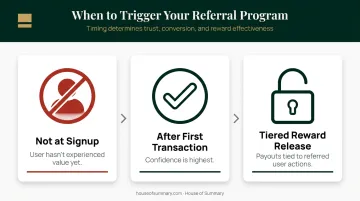
Effective fintech referral programs account for this by timing the trigger carefully:
- Not at signup — the referring user hasn't yet experienced the product value
- After the first successful transaction or when a savings milestone is reached — when confidence is highest
- With tiered reward release — payouts that unlock only after the referred user completes a meaningful action (funding an account, completing a transaction) rather than just registering
Revolut built much of its early growth through referral mechanics timed to genuine product moments, combined with waitlist exclusivity that made users feel they were accessing something other people wanted.
Community-led activation extends this further: gated financial literacy cohorts, investment education challenges, or savings programs that build engagement and then convert organically when participants hit meaningful milestones. By that point, the product is the logical conclusion — not a separate sales pitch.
Fintech Marketing Campaigns Worth Studying
Campaigns That Challenged the Status Quo
Current's NYC Subway Campaign: "What Do You Think We Are, A Bank?" used consumer frustration with traditional banking as its entire hook. The meme-friendly phrasing made it inherently shareable, and the timing — during stimulus payment debates and coverage of essential workers — gave it cultural resonance beyond its media placement.
The subway format was strategic: commuters had nothing else to look at, and the irreverent tone fit the New York context perfectly.
Airwallex's Dual Strategy: The "Future of Finance" video series combined high-production creative — legacy financial systems being physically dismantled — with their 930-screen OOH takeover tied to the McLaren F1 cultural moment. The approach is instructive: bold brand-building content plus a timely, credible event partnership, running across channels simultaneously rather than betting on one format.
TransferWise's "The Party's Over": Rather than explain their product, TransferWise made an entertainment-first piece that positioned traditional banking's dominance as something that had simply run its course. Humor and storytelling carried the disruption message without ever feeling like a product demo — which is why it worked as entertainment rather than advertising.
Campaigns That Built Connection Through Identity
Cash App commissioned a two-minute cinematic short starring Timothée Chalamet that premiered in cinemas before major blockbusters — an ad that positioned itself as a cultural artifact rather than a media placement. The decision to debut in physical cinemas signaled where premium fintech creative is heading: brands competing for cultural status, not just share of voice.
SoFi's "Face of Finance": SoFi built an entire campaign around AI image generation bias — when asked to show "financially successful" people, AI systems produced images that were only 2% women. Rather than run a generic diversity campaign, SoFi used a concrete, demonstrable data point to build a cause-led narrative.
The result drove event participation and positioned the brand as values-aligned without making the cause feel performative.
Each campaign here led with a human story, cultural observation, or shared frustration — and the product appeared as the natural resolution, not the headline.
The Best Channels for Fintech Advertising
Paid Search and Social
Paid search targeting high-intent financial queries — "open business checking account," "best investing app" — delivers qualified traffic but at significant cost. Financial services keywords are among the most expensive in Google Ads, and compliance requirements mean ad copy must be pre-approved and carefully substantiated.
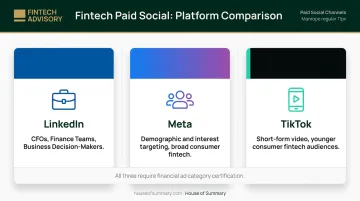
On social, three platforms dominate fintech campaigns:
- LinkedIn — B2B fintech targeting CFOs, finance teams, and business decision-makers
- Meta and TikTok — consumer fintech, where demographic and interest targeting matters more than professional profile
- All three require category certification for financial ads; violations risk account suspension
SEO and Content Distribution
Organic search in fintech targets YMYL queries where Google's quality standards require demonstrated E-E-A-T: expert authorship, cited data, authoritative backlinks. This isn't a quick-win channel — it's trust infrastructure.
A well-built fintech content library takes 6–12 months to gain traction in rankings. When it does, it delivers qualified traffic at near-zero marginal cost and positions the brand as a credible resource rather than an advertiser.
OOH, Sponsorships, and Event Marketing
Physical channel presence gives fintech brands something digital-only campaigns can't replicate: persistent visibility in offline environments. Nutmeg's London Underground campaign worked partly because commuters had no phone signal — the ad held undivided attention in a way that scroll-past digital placements never achieve. PensionBee's Brentford FC sponsorship built recognition in a demographic (football fans, working-age adults) that maps directly to pension product users.
For B2B fintech, conference presence and event sponsorship serve a similar function. Showing up at industry events signals longevity and seriousness in ways that paid digital placements don't.
Newsletter Advertising
Newsletter advertising offers structural advantages that paid search and social can't match:
- No ad blockers — email ads reach subscribers' inboxes regardless of browser extensions
- No algorithmic interference — placement is guaranteed, not subject to platform bidding changes
- Opt-in attention — subscribers chose to receive the publication, so attention is engaged from the first line
For fintech brands targeting finance professionals, executives, and business decision-makers, the audience quality in specialized newsletters is difficult to replicate through programmatic channels. House of Summary's newsletter network — reaching 500,000+ subscribers across Presidential Summary, Geopolitical Summary, Dubai Summary, and London Summary — serves exactly this profile: decision-makers, executives, and high-income professionals concentrated in New York, Los Angeles, London, and Dubai.
For fintech brands targeting wealth-concentrated metros and HNW professionals, that concentration is harder to achieve through broad digital buys — income and seniority targeting in programmatic remains unreliable. Newsletter placements appear within editorial content readers already trust, which directly shapes how financial brands are perceived.
What the Best Fintech Campaigns Have in Common
Three patterns appear across every campaign worth studying here.
Creative grounded in product truth. The strongest campaigns in this list didn't manufacture a story — they found one. WePay's stunt worked because account freezing was a genuine PayPal problem. SoFi's AI bias campaign worked because the data was real. Cash App's Chalamet film worked because it reflected the brand's cultural positioning authentically. Buzz without product truth stops at awareness; conversion requires the user to believe the brand actually delivers something.
Multi-channel execution by default. No single tactic in this list won in isolation. WePay's stunt had a landing page. Current's subway ads had social amplification. Cash App's film premiered in cinemas before going digital. Klarna's celebrity campaigns ran across TV, OOH, and social simultaneously. Reach came from integration, not from one brilliant placement.
Trust-building as the underlying goal. Whether through education (Wealthsimple), transparency (Current), cultural cause (SoFi), or social proof (Klarna), every campaign was doing the same foundational work: convincing a skeptical audience this brand is legitimate, credible, and worth handing money to. Fintech marketers who optimize for short-term conversion at the expense of trust tend to acquire users who churn quickly and refer nobody.
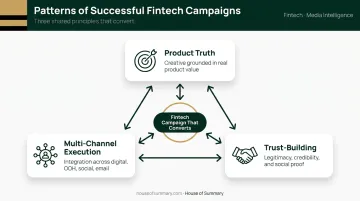
All three patterns converge on one question worth asking before any campaign launches: does this build trust, or does it borrow it? If the honest answer is neither, conversion is unlikely.
Frequently Asked Questions
What is fintech advertising?
Fintech advertising refers to the marketing and promotional activities used by financial technology companies to attract users, build brand trust, and drive product adoption. It spans digital, OOH, content, influencer, and email channels, and typically operates under strict regulatory requirements from bodies like the FTC, CFPB, and SEC.
What are the main types of advertisements used in fintech?
The primary ad types are paid search, paid social, display/programmatic, out-of-home, influencer and sponsored content, video, and newsletter/email advertising. Fintech brands typically run combinations rather than single-channel campaigns, with channel mix depending on whether the product is B2B or consumer-facing.
What makes a fintech marketing campaign successful?
Successful campaigns combine a clear product truth with emotional or cultural resonance, execute across multiple channels simultaneously, and prioritize trust-building over pure awareness generation. Campaigns that disconnect creative from the actual product tend to generate impressions without conversion.
How do fintech companies build trust through marketing?
The main mechanisms are educational content that demonstrates genuine expertise, social proof through reviews and testimonials, full fee and feature transparency, and compliance-forward messaging that reassures users about data and money security. Sustained consistency across all these signals matters more than any single tactic.
What are the biggest challenges in fintech advertising?
The three primary challenges are high customer acquisition costs (averaging $200–$300 per user in paid channels), strict regulatory and compliance requirements that limit creative freedom, and baseline consumer skepticism that makes trust-building a prerequisite for conversion rather than an afterthought.
How can smaller fintech companies compete with large brands in marketing?
Focus on niche audiences where you can own the conversation rather than compete on volume. Lean into organic channels like SEO and educational content, leverage referral programs timed to genuine product milestones, and prioritize high-engagement targeted channels (such as specialized newsletters) over expensive broad-reach media buys where larger budgets will always outpace you.