But banking advertising faces a challenge most industries don't. Financial decisions carry real stakes — mortgages, savings accounts, credit cards — meaning consumers research carefully before they act. They need to trust who they're choosing. That trust requirement, layered on top of strict regulatory constraints and fierce competition from fintechs, means the right advertising strategy is about far more than impressions. It's about relevance and credibility.
This article breaks down the top banking advertising trends reshaping the industry, what's driving them, and the practical tips that separate campaigns that convert from those that just cost money.
Key Takeaways
- AI-powered personalization and behavioral targeting are replacing generic demographic campaigns for financial brands.
- Content marketing — calculators, educational tools, branded financial guidance — has become a core advertising strategy, not an optional extra.
- Gen Z and Millennials — now primary buyers of mortgages, auto loans, and credit cards — demand mobile-first, values-aligned messaging.
- Newsletter advertising is gaining ground as a high-trust, ad-blocker-proof channel that reaches executives and high-income professionals at scale.
- Google and Meta's financial advertising restrictions are pushing banks toward premium channels with fewer targeting constraints.
Key Advertising Trends in Banking Content
Consumer behavior, platform shifts, and new technology have remade the landscape for bank marketers. Here are the five trends driving the biggest changes in how financial brands reach and convert customers.
Trend 1: Hyper-Personalization Powered by AI and Behavioral Data
Banks are now using behavioral and transactional data to serve ads that match where a customer actually is in their financial journey — retargeting someone who browsed mortgage rates, reaching a user who searched for high-yield savings, or identifying a likely auto loan seeker based on browsing patterns.
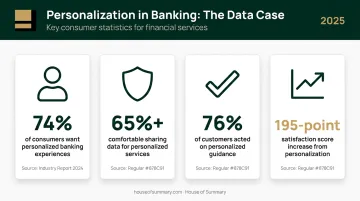
The data backs this up. According to a Q2 consumer survey, 74% of consumers want more personalized banking experiences, and more than 65% are comfortable with their financial institution using their data to deliver them. When banks do provide personalized guidance, the impact is measurable: J.D. Power found that 76% of customers who received personalized guidance acted on it — and doing so increased satisfaction by 195 points on a 1,000-point scale.
13% of retail bank customers said they're likely to switch banks in the next 12 months, and fewer than half were certain they'd stay. In that environment, personalization isn't just a creative choice — it's a retention mechanism.
Behavioral targeting now extends to mortgage shoppers, auto loan seekers, deposit-focused consumers, and bank switchers, with providers like Experian offering approximately 400 financial audience segments activatable across social, CTV, mobile, display, and email.
Trend 2: Omnichannel Campaigns That Follow Customers Across Touchpoints
Banking is a multi-channel relationship — and advertising needs to reflect that. According to the ABA's 2025 national survey, 54% of bank customers use mobile apps as their primary banking method, with online banking second at 22% and branch visits at 9%.
That's not a case for digital-only advertising — it's a case for integrated campaigns. Customers still walk into branches, still respond to mail, still watch TV. The most effective banking campaigns coordinate messaging across:
- Social media (Meta, TikTok, LinkedIn) for awareness and targeting
- OTT/CTV for high-quality video at scale across streaming platforms
- Mobile ads for in-app and location-based placements
- In-branch experiences reinforcing the same messaging seen online
Social Mirror Ads and OTT placements have emerged as strong performers in this mix — they deliver premium video and display creative across devices with behavioral targeting built in, bridging the gap between digital reach and high-quality ad formats.
Trend 3: Content Marketing as the New Banking Advertisement
The most forward-thinking financial institutions have stopped leading with products and started leading with value. Bank of America's Better Money Habits platform is the clearest large-scale example: a financial education destination covering savings, homebuying, credit, and retirement — with no sales pitch at the front door.
Content that helps someone understand their mortgage options, calculate how much they should save, or learn about credit scoring builds the kind of trust that converts — without the friction that comes from hard-sell creative.
This approach spans multiple formats:
- Educational articles and financial calculators tied to specific life stages
- Branded podcasts hosted by credible financial voices
- Financial literacy resources offered by credit unions and community banks
- Creator partnerships by fintech brands targeting younger audiences
Consumers don't buy financial products impulsively — they research. Content that shows up during that process and actually helps earns trust that a banner ad never will.
Trend 4: Newsletter and Inbox Advertising as a Premium Finance Channel
As ad fatigue grows across social and programmatic channels, inbox advertising is gaining serious traction for financial brands. The appeal is structural: email reaches readers directly, bypasses algorithm interference, and lands in an environment where ad blockers simply don't apply.
The audience quality in financial newsletters is also worth noting. Publications targeting executives, policy professionals, and high-income consumers — like those in the House of Summary network — attract exactly the decision-makers that banking advertisers need to reach.
With 500,000+ subscribers and 254,866+ emails opened daily across Presidential Summary, Geopolitical Summary, Dubai Summary, and London Summary, the platform gives financial advertisers access to affluent professionals concentrated in New York, Los Angeles, London, and Dubai. Advertisers on the platform have reported click-through rates 4x higher than Google AdWords.
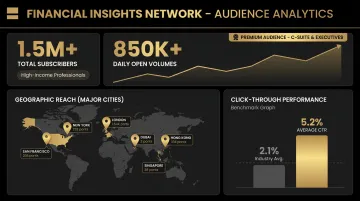
Mailchimp's benchmark data puts business and finance email open rates at 31.35% with a 2.78% click rate — strong by any digital standard. Meanwhile, nearly 60% of U.S. consumers use some form of ad blocker or anti-tracking software, meaning newsletter placements guarantee visibility that web display cannot.
For banking brands facing tight restrictions on Google and Meta, newsletter channels offer an additional advantage: fewer platform-level targeting constraints and a brand-safe editorial environment aligned with premium financial messaging.
Trend 5: Targeting Gen Z and Millennials With Authentic, Values-Aligned Messaging
Younger audiences represent the incoming wave for mortgages, auto loans, and credit cards — and they're the hardest segment to reach with traditional bank advertising. Deloitte research confirms that Gen Z and Millennials carry the highest bank-switching risk of any generation. Their expectations were shaped by fintech — fast, mobile-first, transparent — and legacy institutions that don't match that experience get bypassed.
The homeownership angle is telling: 63% of Gen Z said they planned to purchase a home in 2024, according to a ServiceLink survey cited by National Mortgage News. That's a massive addressable audience — but reaching them requires a different creative approach:
- TikTok and Instagram over traditional display — more than two-thirds of Gen Z report making purchase decisions based on TikTok content
- Influencer and creator partnerships that feel peer-to-peer rather than institutional
- Transparency-forward messaging around fees, rates, and how the bank actually works
- Community and sustainability signals that align with what younger consumers value in brands they trust
That creative shift matters because the trust gap is real. Morning Consult data shows banks sit at 66% trust among U.S. adults, while fintechs lag at 37%. Banks that communicate authentically — rather than just transactionally — close that gap with younger audiences faster.
What's Driving These Banking Advertising Trends
These shifts aren't random. Several forces specific to banking are behind them.
AI adoption is the most significant accelerant. S&P Global reported that 54% of financial services companies had deployed AI initiatives by January 2025, up from 40% a year earlier. Banks are using it to segment audiences with precision, automate personalization at scale, and identify likely switchers before they leave.
Consumer behavior is reinforcing the shift. Chase's 2024 Digital Banking Attitudes Survey found 78% of U.S. consumers use their mobile banking app weekly, with 62% saying they couldn't live without it. Digital-first advertising isn't a strategic preference — it's a response to where customers actually are.
Then there's the competitive pressure. With fintechs offering competitive rates and frictionless onboarding, loyalty is more fragile than most banks want to admit. J.D. Power data shows only 46% of retail bank customers were certain they'd stay with their current bank — a real vulnerability for institutions that still treat advertising as a pure acquisition channel.
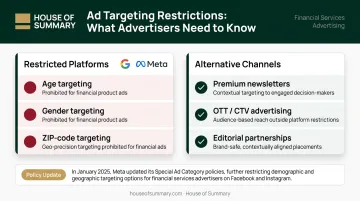
Regulatory and platform constraints are also reshaping where budgets go. Three specific restrictions have pushed banks toward alternative channels:
- Google prohibits age, gender, and ZIP-code targeting for consumer finance ads in personalized advertising
- Meta removed those same targeting options for U.S. financial products entirely as of January 2025
- Both restrictions push spend toward channels — premium newsletters, OTT, editorial partnerships — where targeting flexibility and brand-safe environments coexist
Tips for Advertising Banking Content Effectively
Knowing the trends is step one. Execution is where most campaigns win or lose.
Tip 1 — Lead with value, not a sales ask. Financial decisions are high-stakes and research-heavy. Ads that open with a useful tool, educational content, or financial guidance consistently build stronger brand credibility than direct-sell creative. A mortgage calculator landing page outperforms an "Apply Now" banner because it gives prospects a reason to engage before committing.
Tip 2 — Pair precise targeting with a single clear CTA. Regardless of channel, effective banking ads combine:
- Behavioral and contextual targeting matched to where the customer is in their decision
- Creative tailored to each audience segment (don't run mortgage ads to Gen Z renters)
- A direct, specific CTA — "See your rate," "Open in 5 minutes," "Start saving today"
Vague CTAs and mismatched audience-creative pairings are the most common reasons banking campaigns underperform despite solid reach.
Tip 3 — Choose channels based on audience fit, not cost efficiency. High-intent, high-income audiences respond to premium environments: financial newsletters, editorial sponsorships, OTT placements. Younger audiences respond to mobile-first, social-native formats. The biggest mistake financial marketers make is choosing channels based on CPM efficiency rather than audience fit — a cheap impression that reaches the wrong person at the wrong moment converts at near-zero.
Future Signals for Banking Advertising to Watch
A few developments will reshape banking advertising over the next one to three years.
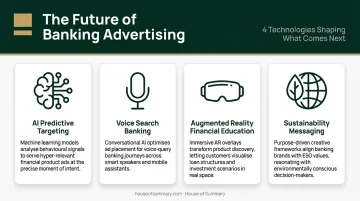
Technologies on the near-term horizon:
- AI-driven predictive targeting that identifies likely mortgage, auto loan, or credit card customers before they begin searching
- Voice search optimization for banking queries through Alexa and Siri — a market already valued at $4.18 billion in 2024
- Augmented reality for interactive financial education and product visualization
- Sustainability and ethical banking messaging as a growing differentiator, particularly for Millennial and Gen Z audiences
The First-Party Data Shift
As third-party cookie deprecation accelerates, ethically sourced customer data has become a core business asset. Banks that have already built direct-to-audience relationships — through owned newsletters, email lists, and content subscriptions — hold a structural advantage over those still dependent on programmatic targeting that relies on third-party signals.
Banks that invest in direct channels now are accumulating audience equity. Those that don't remain exposed to platform rule changes they can't control.
Conclusion
Banking advertising is in the middle of a genuine transformation. Personalization, omnichannel coordination, content-first trust-building, and the rise of high-engagement channels like newsletters have moved from experimental to expected — financial brands that ignore them are already behind.
The thread connecting every trend in this article is trust. Banking is an industry where consumers entrust their finances to an institution. Advertising that earns that trust — through relevance, transparency, and credibility — converts more reliably than advertising that just chases reach. That's especially true in channels like newsletters, where readers have already opted in, ads land without algorithmic interference, and a well-placed message reaches someone in a focused, receptive state — not scrolling past it.
Frequently Asked Questions
What are the 4 P's of marketing in banking?
In banking, the 4 P's are Product (the financial services and accounts offered), Price (interest rates, fees, and incentives), Place (branches, apps, and digital channels), and Promotion (advertising, content, and campaigns). Together, they define how a financial institution positions itself in a competitive market.
What are the most effective advertising channels for banks and credit unions?
Top-performing channels include social media (Meta, TikTok), OTT/CTV, mobile advertising, and premium email newsletters. The best results come from omnichannel campaigns that match the right format to the right audience segment rather than relying on a single channel.
How can banks build trust through advertising?
Trust starts with leading on education — financial wellness content, real customer stories, and transparent messaging outperform hard-sell creative. Appearing consistently in credible, curated editorial environments reinforces that positioning at the brand level.
What compliance considerations affect bank advertising campaigns?
Google and Meta impose restrictions on financial advertisers covering age, gender, and ZIP-code targeting. Working with compliance-aware partners — and prioritizing channels like premium newsletters that carry fewer platform-level restrictions — reduces exposure while maintaining reach.
How should banks approach advertising to Gen Z and Millennial audiences?
Younger audiences respond to mobile-first formats, authentic influencer partnerships, and values-aligned messaging around transparency and community. Platforms like TikTok and Instagram outperform traditional display for this segment because content that feels peer-driven and platform-native earns more trust than conventional institutional messaging.
What is the difference between content marketing and paid advertising for banks?
Content marketing — articles, calculators, webinars — builds long-term trust and brand authority. Paid advertising drives direct awareness and conversions. The strongest banking strategies coordinate both: content lays the foundation, paid campaigns convert on it.