

According to a 2024 survey reported by The Financial Brand, 91% of consumers identify mobile and online access as a critical factor when choosing a bank. The first impression most banks make isn't a branch, a teller, or an ad — it's a piece of content.
This guide covers what makes content marketing uniquely challenging for financial institutions, which formats actually deliver results, how to build a strategy that works, and where most banks go wrong before they even get started.
Key Takeaways
- 91% of consumers prioritize digital access when choosing a bank — content is often the first touchpoint
- In SEO, banks compete against major publishers — not just other banks — making financial services one of the toughest verticals
- Compliance isn't an obstacle — but it must be embedded in content workflows, not bolted on at the end
- Start with bottom-of-funnel content, prove ROI, then expand upward through the funnel
- Without a distribution plan, 96.55% of pages get zero organic traffic — production without promotion wastes the investment
Why Banks Can't Afford to Ignore Content Marketing
The shift to digital banking has fundamentally changed how customers discover and evaluate financial institutions. The FDIC's 2024 release of its 2023 household survey found that 48.3% of banked U.S. households now use mobile banking as their primary method of account access — a number that has grown steadily year over year.
That shift means banks must earn attention and credibility online long before a prospect initiates contact — and content is the primary tool for doing it.
The Trust Gap Banks Must Close
Financial decisions carry real personal consequences, which raises the cost of distrust. The data shows banks are falling short.
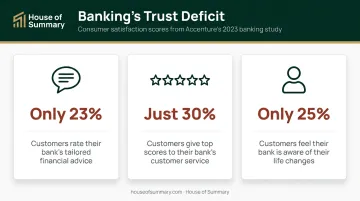
Accenture's 2023 global banking consumer study found:
- Only 23% of consumers rated their bank highly for tailored advice or product range
- Just 30% gave customer service a 9 or 10 out of 10
- Only 25% felt their bank was extremely aware of important life and financial changes
Content marketing is the most practical way to close that gap at scale. It answers questions before customers think to ask them, demonstrates expertise without a product pitch attached, and builds enough familiarity that when a decision arrives, the bank is already in the conversation.
What Makes Content Marketing for Banks Uniquely Challenging
Competing in the Most Crowded SEO Vertical
Financial services websites collectively receive around 2.2 billion organic visits per month, according to Semrush. Banks aren't just competing with each other — they're competing with NerdWallet, Bankrate, Investopedia, Forbes, and Yahoo Finance, all of which consistently outrank banks for high-value financial search terms.
These publishers have years of domain authority, dedicated editorial teams, and content strategies optimized entirely around search. A community bank or regional credit union trying to rank for "best savings account" is fighting a different battle than one trying to answer hyper-specific questions its local customers actually ask.
Google also classifies financial content under Your Money or Your Life (YMYL) topics, meaning it holds this content to higher quality and authority standards. Generic, shallow articles don't survive in this environment.
Compliance Is a Structural Reality
Bank content must comply with regulations including UDAAP (Unfair, Deceptive, or Abusive Acts or Practices), which the CFPB defines broadly — covering any representation, omission, or practice likely to mislead a consumer in a material way. That applies to blog posts, landing pages, comparison copy, and call-to-action language.
This isn't just a legal checkbox. It fundamentally shapes what banks can and cannot publish:
- Rate comparisons must include accurate, current disclosures
- Superlative claims ("best," "lowest") require substantiation
- Financial guidance must be appropriately qualified to avoid regulatory exposure
That means compliance teams need a seat at the table during content planning — not just at the end when copy is already written.
The Homogeneity Problem
Regulatory constraints define what banks can't say. But the harder challenge is figuring out what makes them worth reading in the first place. Most banks offer similar products, which makes topics like "how to save money" or "what is a mortgage" quickly commoditized — hundreds of institutions publish near-identical versions.
Differentiation requires deliberate choices:
- Build for a specific audience — agricultural businesses, medical practices, or startup founders — rather than everyone
- Mine proprietary data from the bank's own loan portfolio, deposit trends, or customer behavior for insights no competitor can replicate
- Publish perspectives from actual relationship managers, loan officers, or economists with direct field experience
In financial services, generic content does more than underperform. Readers evaluating where to put their money notice when a bank can't demonstrate expertise in its own subject matter.
The Best Content Formats for Bank Marketing
Educational Blog Articles and Long-Form Guides
Written content remains the dominant format in financial services because customers do serious research before opening accounts or taking out loans. These articles should answer specific questions tied to actual buying intent — not just broad financial literacy topics.
An article titled "What credit score do I need to qualify for an SBA loan?" serves a different purpose than "How to improve your credit score." One targets a prospect close to a decision; the other targets general curiosity. Both have value, but they serve different funnel stages.
Interactive Calculators and Financial Tools
Mortgage calculators, savings projectors, and loan comparison tools serve dual purposes: they provide genuine utility while increasing time on site and return visits. Banks with specific niche audiences — small business, agricultural lending, or commercial real estate — can build calculators tied directly to their customers' exact financial scenarios.
A farm equipment financing calculator, for example, does something no general-purpose tool can replicate: it speaks directly to one specific customer's decision, in their own context.
Thought Leadership Content
Whitepapers, market commentary, and economic reports position the bank's internal experts as genuine authorities. When insights come from practitioners — relationship managers, economists, loan officers with decades of experience — they carry credibility that generic vendor content simply can't match.
This format works particularly well for commercial banking divisions. Business owners and CFOs actively seek expert perspectives on interest rate movements, credit markets, and regional economic conditions — and they notice when insights come from people who've actually worked the deals.
Video and Podcast Content
Short-form video works well for social distribution and humanizes the bank's brand. Longer audio formats like podcasts reach professionals and business owners during commuting or downtime.
One non-negotiable: both formats require consistent cadence. Sporadic production — a podcast with six episodes then nothing, or a YouTube channel updated twice a year — damages credibility more than not producing the content at all.
Sponsored Newsletter Advertising
Email newsletters offer something most digital channels can't: direct inbox access with no algorithms, no ad blockers, and no visual clutter competing for attention. For banks targeting financially literate, high-intent audiences, newsletter advertising delivers brand messages to engaged readers at the moment they've chosen to pay attention.
House of Summary's network of finance-focused newsletters — Presidential Summary, Geopolitical Summary, London Summary, and Dubai Summary — reaches 500,000+ subscribers with over 254,000 emails opened daily. Readership skews toward executives, decision-makers, and high-income professionals in New York, Los Angeles, London, and Dubai: precisely the demographics banks target for premium financial products and wealth management services.

For banks tired of fighting for display ad impressions or algorithm-dependent social reach, newsletter sponsorship offers a direct line to engaged readers — with click-through rates that run 4x higher than Google AdWords.
How to Build a Content Marketing Strategy for Your Bank
Understand Your Customers and Set Clear Goals
Different customer segments require entirely different content approaches — and CRM data, customer interviews, and input from sales and lending teams are what make those distinctions concrete:
| Segment | Content Priorities | Preferred Formats |
|---|---|---|
| Retail consumers | Savings tips, fee comparisons, account guides | Blog articles, short video |
| Small business owners | Cash flow, lending options, payroll | Long-form guides, calculators |
| High-net-worth individuals | Wealth planning, estate strategy | Whitepapers, advisor commentary |
| Startups | Business banking basics, credit access | Educational hubs, FAQ content |
Build distinct personas from this data before writing a single word. Without that foundation, content is guesswork.
Content built for acquisition looks different from content built for cross-selling or retention. Define which goal each piece serves before production begins — not after.
Prioritize the Funnel From the Bottom Up
The most common strategic error in bank content marketing is starting with brand awareness content before establishing a base of content that actually converts.
Start at the bottom of the funnel. Comparison pages, "how to open a business account" guides, product-specific search content — these target audiences with clear purchase intent and generate faster, measurable results. They also build the internal business case for expanding the content program.
Once bottom-of-funnel content is established and driving measurable outcomes, work upward:
- BOFU — comparison content, product guides, intent-specific search pages
- MOFU — educational content that nurtures prospects not yet ready to decide
- TOFU — brand-building content that creates broad awareness over time
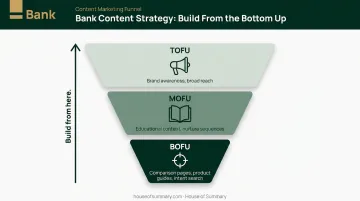
Skipping ahead to TOFU is tempting — brand content feels important — but it produces the slowest ROI and the weakest business case for continued investment.
Build a Content Calendar and Set Measurement KPIs
A documented content calendar separates a real strategy from ad hoc publishing. It should assign topics, formats, owners, deadlines, and distribution channels for every piece.
Track two categories of metrics:
- Marketing metrics: organic traffic, time on page, email open rates, social engagement
- Business metrics: new account opens, loan applications influenced by content, deposit growth attributed to specific campaigns
Banks that have moved beyond last-click attribution are building CRM integrations that tie content touchpoints directly to financial outcomes. That connection is the only way to demonstrate that content is generating revenue, not just traffic.
The Biggest Mistakes Banks Make With Content Marketing
Spreading investment too thin. Banks with limited marketing resources frequently dilute their impact by trying to maintain a blog, YouTube channel, podcast, and social presence simultaneously — producing mediocre output across all channels. Master one channel, prove ROI, then expand.
Publishing without a distribution plan. Ahrefs' 2023 study of approximately 14 billion web pages found that 96.55% of pages receive zero organic traffic from Google. Publishing an article and waiting for traffic is not a strategy. Every piece of content needs a defined distribution pathway — SEO, email, social, or paid — before it is produced.
Letting compliance become a bottleneck. Many bank content teams slow production to a halt by treating compliance review as a final gate rather than an integrated workflow. The fix involves three concrete changes:
- Build pre-approved messaging libraries for common topics
- Create shared content checklists with compliance language already embedded
- Involve compliance teams in topic planning (not final review)
The ABA Banking Journal also recommends automated approval workflows and keyword filters for flagged terms like "guarantee" to keep production moving without adding regulatory risk.
How to Measure What's Working
Most bank marketing teams track traffic, shares, and time on page — but struggle to connect those numbers to account openings or loan volume. Both matter. Business metrics must take priority.
Start by identifying which metrics actually reflect business outcomes. Key measures worth tracking include:
- Customer acquisition cost (CAC) per content channel
- Lifetime value (LTV) of customers who engaged with content before converting
- Multi-touch attribution using CRM integration to trace content touchpoints to account openings
- Conversion rate by content type — comparing bottom-of-funnel pieces against awareness content
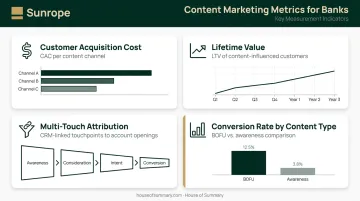
As The Financial Brand notes, banks are increasingly moving beyond last-click attribution toward CAC and LTV as primary ROI measures.
Schedule content audits on a fixed cadence. Financial regulations change, products evolve, and interest rates shift. Outdated content creates compliance exposure and erodes the credibility content marketing is supposed to build. Audit the library on a defined schedule — checking accuracy, regulatory alignment, and performance — so it stays an asset rather than a risk.
Expect a long timeline. Ahrefs' research on Google ranking timelines found that 72.9% of pages in Google's top 10 are more than three years old, with the average number-one page at five years old. Semrush estimates SEO takes 4–12 months to produce meaningful results. Bottom-of-funnel content often shows measurable conversions sooner — but sustained organic growth compounds over years of consistent output, not individual campaigns.
Frequently Asked Questions
What is a content bank?
A "content bank" is an organized library of pre-produced brand assets, articles, and media that a company draws from for ongoing marketing. It's distinct from content marketing for banks, which refers to the strategic use of educational and thought leadership content by financial institutions to attract and retain customers.
Do banks offer sponsorship?
Yes — many banks and financial institutions sponsor events, media platforms, and content channels as part of their broader marketing strategy. This includes sponsoring financial newsletters, industry reports, and podcasts to reach targeted professional audiences in a brand-appropriate context.
What type of content works best for bank marketing?
Bottom-of-funnel content — comparison pages, product-specific guides, and intent-driven search content — tends to drive the fastest measurable results. Long-form educational content and thought leadership build trust and brand equity over a longer time horizon.
How do banks handle compliance in content marketing?
Banks should integrate compliance review early in the content creation process, using pre-approved messaging frameworks and topic checklists to maintain UDAAP alignment without creating production bottlenecks. That shift — from final gatekeeper to workflow partner — is what keeps content moving without sacrificing accuracy.
How long does content marketing take to show results for banks?
Organic SEO content typically takes 4–12 months to rank meaningfully, and sustainable top-10 placement often takes years. Bottom-of-funnel content with clear purchase intent can yield measurable conversions faster.
Should a bank focus on SEO or social media for content distribution?
Align channel choice with where your audience is and what they're doing. SEO captures high-intent, research-driven queries at the moment of decision. Social media and email newsletters are more effective for trust-building and staying top of mind with prospects who aren't yet ready to act.