The gap between effort and results almost always traces back to avoidable mistakes — in how content is planned, created, distributed, measured, and sustained over time.
This article maps 12 of the most common pitfalls across those five areas, with specific guidance on what to do differently.
TL;DR: 12 Pitfalls at a Glance
- Strategy failures (1–3): No goals, no audience research, no publishing schedule — content fails before it starts
- Creation failures (4–6): Thin copy, promotional tone, and repetitive formats erode trust and search rankings
- Distribution failures (7–8): No promotion plan and a neglected email list mean strong content goes unseen
- Measurement failures (9–10): Chasing vanity metrics and skipping content repurposing burns budget without results
- Longevity failures (11–12): Inconsistent voice and no SEO foundation accelerate content decay
Strategy-Level Pitfalls: The Mistakes Made Before You Write a Word
Strategic errors are the most expensive kind. They set a wrong direction that every subsequent piece of content follows — meaning effort compounds in the wrong direction.
Pitfall 1: Jumping In Without Clear Goals
"Build brand awareness" is not a goal — it's a direction without a destination. A useful content goal connects to a measurable outcome: increase organic traffic to the pricing page by 30% in Q2, or generate 200 qualified leads per month through gated assets.
The numbers bear this out. According to CMI's 2025 B2B research, only 40% of B2B marketers have a documented content strategy — meaning the majority are producing content without a formal plan. Among marketers whose strategies underperform, 42% cite a lack of clear goals as a contributing factor.
Before creating anything, define:
- What business outcome this content supports
- Who it's meant to reach and at which funnel stage
- How you'll measure whether it worked
Pitfall 2: Skipping Audience Research
Creating content based on what the brand wants to say — rather than what the audience actually needs — is a fast path to low engagement. Buyer personas fix this by defining your audience's role, challenges, information habits, and decision criteria.
The key word is "fix." Personas should shape topic selection, tone, and format — not sit in a folder after the initial workshop.
Lightweight research doesn't require a budget. Start with:
- Social media analytics — what your audience shares, comments on, and asks
- Keyword tools — what they're searching for, and how they phrase it
- Customer interviews — even five short calls reveal more than months of data analysis
- Sales team input — the objections and questions that appear before every purchase
HubSpot's analysis of over 330,000 CTAs found that personalized calls-to-action converted 202% better than generic ones. Persona research is what makes personalization possible.
Pitfall 3: Publishing Without a Content Calendar
Without a content calendar, the same problems surface repeatedly. Two writers cover identical topics. Awareness pieces pile up while decision-stage content goes missing. Publishing spikes one week and stalls the next.
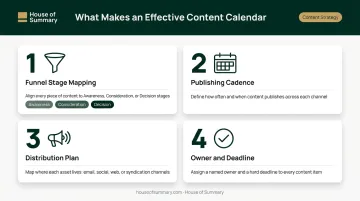
A content calendar fixes all three — but only if it does more than list titles and dates. It should map:
- Topics to funnel stages (awareness, consideration, decision)
- Publishing cadence per channel
- Distribution plan for each piece
- Owner and deadline for each step
CoSchedule's 2022 survey of 515 marketers found that organized marketers were 674% more likely to report success than disorganized ones. Planning discipline — not talent or budget — accounts for most of that gap.
Content Creation Pitfalls: Where Good Intentions Go Wrong
Even teams with a clear strategy can undermine themselves in execution. The most common failure modes — quality shortcuts, an off-tone editorial voice, and format monotony — rarely show up in strategy docs. They show up in published content.
Pitfall 4: Prioritizing Quantity Over Quality
Publishing high volumes of thin, generic content damages both SEO performance and brand credibility. Google's guidance is direct: its ranking systems are designed to surface helpful, reliable, people-first content — and it explicitly warns that using automation primarily to generate scaled content violates spam policies.
Quality in practice means:
- Original perspective, not a rephrased version of the top result
- Specific to audience needs, not broad and generic
- Editorially reviewed, with sources verified and claims checked
- Structured for the reader's actual question, not keyword density
With 95% of B2B marketers now using AI-powered tools, the risk of unreviewed, low-quality output at scale has increased. CMI's 2026 research found 12% of AI users reported decreased content quality — a predictable outcome when volume goals override editorial standards.
Pitfall 5: Using Content Purely as a Sales Tool
Audiences disengage quickly from content that reads like a brochure. The distinction matters:
- Educational content builds trust by solving a problem first
- Promotional content asks for a sale before trust exists
A practical framework many teams use is an approximate 80/20 split — roughly 80% educational or informational content, 20% explicitly product-focused. The logic is straightforward: if every piece points back to your product, readers stop trusting your editorial judgment.
A concrete example: a fintech brand can write about how to evaluate business banking fees without turning the article into a product demo. The educational piece builds trust. The CTA at the bottom earns the click.
Pitfall 6: Neglecting Storytelling and Format Variety
Text-heavy, narrative-flat content loses readers — especially in competitive verticals where five other articles cover the same topic. Storytelling makes content more memorable: real examples, client scenarios, and specific situations work better than abstract principles.
Stretching that storytelling across formats also extends reach. Wyzowl's 2026 survey found 82% of video marketers report good ROI and 85% say video helped generate leads. CMI's 2025 data showed that while short articles are the most-used format at 92%, video was rated the most effective format by 58% of B2B marketers.
Different formats serve different habits:
- Long-form articles — search-driven, in-depth research
- Short-form video — social platforms, quick demonstrations
- Infographics — data-heavy content, shareable on visual channels
- Audio/podcasts — commute consumption, loyalty-building
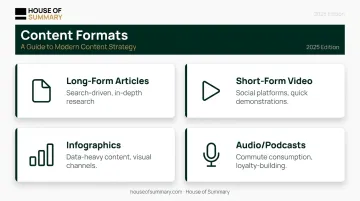
Repurposing one core piece across formats multiplies reach without multiplying production time.
Distribution and Promotion Pitfalls: Great Content That No One Sees
Publishing is not the finish line. Without deliberate distribution, even excellent content disappears within 48 hours of going live.
Pitfall 7: Treating Publishing as the Final Step
The "publish and hope" approach ignores how content is actually discovered. Most readers don't stumble onto articles — they find them through search, social feeds, email, or referrals. None of those channels are passive.
A multi-channel promotion framework for each piece should include:
- Organic social — multiple posts across platforms, not just one on publish day
- Internal linking — connecting new content to existing high-traffic pages
- Email — sending to your own subscriber list, or partnering with relevant newsletters
- Paid amplification — boosting high-performing pieces once organic signals confirm quality
- SEO discoverability — ensuring the piece is technically indexed and properly linked
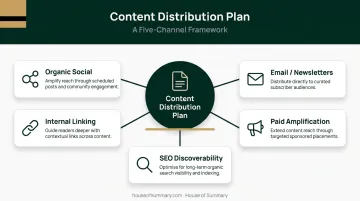
Content also needs re-promotion over time, not just a one-time share on the day it goes live. A strong piece from six months ago is still worth sending to new audience segments.
Pitfall 8: Underestimating Email and Newsletter Marketing
Email consistently outperforms social and display channels on engagement — partly because it reaches readers directly, without algorithm interference, ad blockers, or visual clutter competing for attention. Litmus reports email marketing delivers $36 for every $1 spent, and Mailchimp's December 2023 benchmarks show an average open rate of 35.63% — a figure that most social and display channels don't approach.
Those ROI figures explain why newsletter advertising partnerships are gaining serious traction among media buyers. Unlike display or social, your message reaches a focused, high-intent audience directly in their inbox — in a brand-safe editorial environment, with no risk of being filtered by an ad blocker.
House of Summary's newsletter network spans Presidential Summary, Geopolitical Summary, Dubai Summary, and London Summary, reaching 500,000+ subscribers with 254,866+ emails opened daily, concentrated in the US, UK, and UAE. Placements appear as native editorial content within each newsletter's natural flow. BSH Hausgeräte ran a campaign through Dubai Summary and saw click-through rates 4x higher than Google AdWords, a result that reflects both the quality of the audience and the undivided attention an inbox placement commands.
Measurement and Optimization Pitfalls: Flying Blind
Pitfall 9: Tracking Vanity Metrics Instead of Meaningful Ones
Page views and follower counts look impressive in reports but don't tell you whether content is moving the business. HubSpot defines vanity metrics as numbers that appear significant without providing meaningful insight into performance — and recommends replacing them with actionable equivalents.
| Vanity Metric | Replace With |
|---|---|
| Total page views | Conversion rate from content |
| Social followers | Email CTR from newsletter |
| Email open rate (alone) | Click-through rate + lead quality |
| Impressions | Content-attributed pipeline |
The right KPIs depend on the goal. Awareness-stage content should track reach and time on page. Consideration-stage content should track return visits and email sign-ups. Decision-stage content should track conversion rate and lead quality.
Recommended tools:
- GA4: web traffic, events, and conversion tracking
- HubSpot: CRM attribution, lead source, and form completions
- Semrush: SEO visibility, keyword rankings, and content audits
Pitfall 10: Never Repurposing Existing Content
Treating every content need as a from-scratch project ignores the asset value of what already exists. Semrush reports that 42% of marketers identify updating and repurposing content as a primary driver of content marketing success — and it requires fewer resources than creating new pieces.
Concrete repurposing examples:
- Long-form article → newsletter digest for your subscriber list
- Research findings → infographic for social distribution
- Comprehensive guide → short-form series across LinkedIn or email
- Podcast episode → transcript-based blog post
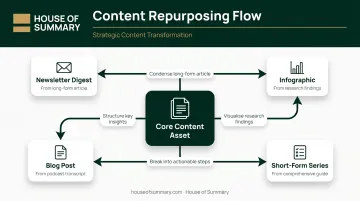
HubSpot's historical optimization program, built around systematically refreshing old blog posts, nearly tripled monthly leads from those updated pieces. That return came entirely from improving what already existed — no new channels, no additional production budget required.
Consistency and Longevity Pitfalls: Eroding Trust Over Time
Pitfall 11: Inconsistent Brand Voice Across Channels
When content sounds like it comes from different organizations depending on the platform — casual and vague on LinkedIn, overly technical in email, inconsistent on the blog — it erodes trust. Readers notice, even if they don't consciously register why.
A brand voice guide should cover:
- Tone and vocabulary preferences
- Sentence style and reading level
- Examples of what the brand would and wouldn't say
- Editorial standards for AI-assisted drafts
Teams need to operationalize it: share it with every contributor, build it into editorial briefs, and review it as part of the content approval process.
Research from Marq found that 85% of organizations have brand guidelines, but only 30% consistently enforce them — and consistent branding correlates with 10–20% overall growth. Having a guide that no one uses is not a solution.
AI writing tools carry a specific risk here: outputs will match a generic style, not your brand's voice, unless someone with editorial judgment reviews them against defined standards.
Pitfall 12: Neglecting SEO and Evergreen Content Planning
Content with no SEO foundation generates a spike at publication and flatlines within weeks. Evergreen content, built on keyword research, strong internal linking, and topics with consistent search demand, continues to attract traffic and generate leads long after publication.
This distinction matters for budget decisions. A single well-researched evergreen piece can deliver more cumulative traffic over 24 months than 20 trend-chasing pieces that spike and disappear.
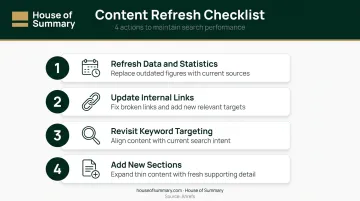
SEO doesn't stay still, either. Search intent evolves, algorithms update, and competitors improve their rankings. Existing content needs periodic optimization:
- Refresh data, statistics, and examples that have aged
- Update internal links to newer related content
- Revisit keyword targeting as intent shifts
- Add new sections addressing questions that have emerged since publication
Ahrefs recommends refreshing seasonal content approximately three months before peak interest — a useful benchmark for topic-dependent cadence planning.
Frequently Asked Questions
What is the biggest mistake brands make in content strategy?
The most common mistake is starting content production without clearly defined goals. This produces scattered output that doesn't serve any specific business objective, making it impossible to evaluate what's working or adjust course.
How do I know if my content marketing strategy is working?
Track KPIs tied to specific goals: organic traffic growth, lead generation rates, conversion percentages, or email engagement rather than vanity metrics like pageviews or follower counts. If your reporting doesn't connect to a business outcome, it's not measuring effectiveness.
How often should I publish content for content marketing to be effective?
Consistency matters more than volume. A sustained schedule of well-researched pieces (even one per week) outperforms sporadic bursts of thin content in both SEO performance and audience trust.
Why is content promotion just as important as content creation?
Most content is discovered through deliberate distribution across search, social, email, and paid amplification, not through passive organic discovery. Great content that isn't promoted simply won't reach its intended audience.
What's the difference between content marketing and advertising?
Content marketing earns attention by providing genuine value: education, insight, and informed analysis. Advertising pays for placement. Both serve a purpose, and the strongest programs use them together rather than treating them as substitutes.
How do I fix poor-performing content without starting from scratch?
Audit it first: check for gaps in audience relevance, SEO optimization, and promotional reach. A targeted update, stronger internal linking, or a repurposing push often delivers more value than replacing the piece entirely.