The problem is that "readers don't notice" can slide from seamless to deceptive faster than most advertisers anticipate. When that line gets crossed, the fallout isn't just bad press for one campaign. It damages the publisher, invites regulators, and becomes the kind of cautionary tale that gets cited in media ethics courses for years.
This article walks through the most notorious native advertising failures on record — what happened, why it backfired, and what the pattern reveals about where the format still goes wrong today.
Key Takeaways
- Native advertising fails when the advertiser's agenda overrides the reader's experience
- The worst failures share the same flaws: undisclosed commercial relationships, mismatched content, and no editorial judgment
- Real-world examples include The Atlantic's Scientology advertorial, the NY Times/Dell millennial piece, and Lord & Taylor's undisclosed influencer campaign
- Bad native ads don't just underperform — they erode publisher trust and attract regulatory action
- The fix: disclose clearly, match content to the audience, and partner with publishers that have real editorial standards
What Makes Native Advertising Go Wrong
Native advertising is paid content designed to match the look, feel, and function of the platform it appears on. That mimicry is the format's strength — and its built-in risk. When it works, readers engage with it as they would any editorial content. When it fails, the same seamlessness becomes a mechanism for disguising a commercial agenda.
The FTC's native advertising guidelines define the problem precisely: ads become deceptive when their format misleads reasonable consumers about their commercial nature. The FTC evaluates the "net impression" of an ad — meaning how the average reader experiences it, not just what the fine print says. On disclosures, the FTC draws a clear line:
- Acceptable: "Ad," "Advertisement," "Paid Advertisement," "Sponsored Advertising Content"
- Insufficient: "Promoted" or "Promoted Stories" — too vague to meet the standard
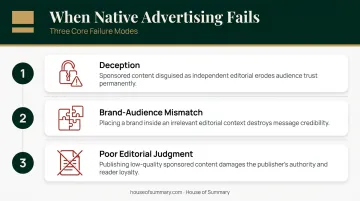
Most native advertising failures trace back to three core failure modes:
- Deception — the ad's commercial nature is deliberately obscured or labeled inadequately
- Brand-audience mismatch — the content has no genuine relevance to the publication's readership
- Poor editorial judgment — publishers approve material they would reject as journalism
The cases below are instructive precisely because they're not edge cases — they ran in major publications, cleared editorial review, and still caused lasting damage to reader trust.
The Worst Native Advertising Examples Ever Made
The Atlantic's Scientology Advertorial (2013)
On January 14, 2013, The Atlantic published a sponsored piece praising Scientology's leader and celebrating the organization's expansion. It was labeled "Sponsor Content" but formatted to look and read like a standard Atlantic article. Reader backlash was immediate and intense.
The Atlantic pulled the piece the same night. Their published statement read: "We screwed up. It shouldn't have taken a wave of constructive criticism — but it has — to alert us that we've made a mistake."
Why it failed on every level:
- The content was irrelevant and alienating to The Atlantic's educated, skeptical readership
- The "Sponsor Content" label was criticized by the Columbia Journalism Review as inadequate for a piece this politically and culturally charged
- The publication's editorial credibility, built over more than a century, was the implicit endorsement Scientology was purchasing
This case remains the industry's most-cited native advertising failure. The Atlantic didn't just run a bad ad. It published what read as institutional propaganda for a controversial organization, using its own reputation as the vehicle.
The New York Times and Dell's Millennial Advertorial (2014)
When the Times launched its native advertising program, Dell was the first sponsor. The paid post, dated January 8, 2014, asked: "Will Millennials Ever Completely Shun the Office?" — a premise designed to position Dell's remote-work hardware.
The agenda was visible from the first sentence. A Financial Times staffer described the unit as "as advertorial as native gets." Digiday noted that even the disclosure was slightly misleading: the "Posted by Dell" label was technically inaccurate because the Times' own advertising department produced the content.
The core problem wasn't the disclosure — it was the content:
- The piece offered no genuine insight on the millennial-workplace question
- The promotional angle was obvious enough to undermine both Dell's credibility and the Times' reputation for substance
- Readers came to the Times for depth; what they got was a hardware pitch dressed as workplace analysis
This example illustrates a specific failure mode: adequate disclosure doesn't save bad content. When the advertiser's agenda is transparent from the first paragraph, the label doesn't matter — readers feel used anyway.
That dynamic gets worse when disclosure disappears entirely — which is exactly what happened with Lord & Taylor.
Lord & Taylor's Undisclosed Instagram Campaign (FTC Action, 2016)
Lord & Taylor paid 50 fashion influencers between $1,000 and $4,000 each to post identical Instagram photos of a dress from its Design Lab collection, with no requirement to disclose that the posts were paid placements. The campaign reached 11.4 million Instagram users and generated 328,000 brand engagements.
The FTC announced its settlement with Lord & Taylor on March 15, 2016. A final consent order was approved May 23, 2016, prohibiting deceptive advertising techniques and requiring clear disclosure of material connections going forward. No monetary penalty was included in the settlement.
Why this case matters beyond the numbers:
This was one of the first major FTC enforcement actions extending native advertising's transparency problem into social media. Fifty influencers posting coordinated content that appeared organic wasn't an oversight — it was a system designed to deceive.
Lord & Taylor wasn't alone. Two other enforcement actions from the same period show how widespread the practice had become:
- Machinima (September 2015): Settled FTC charges for paying influencers to post undisclosed Xbox One endorsement videos
- Warner Bros. (July 2016): Settled over paid influencer videos for Shadow of Mordor that generated more than 5.5 million views without adequate disclosure
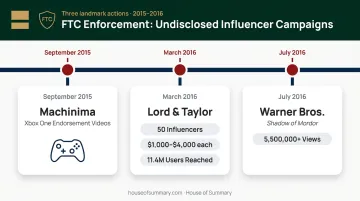
In each case, the commercial relationship was deliberately hidden. That's the line the FTC draws between poor execution and actionable deception.
What These Failures Have in Common
The Disclosure Gap
In every case, the commercial relationship between advertiser and publisher was either hidden, minimized, or labeled in a way designed to be overlooked. This isn't just an ethical problem — it's a strategic one.
Research from Wojdynski and Evans in the Journal of Advertising found that disclosure position and language directly affect advertising recognition. "Advertising" and "Sponsored" wording increased recognition compared to vague alternatives. Placement at the top of the content outperformed bottom or middle positioning. Yet many publishers continued using ambiguous labels in locations readers rarely see.
The Audience-Content Mismatch
Each failure involved content that served the advertiser's interests rather than the reader's:
- A Scientology expansion piece served to Atlantic readers expecting commentary
- A remote-work hardware pitch dressed up as workplace analysis for Times readers
- Coordinated influencer posts that followers mistook for genuine recommendations
Effective native advertising starts with a different question: what does this audience actually need to know? When the answer genuinely shapes the content, the brand message earns its place. When it doesn't, readers notice.
Editorial Abdication
The Atlantic case exposed something beyond reader deception — it revealed a failure of institutional judgment. The "church and state" principle in media, the strict separation between editorial and advertising, exists because a publication's credibility is inseparable from its audience's trust.
When publishers suspend editorial standards for a paying advertiser, they're selling the one asset that makes them valuable to advertisers in the first place.
Research published in Digital Journalism found that native advertising lowered perceptions of publisher credibility and generated greater attitudinal damage for online publishers than for legacy print brands. The reputational cost lands harder on digital-native outlets that have less institutional goodwill to absorb it.
The Real Cost of Bad Native Advertising
When an audience feels deceived by a native ad, they don't just stop trusting the advertiser — they reconsider their relationship with the publisher. That erosion is the real cost, because publisher credibility is what advertisers are buying access to in the first place.
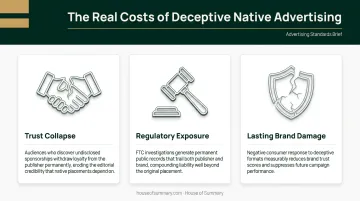
The damage doesn't stay contained to reputation, either. Three categories of fallout consistently follow deceptive campaigns:
- Trust collapse — Readers who feel misled pull back from the publisher, not just the brand. Credibility, once spent, takes years to rebuild.
- Regulatory exposure — FTC investigations and consent orders generate press coverage that outlasts the original campaign. The Lord & Taylor, Machinima, and Warner Bros. settlements created permanent public records still cited as industry warnings today.
- Lasting brand damage — Campbell and Evans, writing in the Journal of Interactive Marketing, found that consumers respond more negatively when they recognize native content as advertising, but that perceived sponsorship transparency reduces those reactions. Brands that face backlash from deceptive native ads carry that reputational weight into every campaign that follows.
The throughline is straightforward: the short-term gains from obscuring sponsorship aren't worth what gets lost — on both sides of the publisher-advertiser relationship.
How to Avoid These Native Advertising Pitfalls
Disclose Clearly — It's a Feature, Not a Concession
The research on disclosure is consistent: clear labeling doesn't kill engagement. Readers who know they're reading sponsored content and find it genuinely useful respond positively — to the brand and to the publisher. Trying to obscure the commercial relationship trades a small short-term attention gain for a large long-term trust deficit.
FTC guidelines are specific about what works. Acceptable labels include:
- "Ad" or "Advertisement"
- "Paid Advertisement"
- "Sponsored Advertising Content"
Vague terms like "Promoted" don't meet the standard. The label should appear before the reader engages with the content — not buried at the bottom.
Content Must Serve the Reader First
The advertiser's product can appear in native content — but only after genuine value has been delivered. That means understanding what the publication's audience actually wants to read, and building content around that need. The brand message follows naturally from relevance; it can't substitute for it.
Platform Choice Determines Risk Level
Not all native advertising environments carry the same risk. Algorithmic feeds and open web placements operate in environments where readers have lower expectations of editorial curation — meaning deception is more likely, and discovery more damaging.
Newsletter-based native advertising operates differently. Readers have explicitly subscribed to a trusted publication, which creates an inherently more transparent environment.
House of Summary's network covers global news, geopolitics, and city-specific content across 500,000+ subscribers, positioning native placements within human-written editorial that readers already trust. Because the audience opted in and recognizes the editorial voice, branded content that fits the publication's standards lands without the friction that causes failures elsewhere.
The medium shapes the risk level. The principles, however, are constant: disclose clearly, match the audience, and hold paid content to the same editorial standards as earned content.
Frequently Asked Questions
What is the most famous example of native advertising gone wrong?
The Atlantic's January 2013 Scientology advertorial is the industry's most cited failure. The piece was pulled the same night it published after intense reader backlash, and The Atlantic issued a public apology. It remains the standard cautionary example in native advertising discussions.
What makes a native ad deceptive versus legitimate?
The distinction is disclosure and intent. A legitimate native ad clearly signals its sponsored nature while matching the platform's content style. A deceptive one uses the platform's design and audience trust to obscure the commercial relationship — regardless of whether a label technically exists.
Has the FTC taken action against brands for bad native advertising?
Yes. Lord & Taylor settled FTC charges in 2016 for an undisclosed influencer campaign. Machinima settled in 2015 for paid Xbox One endorsement videos without disclosure. Warner Bros. settled in 2016 for undisclosed paid influencer content with more than 5.5 million views.
Does bad native advertising hurt the publisher or just the advertiser?
Both. The advertiser loses credibility with the audience, while the publisher risks losing reader trust in their editorial integrity — the core asset that makes their audience valuable to advertisers in the first place.
What's the difference between native advertising and sponsored content?
Native advertising is the broader format — any paid ad designed to match a platform's form and function. Sponsored content is one specific type: editorial-style content paid for by a brand and published on a media platform, usually with a byline or disclosure indicating the advertiser's role.
How can brands run native ads without damaging their reputation?
Most of the risk comes down to three practices:
- Disclose the commercial relationship clearly and upfront
- Create content that serves the publication's audience, not just the brand's messaging goals
- Choose publisher partners whose editorial standards align with the brand's values