
Introduction
Most businesses produce content constantly and see little return. The problem isn't effort. It's the absence of strategy. Publishing without a clear audience, purpose, or distribution plan is activity, not growth.
According to CMI's 2025 B2B research, 95% of marketers have a content strategy, but only 29% rate it extremely or very effective. The gap isn't access to tools or channels — it's the quality of the plan behind them.
This guide covers a practical framework for building a content strategy that compounds: starting with audience clarity, building the right content mix, distributing deliberately, and measuring what actually matters. The principles apply whether you're a solo creator or a growing media operation.
House of Summary built its newsletter network on these principles: clear editorial purpose, verified information, and a direct reader relationship no algorithm can interrupt. The same thinking that drives a successful media business drives content-led growth for any brand.
Key Takeaways
- A documented content strategy turns content from a recurring cost into a compounding business asset
- 82% of top-performing B2B marketers cite audience understanding as their primary success factor
- The 70/20/10 rule balances proven, experimental, and promotional content to keep audiences engaged
- Email newsletters are the most defensible owned distribution channel — no algorithms, no ad blockers
- Measure content against business goals, not vanity metrics like views or likes
What Is a Content Creation Strategy (and Why It Drives Business Growth)
A content creation strategy is a documented plan that defines what you create, who it's for, why it matters, how it gets distributed, and how success is measured. The keyword is documented. Reactive, unplanned posting doesn't qualify.
The distinction matters because unplanned content wastes resources without building anything durable. A strategy transforms content from a recurring cost into a compounding asset — each piece builds audience trust, compounds search visibility over time, and nudges buyers closer to a decision.
Strategy vs. Content Marketing
These two terms get conflated constantly, and the confusion causes real problems:
- Content strategy = the plan: what to create, for whom, why, and how to measure it
- Content marketing = the execution: producing and distributing content to attract and retain an audience
Both are required, and they operate in sequence — strategy first, always. A plan without execution gathers dust. Execution without a plan produces content no one asked for.
The data supports treating strategy as a priority: a Semrush 2023 global report of 1,700+ marketers across 34 countries found that 97% of those with a defined content marketing strategy reported positive results — and 70% of highly successful marketers track content marketing ROI.
Start With Your Audience: The Foundation of Effective Content
Creating content without a clear audience profile is the root cause of low engagement, poor conversion, and wasted production effort. Format decisions, topic selection, and distribution choices are all downstream of one question: who exactly are you trying to reach?
Building a Functional Audience Profile
A useful audience profile combines three layers:
- Demographics — role, industry, seniority, geography
- Psychographics — what frustrates them, what they aspire to, how they prefer to consume information
- Behavioral signals — which channels they use, what formats they engage with, when they're most active
Most businesses skip the psychographic layer and wonder why their content gets ignored. Knowing that your audience is "marketing directors in financial services" tells you who they are. Knowing they're drowning in vendor pitches and skeptical of generic advice tells you how to write for them.
Content Personas in Practice
A single business often needs 2-3 distinct personas with different content needs. A media buyer evaluating newsletter sponsorships needs performance data, audience composition breakdowns, and comparative CPM benchmarks. A brand manager at the same company needs editorial tone examples, brand-safety positioning, and storytelling formats. Same company, completely different content — and neither piece works for both audiences.
House of Summary's reader base is a practical example of this principle at work. Presidential Summary reaches US-based executives tracking global politics. Dubai Summary serves professionals embedded in the UAE market. The editorial approach across both newsletters is consistent — but the specific content, references, and context differ meaningfully by audience.
How to Gather Real Audience Insights
Don't rely on assumptions. Use:
- Customer and subscriber interviews
- Survey data with open-ended questions
- Engagement analytics (which pieces got the most clicks, shares, replies)
- Community feedback and reader responses
- Social listening across the channels your audience uses
CMI's 2025 B2B data found that 29% of marketers with less effective strategies cited audience research as a core failure point — and 40% identified creating the right content for the right audience as an ongoing challenge. Those numbers suggest that most teams know what they should be doing; they just haven't built a system to do it consistently.
Build a Content Framework: Pillars, Formats, and the 70/20/10 Mix
With audience clarity established, the next step is building a framework that gives your content coherence and direction.
Content Pillars
Content pillars are 3-5 core themes that sit at the intersection of your expertise and your audience's pressing needs. Every piece of content should connect to one of these pillars.
Pillars do two things simultaneously: they keep your content coherent for readers and build topical authority over time for search. Without them, content sprawls. Covering everything means being known for nothing.
Format Selection
Format choice should follow audience preference and business goal, not trend. A broad look at what works:
| Format | Best For |
|---|---|
| Long-form articles / blogs | Depth, SEO, considered-purchase audiences |
| Email newsletters | Trust-building, direct relationships, high-intent readers |
| Video | Engagement, demonstration, product education |
| Social posts | Reach, community, content discovery |
| Case studies / white papers | B2B consideration, proof of expertise |
CMI's 2025 B2B data shows videos (58%) and case studies (53%) as the formats producing the best results — formats that connect expertise with proof, not just information.
The 70/20/10 Rule
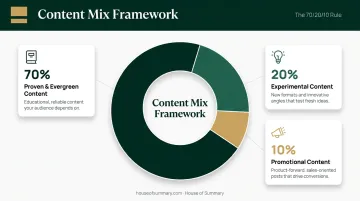
Originally developed through Coca-Cola's Content 2020 strategy, this framework provides a useful guide for content allocation:
- 70% — Proven, reliable content that consistently serves your audience (educational, evergreen, useful)
- 20% — Experimental or innovative content that tests new formats or angles
- 10% — Promotional or product-forward content
The 10% promotional ceiling is deliberate. Audiences disengage when content feels like a sales pitch. The 70/20/10 balance keeps your channel genuinely valuable — which is precisely what makes the 10% promotional content effective when it appears.
The 5 C's Quality Checklist
Before publishing, run any piece against this framework:
- Clear — Easy to understand, no ambiguity
- Concise — Respects the reader's time
- Compelling — Gives a reason to keep reading
- Credible — Based on verified information or genuine expertise
- Consistent — Aligned with brand voice, published reliably
House of Summary applies all five across its newsletter network: every claim is verified before publication, content summarizes rather than inflates, and each newsletter ships on a consistent daily schedule. That discipline is what builds the reader trust that makes the channel worth advertising in.
Quality vs. Quantity
Those five criteria reinforce a finding from CMI: 77% of top-performing B2B marketers prioritize high-quality content, while 20% of less effective strategies chase quantity instead. One well-researched, genuinely useful piece outperforms five thin ones.
Build a production cadence your team can sustain without compromising standards. A consistent weekly piece beats an unsustainable daily schedule that collapses after six weeks.
Distribute Strategically: Getting Content in Front of the Right People
Even strong content fails without a deliberate distribution plan. Most teams spend the majority of their time on creation and treat distribution as an afterthought. That ratio deserves rebalancing, particularly for content that's already published and proven.
The Three Distribution Channels
| Channel Type | Examples | Characteristics |
|---|---|---|
| Owned | Email, website, blog | Full control, most defensible long-term |
| Earned | Organic shares, backlinks, press | Built over time, high credibility |
| Paid | Sponsored content, ads | Fast reach, requires ongoing budget |
Build owned channels first. They're the only distribution assets a business fully controls — no algorithm changes, no platform policy shifts, no dependency on third-party reach.
Why Email Newsletters Lead
Email is the highest-signal owned distribution channel available. Unlike social media, email reaches subscribers who opted in deliberately, lands in the inbox with undivided attention, and operates entirely outside algorithmic interference.
Mailchimp's benchmark data puts the all-industry average email open rate at 35.63% — a figure that reflects genuine reader intent compared to passive social scrolling.
The inbox advantage extends to advertising as well. House of Summary's newsletter network reaches 500,000+ subscribers with 254,866+ emails opened daily.
Because newsletter ads appear within the reading flow rather than in dedicated ad slots, they sidestep the banner blindness that plagues display advertising. One advertiser reported click-through rates 4x higher than Google AdWords — a direct result of reaching opt-in readers in a distraction-free format.
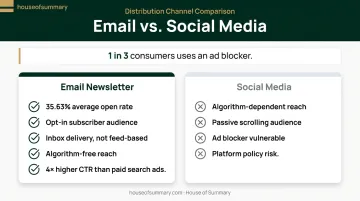
Nearly 1 in 3 global consumers now use ad blockers. Email reaches them anyway.
Content Repurposing
A single well-researched piece can travel much further than its original format:
- Start with a long-form article — this is the core asset
- Extract key findings for an email newsletter summary
- Break key points into a social post series (3-5 posts)
- Turn the structure into a short video script or talking points
- Reference the data in future pieces to build internal linking
Repurposing extends reach without proportionally increasing production effort. Yet CMI found that 48% of B2B marketers don't repurpose content consistently — which means most teams are leaving reach on the table with assets they've already built.
Track What Matters: Measuring Content Performance for Growth
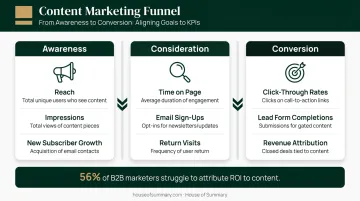
Tracking metrics without tying them to business goals produces numbers, not answers. Views and likes tell you something reached people — they don't tell you it mattered. The discipline is connecting content KPIs directly to specific outcomes: leads, pipeline, retention.
Metrics by Content Goal
| Content Goal | Metrics Worth Tracking |
|---|---|
| Awareness | Reach, impressions, new subscriber/follower growth |
| Consideration | Time on page, email sign-ups, return visits |
| Conversion | Click-through rates, lead form completions, revenue attribution |
CMI's 2025 data found that 56% of B2B marketers struggle to attribute ROI to content and 44% cannot tie content performance to business goals. That gap is widespread. Solving it puts you ahead of more than half the field.
Building a Review Cadence
Knowing what to track is only half the equation. When you review it matters just as much:
- Monthly — Spot trends in engagement metrics; identify what's working and what's not
- Quarterly — Assess whether content is contributing to business goals (leads, pipeline, retention)
- Annual — Full content audit: what to update, what to repurpose, what to retire
Track trends over time, not individual post performance. A single piece performing poorly tells you little. A pattern across 20 pieces reveals something worth acting on.
Content Creation Mistakes That Quietly Kill Growth
Creating for Yourself Instead of Your Audience
CMI found 42% of less effective content strategies cite a lack of clear goals as a primary failure factor — and that almost always traces back to unclear audience priorities. Many businesses produce content that reflects what leadership finds interesting or what the product team wants to promote, rather than what their audience actually needs. The fix: return to audience research and validate topics before you produce them.
Chasing Every Channel at Once
Spreading content across every platform dilutes effort and produces mediocre results everywhere. Choose 1-2 primary channels where your audience is most active, build genuine presence there, and expand only when those channels are performing. A single channel done well will generate more return than six channels done poorly.
Treating Content as a Short-Term Campaign
Content marketing compounds over time. Businesses that expect immediate results and abandon their strategy after 60-90 days never reach the point where content starts generating consistent returns. CMI found that in a given year, 39% of marketers saw content performance improve, while 15% said it was too soon to tell. Meaningful traction rarely shows up inside a single quarter. Build for 12+ months, not 60 days.
Frequently Asked Questions
What are the 5 C's of content creation?
The 5 C's are Clear, Concise, Compelling, Credible, and Consistent. Used as a pre-publication checklist, they ensure content is easy to understand, respects the reader's time, earns continued attention, draws on verified information, and maintains a consistent brand voice.
What is the 70/20/10 rule for content?
The rule allocates 70% of content to proven, audience-serving formats; 20% to experimental or innovative content; and 10% to promotional material. This mix sustains long-term audience engagement while still serving business goals and leaving room to test new ideas.
What types of content are most effective for business growth?
It depends on your audience and goal, but CMI's 2025 B2B data points to video (58%) and case studies (53%) as top performers. Long-form educational content and email newsletters are also reliable drivers of trust and conversion.
How do you measure the success of a content creation strategy?
Connect metrics to business outcomes. Awareness content maps to reach and new audience growth; consideration content to time on page and email sign-ups; conversion content to leads and revenue. Track trends over time, not individual post performance.
How often should a business publish content?
Consistency and quality matter more than frequency. One strong piece per week published reliably outperforms daily output that erodes in quality or collapses under production pressure. The best cadence is the one your team can sustain without compromising standards.
What is the difference between content strategy and content marketing?
Content strategy is the plan — what to create, for whom, why, and how to measure it. Content marketing is the execution and distribution. Without a clear strategy, content marketing generates activity but rarely produces results that compound over time.