Success isn't determined by subscriber count alone. Sponsors pay for attention from a specific type of reader. A 2,000-subscriber newsletter about B2B SaaS procurement can command higher rates than a 50,000-subscriber general news digest. What matters is niche clarity, engagement quality, how you package your offer, and how you find the right partners.
This guide covers what makes a newsletter sponsor-ready, the exact steps to land your first deal, pricing frameworks that protect your value, and the mistakes that kill long-term revenue.
Key Takeaways
- Engagement and niche focus outweigh raw subscriber counts when sponsors evaluate newsletters
- Build a media kit, define your formats, and create a public sponsorship page before outreach
- Use CPM for scale, flat rates for simplicity, and skip CPA unless you own the conversion path
- Reach sponsors via direct outreach, marketplaces like Paved and Who Sponsors Stuff, or inbound through your sponsorship page
- Recurring sponsor relationships consistently outperform one-off deals on revenue
What Makes a Newsletter Sponsor-Ready
Sponsors don't buy reach. They buy attention from a specific audience. Before you pitch anyone, you need to prove you've built a defined, engaged readership that matches what advertisers are looking for.
Niche Depth Matters More Than Breadth
Focused newsletters consistently attract more sponsor interest than general-topic publications. A newsletter about global geopolitics or fintech compliance has clear audience value. Advertisers know exactly who reads it and what problems those readers are trying to solve.
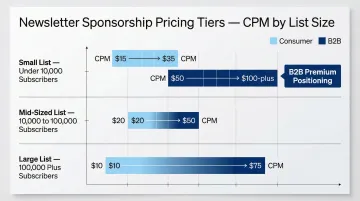
B2B newsletters command significantly higher rates. Specialized B2B publications charge CPMs of $50–$100+, while broader consumer newsletters sit closer to $15–$35.
Networks like House of Summary demonstrate this principle. Their publications focus on specific verticals — global news, geopolitics, city-specific content — rather than covering everything for everyone. That clarity makes them attractive to advertisers seeking decision-makers and professionals.
Engagement Benchmarks Trump List Size
A 5,000-subscriber newsletter with a 45% open rate and 4% click-through rate will command higher fees than a 30,000-subscriber list with a 20% open rate and 1% CTR. For a sponsor, an engaged reader is a potential customer — that's what justifies the spend.
Industry benchmarks show average open rates around 35.63%, though these numbers are inflated by Apple's Mail Privacy Protection. Sponsors now prioritize click-through rates. A CTR between 2% and 5% is considered solid, and click-to-open rates above 10.5% signal the kind of reader engagement that justifies premium pricing.
Small lists can outperform large ones on this basis. A newsletter with 3,000 subscribers but 50% open rates and 6% CTR demonstrates audience quality that sponsors will pay for.
Consistency Signals Professionalism
Sponsors want predictability. Publishing on a reliable schedule — whether daily, weekly, or biweekly — builds trust with both readers and advertisers. It shows you run your newsletter like a business, not a hobby.
Consistent publishing also makes campaign planning easier for sponsors. They can book placements weeks in advance, align them with product launches, and forecast reach with confidence.
Step-by-Step: How to Secure Paid Sponsorships for Your Newsletter
Step 1: Choose Your Sponsorship Format
Decide how sponsors will appear in your newsletter before you approach anyone. Three main formats dominate the market:
| Format | What It Is | Best For |
|---|---|---|
| Classifieds | Short text links (1–3 lines), grouped at top or bottom | Volume; multiple sponsors per issue |
| Shoutouts | Multi-paragraph mid-newsletter placements | Most newsletters starting out; higher engagement |
| Dedicated sends | Full issues devoted to one sponsor | Maximum attention; proven relationships only |
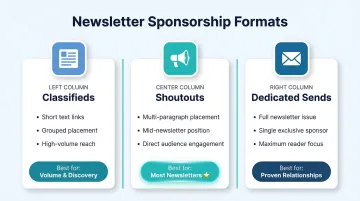
Classifieds are low-friction and stack easily, but pay less per placement. Shoutouts give you control over tone and copy — you write it yourself, which keeps the voice consistent. Dedicated sends command the highest rates but carry real risk: readers may unsubscribe if they feel the editorial line has been sold.
Start with classifieds or shoutouts. Layer in premium formats once you have performance data and proven sponsor relationships.
Step 2: Build a Media Kit and Sponsorship Page
No media kit means no credibility. Sponsors need to see your numbers before they'll consider working with you.
Essential media kit components:
- Total subscribers
- Average open rate
- Average click-through rate
- Audience demographics (job titles, geography, income if available)
- Available ad formats
- Pricing
- Examples of past sponsors (once you have them)
Keep it simple. A one-page PDF works. Include a short audience description that explains who reads your newsletter and why. If you publish multiple newsletters, call out the collective reach and any bundled pricing options.
Create a public sponsorship page on your website. It reduces friction for inbound sponsors and positions you professionally. Feature engagement stats prominently, include sponsor testimonials if available, and embed a contact form. Make it easy for brands to reach you.
Step 3: Find and Reach Out to Potential Sponsors
Work both inbound and outbound channels at the same time — waiting on one alone is too slow.
Inbound: Your sponsorship page and marketplace listings. Three platforms worth listing on:
- Paved — requires 25,000 subscribers for its Marketplace, but the free Booker tool has no minimum
- Who Sponsors Stuff — tracks 500+ newsletters and 10,000+ sponsors; useful for research too
- Letterwell — classifieds-style marketplace for smaller or niche lists
Note: Swapstack was acquired by beehiiv in 2023 and is no longer an active sponsorship platform.
Outbound: Direct pitches to brands already aligned with your audience. Research what companies sponsor similar newsletters. Check their websites, LinkedIn pages, and public campaigns. Look for marketing managers or partnerships leads.
A strong cold outreach pitch includes:
- Brief newsletter introduction (1–2 sentences)
- Key engagement stats (open rate, CTR, audience size)
- Why the sponsor's product fits your audience (be specific)
- Clear call to action (schedule a call, review the media kit, book a test placement)
Keep it under 150 words. Lead with value, not credentials.
Step 4: Qualify Sponsors and Close the Deal
Not every sponsor is worth accepting. Ask these questions before closing:
- Does the sponsor's product genuinely serve my audience?
- Is there potential for an ongoing relationship?
- Have they sponsored newsletters before?
- Can they meet my pricing?
One misaligned sponsor can erode reader trust faster than any other mistake. If a product doesn't fit, decline.
For new relationships, offer a discounted first placement — typically 20–30% off. It lowers their risk, gives you a performance case study, and usually converts to repeat bookings at full rate.
How to Price Your Newsletter Sponsorships
Pricing isn't universal. Rates depend on list size, engagement, niche value, and placement type. A high-engagement niche newsletter justifies rates that outperform much larger general-audience lists.
Three Main Pricing Models
CPM (cost per 1,000 subscribers) is transparent and scales with list growth. Sponsors understand it. Industry benchmarks make it easy to compare rates. Typical ranges:
- Small newsletters (<10,000): $15–$35 (consumer), $50–$100+ (B2B)
- Mid-sized (10,000–100,000): $20–$50
- Large (100,000+): $10–$75
Flat rate is a set fee per placement, regardless of list size. It's simpler to manage and protects against underpricing as your audience grows. Most newsletters under 10,000 subscribers use flat rates. Small newsletters typically charge $50–$250 per placement, mid-sized charge $500–$3,000, and large newsletters charge $3,000–$20,000+.
CPA (cost per acquisition) means sponsors pay only when readers complete a specific action — a purchase, signup, or download. Rates commonly range from $10 to $100 per acquisition. It's the lowest risk for sponsors but the highest risk for publishers. Conversion depends on factors you don't control — landing page quality, product pricing, attribution tracking. Avoid pure CPA deals unless you have direct influence over conversion.
Starting Framework
Start by researching what comparable newsletters in your niche charge. Factor in your open and click rates relative to industry averages, then test pricing incrementally before committing to a permanent rate card.
Raise rates by 15–20% when your calendar fills consistently or when you add 5,000–10,000 subscribers. Other clear signals it's time to increase rates:
- Sponsors book immediately without negotiating
- You're sold out weeks in advance
- Your click-through rates outperform category averages
Tiered Sponsorship Packages
Offering multiple placement options gives sponsors flexibility and helps you maximize revenue per issue.
- Primary placement: Top-of-newsletter shoutout, highest visibility, premium pricing
- Secondary mention: Mid-newsletter text block, moderate pricing
- Classified bundle: Short text link grouped with others, lowest pricing
Publishers offering flexible pricing or first-placement discounts close initial deals faster. Once sponsors see performance, they upgrade to premium placements.
Common Mistakes When Seeking Newsletter Sponsorships
Pitching Sponsors Too Early
Approaching brands without audience data or a media kit signals inexperience. Sponsors ignore pitches that don't include subscriber counts, engagement metrics, or audience demographics. Build your foundation first. Prove engagement before you ask for money.
Accepting Misaligned Sponsors for Short-Term Revenue
Including irrelevant ads destroys reader trust faster than almost anything else. Readers unsubscribe. Future sponsors see declining engagement and walk away. Once that trust erodes, your sponsor pipeline dries up alongside it.
Ignoring FTC Disclosure Requirements
FTC disclosure requirements are strict. The FTC's 2023 Endorsement Guides mandate that disclosures be unavoidable, clear, and conspicuous. Relying on platform-provided tools is often insufficient — disclosures cannot be hidden behind a "more" link.
Use one of these approved terms in every sponsored placement:
- "Ad"
- "Paid ad"
- "Sponsored"
- "Advertisement"
### Underpricing Out of Insecurity
Starting too low anchors expectations with sponsors and makes it difficult to increase rates later. Research comparable newsletters before setting any initial price. If you're unsure, start at the middle of the range for your list size and niche. Adjust based on sponsor response and booking velocity.
Conclusion
Securing paid newsletter sponsorships rewards preparation. A clear niche, strong engagement data, a professional media kit, and a disciplined approach to qualifying sponsors create the foundation for consistent revenue.
That consistency compounds over time — the most valuable sponsorship relationships are long-term ones. Choosing sponsors whose products genuinely serve your audience protects the trust that makes your newsletter worth opening. Readers who trust your recommendations engage more deeply and stay subscribed longer. Sponsors willing to pay a premium know this, and they're looking for newsletters that have already earned it.
Frequently Asked Questions
What are newsletter sponsorships?
Newsletter sponsorships are paid placements where brands pay to feature their product or message within an email newsletter — reaching a specific, engaged audience directly in their inbox.
How do I get newsletter sponsorships?
Build an engaged, niche audience first. Create a media kit with subscriber count, open rate, and click-through rate. Add a sponsorship page to your website. Then reach out to relevant brands directly or list your newsletter on platforms like Paved, Who Sponsors Stuff, or Letterwell.
What types of newsletter sponsorships are there?
The three main formats are classifieds (short text links), shoutout placements (multi-paragraph dedicated sections woven into the content), and deep dives or dedicated sends (full issues devoted to one sponsor). Classifieds and shoutouts are the easiest starting point — they require less production effort and are simpler for sponsors to evaluate.
How much do newsletter sponsorships cost?
Rates vary based on list size, niche, and engagement. Small newsletters (<10,000 subscribers) typically charge $50–$250 per placement. Mid-sized newsletters (10,000–100,000) charge $500–$3,000. Large newsletters (100,000+) charge $3,000–$20,000+. B2B and specialized newsletters command higher rates.
What's a good open rate for a newsletter?
Average open rates sit around 35.63% across industries, though Apple's Mail Privacy Protection inflates these numbers. Sponsors look for open rates above 30%; 40–50%+ is strong. Click-through rates carry more weight now — 2% to 5% is considered respectable.
Where should I place sponsorships in my newsletter?
Top-of-newsletter placements get the most eyeballs, while mid-content placements feel more native and less like ads. Most sponsors prefer above-the-fold positioning — lead with your editorial content, then integrate the sponsorship before readers scroll away.