Newsletter sponsorships cut through that. Instead of fighting for attention on a crowded social feed or paying for impressions that get blocked before they load, a newsletter placement lands directly in the inbox of a reader who chose to be there.
This guide covers why fintech and payments brands are shifting budget toward finance newsletter sponsorships, how the channel works, what the right partner looks like, and how to measure ROI clearly.
Key Takeaways
- Finance newsletter readers are opted-in professionals — executives, founders, and decision-makers who actively choose what lands in their inbox
- Ads land directly in the inbox — no ad blockers, no algorithm deciding who sees your message
- Finance email benchmarks show 27.1% open rates — versus a 21.5% all-industry average
- ROI is measurable: track CTR, cost per click, and post-click conversions using UTM parameters and dedicated landing pages
- Vet partners on three things: verified audience demographics, editorial independence, and post-send performance reporting you can actually act on
Why Fintech and Payments Brands Are Overpaying for Underperforming Ads
Paid digital advertising has a structural problem in financial services. The costs are high, the targeting is imprecise, and a growing share of the audience never sees the ad at all.
The Cost Problem
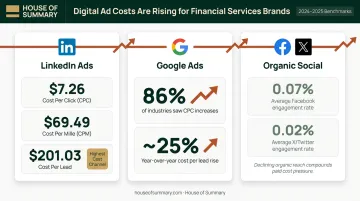
B2B paid social benchmarks tell the story plainly. Metadata.io's 2024 B2B paid social report puts LinkedIn at $7.26 CPC, $69.49 CPM, and a $201.03 cost per lead — before any finance-sector premium. Meanwhile, 2024 Google Ads data shows CPCs increased across 86% of industries, with average cost per lead rising roughly 25% year-over-year. For financial services brands already constrained by compliance requirements that limit creative flexibility, expensive placements and restricted messaging are a difficult combination.
The Visibility Problem
Even when budgets are committed, the audience may not be reachable. Blockthrough's 2023 ad-filtering report recorded 912 million active ad-blocking users worldwide — up 11% from two years prior — with projected publisher revenue losses of $54 billion in 2024. Browser-based ad blockers target display and programmatic ads directly, meaning a meaningful portion of paid display spend simply never renders.
The organic fallback isn't better. Rival IQ's 2025 benchmarks show financial services brands averaging just 0.07% engagement per post on Facebook and 0.02% on X/Twitter. Organic reach is functionally negligible, which means paid spend isn't supplementing organic visibility — it's replacing it entirely.
The Compounding Effect
The result is a channel mix that demands consistent spend just to maintain basic reach, while delivering uncertain results and limited ability to verify who actually saw the message.
Finance and payments brands running ABM campaigns or targeting senior decision-makers feel this most acutely. The audiences worth reaching are exactly the ones most likely to use ad blockers — and least likely to engage with mid-scroll social content.
Budget reallocation toward newsletter sponsorships follows directly from this gap. Axios reported 3x more 2025 advertising revenue pre-booked than at the same point in 2023, attributed to pitching niche audiences in financial services and other verticals — a channel that reaches inboxes directly, with no ad blockers in the way.
What Fintech Newsletter Sponsorships Are and How They Work
Sponsorship Formats Explained
A fintech newsletter sponsorship is a paid placement inside a curated email publication. The brand's message appears alongside editorial content — not as a pop-up or programmatic unit, but as a clearly labeled native feature that readers encounter in the flow of the newsletter.
The three standard placement types:
- Top-of-newsletter (title sponsorship) — Maximum visibility. Brand appears before editorial content, capturing attention at the highest-engagement moment of the read
- Mid-content placement — Embedded between articles, following the editorial flow. Strong for direct response because readers are already engaged
- Classified or brief listing — Shorter, lower-cost format suited for product announcements, event promotions, or targeted offers
Some publishers also offer full-issue takeovers, where a single sponsor has exclusive presence across an entire newsletter send. House of Summary, for instance, offers full-newsletter takeover packages alongside multi-newsletter bundles for brands seeking coordinated reach across publications simultaneously.
How Inbox Delivery Differs From Other Channels
Newsletter ads don't face the same friction as web-based advertising. Standard browser ad blockers — the browser extensions and DNS-level tools that strip display and programmatic ads — operate on web page requests and ad server calls. A newsletter arrives as email content the subscriber requested, which means it reaches the inbox regardless of what ad-blocking software the reader runs.
That means direct delivery — no algorithmic filter, no ad server dependency. House of Summary's click-through rates run 4x higher than Google AdWords, a direct result of inbox-native delivery to audiences who opted in for the content.
Sponsorship Workflow for Finance Brands
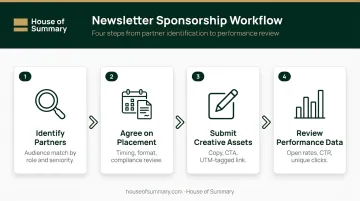
The process runs in four steps:
- Identify newsletter partners whose audience composition matches your target buyer profile — look beyond subscriber count to job function, seniority level, and geographic concentration
- Agree on placement type and timing — coordinate around campaign goals, issue cadence, and any compliance review timelines
- Submit creative assets — short copy, a call-to-action, and a destination link (UTM parameters supported)
- Review post-send performance data — open rates, click-through rates, and unique click counts from the publisher
For regulated financial services brands, the format accommodates compliance workflows without friction. Publishers review copy before publication and clearly label placements as sponsored content. The pre-send window gives legal and compliance teams time to approve messaging before it goes live.
Why Finance Newsletter Readers Are a Unique Advertising Audience
The Opt-In Difference
Social media users encounter ads passively — the ad appears whether or not they want it. Newsletter subscribers made a deliberate choice to receive this content. In a finance context, that self-selection matters: readers subscribing to newsletters covering markets, policy, payments trends, or geopolitical developments are signaling genuine professional interest in those areas. That active interest is a fundamentally different starting point than passive scroll exposure.
Reader Profile and Seniority
Finance newsletter audiences tend to skew heavily toward decision-makers. Axios reports that 1 in 5 of its newsletter subscribers are C-suite or above, with a 46% average open rate — the same professionals B2B finance brands pursue through expensive LinkedIn campaigns or account-based marketing programs.
House of Summary's network of 500,000+ subscribers reflects this concentration. The audience is clustered in major financial centers:
- 66% based in the United States (New York and Los Angeles dominant)
- 10.47% in the UK, concentrated in London
- 18.20% in the UAE, concentrated in Dubai
The reader profile spans C-suite executives, founders, senior professionals, policy experts, and high-net-worth individuals — demographics that are, as House of Summary's own positioning notes, "particularly difficult to reach efficiently through programmatic or social."
Trust Transfer in Financial Services
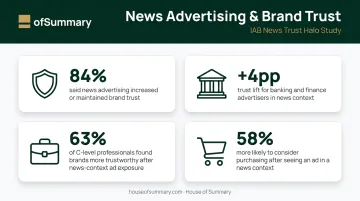
Readers extend trust in editorial voices to brands that appear alongside that content. The IAB's News Trust Halo study — surveying 2,029 U.S. news consumers — found measurable lifts across every credibility metric:
- 84% said advertising in news either increased or maintained brand trust
- +4 percentage points of trust lift for banking and finance advertisers specifically
- 63% of C-level professionals found brands more trustworthy after news-context ad exposure
- 58% were more likely to consider purchasing from those brands
For finance advertisers, where credibility drives purchase decisions more than almost any other category, that context premium is a direct competitive advantage over display and social placements.
Engagement Benchmarks
Campaign Monitor's financial services email benchmarks show a 27.1% open rate and 2.4% CTR — both above the all-industry averages of 21.5% and 2.3% respectively. Finance readers are more engaged with email content than the average subscriber base, meaning each sponsorship placement reaches an audience that is actively reading — not skimming or scrolling past.
What to Look for in a Fintech Newsletter Sponsorship Partner
Not all newsletter partnerships are equally valuable. These are the factors that separate effective placements from wasted spend.
Audience alignment before everything else
Subscriber count is a vanity metric without audience composition data to back it up. Finance and payments brands should ask for:
- Job functions and seniority levels of subscribers
- Industry verticals represented
- Geographic concentration (especially relevant for region-specific financial products)
- Any first-party demographic data the publisher collects
A smaller, precisely matched audience will outperform a large but loosely relevant one in nearly every scenario.
Editorial quality and verification standards
Readers who trust the newsletter's editorial content are more likely to engage with sponsorships. Before committing, review several past issues and ask:
- Is the reporting accurate and consistent in quality?
- Does the editorial voice match the audience you're trying to reach?
- Does the publisher have a clear policy on unverified claims?
House of Summary operates on a verification-first editorial standard: everything is checked before it reaches the inbox. If a claim cannot be confirmed, it doesn't get published. That commitment to accuracy supports the reader trust that makes sponsorships perform.
Transparent performance reporting
A legitimate newsletter partner provides post-send data including open rates, click-through rates, and unique click counts. Before signing, confirm:
- Whether UTM parameters and custom tracking links are supported
- How quickly post-send reports are delivered
- Whether conversion pixel tracking is available for post-click measurement
House of Summary's advertiser FAQ addresses UTM and tracking link support directly — a useful checkpoint for performance-driven media buyers who need to connect newsletter traffic to downstream conversions in their analytics platform.
How to Measure ROI on Your Fintech Newsletter Sponsorship
Primary Metrics
| Metric | What It Tells You |
|---|---|
| Open rate | List health and subject line performance |
| Click-through rate (CTR) | How effectively the placement drove action |
| Cost per click (CPC) | Efficiency benchmark for cross-channel comparison |
| Unique click count | Actual reach of your specific placement |
For fintech brands, CTR and CPC are more meaningful than raw impressions. The goal is qualified traffic to a specific offer, not passive exposure. Paved's newsletter benchmarks put average CPC at $4.96 for general newsletters and $18.36 for premium niche publications — finance newsletters typically fall in the higher tier given audience quality.
Conversion Tracking Beyond the Click
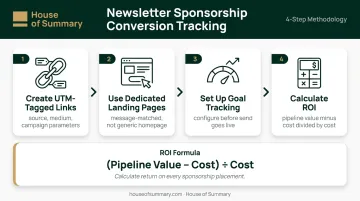
Clicks are only the starting point. What matters is what follows: demo requests, account sign-ups, and form completions that move prospects into your sales pipeline. To track this accurately:
- Create UTM-tagged links for each newsletter placement (source, medium, campaign)
- Use dedicated landing pages that match the sponsorship message, not generic homepages
- Set up goal tracking in your analytics stack before the send goes live
- Calculate ROI as: (pipeline or revenue value from conversions − sponsorship cost) ÷ sponsorship cost
Testing and Optimization
First-time newsletter sponsors should treat early placements as test campaigns. Test these variables one at a time:
- Copy angle (product benefit vs. social proof vs. offer-led)
- Call-to-action phrasing
- Placement position (top vs. mid-content)
- Newsletter selection within a network
Over two to four runs, you'll have enough data to identify which combinations drive the strongest results. That's the point at which increasing spend becomes a data-backed decision rather than a guess.
Frequently Asked Questions
How much does it cost to sponsor a finance newsletter?
Costs vary based on audience size, engagement rate, niche specificity, and placement type. Premium finance and fintech newsletters command higher rates due to audience quality — Paved benchmarks suggest CPMs of $23+ for targeted niche publications. Request a media kit for specific pricing; for House of Summary, contact sales@houseofsummary.com.
What metrics should I track to evaluate fintech newsletter sponsorship ROI?
Track click-through rate, cost per click, and post-click conversions such as demo requests or sign-ups. Use UTM parameters and dedicated landing pages to connect newsletter traffic to business outcomes in your own analytics platform.
How do fintech newsletter ads compare to paid social or display advertising?
Newsletter ads reach opted-in readers in an inbox environment that standard browser ad blockers don't affect, with no algorithm determining whether your message gets seen. Engagement rates typically run higher than display or paid social for finance-specific audiences, though the audience scale is smaller and more targeted by design.
What sponsorship placement formats are available in fintech newsletters?
The three main formats are top-of-newsletter (maximum visibility), mid-content placement (embedded in editorial flow), and classified listings (lower-cost, shorter copy). Full-issue takeovers are also available from select publishers, including House of Summary. Choose placement based on whether your goal is brand awareness or direct response.
How do I verify that a finance newsletter's audience matches my target customers?
Request audience demographic data covering job roles, seniority levels, industry verticals, and geographic distribution. Review recent issues to assess editorial quality and content fit. Ask the publisher for post-send performance benchmarks from comparable sponsors before committing to a campaign.