

Introduction
Fintech marketing has a problem most industries don't face: the target audience is too smart for the usual playbook.
Finance-savvy readers — investors, executives, founders, wealth managers — have seen every variation of the "disruptive" pitch. They use ad blockers, scroll past banner ads, and dismiss promotional content before they've finished the headline.
Traditional display advertising in this space doesn't just underperform. It often signals to the reader that a brand doesn't understand them.
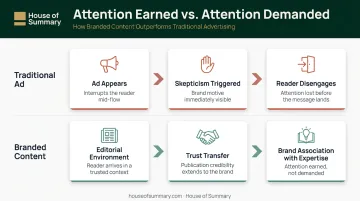
Branded content takes a different approach. It leads with information the reader actually wants, placed inside editorial environments they already trust — so attention is earned rather than demanded.
This article covers what branded content means in a fintech context, why finance-savvy audiences respond to it when they ignore everything else, which channels deliver it most effectively, and how to execute it without losing the credibility you're trying to build.
Key Takeaways
- Finance-savvy audiences are high-intent, skeptical, and hold branded content to a higher editorial standard than general consumers
- Branded content works in fintech because it leads with education and insight — not a product pitch
- Newsletter placements bypass ad blockers entirely and deliver brand messages inside the reader's active attention window
- IAB research found 84% of news consumers say ads in trusted editorial environments maintain or increase brand trust
- Handled well, compliance disclosures and transparency function as active trust signals with finance audiences
What Is Branded Content in Fintech, and Why Does It Matter?
Branded content is content that provides genuine value to the reader while being transparently funded by a brand. It's not an ad wearing editorial clothing — it's actually useful content that happens to carry a brand's name.
The distinction that matters most here is where it lives. Unlike owned content marketing (blog posts, a brand's own social feed), branded content is typically published through a third-party media channel — a newsletter, a financial publication, a thought leadership platform. That placement is what gives it power: the content borrows credibility from an environment the reader already trusts.
Why This Distinction Matters in Fintech
Financial audiences actively distrust overt advertising. They're accustomed to evaluating claims critically and recognizing when a piece is written to sell rather than inform. Standard ad formats trigger that skepticism immediately.
Branded content sidesteps the problem by adopting the format of editorial content — the form the reader comes to the channel for in the first place. Done well, it delivers:
- Genuine information the reader finds useful, not product features they didn't ask about
- Third-party editorial credibility from the channel it appears in
- Brand association with expertise and quality, not interruption
The IAB's Native Advertising Playbook defines native advertising as paid content designed to be cohesive with the page's content and consistent with the platform experience. That cohesion is the mechanism: not deception, but genuine alignment between what the channel delivers and what the brand has to say.
For fintech brands, that alignment isn't incidental — it's the entry point. Audiences who filter out ads on instinct will engage with content that earns its place on the page.
Who Are Finance-Savvy Audiences and What Do They Expect?
"Finance-savvy" doesn't just mean wealthy. It means readers who follow financial news closely, evaluate products critically, and have enough domain knowledge to identify when a piece of branded content is shallow or self-serving.
This audience includes:
- Retail investors who actively research before making decisions
- Business finance decision-makers at mid-market and enterprise companies
- Startup founders navigating funding, payments, and banking infrastructure
- Executives whose daily workflow includes tracking markets, policy, and geopolitical risk
The Trust Threshold Is Higher Here
These readers don't just skim. They check credentials, cross-reference claims, and disengage the moment a piece starts to feel like a sales brochure. Getting past that skepticism requires a different approach than general consumer marketing.
The IAB's 2020 News Trust Halo study found that 63% of business executives said advertising in news-adjacent environments makes a brand more trustworthy. That figure matters because it shows trust transfer is real and measurable — but only when the editorial environment itself earns it.
What They Actually Respond To
Finance-savvy readers respond to specificity over generality, data over claims, and transparency over enthusiasm. They want branded content that:
- Opens with a problem they recognize from their own professional context
- Delivers data or insight they haven't already seen
- Respects their knowledge level — no over-explanation of concepts they understand
- Is honest about what it is — a clearly labeled sponsored piece reads as more trustworthy than a vaguely ambiguous one
Placement choice signals authority. A brand appearing in a curated, credible newsletter communicates something different than the same brand running banner ads across low-quality display networks. The environment is part of the message.
That's why audience composition matters as much as channel. House of Summary's readership profile — decision-makers, executives, and policy professionals across New York, London, and Dubai — reflects exactly the finance-savvy reader described above. 66% of the network's readership is US-based, with strong representation in New York and Los Angeles, two of the densest concentrations of finance professionals in the world.
Why Branded Content Outperforms Traditional Advertising in Fintech
The performance gap between branded content and traditional display advertising isn't subtle in this category.
The Display Problem
Display advertising in fintech faces three compounding challenges:
- Ad blockers — a GWI survey found that 50% of business news website visitors used an ad-blocking tool in the prior month (though this data is from 2018; treat it as a directional signal)
- Banner blindness — even readers who don't block ads have learned to ignore peripheral ad placements
- Platform friction — Google requires financial services verification before campaigns can run; Meta restricts credit, loan, and insurance ads to users 18+ and may require advertiser licensing in the target country
The result: a fintech brand running display-only campaigns is reaching a fraction of the intended audience, and often the wrong fraction.
Newsletter Advertising's Structural Advantages
Inbox-delivered branded content eliminates all three problems at once. Ad-blocking software operates at the browser level — it has no mechanism to filter content inside email messages that subscribers have explicitly opted into. When a subscriber opens a newsletter, the branded content appears as part of what they came to read, with their attention already engaged.
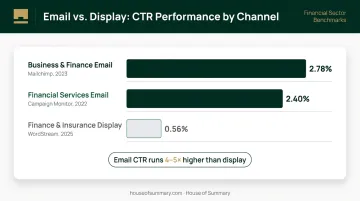
The numbers reflect this structural difference:
| Source | Channel | CTR |
|---|---|---|
| Mailchimp 2023 | Business & Finance email | 2.78% |
| Campaign Monitor 2022 | Financial Services email | 2.40% |
| WordStream 2025 | Finance & Insurance display | 0.56% |
Email CTR runs four to five times higher than display — and that gap compounds when you factor in the audiences that display never reaches due to ad blockers.
House of Summary's newsletter network specifically documents that "ad blockers don't apply to email" and that newsletter placements appear "inside the reading flow, where attention is already present." The inbox is structurally different from a webpage; there's no sidebar, no competing visual noise, no algorithm deciding whether to show the placement at all.
The Trust Transfer Effect
When a finance-savvy reader trusts the newsletter they're reading, that trust extends — in documented ways — to brands appearing alongside the editorial content. Where and how a brand appears is itself a credibility signal.
House of Summary's editorial process — human-written, fact-checked, with every claim verified before it reaches the inbox — creates the kind of environment where this trust transfer operates. A brand appearing alongside that editorial quality benefits directly from the credibility the reader already associates with the publication.
The Best Branded Content Channels for Finance-Savvy Audiences
Specialized Finance Newsletters
Newsletters are the premium channel for fintech branded content because the structural conditions are ideal:
- Readers opted in — they actively chose to receive this content
- No algorithms suppress or limit delivery
- No ad blockers interfere with branded placements
- No visual competition from surrounding content
Effective fintech newsletter branded content matches the editorial voice of the publication, opens with something genuinely useful to the reader, and positions the brand's value proposition as a natural part of that value — not a detour from it.
House of Summary's network reaches 500,000+ subscribers with 254,866+ emails opened daily across Presidential Summary, Geopolitical Summary, Dubai Summary, and London Summary. While none is exclusively a finance publication, each draws the professional and executive readers fintech brands need — finance decision-makers tracking global business news, geopolitical risk, and market-adjacent policy shifts.
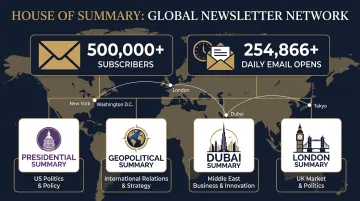
That readership profile maps directly to fintech buyer personas: neobank customers, wealth management prospects, brokerage platform users, and crypto-adjacent professionals following regulatory developments.
Thought Leadership and Co-Authored Editorial
In this model, a fintech brand co-creates articles, analysis, or research pieces with an established editorial platform or independent expert. The brand's name is attached to content that stands on its own merits — which signals genuine expertise rather than paid visibility.
Co-authored editorial also compounds over time. Authority content placed on established platforms accumulates backlinks, search visibility, and reader trust long after the campaign ends — often delivering measurable returns six to twelve months post-publication.
Sponsored Research and Data Reports
The fintech brand funds original research on a topic its audience already cares about, then publishes it through a respected media or research partner. Stripe's 2020 report on regulatory complexity and international growth is a useful benchmark — it functioned as a substantive downloadable asset that positioned the brand as an authority on cross-border payments, not simply a vendor promoting its own product.
What makes this format durable comes down to timing. The Edelman-LinkedIn 2024 B2B Thought Leadership Impact Report found that 95% of business buyers are not actively seeking goods or services at any given time. Nearly 90% of global buyers also report longer purchase cycles. Sponsored research reaches those out-of-market readers with something worth engaging now — establishing the brand well before the purchase decision begins.
The strongest sponsored research assets share a few traits:
- Focused on a specific industry problem, not a broad market overview
- Published through a credible third-party media or research partner
- Designed for sustained distribution, not a single launch moment
How to Create Branded Fintech Content That Actually Converts
Three principles separate branded content that earns engagement from branded content that gets ignored.
Lead with the Reader's Problem, Not the Brand's Solution
The most common mistake fintech brands make is opening with what their product does. Finance-savvy readers disengage immediately — they came for information, not a pitch.
The correct sequence:
- Identify the specific problem or question your target reader has right now
- Deliver genuine insight on that problem — data, context, or framing they haven't seen
- Position the brand's perspective as the informed answer, not as the primary subject
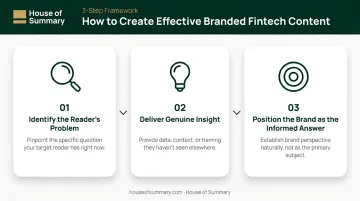
The content's job is to be genuinely useful. The brand earns trust by being the source of that usefulness — not by announcing itself.
Maintain Editorial Transparency
That value-first approach only holds if readers trust what they're reading. Label branded content clearly — make disclosures visible, not buried.
This feels counterintuitive — most brands instinctively want to minimize the "this is an ad" signal. But with finance-savvy readers, the opposite logic applies. A clearly labeled sponsored piece reads as honest. A poorly labeled piece that tries to pass as independent editorial reads as deceptive, and once a reader suspects deception, the brand loses them entirely.
The FTC's guidance on native advertising is clear: disclosures must be prominent and unambiguous. For fintech brands in particular — where credibility is the product — treating transparency as a trust signal rather than a legal checkbox is what separates brands that build audiences from brands that burn them.
Match Depth to Audience Sophistication
Finance-savvy readers won't engage with surface-level content — and they'll remember the brand that wasted their time. Branded content for this audience needs to contain:
- Actual data references, not vague claims
- Specific framing that shows category expertise
- Insight that rewards careful reading, not just a quick skim
A 600-word branded piece that says something substantive will outperform a 1,500-word piece padded with generalities. The quality standard for this audience is the editorial quality of the best finance journalism they already read — the branded content has to meet that bar to earn their time.
Frequently Asked Questions
What are some examples of fintech brands?
Recognizable fintech brands include Stripe and Adyen (payments infrastructure), Wise and Revolut (cross-border transfers), Robinhood and Chime (consumer investing and banking), and SoFi (lending). B2B players like Stripe target developers and CFOs; B2C brands like Chime target retail consumers — and their content strategies differ accordingly.
What are the 4 pillars of fintech?
The four core domains are payments, lending, wealth management, and insurance — a breakdown supported by BIS research. Each carries different content priorities: payments emphasizes efficiency, lending emphasizes access and risk, wealth management emphasizes trust, and insurance emphasizes transparency.
What are the 5 D's of fintech?
The 5 D's — Digitization, Disruption, Democratization, Decentralization, and Data — are a practitioner shorthand, not a formal standard. The framework circulates widely across fintech commentary and works as a useful lens for the innovation story fintech brands typically communicate.
How is branded content different from traditional advertising in fintech?
Branded content delivers value through education or editorial framing rather than direct promotion. This makes it more compatible with compliance requirements and more trusted by financially literate readers who actively ignore banner ads and skip pre-roll video.
What makes branded content effective for finance-savvy audiences?
Effectiveness comes from three things finance-savvy readers evaluate quickly: whether the content matches the editorial quality of its environment, whether it leads with insight rather than promotion, and whether the brand sponsorship is disclosed honestly.
How should fintech brands approach compliance in branded content?
Build legal review into the content workflow from the beginning — not as a final check. Ensure all financial claims are substantiated and accurate. Treat disclosures as trust signals rather than fine print to minimize. Finance audiences respect brands that operate transparently within regulatory constraints.