Introduction
Media buyers at mid-size brands receive upward of 50 sponsorship pitches per month. Without a strong media kit, your newsletter rarely gets a second look — regardless of your open rates, audience quality, or content.
A media kit is the document that either moves a buyer to act or sends them to the next pitch in their inbox. The problem is that most publishers treat it as an afterthought — a PDF assembled the night before a sales call rather than a strategic asset built to do the selling for you.
What follows covers what a winning newsletter media kit actually requires: what to prepare, which elements carry the most weight with serious buyers, and the mistakes that quietly kill deals before they start.
Key Takeaways
- A newsletter media kit is your advertiser-facing sales document — lead with audience quality, not just subscriber numbers.
- Engagement metrics (open rate, CTR) matter more to media buyers than vanity metrics like total list size.
- Clearly define ad formats, pricing, and next steps so buyers can say yes without chasing down details.
- Design signals editorial standards; a cluttered or outdated kit sends the wrong message.
- Treat your media kit as a living document — update it quarterly as your newsletter grows.
What Is a Newsletter Media Kit and Why Do Advertisers Care?
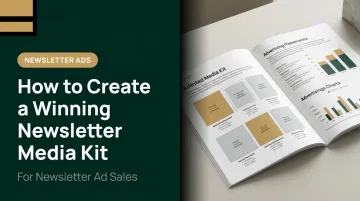
A newsletter media kit is a dedicated document or page that gives potential advertisers everything they need to decide whether to buy. It covers your audience, reach, engagement, available ad formats, pricing, and contact information — all in one place.
This is different from a general press kit or brand overview. A media kit is built specifically for media buyers and brand partnerships, not journalists. Its primary job is to remove obstacles and make the buying decision straightforward.
Why the Newsletter Channel Gets Attention
Newsletter advertising earns serious consideration from media buyers for one straightforward reason: the inbox is a different environment than social or display.
According to eMarketer, roughly 45% of US consumers have installed or used an ad blocker on mobile or a web browser — and globally, 52% across 48 markets have used ad blockers.
Newsletter ads bypass this entirely. They land in the inbox with no algorithm filtering, no visual clutter competing for attention.
Publishers like House of Summary — which operates Presidential Summary, Geopolitical Summary, Dubai Summary, and London Summary — position this as a core advantage: ads appear inside the reading flow, where reader attention is already present.
Direct delivery, editorial context, and opt-in audiences make newsletter advertising resilient — even when broader digital ad markets soften.
What You Need Before Building Your Newsletter Media Kit
A media kit is only as strong as the data and assets behind it. Building one without them leads to vague copy that advertisers dismiss on sight.
You'll need three things ready before you write a single word: your audience and performance data, your ad format inventory, and your brand assets.
Audience and Performance Data
Gather these before writing a single line:
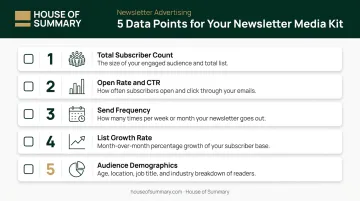
- Total subscriber count across your list (or per publication, if you run multiple)
- Open rate and CTR — your most important engagement signals
- Send frequency — how often each newsletter publishes
- List growth rate — month-over-month or year-over-year
- Audience demographics — geography, profession, seniority, interests — from your ESP or subscriber surveys
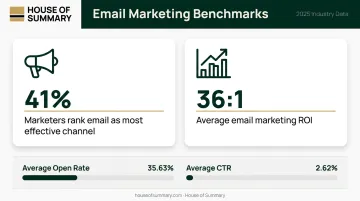
For context on what strong engagement looks like: Mailchimp's December 2023 benchmark data puts the overall average open rate at 35.63% and average CTR at 2.62% across industries. Business and Finance newsletters average 31.35% open rate and 2.78% CTR. If your numbers beat these, lead with them.
Ad Format Inventory
Know what placements you offer before writing anything. Common newsletter ad formats include:
- Dedicated sends (full issue sponsorship)
- Sponsored sections or native editorial placements
- Display banner ads
- Classified or brief text mentions
- Multi-issue or multi-publication bundle packages
Each placement needs a name, a position in the email, and a clear purpose. Once that inventory is documented, you have something concrete to sell — and something concrete to show.
Brand and Visual Assets
Pull these together before you open a design tool:
- Newsletter logo and brand color palette
- Sample issues or screenshots showing ads in context
- Logos or names of past brand partners
- Any press mentions or notable audience recognition
Advertisers scan kits quickly. Logos from recognizable past partners and real ad screenshots do more to build trust than any claim you write.
How to Create a Newsletter Media Kit
Step 1: Write Your Brand Story and Audience Overview
Open with 3–5 sentences that communicate who your newsletter is for, what it covers, and why readers subscribe and stay. This is the "why us" that sets the tone for everything that follows.
Follow with an audience overview framed in terms that matter to an advertiser — not just age or location, but the mindset and behaviors that make your list commercially valuable.
House of Summary, for example, describes its readership as decision-makers, C-suite executives, founders, senior professionals, and high-net-worth individuals whose work requires staying informed about global developments. An advertiser learns far more from that description than from a raw subscriber count.
Step 2: Present Your Performance Metrics Clearly
Lead with open rate and CTR — not subscriber count. Media buyers evaluate audience quality before quantity.
If you publish multiple newsletters, present metrics per publication. A buyer considering a campaign targeting UAE-based executives needs Dubai Summary's numbers, not a blended network average. Breaking metrics out by publication lets buyers self-select the most relevant audience for their campaign, which speeds up their decision.
Present your numbers alongside an industry benchmark so advertisers can put your performance in context without doing extra research. A 38% open rate means more when the buyer can see that the industry average sits around 35%.
Step 3: Define Your Ad Formats and Specifications
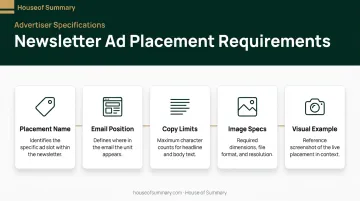
List every available placement with:
- A clear name (e.g., "Primary Sponsored Section," "Native Editorial," "Full-Issue Takeover")
- Position in the email (top-of-email, mid-scroll, footer)
- Character or word limits for copy
- Image dimensions and file requirements
- What the deliverable looks like — ideally with a screenshot from a real issue
Placement tiers matter. A primary sponsor slot at the top of an issue commands a different rate and visibility level than a secondary mention further down. Spelling out that difference helps buyers make informed decisions, including choosing to upgrade.
House of Summary's ad inventory, for instance, spans native editorial placements, display banner ads, full-newsletter takeovers, and multi-newsletter bundle packages across its four publications. Each format serves a different campaign objective, and describing those differences reduces back-and-forth with buyers.
Step 4: Include a Pricing Structure or Rate Card
Provide at minimum a starting price range or CPM. Leaving pricing out forces an extra email exchange — and many buyers won't send it.
For reference on market rates: beehiiv's 2025 sponsorship pricing data puts CPMs typically between $10 and $75 for newsletters with 3,000 to 100,000+ subscribers. Specialized B2B newsletters often command $50 to $100+ CPM, while broader consumer newsletters generally fall between $15 and $35 CPM. Newsletters showing 40%+ open rates and 3–5% CTR on sponsored links can justify higher rates even with smaller audiences.
Also note any:
- Package options (single-issue, multi-week, full-network bundles)
- Volume discounts for longer commitments
- Exclusive sponsorship opportunities
This signals a structured advertising program, not ad hoc deals.
Step 5: Add Social Proof and Past Partnerships
Social proof converts skeptical buyers faster than any pitch. Include:
- Logos or names of brands you have worked with
- Campaign results you are permitted to share (open rate, CTR, conversion metric)
- Press mentions or notable audience recognition
Even one specific result adds more credibility than three paragraphs of self-description.
House of Summary features a testimonial from Faik Serkan Ergun, CEO of BSH Hausgeräte, who reported: "We saw click-through rates 4x higher than Google AdWords." External validation like this shifts your kit from self-promotional to independently verified.
Step 6: End With a Clear Call to Action
Close with one specific next step — email a sales contact, book a call, or download a rate card. Make contact information impossible to miss.
Use a dedicated advertising email rather than a generic contact form. For House of Summary, that means directing buyers to sales@houseofsummary.com. The team typically replies within a few hours. Ambiguity at this stage costs real sponsorship revenue.
What Separates a Winning Media Kit From a Forgettable One
Audience Intent, Not Just Size
A media kit describing 10,000 highly engaged finance executives is more compelling to premium advertisers than one listing 100,000 general subscribers. Specialized B2B newsletters command $50–$100+ CPM versus $15–$35 for broader consumer newsletters. The difference is audience intent.
Frame your audience in terms of intent and commercial behavior, not demographics alone.
Engagement Rate as the Lead Metric
Litmus reports that 41% of marketers rank email as their most effective marketing channel, with an average ROI of 36:1. Open rate and CTR are the metrics that justify that confidence.
A high open rate proves readers are conditioned to engage. A strong CTR proves they act on what they read. Together, these two numbers tell a buyer more about your newsletter's commercial value than any other statistic.
Design That Matches Editorial Quality
The visual presentation of a media kit is a proxy for editorial standards. A well-designed kit signals that the publisher takes the reader experience seriously — which is exactly what an advertiser wants for their brand association.
Match the design tone to your editorial identity. A geopolitics or business publication should feel premium and considered. A lifestyle newsletter can carry a lighter touch. Either way, it should look intentional.
Specificity Over Vague Descriptions
"Sponsored content available" loses deals. Winning media kits specify:
- Word count and format
- Placement position
- Link type (text link, CTA button)
- Exclusivity terms
- Turnaround time
Advertisers should know exactly what they're buying before they reply.
A Frictionless Path to Purchase
Every extra step between "interested" and "booked" reduces close rates. Low friction looks like:
- A dedicated media kit page or downloadable PDF
- A direct advertising email with a fast response time
- Optional rate card download
- A brief FAQ covering common advertiser questions
Common Mistakes Newsletter Publishers Make
Most of these errors share a common thread: they make the buyer's job harder than it needs to be.
- Burying open rates under subscriber count. Experienced buyers know a large but disengaged list is a liability. If your open rate is strong, put it front and center.
- Showing stale numbers. A kit with last year's subscriber figures or logos from brands that no longer advertise signals neglect. Set a quarterly reminder to refresh every metric.
- Overloading the design. Too many ad formats, too many statistics, and too much backstory push buyers toward inaction. Every element should make the purchase decision easier.
- Hiding your pricing. Rate cards behind contact forms filter out serious buyers and waste everyone's time. Listing a starting range upfront attracts advertisers who are already ready to commit.
Frequently Asked Questions
What should a newsletter media kit include?
A media kit needs six things: newsletter overview, audience demographics and engagement metrics, available ad formats with specs, pricing or a rate card, social proof from past partnerships, and clear contact information. Everything else is optional.
How long should a newsletter media kit be?
Aim for 4–8 pages for a PDF, or one well-organized webpage. Cover every key buyer question without overwhelming readers with unnecessary backstory or excessive ad format detail.
What metrics matter most to newsletter advertisers?
Open rate and CTR are the most important signals, followed by subscriber count, list growth rate, and audience demographics. Subscriber count alone won't close a deal with a serious media buyer.
Should I include pricing in my newsletter media kit?
Yes: at minimum, a starting price range or CPM. It removes friction, filters for serious buyers, and positions you as a transparent partner.
What format should a newsletter media kit be in?
A downloadable PDF, a dedicated landing page, or both — most buyers either forward kits internally or reference a URL, so covering both formats is worth the effort.
How often should I update my newsletter media kit?
Refresh all metrics quarterly and review the full kit at least twice a year, especially after significant list growth, new ad formats, or notable brand partnerships. Stale kits signal an unserious publisher.