Introduction
Senior newsletters — both print community bulletins and email editions — represent one of the most underutilized yet high-trust advertising channels available to brands targeting older adults. With 31% of U.S. adults aged 65+ getting news from email newsletters and the 55–64 age group showing the highest email open rate across all demographics at 25.7%, seniors are highly loyal newsletter readers who engage with content more deeply than most digital formats.
Placing an ad in a senior newsletter sounds simple. In practice, results vary widely based on which newsletter you choose, how the ad is formatted, and what the copy actually says. A display ad in a local retirement community bulletin performs very differently than a sponsored segment in a national digital senior publication, even when both technically reach the same demographic.
Most campaigns underperform not because the audience is wrong, but because the execution ignores what makes senior newsletter readers different. This guide breaks down exactly how to get it right.
Key Takeaways
- Senior newsletters offer direct access to a high-trust, loyal audience with strong purchasing power and ads that bypass ad blockers entirely
- Choosing the right newsletter, matching your format to the publication, and writing in plain language are the three levers that drive results
- Print and digital senior newsletters require different approaches to ad placement and creative
- Prioritize newsletters with verified demographics, clear readership numbers, and trust-building editorial tone
- Plan for 2–3 placements before results become measurable
How to Advertise in Senior Newsletters
Step 1: Research and Identify the Right Senior Newsletter
Senior newsletters fall into two broad categories: print publications (community center bulletins, retirement community newsletters, nursing home papers) and digital email newsletters aimed at the 55+ demographic. Knowing which type your audience reads is the starting point.
Locating Print Senior Newsletters:
Contact these organizations directly:
- Local senior centers (there are more than 11,000 senior centers serving over 1 million older adults daily)
- Retirement communities (approximately 32,231 assisted living communities operate in the U.S.)
- AARP chapters
- Nursing home activity coordinators
Many print senior newsletters do not have a web presence. Expect to make direct phone calls or send emails to locate them.
Locating Digital Senior Newsletters:
Search for email newsletter networks that publish audience demographics, subscriber counts, and open rate data. Examples include:
- Next Avenue: Over 100,000 newsletter subscribers
- Sixty and Me: 92,000 daily newsletter subscribers
- AARP newsletters: 12 distinct AARP newsletters across multiple topics
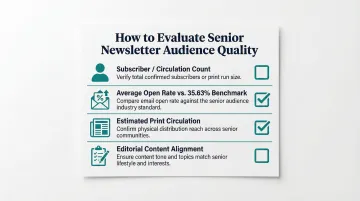
Evaluate Audience Quality Indicators:
Before committing, assess:
- Subscriber or circulation count — How many people receive each issue?
- Average open rate (digital) — Is it above the 35.63% industry average?
- Estimated circulation (print) — How many copies are distributed?
- Editorial content alignment — Does the newsletter's topic match your product or service category?
Step 2: Contact the Publisher and Understand Ad Options
Most community senior newsletters are managed by a coordinator, editor, or nonprofit administrator — not a dedicated sales team. Keep outreach direct, professional, and clear about your ad intent and budget range. Once you have a contact, ask specifically about available formats and rates.
Typical Ad Formats Available:
- Display ads — Banner or box ads in print newsletters
- Sponsored segments — A short text block or sponsor note
- Dedicated advertiser spotlights — Featured placement in digital newsletters
- Classified-style listings — Text-only ads in smaller print publications
Some print newsletters only offer classified listings. Ask upfront what formats are available.
Request Key Information:
- Media kit or rate card (if available)
- Circulation numbers
- Publication frequency
- Audience demographic data
If a media kit doesn't exist, ask for basic metrics directly. When data is sparse, request references from past advertisers or propose a single trial placement before committing to a longer run.
Step 3: Select Your Ad Format and Placement Position
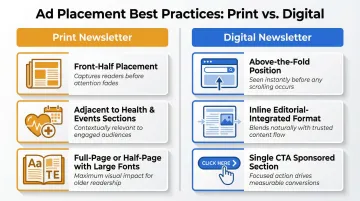
Ads near the top or adjacent to high-value editorial content — health tips, community events — consistently outperform back-page classifieds. Position is as important as the ad itself.
Print Newsletter Placement Best Practices:
- Full-page or half-page display ads with large fonts and high-contrast visuals outperform small text-heavy placements
- Front-half placement beats back-page positioning
- Ads adjacent to popular recurring sections (event calendars, health columns) get higher readership
Digital Newsletter Placement Best Practices:
- A clearly labeled "Sponsored" section with a single call to action performs better than banner-style ad images
- Above-the-fold placement is critical — users spend 57% of their page-viewing time above the fold
- Inline editorial-integrated ads bypass "banner blindness"
Step 4: Create and Submit Your Ad
Confirm Submission Requirements:
- File format — Print typically requires print-ready PDFs; digital newsletters may accept HTML snippets, image files, or plain text copy
- Deadlines — When must materials be submitted?
- Formatting responsibility — Will the publisher format the ad, or do you provide print-ready artwork (a finalized file requiring no further design work)?
Mobile Optimization for Digital Ads:
With 90% of adults aged 50+ owning a smartphone and 81% of mobile users preferring to open emails on their smartphones, a poorly formatted ad on mobile will cost you clicks regardless of how strong the copy is.
Technical Checklist:
- Landing page loads quickly on mobile
- Text is readable without zooming
- Click targets (buttons, links) are large enough for easy tapping
- Forms (if applicable) are simple and mobile-friendly
Step 5: Track Performance and Optimize
Key Metrics to Monitor:
For Digital Newsletters:
- Click-through rate (CTR)
- Landing page visits from the newsletter source
- Conversion actions (form fills, purchases, calls)
For Print Newsletters:
- Use a unique phone number to track calls
- Create a dedicated URL or QR code
- Offer a coupon code specific to the newsletter
Plan for Multiple Placements:
Newsletter ads typically require 2–3 consecutive placements before showing measurable lift. Research shows that repetition improves older adult memory for automated messages, and maximum attitude toward an advertisement is reached at approximately 10 exposures.
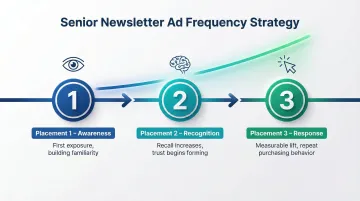
Budget for at least a 3-issue test run before evaluating whether a placement is worth continuing.
When Senior Newsletter Advertising Makes Sense (and When It Doesn't)
Not every brand belongs in a senior newsletter — and placing ads in the wrong channel wastes budget. This channel works best when a highly targeted, trust-oriented audience matters more than raw reach. It's well-suited for businesses offering:
- Healthcare and wellness
- Financial planning
- Senior living communities
- Home services
- Travel
- Legal services (estate planning)
- Local businesses
The spending power is real: the 50+ population contributed $8.3 trillion to the U.S. economy in 2018 and accounted for 56 cents of every dollar spent.
When It May Not Fit
- Brands targeting only a sub-segment of seniors (e.g., only urban tech-savvy retirees) may find broad community newsletters wasteful
- Businesses with very short sales cycles needing immediate mass reach may find newsletter lead times and limited circulation constraining
Alternatives to Consider
- Facebook advertising — 74% of adults aged 50–64 and 57% of adults aged 65+ use Facebook
- Direct mail campaigns — Average response rate is 4.4% vs. 0.12% for email, with adults aged 45–54 responding at 14.1%
- Community event sponsorships — Local presence builds trust and visibility among active seniors
Key Variables That Determine Ad Performance
Two advertisers placing ads in the same senior newsletter can get vastly different results. Outcomes depend almost entirely on controlling the right variables.
Newsletter Audience Quality
Engagement level matters more than raw subscriber count. A small, loyal, niche-focused senior newsletter will typically outperform a large but low-engagement publication.
High-engagement newsletter networks consistently outperform display advertising — some reporting click-through rates 4x higher than Google AdWords — precisely because inbox delivery commands undivided reader attention with no competing distractions.
When evaluating any newsletter's performance, look for:
- Open rates above industry benchmarks — Healthcare newsletters average 23.7% open rates; education averages 28.5%
- Click-to-open rate (CTOR) — Average CTOR ranges from 5.3% to 10.5% across industries
- Editorial tone aligned with high-intent readers — Does the content build trust and authority?
Ad Placement and Frequency
Placement position and recurring exposure significantly influence recall and response rates among senior readers.
Placement position matters from the first impression:
- Above-the-fold placement in digital newsletters captures attention immediately
- Front-half placement in print publications gets more deliberate reading time
- Ads adjacent to popular editorial sections benefit from the reader's existing focus
Repetition compounds that attention into trust. Older adults are more likely to engage in repeat purchasing, and familiarity accelerates that decision. Research shows recall increases linearly up to the 8th exposure — which is why recurring placements outperform one-time insertions for this audience.
Publication Frequency and Timing
Not all newsletter cadences work the same way. Monthly print publications and weekly digital emails create different attention windows:
- Monthly publications get more deliberate reading time as readers review community updates and events
- Weekly emails get more frequent but shorter attention spans
- Sending at least one email per week increases engagement by 3x
Match campaign duration to publication frequency. For monthly newsletters, plan at least a 3-month run (3 insertions). For weekly digital newsletters, commit to 4–6 weeks.
Relevance of Editorial Alignment
Ads placed in newsletters whose editorial content closely matches the advertiser's category produce higher response rates. A home care services ad in a senior health newsletter will outperform the same ad in a general community bulletin because the reader's mindset is already aligned with the topic.
This is contextual relevance in practice: the ad feels like a natural extension of the content, not an interruption.
Ad Copy and Creative Guidelines for Senior Readers
Ad copy written for a general adult audience will underperform in senior newsletters. Older readers prioritize clarity, trust, and relevance — not urgency or novelty — so every element of your ad needs to reflect that.
Language and Readability
Use short sentences, plain English, and active voice. Avoid jargon, fine print, or multiple competing messages in one ad.
Copy Structure:
- One clear headline
- One primary benefit statement
- One call to action
- No clutter
Font Size and Contrast (Print Ads):
The American Printing House recommends 18-point font for body text, 20-point for subheadings, and 22-point for headings. Fonts should be sans-serif (no decorative elements).
The American Foundation for the Blind recommends a minimum of 18-point sans-serif type such as Arial or Verdana.
Color Contrast:
WCAG 2.1 Level AA requires a contrast ratio of at least 4.5:1 for normal text and 3:1 for large text. Use dark text on light backgrounds.
These visual standards do more than aid readability — they signal professionalism, which directly affects whether seniors trust your ad.
Trust and Tone
Seniors are skeptical of advertising that feels manipulative or excessively promotional.
Copy should:
- Lead with a clear benefit statement
- Include a credibility signal (phone number, physical address, local business name)
- Use a warm, direct tone rather than high-pressure language
Example:
- ❌ "Limited time offer! Act now before it's too late!"
- ✅ "Call us at (555) 123-4567 to schedule a free consultation"
Call to Action Design
CTAs must be simple and specific:
- "Call us at [number]"
- "Visit [URL]"
- "Bring this ad in for [offer]"
Vague phrases like "Learn more" or "Get started today" underperform.
Digital newsletters add another layer of requirements. Since 47% of people check email on mobile, an ad that renders poorly on a phone loses nearly half its audience before a single word is read.
For Digital Newsletters:
- Make the CTA button or link visually prominent
- Ensure the linked page loads quickly
- Confirm the destination page displays cleanly on mobile screens
Common Mistakes to Avoid When Advertising in Senior Newsletters
Treating All Senior Newsletters as Interchangeable
Advertisers often buy space in the first newsletter they find rather than vetting audience quality, publication frequency, or editorial fit. This leads to wasted spend on publications that don't reach the right seniors for their product.
Before committing budget, review at least three to five options — compare readership demographics, issue cadence, and whether the editorial tone matches your brand.
Using Ad Creative Designed for Younger Audiences
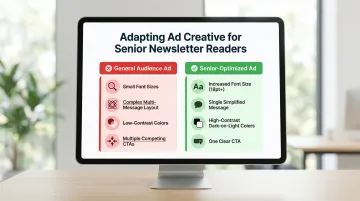
Repurposing a social media banner ad or a display ad with small text, dark backgrounds, and multiple CTAs will underperform in senior newsletter contexts.
Ad creative must be adapted, not recycled:
- Increase font sizes
- Simplify the message
- Use high-contrast colors
- Feature one clear CTA
Don't Measure After a Single Run
Senior readers typically need multiple exposures before acting, so a single insertion rarely produces data worth measuring against.
Advertisers who cancel after one run miss the compounding trust effect that repeated newsletter presence builds. Plan for at least 2–3 placements before evaluating results — that's when patterns in response rates become reliable enough to act on.
Frequently Asked Questions
How to advertise in 55+ communities?
The most effective approaches are placing ads in community newsletters (print or digital), sponsoring local events, and distributing materials through the activity office. Senior newsletters tied to 55+ communities are often the highest-trust channel available.
Where is the best place to advertise to seniors?
Senior newsletters, direct mail, Facebook (for the 55–70 age group), and community print publications consistently rank highest for engagement. Newsletters have a particular edge: only 15.6% of users aged 65+ and 24.8% aged 55–64 use ad blockers, meaning your message reaches the inbox unfiltered.
What can I say instead of "older people"?
Preferred terms include "seniors," "older adults," "retirees," "adults 55+," or "adults 65+." The right term depends on context — "older adults" is widely accepted in health and social settings. Avoid "elderly" in ad copy, as many in this demographic find it patronizing.
How much does it cost to advertise in a senior newsletter?
Small community print newsletters typically charge $50–$200 per issue for a display ad. Established digital senior email newsletters with large, verified audiences can run several hundred to several thousand dollars per placement. Pricing reflects audience size and engagement quality.
What ad formats work best in senior email newsletters?
Sponsored text segments (a short paragraph with a clear headline and one link) and simple banner images with large, high-contrast text consistently outperform complex HTML ads. A single, clear CTA with a landing page optimized for mobile is essential for digital newsletter placements.
How do I know if a senior newsletter's audience is worth advertising in?
Ask for verified subscriber count, open rates, publication frequency, and basic audience demographic data. Target newsletters with open rates above the 21.5% industry average and click-to-open rates (CTOR) above 5.3% — and confirm the audience aligns with your product category.