The concept is simple. The execution is where most publishers struggle. They don't know how to package their value, can't price with confidence, and send generic pitches that get ignored. A newsletter with 8,000 engaged subscribers in a specific niche can outperform one with 80,000 passive readers — but only if the publisher knows how to communicate that.
This guide covers everything from what to prepare before your first outreach to how to pitch, price, and turn one-off placements into repeat revenue.
Key Takeaways
- Prepare before you pitch — know your audience, track key metrics, and have a media kit ready
- Niche and engagement beat raw subscriber count — specificity commands premium CPMs
- Three pricing models dominate: CPM, flat-rate, and CPC, each suited to a different stage of your newsletter's growth
- Personalized outreach to the right contacts converts; generic mass pitches rarely do
- Long-term sponsor relationships generate predictable revenue; one-off deals don't
What You Need Before Approaching Sponsors
Sponsors make fast decisions. The newsletter that gets a "yes" is the one that makes audience fit, engagement quality, and placement value obvious at a glance. Preparation isn't a nice-to-have — it directly determines whether your outreach converts.
Audience Definition and Niche Clarity
A clearly defined niche makes a newsletter more attractive to sponsors than a large but generic one. A newsletter covering geopolitics for global executives will always be more valuable to specific advertisers than a broad news digest with ten times the subscribers.
Before reaching out to anyone, write a one-sentence audience profile that answers three questions:
- Who reads it? (job title, industry, life stage)
- What do they care about? (topics, problems, ambitions)
- What do they spend money on? (categories relevant to potential sponsors)
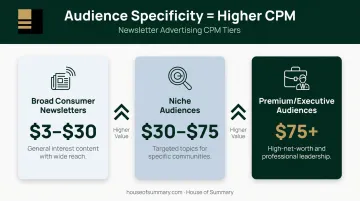
This positioning difference shows up directly in pricing. According to Paved's 2026 sponsorship guide, broad consumer newsletters command CPMs of $3–$30, while niche audiences reach $30–$75, and premium or executive audiences can command $75+ CPM. The same send, to the right audience, can generate 10x the revenue.
House of Summary's network illustrates this well. Publications like Geopolitical Summary and Dubai Summary reach C-suite executives, founders, and policy professionals — an audience that naturally attracts premium advertisers like BSH Hausgeräte, who specifically cited the "high-intent readers" and "audience quality" as reasons for their placement.
Metrics That Matter to Sponsors
Sponsors evaluate newsletters on a short list of performance signals:
| Metric | What it signals to sponsors |
|---|---|
| Open rate | Whether your subject lines work and readers actually show up |
| Click-through rate (CTR) | Whether the audience acts on what they read |
| List size | Reach and scale of the placement |
| Growth rate | Trajectory and momentum of the audience |
For benchmarks: beehiiv's 2025 State of Email Newsletters found a 37.67% average open rate and 4.59% CTR across newsletters in 2024. If your metrics are at or above those levels, say so explicitly in your pitch — context matters when a sponsor is comparing options.
Engagement always outweighs raw size. A newsletter with a 45% open rate and consistent clicks tells a sponsor their ad will be seen and acted on. When sponsors weigh options, that signal matters far more than a bloated list with low activity.
Building Your Media Kit
Your metrics become the foundation of your media kit — the document that converts a sponsor's interest into a signed placement. Keep it clean, scannable, and data-forward. At minimum, include:
- Newsletter name, description, and publishing frequency
- Audience demographics (geography, job titles, income level where relevant)
- Key metrics: open rate, CTR, list size, and growth rate
- Sponsorship formats available and pricing
- A sample issue
- Contact information
Format it as a PDF and update it quarterly. Outdated metrics erode sponsor confidence fast. Platforms like Paved let publishers connect their email service provider so metrics refresh automatically, which matters when you're managing several active inquiries.
How to Get Newsletter Sponsors: Step-by-Step
Landing sponsors follows a repeatable sequence. Skip a step and you'll either get ignored or end up with deals that undervalue your audience.
Step 1: Build Your Prospect List
Don't guess at which brands might be interested. Research it:
- Check which brands sponsor similar newsletters in your niche — if they're already buying newsletter ads, they understand the format
- Look at the links your subscribers click most; those categories are where your audience spends money
- Search company websites for "Advertise" or "Partnerships" pages to find the right contact
Organize prospects into three tiers:
- Tier 1 — Perfect fit: audience overlap is obvious, brand already buys newsletter ads
- Tier 2 — Good match: strong category alignment, may need more education on the format
- Tier 3 — Possible: loosely relevant, lower priority
Track everything in a simple spreadsheet: company name, contact person, date reached, response received, and follow-up date.
Step 2: Set Your Rates
Three pricing models dominate newsletter sponsorships:
| Model | How it works | Best for |
|---|---|---|
| CPM | Cost per 1,000 opens or subscribers | Publishers with larger, growing lists |
| Flat-rate | Fixed price per issue | Smaller lists; simpler deals |
| CPC | Paid per click | Performance-focused sponsors; highly engaged audiences |
For reference, Paved's pricing guide shows newsletter CPMs typically running $15–$30 per 1,000 opens for primary placements, with CPC rates around $1–$5 per click. For flat-rate deals by list size:
- ~3,000 subscribers: approximately $75–$150 per placement
- ~5,000 subscribers: approximately $125–$250
- ~10,000 subscribers: approximately $250–$500
Above-average engagement justifies rates above these baselines regardless of list size. If your open rate is 20 points above the industry average, price accordingly.
Step 3: Craft and Send Your Pitch
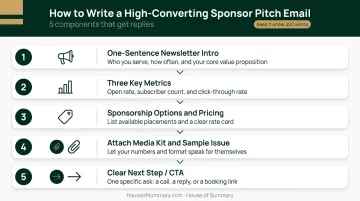
A strong pitch email is short, specific, and easy to act on. Keep it under 200 words. Structure it like this:
- One-sentence intro about your newsletter and audience
- Three key metrics (open rate, CTR, list size)
- Sponsorship options with pricing
- Attached media kit and sample issue
- A clear next step
Personalize every pitch. Reference a specific product launch, campaign, or content from the brand — and address a named person, not "Hi there." In one sentence, explain exactly why their brand fits your audience's behavior. Sponsors ignore generic pitches.
Step 4: Follow Up and Close
Most sponsors don't respond to the first email. Follow up 5–7 business days later with a short message that adds value — share a relevant stat, mention a recent issue topic that aligns with their product, or note a campaign deadline. "Just checking in" adds nothing.
When negotiating:
- If a sponsor counters with a lower rate, offer a discounted first placement to reduce their perceived risk
- Bundle additional value (extra mentions, social amplification) rather than simply cutting price
- Walk away from deals that require heavy discounting before the first campaign — sponsors who start by undervaluing your audience rarely become repeat buyers
Understanding Newsletter Sponsorship Pricing Models
Pricing confusion is one of the main reasons newsletter publishers either undersell their value or fail to close deals. The right model depends on your stage, niche, and what the sponsor expects from the campaign.
Each model comes with trade-offs. Here's how the three main options compare:
| Model | Best For | How It Works | Watch Out For |
|---|---|---|---|
| CPM | Larger lists | Sponsor pays per 1,000 impressions | No performance guarantee — pays for reach, not outcomes |
| Flat-Rate | Smaller or mid-size lists | Fixed price per issue or placement | Doesn't scale with list growth |
| CPC | Highly engaged audiences | Sponsor pays per click | Risky if your CTR is inconsistent — shifts risk to you |
CPM feels familiar to media buyers from digital ad budgets and scales predictably as your list grows. Flat-rate is easier to quote and removes complexity from the buying decision. CPC can earn more per issue if your engagement is strong, but it's a liability with average click rates.
Calibrating Your Rates
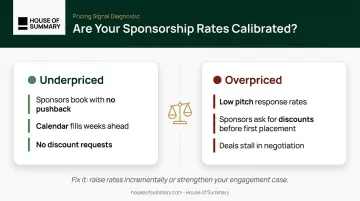
Two clear signals tell you whether your pricing is off:
- Underpriced: Sponsors book placements quickly with no pushback, your calendar fills weeks in advance, and nobody asks for a discount
- Overpriced: Low response rates on pitches, sponsors consistently ask for discounts before the first placement, and deals stall in negotiation
Both are fixable. If you're underpriced, raise rates incrementally with new sponsors while honoring existing commitments. If you're overpriced, reassess your positioning — either adjust pricing or strengthen the engagement case you're making in your pitch.
Common Mistakes When Getting Newsletter Sponsors
Pitching Before You're Ready
Reaching out without a media kit, inconsistent metrics, or a vague audience profile almost always results in silence. Sponsors make quick decisions based on the information in front of them. If that information is missing or unclear, the decision defaults to "no."
Prepare the full package first — media kit, audience profile, metrics, and sample issue — before sending a single pitch.
Treating Every Sponsor as a One-Off Deal
Publishers who focus only on filling a single placement miss the larger revenue opportunity. Predictable income comes from repeat bookings and multi-issue packages, not individual placements.
When closing a deal, propose a multi-issue commitment from the start. Offer a modest discount — 10–15% — for sponsors who book four or more consecutive placements. This reduces churn, simplifies scheduling, and gives sponsors enough runway to actually measure results.
House of Summary structures multi-week and cross-newsletter bundle packages at discounted rates for this reason — sustained presence produces better results for the brand and steadier revenue for the publisher.

Misaligning Sponsor Content with Your Audience
Accepting irrelevant sponsors damages reader trust quickly. A finance-focused newsletter running ads for fast fashion or unrelated consumer products creates cognitive dissonance — and can drive unsubscribes that permanently reduce the list value you're selling.
Beyond audience impact, misaligned sponsors tend to produce weak campaign results. Clicks stay low, conversions don't materialize, and the sponsor doesn't rebook. Only accept placements from brands whose products your readers would genuinely consider.
Compliance matters here too. The FTC updated its Endorsement Guides in June 2023, and the rules apply directly to newsletter sponsorships:
- Label every placement as "Sponsored" or "Ad" near the content itself
- Disclosure must be visible and conspicuous — not buried in footer text
- Linking to a separate disclosure page does not satisfy the requirement
Misaligned sponsors that underperform make this worse: weak results invite scrutiny, and missing disclosures create legal exposure. Get both right from the start.
Frequently Asked Questions
How many subscribers do I need to get newsletter sponsors?
There's no universal minimum. Engagement and niche relevance matter more than list size — a 3,000-subscriber newsletter covering a specific professional category can attract sponsors that a 30,000-subscriber general digest can't. Marketplace platforms like Paved have eligibility thresholds (25,000 for the Marketplace, 50,000 for the Ad Network), but direct sponsorships don't require hitting those numbers first.
How much should I charge for newsletter sponsorships?
Rates depend on list size, niche, and engagement quality. A general starting point from Paved's benchmarks: roughly $75–$150 per placement at 3,000 subscribers, scaling to $250–$500 at 10,000. CPM for primary placements typically runs $15–$30 per 1,000 opens. Above-average open and click rates justify pricing above those baselines.
What should a newsletter media kit include?
At minimum: newsletter description, publishing schedule, audience demographics, key metrics (open rate, CTR, list size, growth rate), sponsorship formats with pricing, a sample issue, and contact information. Past sponsor results significantly strengthen the kit.
What is the difference between CPM, flat-rate, and CPC pricing?
CPM charges per 1,000 opens or subscribers and scales with list growth. Flat-rate is a fixed price per issue regardless of list size, simpler and more predictable. CPC charges per click, rewarding publishers with highly engaged audiences and reducing upfront risk for sponsors.
How do I find brands that want to sponsor newsletters?
Start by identifying brands already advertising in similar newsletters in your niche — they've already bought into the format. Check which links your subscribers click most to identify relevant product categories. Then look up those companies' partnership or advertising pages to find the right contact.
How do I prove results to sponsors after a campaign?
Send a post-campaign report within a week of the send date. Include opens, clicks, and conversions tracked via unique UTM links or promo codes the sponsor provided. Timely, specific reporting builds trust and drives repeat bookings.