
Introduction
The competition for investor attention has never been more concentrated. According to the PitchBook-NVCA Venture Monitor, US venture capital deployed $339.4 billion across 16,709 deals in 2025 — and a median VC firm reviews roughly 200 companies to close just 4 of them. Most pitches never get a second look.
Getting in front of investors means solving two separate problems: positioning your business so it earns attention, and treating investors as a distinct audience that demands its own strategy, channels, and messaging. What works for customers rarely works here.
Investors aren't passive consumers. They come in with specific criteria, compressed timelines, and a high threshold for what's worth their time — which means the margin for generic outreach is essentially zero.
Key Takeaways
- Know exactly which investor type you're targeting — angel, VC, or institutional — before spending a dollar on outreach
- Get your business fundamentals investor-ready before any advertising effort will land
- Investor materials must lead with proof — traction, team credentials, and market data — not projections alone
- LinkedIn, finance-focused email newsletters, and in-person events consistently outperform generic digital advertising for reaching serious investors
- Most outreach fails because the right message never reaches the right investor through the right channel
Know Your Investor Audience Before You Advertise
Not all investors are interchangeable. Advertising to them without understanding who they are and what they're looking for wastes both budget and credibility.
Segment Your Investor Target Before You Spend
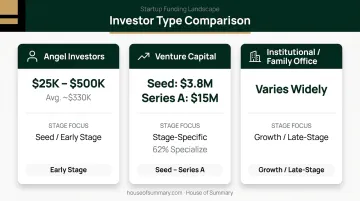
Different investor types operate on entirely different terms:
| Investor Type | Typical Check Size | Stage Focus |
|---|---|---|
| Angel investors | $25K–$500K (avg. ~$330K) | Seed / early stage |
| Venture capital | Median seed round $3.8M, Series A $15M | Stage-specific (62% of VC firms specialize) |
| Institutional / family office | Varies widely | Growth, late-stage |
Before building any campaign, answer three questions about your target investor:
- What stage do they typically back?
- Which industries or verticals match their portfolio?
- What level of involvement do they want post-investment?
Research is accessible. Investor portfolios, LinkedIn activity, and press coverage of past deals reveal patterns that tell you whether your business fits their thesis. Building an investor persona from this data determines which channels and messages will actually land — and which will be ignored.
Understand What Investors Are Evaluating
According to NBER research, 95% of VC firms cite the management team as important and 47% rank it as the single most important criterion. Business model follows at 83%, product at 74%, and market at 68%.
Your advertising must speak directly to these criteria — not generically, and not in the language you'd use for a customer pitch.
Before that messaging reaches investors, there's a compliance layer to consider. Advertising that solicits equity investment carries legal weight — the SEC's Rule 506(c), effective September 2013, permits general solicitation only when all purchasers are accredited investors and the issuer takes reasonable steps to verify accredited status. Consult legal counsel before running any investor-solicitation campaign.
Lay the Groundwork That Earns Investor Trust
Advertising to investors before your business is in strong shape is counterproductive. An investor who clicks on your ad and finds weak financials, a thin team, or a muddled value proposition won't come back.
What to Strengthen Before You Advertise
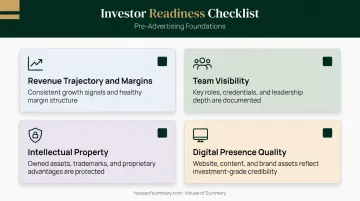
Focus on four areas:
- Revenue trajectory and margins — VCs respond to financial direction, not just current numbers. Fewer than 30% of portfolio companies meet projected financials, so early traction data carries more weight than forecasts
- Team visibility — With the management team ranking as the top VC decision criterion, your leadership's track record and domain expertise need to be publicly visible and verifiable
- Intellectual property — Defensibility matters to investors evaluating competitive moat
- Digital presence quality — Your website, LinkedIn profiles, and press coverage function as informal due diligence. An investor who discovers you through an ad will check these immediately
Once those foundations are solid, the next step is viewing them through the same lens an investor uses.
The Investor Lens Test
Audit every public-facing asset through a simple filter: does this answer the questions a skeptical investor asks in the first 60 seconds?
- Is the market opportunity clear?
- Can the team actually execute, and what's the evidence?
- Is there any proof this is working?
If any asset fails that test, fix it before you advertise. DocSend's pitch deck metrics show the average investor spends just 2 minutes 43 seconds reviewing a deck, with the most time going to financials (23 seconds), team (22 seconds), and traction (15 seconds). Every second counts — so make the answers to those three questions impossible to miss.
Create Marketing Materials That Speak Directly to Investors
Investor-facing materials are not customer-facing content with different headers. The audience, the questions they're asking, and the signals they respond to are distinctly different — and conflating the two is one of the most common mistakes founders make.
The Core Assets You Need
Every investor advertising campaign should be supported by:
- A pitch deck: Evidence-dense and scannable, kept to what's necessary (DocSend data puts the average at 19 pages)
- A one-page business overview: Built for quick-review situations — events, email outreach, and platform profiles
- A password-protected investor page on your website: Consolidates all materials in one place, signals professionalism, and gives you a trackable destination for your advertising CTAs
Lead With Proof, Not Plans
Y Combinator's guidance on investor pitching is direct: an investor pitch is not a customer pitch. It must explain why the company is a good business, not just how the product works. Investors need to understand the problem's scale and how new capital addresses the specific obstacles to growth.
Your materials should reflect that priority:
- Start with traction data: customer growth, engagement metrics, revenue milestones
- Include media mentions and third-party validation — credibility signals investors can verify independently
- Anchor projections to real data. NBER research shows fewer than 30% of portfolio companies meet their projected financials, so projection-heavy decks get discounted fast
- Present everything in a clean, consistent design. A poorly formatted deck undermines credibility before a single number is read
Pick the Right Channels to Reach Investors
Channel selection is where most investor advertising breaks down. Broad social media campaigns and generic display ads reach consumers. Investors are not browsing the open web looking for their next deal.
LinkedIn and Professional Networks
LinkedIn is the most direct digital channel for investor outreach, with 89% of B2B leads originating on the platform according to LinkedIn's own data on B2B decision-makers. For investor advertising specifically, the strategy is:
- Optimize founder and company profiles to reflect investment narrative, not just product story
- Publish thought leadership content that demonstrates market expertise
- Participate in investor-relevant groups with substantive commentary
- Use direct outreach with personalized, specific messages — not templates
LinkedIn works for investor discovery. It rarely closes deals on its own.
Finance-Focused Email Newsletters
Finance and business newsletters are among the most targeted environments available for investor-facing advertising. Unlike social feeds, newsletter placements reach readers who have deliberately opted into specific subject matter — and deliver in the one environment where there's no algorithm filtering your message.
Financial services email achieves a 27.1% open rate and 2.4% CTR according to Campaign Monitor's benchmark data — outperforming most digital channels. Newsletter ads also sidestep ad blockers, which affect 21% of desktop users globally according to PageFair/Blockthrough's 2022 report, a structural advantage display advertising cannot match.
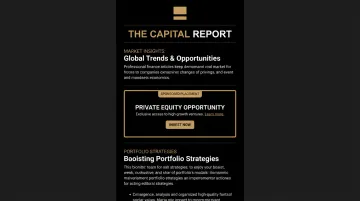
For brands targeting investor demographics, placement in specialized finance and business newsletters puts your message in front of an audience already primed for business and financial content. The House of Summary network, for example, reaches 500,000+ subscribers including executives, decision-makers, and high-income professionals concentrated in New York, Los Angeles, London, and Dubai.
Its publications — Presidential Summary, Geopolitical Summary, London Summary, and Dubai Summary — serve readers whose professional roles require staying current on global markets and policy. That editorial context makes investor-facing brand messages land naturally rather than interrupting.
In-Person Events and Platform Listings
Additional channels to consider:
- Sector-specific conferences and pitch competitions — put you in front of investors who are actively in deal-flow mode
- Angel network events — ACA member groups invested ~$950M across 1,000+ companies in 2021, indicating meaningful deal flow through these networks
- Online platforms — AngelList reports $171B+ in platform assets with 72,000+ investors; Wefunder claims 1M+ investors; these environments attract investors in active discovery mode, not passive browsing
That deal flow context matters: per NBER data, only about 10% of VC sourcing comes from inbound company contact. Professional networks and referrals dominate. Events accelerate introductions that advertising alone cannot manufacture.
Common Mistakes to Avoid When Advertising to Investors
Most investor outreach fails not because the idea is weak, but because the messaging makes avoidable errors. Three patterns show up repeatedly:
Advertising to every investor type at once. Casting too wide a net dilutes the message and signals poor judgment. Investors want founders who understand who the right financial partner is — not founders chasing whoever has capital.
Framing investor content like customer content. Customer messaging emphasizes product benefits. Investor messaging must address market size, exit potential, revenue trajectory, and use of capital. Research on VC behavior consistently shows that interest generated at the awareness stage evaporates when the pitch itself is framed for the wrong audience.
Skipping the follow-up infrastructure. An ad creates a window of attention, not a closed deal. Without a clear CTA, a dedicated landing page, and a meeting booking flow, generated interest dissipates before it converts. The ad works only as well as the system behind it.
Frequently Asked Questions
What is the most effective channel for advertising to investors?
High-intent, niche channels — finance-focused email newsletters, LinkedIn, and investor-specific platforms like AngelList — consistently outperform broad digital advertising. They reach investors in environments they actively trust and engage with, rather than interrupting their general browsing.
Is it legal to advertise for investors?
In the US, SEC Rule 506(c) — effective September 2013 — permits general solicitation when all purchasers are accredited investors and the issuer takes reasonable steps to verify accredited status. Always consult legal counsel before running any investor-solicitation advertising campaign.
What should investor-targeted advertising include?
A clear articulation of the market opportunity, evidence of traction, and a compelling team narrative. Pair those with a specific call to action — a landing page, a deck download, or a meeting request — that moves the investor to the next step.
How do you identify the right investors to target before advertising?
Research investor portfolios, published investment theses, and LinkedIn activity to build a clear investor persona. Then match your advertising channels and messaging to where and how those investors consume information — not where your customers do.
Does social media work for reaching investors?
LinkedIn works well for direct outreach and thought leadership. General social platforms deliver a low signal-to-noise ratio for investor audiences. Targeted, high-quality content environments like finance-focused email newsletters and professional communities consistently yield better results.
What makes investors respond to advertising?
Credibility signals drive response: proven traction, a strong team, a clearly defined market problem, and a growth narrative grounded in evidence. Investors respond when advertising shows a business already in motion — not just promising potential.