
Introduction
304 million people now live outside their country of birth. That figure, confirmed by mid-2024 UN data, has nearly doubled since 1990 and represents roughly 3.7% of the entire world's population. If all international migrants formed a single country, it would rank as the fourth most populous on Earth.
Yet the numbers alone don't capture the full picture. Alongside voluntary migrants — people moving for work, education, or family — a parallel crisis of forced displacement has pushed 123.2 million people from their homes through conflict, persecution, and climate stress. That's a record high.
Migration reshapes labor markets, drives remittance flows worth nearly $905 billion annually, and increasingly determines electoral outcomes across Europe and the Americas. For policymakers, economists, and business leaders, these shifts are impossible to ignore. This article breaks down what's actually happening, why it's accelerating, and where the data points next.
Key Takeaways
- The global migrant population hit 304 million in 2024 — up from 275 million in 2020, growing triple the rate of overall population growth.
- Forced displacement reached a record 123.2 million people, including 36.8 million refugees.
- More than half of all migrants move within their own region, not to distant wealthy countries.
- Remittances reached $905 billion in 2024, outpacing both global foreign direct investment and development aid to low- and middle-income countries.
- Migration volumes are projected to keep rising through 2040, driven by economic inequality, aging workforces, conflict, and climate stress.
The Global Migrant Population Has Reached a Record High
The scale of today's migration is genuinely unprecedented. According to the UN's International Migrant Stock 2024 data, 304 million people worldwide lived outside their country of birth as of mid-2024 — nearly double the 153.9 million recorded in 1990 and close to four times the 77.1 million in 1960.
Between 2020 and 2024 alone, the migrant population grew by 10.4% — roughly triple the 3.5% growth of the general global population. That gap — migrant growth outpacing overall population growth by 3x — is the defining feature of the current era.
Where Migrants Are Going
The United States remains the single largest destination by a wide margin:
- US: Over 52 million migrants (17.2% of all global migrants)
- Germany: Second largest destination in Europe
- Saudi Arabia, UK, France: Round out the top five globally
- Europe and North America together account for approximately 51% of all international migrants
Raw totals, though, obscure how thoroughly some countries depend on foreign-born residents. Qatar (76.7% foreign-born) and the UAE (74%) have migrant populations that dwarf their native-born citizens.
The Gulf Cooperation Council states have structured key industries around imported labor — particularly from South and Southeast Asia — with workers from India, Bangladesh, Nepal, and the Philippines filling construction, hospitality, and service roles at scale.
Where Migrants Are Coming From
Top origin countries by emigrant population:
- India: 18.5 million emigrants — the largest diaspora in the world
- China, Mexico, Russia: Major sending countries across multiple decades
- Ukraine: Recorded a 124% increase in its emigrant population between 2020 and 2024 — the largest percentage surge of any country, driven by the ongoing war with Russia
Mexico, by contrast, saw only a +1.3% increase in emigrants over the same period, suggesting that emigration pressure from Mexico has stabilized even as global migration accelerated.
Forced Displacement Has Reached a Historic High
Forced displacement has now reached a scale with no modern precedent — and the numbers require attention from anyone tracking global risk, policy, or population shifts.
According to UNHCR's Global Trends Report 2024, by the end of 2024:
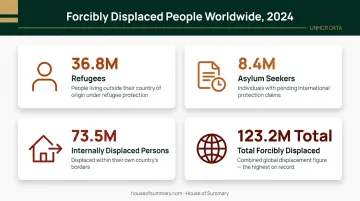
- 36.8 million refugees under UNHCR mandate
- 8.4 million asylum seekers
- 73.5 million internally displaced persons (IDPs)
- Total: 123.2 million forcibly displaced people worldwide
The forcibly displaced population has tripled since 2000, when it stood at approximately 38 million. That growth is not gradual — it tracks directly to a series of protracted and acute crises.
The sharpest surges have come from Syria (ongoing since 2011), Afghanistan (accelerating sharply after the 2021 Taliban takeover), South Sudan, Sudan, and Myanmar. Ukraine's invasion in 2022 added a different dimension: the fastest single-event displacement surge in European history, with millions crossing into Poland and neighboring EU states within weeks.
The Distinction That Matters
Voluntary migrants — people moving for economic opportunity, education, or family reunification — choose to move and retain the right to return. Forced migrants have no such choice.
A refugee is formally recognized under international law as someone fleeing persecution, conflict, or serious harm, and is entitled to legal protections including non-refoulement (the right not to be returned to danger). An asylum seeker is someone whose claim for refugee status is still being processed.
The distinction has significant policy implications: refugees require different legal frameworks, integration support, and often long-term resettlement, especially when conflicts become protracted.
Children Bear a Disproportionate Share
Roughly 40% of all forcibly displaced people are children — approximately 48.8 million. An estimated 2.3 million children have been born as refugees, with no country of origin to return to. For host nations, that means managing education, healthcare, and social infrastructure demands that extend across generations — not just emergency relief cycles.
Intraregional Migration Is the Dominant Pattern
The popular image of migration — desperate journeys from the Global South to wealthy Northern countries — is real, but it describes a minority of global migration flows.
More than 53% of all international migrants in 2024 moved within their own region, not to OECD countries. The regional breakdowns make this pattern even clearer:
- 86% of migrants in Africa come from within Africa
- 80% of migrants in Latin America and the Caribbean originate from the same region
- Venezuelan displacement has been primarily absorbed by Colombia, Peru, Ecuador, and Chile — not Europe or North America
Proximity, lower relocation costs, shared languages, and existing ethnic or cultural networks all drive intraregional flows. East African labor mobility between Kenya, Uganda, and Tanzania follows well-established corridors shaped by both economic opportunity and colonial-era border arrangements.
Intraregional dominance does not mean cross-regional flows are negligible — some are enormous. The South and Southeast Asia to Gulf states corridor moves millions of workers from India, Bangladesh, Nepal, and the Philippines into temporary employment contracts across Saudi Arabia, the UAE, Qatar, and Kuwait. IOM data consistently ranks this among the highest-volume labor migration flows anywhere in the world.
Climate Change as a Migration Driver
Climate change is now a measurable migration driver, with its effects concentrated in sub-Saharan Africa, South Asia, small island nations, and drought-prone regions of the Sahel.
Several interlocking pressures push communities toward displacement:
- Rising sea levels eroding coastlines and flooding low-lying land
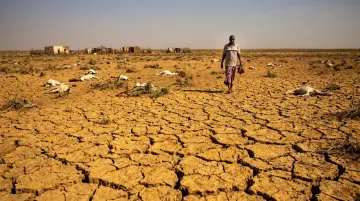
- Agricultural disruption from erratic rainfall and prolonged droughts
- Desertification rendering formerly productive land unusable
- Increasingly frequent extreme weather events destroying homes and infrastructure
Kiribati, a Pacific island nation, has been urging residents to proactively consider relocating abroad as sea level rise threatens its long-term habitability.
Most climate-driven migrants currently move within national borders or to nearby countries rather than internationally. This is largely because the most climate-vulnerable populations — subsistence farmers, coastal communities, informal urban dwellers — often lack the resources required for long-distance migration.
The World Bank's Groundswell report projects that up to 216 million people could be displaced internally by climate change by 2050 across six world regions, under pessimistic scenarios. For executives and planners, that scale of internal displacement has real downstream consequences — from labor market disruptions and agricultural supply chain instability to increased pressure on urban infrastructure in receiving regions.
What's Fueling Today's Global Migration Trends
No single driver explains global migration — it emerges from overlapping economic, demographic, political, and environmental pressures that interact differently by region.
Demographic Imbalances
Aging, shrinking workforces in high-income countries are creating structural demand for migrant labor. The OECD warned in 2025 that population aging will cause significant labor shortages and fiscal pressures across member countries — a trend that migration is, increasingly, the only realistic short-term solution.
Simultaneously, rapid population growth in parts of sub-Saharan Africa, South Asia, and Central America is generating labor surpluses that local job markets cannot absorb.
Economic Inequality
The income gap between high- and low-income countries remains the dominant pull factor in voluntary migration. Expanding internet access — now reaching more than 5.4 billion people globally — is accelerating this dynamic by allowing more people in low-income countries to identify and pursue opportunities abroad.
Conflict and Governance Failures
Ukraine's 124% emigrant surge between 2020–2024 is the starkest recent example, but Afghanistan, Sudan, and Myanmar all represent ongoing crises where political instability and conflict produce sustained displacement. In each case, what starts as emergency flight tends to harden into permanent resettlement — a shift that carries compounding costs for host nations and deep demographic consequences for origin countries.
Urbanization and Informal Settlements
Rapid urbanization in developing countries is a dual-sided driver. It exposes populations to global opportunity and migration networks, while simultaneously straining city infrastructure. In sub-Saharan Africa, approximately 56% of the urban population lives in informal settlements according to World Bank data — conditions that, for many, accelerate the calculus toward emigration.
How Migration Is Reshaping Economies and Politics
The Remittance Economy
Remittances — money migrants send home to their families — have become one of the most consequential financial flows in the global economy. According to the World Bank, remittances reached nearly $905 billion globally in 2024, with $685 billion going specifically to low- and middle-income countries.
That figure exceeds the combined total of global foreign direct investment and official development assistance to those same countries. Remittances are now the single largest external financial inflow for much of the developing world.
The dependency is structural in several countries:
| Country | Remittances as % of GDP |
|---|---|
| Tajikistan | ~45% |
| Nicaragua | ~27% |
| Lebanon | ~27% |
| Honduras | ~26% |
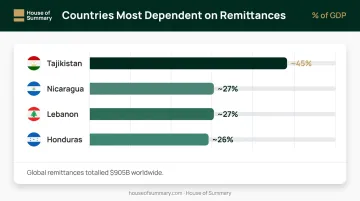
For these economies, migrant workers abroad aren't just individuals seeking better wages — they're a primary economic support mechanism.
Political Backlash and Electoral Consequences
Rising migration volumes have fueled significant political backlash in destination countries. Nativist and anti-immigration movements have gained ground across Europe, with migration policy emerging as a decisive issue in recent EU parliamentary elections and national votes in France, Germany, Italy, and the Netherlands.
The political narrative, however, runs ahead of the economic data. Research consistently shows migrants contribute net positively to host economies through labor, tax revenue, innovation, and entrepreneurship — yet that evidence rarely reaches the debate in time to shape policy before elections are decided.
For readers tracking how migration policy is reshaping electoral outcomes and foreign policy across Europe and the Americas in real time, House of Summary's Geopolitical Summary newsletter covers these developments Monday through Saturday — providing concise, human-written analysis of the power shifts and policy decisions shaping today's world.
Frequently Asked Questions
What are the current global migration trends?
The global migrant population reached 304 million in 2024, with forced displacement hitting a record 123.2 million. More than half of all migrants move within their own region, and remittances from migrants to developing countries surpassed $905 billion annually — a scale that now exceeds all foreign aid and direct investment combined.
Why has global migration increased?
Migration has accelerated due to a convergence of factors: persistent income gaps between rich and poor countries, aging workforces in high-income nations creating labor demand, ongoing conflicts in Ukraine, Afghanistan, Sudan, and Myanmar, and growing climate-related displacement.
Are more Mexicans leaving the US than coming?
Mexico recorded one of the smallest percentage increases (+1.3%) in its emigrant population between 2020–2024, suggesting relatively stable flows. For the most current net migration figures between Mexico and the US, Pew Research Center and the US Census Bureau publish periodic updates tracking directional flows, which have fluctuated significantly across different policy periods.
Which country has the most migrants in the world?
The United States hosts the largest number of migrants in absolute terms — over 52 million people, representing 17.2% of all global migrants. However, Qatar (76.7%) and the UAE (74%) have the highest migrant shares as a proportion of their total population, meaning migrants outnumber native-born citizens by a substantial margin.
What is the difference between a migrant and a refugee?
A migrant is broadly anyone who moves to another country, whether voluntarily or involuntarily. A refugee is someone formally recognized under international law as fleeing persecution, conflict, or serious harm — and is entitled to specific legal protections, including the right not to be forcibly returned to danger.
What role do remittances play in global migration?
Remittances reached nearly $905 billion in 2024, exceeding the combined total of foreign direct investment and official development aid to developing countries. For countries like Tajikistan, where remittances represent roughly 45% of GDP, these flows function as a structural pillar of the national economy — not a supplement to it.