
Introduction
Picture this: a patient sees a hospital billboard during their commute, searches the provider online that evening, lands on a website with a completely different message, and then receives a follow-up email that references neither. Three touchpoints, three different stories. The result? Confusion — and often, a decision to look elsewhere.
This kind of fragmentation is more costly than most organizations realize. Accenture's 2022 healthcare experience research found that 30% of consumers selected a new provider in 2021, up from 26% in 2017.
Of those who switched, 78% cited ease-of-navigation failures — including inconsistent digital experiences — as the driving reason.
Healthcare organizations can't afford that kind of erosion. Patients are making high-stakes decisions about their wellbeing, and they're doing it across more channels than ever.
What follows is a practical breakdown of integrated healthcare marketing — what it means, why fragmented approaches fail, and how to build a strategy that holds together across every channel.
Key Takeaways
- Integrated healthcare marketing means delivering a unified message across every channel a patient or healthcare professional encounters
- Siloed teams create fragmented experiences that erode trust and drive patient switching
- The five pillars — advertising, PR, content/digital, direct marketing, and personal selling — must work together, not independently
- Newsletter placements give healthcare brands direct inbox access — no algorithmic filtering, no ad blockers
- Tie measurement to business outcomes — appointment bookings and cost per acquisition — not just channel-level metrics
What Is Integrated Healthcare Marketing?
Integrated healthcare marketing is the coordinated use of multiple communication channels — digital, traditional, and direct — to deliver a consistent, unified message to patients and healthcare stakeholders at every touchpoint in their journey.
Unlike standard multichannel marketing, integrated healthcare marketing requires deliberate coordination across every message and medium. As a 2020 healthcare IMC study published in PMC defines it:
"The coordination of all marketing communication efforts to ensure consistent presentation of promotional messages to target audiences."
In healthcare, that coordination directly shapes whether patients trust a provider enough to book an appointment or follow through on treatment.
Why Healthcare Raises the Stakes
In most industries, inconsistent messaging is a brand problem. In healthcare, it can delay care-seeking or create genuine confusion about treatment options. Patients act on trust, and trust is fragile when signals don't align.
The Dual-Audience Reality
Healthcare marketing serves two fundamentally different audiences simultaneously:
- B2C patients — individuals researching symptoms, choosing providers, or managing chronic conditions
- B2B stakeholders — healthcare professionals, procurement teams, payers, and administrators making institutional purchasing decisions
The channels, creative, and messaging that work for a patient researching orthopedic surgeons differ considerably from what influences a hospital procurement team evaluating medical devices. An integrated strategy has to serve both audiences without conflating them.
Why Siloed Marketing Breaks Down in Healthcare
When social media, PR, email, and paid search teams each operate with separate goals, separate budgets, and separate reporting lines, the patient receives a disjointed experience at every turn.
Accenture's research makes the business impact concrete: 49% of payer switchers cited experience factors — including inaccurate information and unanswered questions — as their reason for leaving.
The Compliance Risk Layer
Healthcare's regulatory environment makes coordination a legal and operational requirement:
- HIPAA generally requires written authorization before using or disclosing PHI for marketing — a rule that requires legal and marketing teams to communicate before campaigns launch
- FDA guidance requires prescription drug and device promotions to include risk information alongside benefit claims, even on character-limited platforms — meaning social copy and paid ads must be reviewed as a coordinated unit
- FTC standards require health advertising claims to be truthful, non-misleading, and supported by reliable scientific evidence — a standard that applies across every channel simultaneously
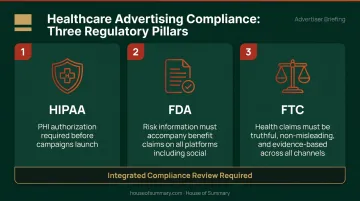
A single misaligned message across channels doesn't just hurt brand consistency. It can create compliance exposure that legal, regulatory, and marketing teams must collectively manage.
The Budget Waste Problem
Compliance risk is only part of the cost. Siloed budgets generate their own predictable losses:
- A TV campaign drives awareness, but no search budget is in place to capture the intent it generates
- Creative assets get duplicated independently across teams, compounding production costs
- Amplification opportunities are missed when channel timing isn't coordinated
Each gap represents money spent building demand that the rest of the funnel isn't positioned to convert.
The Five Pillars of Integrated Marketing Communication in Healthcare
Pillar 1 — Advertising
Covers paid placements across traditional (TV, radio, print, out-of-home) and digital (programmatic display, paid search, connected TV, social ads) channels.
Healthcare advertising works best when awareness-level traditional ads are paired with intent-capture digital ads. A billboard drives awareness; the paid search campaign captures the resulting search query. Neither performs as well without the other.
Pillar 2 — Public Relations and Earned Media
Covers media relations, thought leadership, crisis communications, and key opinion leader (KOL) engagement.
In healthcare, credible third-party coverage carries disproportionate trust value. A clinician quoted in a major news outlet, a positive study cited in a trade publication, or a patient advocate's endorsement moves healthcare audiences in ways that paid placements cannot replicate. PR should be built into the campaign from the start, not treated as an afterthought once other channels are in motion.
Pillar 3 — Content and Digital Marketing
Covers SEO-optimized content (blogs, condition guides, FAQs), social media, and educational video.
Patients research health decisions online before ever contacting a provider. According to Healthgrades' 2025 survey, over 90% of patients consult reviews when searching for a doctor, and 76% say positive online reputation directly influenced their physician choice. Owning those informational touchpoints through strong content is a patient acquisition strategy, not just a brand exercise.

Google classifies health content under YMYL (Your Money or Your Life), which means E-E-A-T signals — Experience, Expertise, Authoritativeness, and Trustworthiness — are weighted heavily in search rankings. Physician-authored content, verified credentials, and accurate medical information aren't optional for healthcare SEO; they're the baseline.
Pillar 4 — Direct and Email Marketing
Covers targeted email campaigns, SMS outreach, and newsletter placements.
Direct channels enable precise segmentation by patient demographics, health condition, or geographic market — useful for appointment reminders, screening campaigns, or health plan enrollment drives. The format also bypasses the algorithmic filtering that limits social media reach.
Dedicated newsletter placements offer a structural advantage that other digital formats can't match: the message arrives in an inbox the subscriber chose to open, with no ad blockers, no algorithmic gatekeeping, and no competing ads on the same page.
House of Summary's newsletter network reaches 500,000+ subscribers with 254,866+ emails opened daily across Presidential Summary, Geopolitical Summary, Dubai Summary, and London Summary. Healthcare advertisers — including health insurance carriers, hospital systems, medical device manufacturers, and telehealth platforms — use the network to reach:
- Decision-makers, executives, and high-income professionals
- A US-majority audience (66%), concentrated in New York and Los Angeles
- Readers in a human-written editorial environment suited to regulated industries
Placements are available as native ads, sponsored content, display formats, or full-issue takeovers.
Pillar 5 — Personal Selling and Relationship Marketing
Covers B2B sales outreach to procurement teams, pharmaceutical detailing to physicians, and patient relationship programs such as wellness memberships or loyalty initiatives.
CRM integration is what makes this pillar "integrated" rather than siloed. When a sales rep calls on a hospital procurement team, the talking points, product positioning, and brand messaging should reflect whatever the prospect has already seen across other channels. A rep walking in with messaging that contradicts the brand's digital presence signals disorganization — and in healthcare procurement, that erodes credibility faster than a weak product pitch.
Key Tactics Across the Healthcare Marketing Channel Mix
Organic Search and Content Marketing
Most patient journeys start with a search query. That makes SEO-optimized educational content one of the most cost-effective patient acquisition tools available — and one of the most chronically underfunded.
Content types that perform well in healthcare IMC:
- Long-form condition guides — comprehensive, medically accurate, physician-reviewed
- FAQ pages — structured for featured snippets and voice search
- Patient testimonial videos — build emotional trust and demonstrate outcomes
- Physician-authored blog posts — establish E-E-A-T signals Google weights for health content
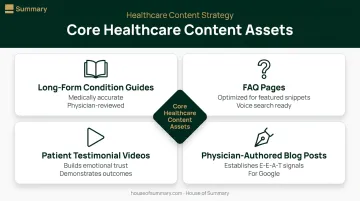
Each of these assets should be repurposed across email, social, and PR channels. A well-researched condition guide doesn't serve just the website — it becomes the basis for an email nurture sequence, a LinkedIn post, and a pitch to a health journalist.
Social Media and Influencer Marketing
Social platforms serve different functions depending on where the audience is in the funnel:
- Facebook and Instagram — patient community building, paid acquisition, condition-specific targeting
- LinkedIn — B2B healthcare, HCP engagement, procurement decision-maker reach
- YouTube — educational video, long-form condition content, physician-led series
Creative must be adapted per platform; brand voice and messaging stay consistent across all of them. A YouTube explainer and a Facebook ad serve different purposes and require different formats, but both should feel like they come from the same organization.
Patient influencers and healthcare professional creators are proving effective at reaching condition-specific communities — particularly for chronic disease management, mental health, and preventive care. The trust these creators carry within their communities is difficult to replicate through standard brand posts.
Paid Digital and Programmatic Advertising
Programmatic display, connected TV (CTV), and paid social allow healthcare marketers to layer audience targeting — demographics, geolocation, health interest signals — with retargeting to re-engage site visitors. A FiercePharma analysis found CTV delivered 82% higher percentage of ad impressions to people identified as clinically relevant to the advertised product, compared to standard digital.
One execution requirement that gets overlooked: ad creative and landing page messaging must align. Sending a patient from a CTV ad to a generic homepage breaks the continuity that integrated marketing exists to protect.
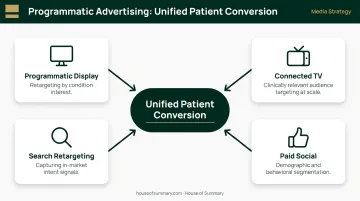
Channels to coordinate in a programmatic healthcare campaign:
- Programmatic display for retargeting site visitors by condition interest
- CTV for clinically relevant audience targeting at scale
- Paid social for demographic and behavioral segmentation
- Search retargeting to capture intent signals already in-market
Traditional and Out-of-Home Advertising
TV, radio, and OOH (billboards, transit) remain effective for top-of-funnel brand awareness — particularly for community hospitals, health plans, and public health campaigns. A 2025 Kantar study found OOH outperformed CTV and digital channels on ad awareness, brand favorability, and purchase intent (in general advertising, not healthcare-specific).
Launch traditional and digital campaigns in coordination. Traditional ads drive awareness and generate search intent; digital campaigns must be live and funded to capture that intent when it arrives.
How to Build, Launch, and Measure an Integrated Healthcare Campaign
Step 1: Strategy and Audience Definition
Before any creative is developed:
- Define campaign objectives — patient acquisition, brand awareness, HCP engagement, or a combination
- Build audience personas — differentiate B2C patient segments from B2B stakeholders
- Audit current channel performance — understand what's working before adding or shifting spend
- Choose the channel mix — based on where the target audience actually consumes information, not internal team preferences
Step 2: Unified Messaging and Brand Governance
A centralized message architecture must be developed before any channel team creates content. This includes:
- Core claim and supporting proof points
- Tone of voice guidelines
- Approved medical and regulatory language
- Visual identity standards
If a patient sees a billboard on Monday and receives an email on Thursday, the brand story should feel continuous — same promise, consistent language, coherent identity.
Step 3: Cross-Functional Team Coordination
Coordination breaks down when teams operate independently. Structural solutions that prevent this include:
- Shared content calendars visible to all channel leads
- Campaign briefs distributed across PR, digital, creative, and analytics teams before launch
- Regular cross-functional syncs — not just kickoffs, but ongoing check-ins throughout the campaign
Step 4: Measurement and Optimization
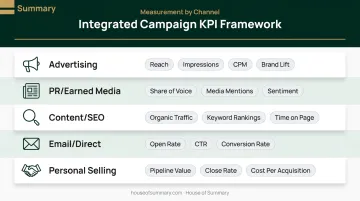
Each pillar has its own KPIs, but a unified dashboard enables the cross-channel attribution that justifies integrated investment:
| Pillar | Primary KPIs |
|---|---|
| Advertising | Reach, impressions, CPM, brand lift |
| PR / Earned Media | Share of voice, media mentions, sentiment |
| Content / SEO | Organic traffic, keyword rankings, time on page |
| Email / Direct | Open rate, click-through rate, conversion rate |
| Personal Selling | Pipeline value, close rate, cost per acquisition |
McKinsey's research across industries shows that customer experience leaders see 15–20% increases in sales conversion and 20–50% declines in service costs — numbers that make the case for integration in budget conversations, not just strategy decks.
Frequently Asked Questions
What are the 5 pillars of IMC?
The five pillars are advertising, public relations, direct marketing, digital/content marketing, and personal selling. In healthcare, each must be coordinated around a single brand message — inconsistency across any one pillar creates gaps that patients and healthcare professionals notice.
Is IMC still relevant today?
More than ever. Patients now interact with healthcare brands across search, social, email, OOH, and in-clinic touchpoints before making decisions. Fragmented messaging across those touchpoints is a greater competitive liability today than in the era of single-channel advertising.
How is integrated healthcare marketing different from traditional healthcare advertising?
Traditional advertising is a single-channel outbound push. Integrated healthcare marketing coordinates owned, earned, and paid channels around a unified message and patient journey, generating more touchpoints, stronger recall, and greater trust at every stage of the decision process.
What makes healthcare marketing different from marketing in other industries?
Three factors set it apart: dual B2B/B2C audience complexity, strict regulatory requirements (HIPAA, FDA guidelines for pharma and device marketing), and the high-stakes, trust-dependent nature of purchasing decisions. In healthcare, messaging inconsistency that's merely annoying in retail can harm patient outcomes or create compliance exposure.
What are common mistakes healthcare organizations make with integrated marketing?
The most common mistakes include:
- Running channel teams in silos without shared goals
- Misaligning campaign messaging with the patient's actual point-of-care experience
- Launching campaigns before defining measurement frameworks
How do you measure the success of an integrated healthcare marketing campaign?
Track channel-level metrics (CTR, organic rankings, share of voice, email open rates) alongside business-level outcomes (patient acquisition volume, appointment bookings, cost per conversion). A unified reporting dashboard that consolidates both levels enables real cross-channel attribution and meaningful optimization.