

What makes this harder than marketing in other industries: patient journeys span weeks or months, touching multiple channels before a booking ever happens. HIPAA constrains the tracking tools you'd normally use. And the type of patient acquired — not just the volume — determines actual financial return.
This article covers the ROI formula, how to benchmark performance, the channels that consistently outperform, the six metrics that matter most, and practical strategies for compounding returns over time.
Key Takeaways
- A 300–500% ROI is a reasonable benchmark for medical practice marketing; top-performing campaigns exceed 900%
- Always calculate ROI using patient lifetime value (LTV), not first-visit revenue — the difference is dramatic
- SEO compounds over time for the highest long-term ROI; PPC generates leads fastest; email and newsletter advertising deliver strong engagement with no algorithmic interference
- Six metrics prove ROI to leadership: audience quality, leads generated, conversion rate, CPA, engagement, and contribution margin
- Build a blended channel strategy — PPC for immediate leads, SEO and email compounding returns over time
Why Measuring Healthcare Marketing ROI Is Uniquely Challenging
Healthcare attribution is harder to measure than nearly any other industry — and the structure of the patient journey is why. A prospective patient might search for symptoms, read a blog post, see a social ad, call your intake line, and then book an appointment weeks later. No single channel deserves full credit. And the tools that normally solve this problem are largely off-limits.
HIPAA Restricts Standard Tracking
The tools that make attribution straightforward in other industries — retargeting pixels, behavioral cookies, session replay scripts — carry significant compliance risk in healthcare. HHS OCR's 2024 guidance confirms that HIPAA-regulated entities may not use tracking technologies in ways that impermissibly disclose protected health information to third-party vendors, including for marketing purposes without proper authorization.
That leaves healthcare marketers relying on compliant attribution methods instead:
- Call tracking with Business Associate Agreements (BAAs) in place
- Form submission attribution tied to campaign source
- CRM-based journey mapping rather than pixel-based retargeting
Payer Mix Changes Everything
Not all patients are financially equal. RAND's PT5.1 study — covering more than 4,000 hospitals across 49 states — found that employer and private-plan hospital prices averaged 254% of Medicare rates in 2022. That gap directly changes the revenue value of every patient a campaign acquires.
A campaign generating 50 commercially insured patients delivers far more revenue than the same campaign generating 50 Medicare patients for the same service line. ROI models that ignore payer mix produce numbers that look clean but tell you very little about actual financial performance.
The Healthcare Marketing ROI Formula Explained
The core formula is straightforward:
ROI = (Total Revenue Generated − Total Campaign Spend) ÷ Total Campaign Spend
A campaign generating $76,000 in patient revenue from $4,600 in spend produces roughly a 15x return. The formula itself is easy. What goes into it is where most practices go wrong.
Why First-Visit Revenue Understates ROI
Using first-appointment revenue as your numerator consistently undervalues marketing performance. An initial visit worth $200 may represent $4,000–$5,000+ in patient lifetime value for someone who becomes a regular patient over years. Dental patients, for instance, can represent lifetime values of $5,000–$10,000 depending on treatment mix and retention.
When you calculate ROI against LTV rather than first-visit revenue, channel evaluations shift considerably. A channel that looks marginal when measured by first-visit revenue can show strong returns once you account for repeat visits, referrals, and long-term treatment plans.
Attribution Models That Work in Healthcare
Three approaches exist for assigning revenue credit across the patient journey:
| Model | How It Works | Best Use Case |
|---|---|---|
| First-touch | 100% credit to first interaction | Brand awareness campaigns |
| Last-touch | 100% credit to final touchpoint before booking | Direct response/conversion campaigns |
| Multi-touch | Credit distributed across all interactions | Full-funnel journey analysis |
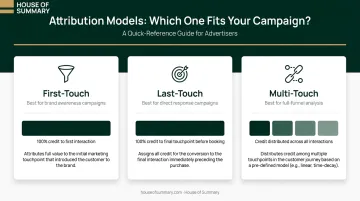
Multi-touch attribution is the most accurate model for healthcare, where journeys regularly span weeks and involve four to seven touchpoints before a patient books. It's also the hardest to implement under HIPAA — a healthcare CRM with BAA-covered tracking isn't optional; it's a prerequisite for getting this right.
ROI Benchmarks to Know
Industry agency benchmarks suggest:
- 300–500% ROI = solid performance for a medical practice
- 900%+ ROI = high-performing, typically multi-channel campaigns
- Results vary meaningfully by specialty, local competition, and payer mix
Treat these as orientation points, not promises. A high-volume primary care practice and a boutique cosmetic surgery clinic will land in very different places even with identical campaign execution.
High-ROI Healthcare Marketing Channels Compared
SEO: Highest Long-Term Ceiling
Healthcare SEO is cited by agencies as delivering 5x–12x ROI for dental and medical practices, driven by high patient LTV and compounding traffic that doesn't require ongoing spend once rankings are established.
The tradeoff: new sites typically require 6–12 months before generating meaningful traffic, and healthcare content falls under Google's YMYL (Your Money, Your Life) standards — so authority and trust signals take longer to build than in less regulated categories.
PPC: Fastest Results, Lower Ceiling
Google Ads delivers immediate visibility. LocaliQ's 2026 healthcare benchmark study — based on 3,542 US campaigns from October 2024 through September 2025 — reports:
- Average CTR: 6.07%
- Average CPC: $5.64
- Average conversion rate: 8.09%
- Average cost per lead: $66.02
Specialty numbers vary considerably. Emergency medicine CTR reached 10.33%; dermatology conversion rate hit 25.33%. PPC is best suited for new practice launches, competitive keyword battles, or time-sensitive promotions. As a standalone long-term strategy, it's less efficient than SEO once organic rankings are established.
Email and Newsletter Advertising: Consistent Engagement
Email reaches subscribers directly without algorithmic filtering or display ad blockers interfering with delivery. Mailchimp benchmarks for health and fitness emails report open rates around 21.48% with click rates of 2.69% — solid engagement for a channel with low ongoing cost per send.
Newsletter advertising extends this advantage by placing brand messages inside curated content that readers have actively opted into. For healthcare brands targeting commercially insured, high-LTV patient segments, audience alignment is the key variable. House of Summary's newsletter network, for example, delivers placements to 500,000+ subscribers across executive and decision-maker demographics in markets including New York, Los Angeles, London, and Dubai — the kind of audience profile that drives quality patient acquisition, not just volume.
Educational Content: The Long Game for Physician Audiences
Where email and newsletters drive direct engagement, content marketing builds authority over a longer arc. Credible clinical content — explainers, outcome-focused articles, evidence summaries — earns trust with physician and executive audiences that paid channels rarely can.
This channel is slower to convert, but it supports SEO performance, reinforces paid campaigns, and is particularly effective for reaching healthcare professionals who respond to peer-informed content rather than promotional messaging.
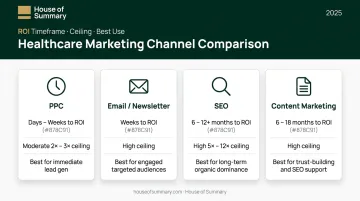
Channel Comparison at a Glance
| Channel | Time to ROI | ROI Ceiling | Best For |
|---|---|---|---|
| PPC | Days–weeks | Moderate (2x–3x) | Immediate lead gen |
| Email/Newsletter | Weeks | High | Engaged, targeted audiences |
| SEO | 6–12+ months | High (5x–12x) | Long-term organic dominance |
| Content marketing | 6–18 months | High | Trust-building, SEO support |
Key Metrics That Prove Healthcare Marketing ROI
Audience Quality and Lead Generation
Reaching a large audience means nothing if it's the wrong one. Audience quality metrics tell you whether campaigns attract people likely to become patients — not just visitors.
Assess audience quality through:
- Demographic alignment — does the audience match your target patient profile?
- Intent signals — are leads arriving via high-intent search terms or branded queries?
- Funnel stage — are leads research-phase browsers or ready-to-book prospects?
Track leads by first-touch channel (where they entered your ecosystem) and last-touch conversion point (where they ultimately acted). Both pieces of data are necessary for intelligent budget reallocation.
Conversion Rate and Cost Per Acquisition
Healthcare conversion rate measures the percentage of targeted individuals completing a desired action — form submission, appointment booking, or intake call. Two distinctions matter:
- Marketing conversion rate: prospect to lead
- Clinical conversion rate: lead to scheduled patient
The second requires coordination between marketing and clinical operations — if the intake process loses leads that marketing generated, the marketing team's numbers will never tell the whole story.
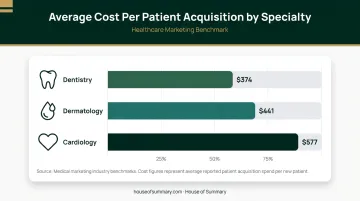
For CPA benchmarks, First Page Sage reports average patient acquisition costs including $374 for dentistry, $441 for dermatology, and $577 for cardiology. These vary by market and competition. Track CPA by service line and channel over time using a healthcare CRM — without consistent measurement methodology, comparisons are meaningless.
Consumer Engagement and Contribution Margin
Engagement metrics — clicks, calls, appointment completions, satisfaction scores — predict conversion potential and correlate with long-term retention. Research published in PMC found patient engagement is associated with improved healthcare quality and outcomes across 17 reviewed studies.
Those engagement numbers ultimately need to translate into financial results. That's where contribution margin (Revenue − Variable Costs) becomes the metric leadership actually cares about.
Key points to understand:
- If a campaign's contribution margin is negative, revise the budget regardless of how strong impressions or click rates look
- Contribution margin can be positive even when net profit appears negative
- For budget justification conversations with leadership, it's the most credible figure on the table
Proven Strategies to Maximize Healthcare Marketing ROI
Align Investment with High-Value Service Lines and Payer Mix
Target service lines with higher reimbursement rates — orthopedics, cardiology, weight management — and track payer mix alongside lead source. RAND's data showing commercial rates at 254% of Medicare means the same volume of leads from a commercially insured population is worth significantly more financially.
Build Centralized Attribution and Reporting
Consolidate multi-channel data in a single platform. The core toolkit:
- A healthcare CRM (with BAA) to track leads from first touch to booked patient
- Google Analytics 4 to monitor website behavior and conversion paths
- Call tracking software to attribute phone-based conversions by channel
- Rank tracking tools to measure SEO progress over time
Consistent metric definitions across quarters keep C-suite reporting credible and budget requests easy to defend.
Run a Blended Channel Strategy, Reviewed Quarterly
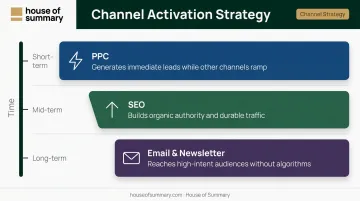
With attribution infrastructure in place, channel performance becomes legible — and that's where the real optimization begins. No single channel handles both short-term acquisition and long-term compounding returns. The most effective structure:
- PPC to generate leads immediately while other channels ramp up
- SEO to build organic authority and durable, zero-marginal-cost traffic over time
- Email and newsletter advertising for consistent reach to high-intent audiences — no algorithms, no ad blockers
Review channel CPA and contribution margin data quarterly. Shift budget toward what's working; cut what isn't performing, regardless of what it cost to set up.
Frequently Asked Questions
How do you calculate healthcare marketing ROI?
Use the formula: (Total Revenue Generated − Campaign Spend) ÷ Campaign Spend. For accurate results, use patient lifetime value rather than first-visit revenue as your revenue input — first-visit figures understate true channel performance.
What is the average ROI for healthcare advertising?
Agency benchmarks suggest 300–500% is solid performance for medical practices, with top-performing multi-channel campaigns exceeding 900%. Healthcare SEO is modeled at 5x–12x for dental and medical practices. Results vary significantly by specialty and geography.
What type of healthcare advertising has the highest ROI?
SEO delivers the highest long-term ROI through compounding organic traffic at zero ongoing media cost. Email and newsletter advertising offer consistently strong engagement rates and direct inbox delivery. PPC generates the fastest short-term returns but carries higher ongoing spend requirements.
What are the 7 P's of healthcare marketing?
Product, Price, Place, Promotion, People, Process, and Physical Evidence. Healthcare's version differs from standard frameworks because clinical expertise, staff interaction, and facility cues shape perceived quality, and patient trust drives decisions more reliably than price does.
What metrics should healthcare marketers track to prove ROI?
The six that matter most: audience quality, leads generated, conversion rate, cost per acquisition, consumer engagement, and contribution margin. Contribution margin is the strongest choice for C-suite reporting — it ties marketing activity directly to financial outcomes.
How long does it take to see ROI from healthcare marketing?
PPC produces results within days to weeks. SEO takes 6–12 months for new sites — longer for YMYL healthcare categories under Google's stricter trust standards. Email and newsletter advertising deliver faster engagement than SEO with more durable returns than PPC.