Introduction
Most healthcare advertising is forgettable. Stock photos of smiling doctors, "compassionate care" headlines, and sad piano music over slow-motion hospital corridors — it blends into the background so completely that patients can't recall which system ran which ad an hour after watching.
That forgettability is expensive. Healthcare advertising in the US runs into the billions annually, yet most campaigns can't demonstrate meaningful lift in patient acquisition or brand recall.
The campaigns that actually work — Cleveland Clinic's empathy series, Carilion Clinic's breast cancer initiative, Huggies' "Meeting Murilo" — didn't succeed by accident. They made specific, deliberate decisions about message, format, and channel. This article extracts those decisions: not a list of campaigns to admire, but transferable principles any healthcare marketer can apply to their next brief.
The patterns that emerge from studying them closely are more instructive — and more replicable — than they might first appear.
Key Takeaways
- Lead with how the patient feels, not what the facility offers — empathy outperforms feature lists every time
- Authentic storytelling consistently outperforms polished production in healthcare contexts
- Educational content builds trust before the ask — it positions brands as advisors, not vendors
- Local community voices amplify reach without requiring large budgets
- Channel alignment matters as much as creative quality — wrong context kills good creative
What Sets Healthcare Advertising Apart
Healthcare advertising operates under constraints most industries simply don't face. HIPAA requires written authorization before using patient-identifiable information for marketing. FDA guidelines govern how drug and device brands communicate claims.
Beyond regulatory compliance, there's a sensitivity threshold consumer goods marketers rarely encounter. Patients aren't choosing between shampoo brands — they're making decisions that affect their health and, sometimes, their lives.
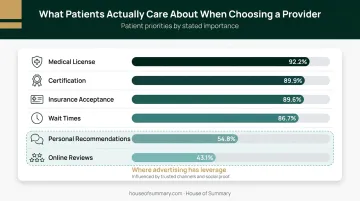
A 2022 study of 1,388 participants on healthcare provider selection found the factors that mattered most:
- Medical license — 92.2% of respondents rated this important
- Certification — 89.9%
- Insurance acceptance — 89.6%
- Wait times — 86.7%
- Personal recommendations — 54.8%
- Online reviews — 43.1%
The pattern is clear: clinical credibility dominates provider selection, while word-of-mouth and peer validation sit at the bottom of the list. Those bottom two are exactly where advertising has real leverage. A campaign can't manufacture a medical license — but it can shape how people talk about a provider.
The core challenge for healthcare marketers is balancing clinical authority with human warmth. Expertise without approachability feels cold. Warmth without credibility feels unserious. The campaigns that get it right do so because they make deliberate structural choices from the start — not by accident.
Key Lessons from the Best Healthcare Advertising Campaigns
Lesson 1: Lead with Empathy, Not Features
Cleveland Clinic's 2013 "Empathy: The Human Connection to Patient Care" video accumulated 8.2 million YouTube views and is still used in caregiver orientation globally. It contains no list of services, no facility tour, no clinical credentials. It shows the inner lives of patients and caregivers moving through the same spaces — and it asks the viewer to consider what those people might be carrying.
A campaign that opens with "state-of-the-art facilities and board-certified specialists" loses to one that shows a mother finally being taken seriously by her doctor. Patients connect with recognition, not credentials.
The Christ Hospital Health Network's 2025 campaign validated patient frustration before introducing the brand — using 10-second TV spots during Jeopardy to acknowledge real patient experiences rather than broadcast clinical specs.
Research supports this direction: a systematic review of 455 healthcare empathy studies found that 81% of tests showed a positive relationship between empathy and patient care outcomes, with 91% of RCTs confirming the effect.
The practical takeaway: Before writing copy, identify the specific fear, frustration, or hope the patient is carrying into this decision. Lead with that. The brand's role comes later.
Lesson 2: Authentic Storytelling Outperforms Polished Production
Healthcare audiences are primed to detect inauthenticity. They've seen enough stock-photo hospitals and actors pretending to be patients that anything feeling manufactured registers as untrustworthy almost immediately.
What actually works is narrative authenticity — stories that feel real because they are. Dayton Children's Emmy-winning documentary Connected followed conjoined twins Pedro and Augusto through their separation. It was high-quality film. It was also deeply real — no scripted patient testimonials, no brand messages inserted into emotional moments. The story was the story.
Hartford HealthCare's partnership with barber Miguel Delvalle (owner of Wise Guys Scissor Society in Hartford) worked for the same reason. A community member narrating a health story in his own voice is more credible than the most polished brand voiceover. Hartford HealthCare went on to win six Emmy Awards at the 47th Annual Boston/New England Emmy Awards, produced with Envision Films.
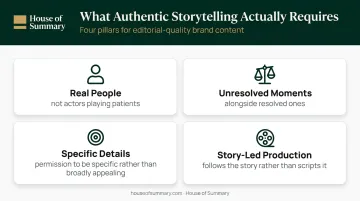
What authentic storytelling actually requires:
- Real people, not actors playing patients
- Unresolved moments alongside resolved ones
- Permission to be specific rather than broadly appealing
- A production team that follows the story rather than scripting it
Lesson 3: Education Earns Trust Before the Ask
Healthcare audiences are often anxious or confused when they first encounter a brand. They're researching symptoms, procedures, or providers — not browsing for options the way they might shop for a car.
McKinsey's 2024 health media research found that 64% of consumers trust health and wellness content from health systems and doctors. That trust is an asset — but it has to be earned by actually answering questions, not by using educational-sounding language to pitch services.
Campaigns that genuinely answer a real question before making an ask position the brand as an advisor. The effect on patient loyalty is concrete: a 2021 peer-reviewed study confirmed the trust-to-loyalty pathway, with patient satisfaction and trust functioning as linked drivers of long-term retention.
The structure that works:
- Acknowledge the patient's specific question or fear
- Answer it fully — don't tease or gate the information
- Then introduce the brand's role in that context
Healthcare brands that skip steps one and two and jump straight to the appointment CTA are leaving the majority of their potential audience behind.
Lesson 4: Local and Community Relevance Amplifies Reach
Healthcare is inherently local. Patients choose providers within geography, within networks, within communities where they already have relationships. A national campaign can build awareness, but conversion happens at the local level.
Carilion Clinic's "Yes, Mamm" breast cancer awareness campaign combined a memorable slogan with community events and accessible locations — currently 9 mammography sites where patients can be seen within one week. The public health goal and the marketing goal were the same campaign.
Hartford HealthCare's "No Hair Left Behind" event — built around barber Miguel Delvalle — set a goal of 100 haircuts and paired that with health support services. The mechanism was simple: find a community member the audience already trusted, and give them the platform.
Tactical implication: Localized campaigns don't require large budgets. They require:
- Genuine connection to the community's actual concerns
- A credible local messenger (physician, religious leader, local business owner)
- Events or touchpoints that deliver real value, not just brand visibility
The AHA documented a comparable example: Livingston County Health Department used local physicians and religious leaders as trusted messengers and achieved a greater than 25% increase in vaccinated residents. The messenger mattered more than the medium.
Lesson 5: Innovation in Format Creates Emotional Stickiness
When Huggies launched "Meeting Murilo" (2015, Brazil), the campaign reached global attention without traditional paid media spend. The concept: a 3D-printed model of an unborn baby was created for blind expectant mother Tatiana Guerra, so she could feel her son before birth. The product connection was natural — Huggies, a brand for babies, facilitating a mother's first meeting with hers.
The technology served the emotion rather than overshadowing it. Format innovation doesn't require cutting-edge tools to achieve the same effect.
Consider:
- Narrative bait-and-switch: UCHealth's mountain biker campaign follows Brian Malek — introduced as a commercial airline pilot, revealed to have survived a serious spinal cord injury treated at UCHealth — subverting expectations to make the outcome land harder
- Unexpected perspective shifts: MedStar Health's patient-point-of-view approach reframes familiar medical interactions through the patient's eyes rather than the clinician's
- Humor and character: Children's Healthcare of Atlanta's campaigns use the knowing look of a parent who's been to the ER before — relatable, specific, not a feature list in sight
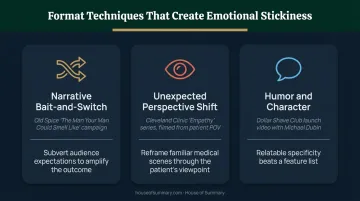
The right format question is: what structure makes the core emotion of this story hit hardest for the specific audience receiving it?
Lesson 6: Consistency and Clarity Win Over Time
One memorable campaign doesn't build a healthcare brand. Cleveland Clinic's empathy work from 2013 is still running in caregiver orientation globally — because the organization didn't treat it as a one-off execution. It became the foundation of a consistent storytelling approach.
The healthcare brands with the strongest reputations maintain consistent visual identity, tone, and message across years and channels. NYU Langone and Penn Medicine both exemplify this: different campaigns, same underlying brand voice, accumulated over time into genuine institutional trust.
Clarity is the other half of this equation. SHSMD's plain language research notes that low health literacy costs the US healthcare system $106–$238 billion annually — and that overly technical language actively erodes credibility rather than building it.
What consistency and clarity require in practice:
- Avoid reinventing visual identity or tone for every campaign
- Communicate patient benefits, not clinical specifications
- Use plain language — if a 12-year-old couldn't understand the headline, rewrite it
- Maintain the same empathetic core across every channel and format
Choosing the Right Channel for Healthcare Messaging
The best creative in the wrong channel still underperforms. A guilt-driven health awareness message placed adjacent to entertainment content on social media pushes audiences away. The same message in a context where people are actively seeking health information performs.
Healthcare advertisers default heavily to TV and social media — and overlook channels where readers are in a focused, intentional consumption mode.
Email newsletters are one of the most underused channels in healthcare advertising. Litmus's 2025 email ROI research found that 35% of companies achieve $10–$36 return per $1 spent on email, with 30% achieving $36–$50 return. Nielsen's 2023 research found that contextual relevance accounts for 23% of total lift in newer digital media channels — meaning the environment where an ad appears affects its performance independently of the creative.
Newsletter advertising in particular offers something most digital channels can't: readers in a distraction-free, opt-in consumption environment where ad blockers can't reach them, algorithms don't filter them, and visual clutter doesn't compete for attention. For healthcare messaging that needs careful attention and comprehension — not just a fleeting impression — that context matters.
House of Summary's newsletter network — reaching 500,000+ subscribers with 254,866+ emails opened daily — illustrates this principle. Healthcare advertisers across pharma, telehealth, health insurance, and digital health brands use the platform because its US-based audience of decision-makers and executives engages in exactly the focused reading environment that healthcare messages require.
The human-written editorial environment also supports compliance-friendly placement for regulated categories navigating FDA and MHRA constraints.
Channel selection is only half the equation. Once you've found the right contexts, consistency across all of them is what builds trust at scale.
A campaign that runs a moving emotional video on social media but sends generic promotional emails breaks the emotional thread. Every touchpoint should reinforce the same empathetic core message:
- Paid social carries the emotional hook
- Email deepens the message in a distraction-free environment
- Video builds narrative and connection
- Direct mail creates a tangible, memorable impression
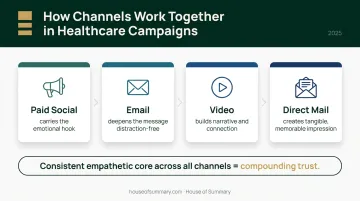
When tone stays consistent across channels, trust compounds — faster than any single channel can achieve on its own.
What's Next for Healthcare Advertising
Three shifts are reshaping how healthcare brands need to think about campaigns:
- AI-enabled personalization is moving targeting from broad demographics to individual relevance — serving content based on health concerns, past behavior, and decision stage. McKinsey's personalization research found that 44% of high-cost follow-up care after acute events was unplanned, with a third attributed to avoidable causes like unclear post-discharge instructions. Personalized campaign messaging addresses exactly that gap.
- Mental health as a primary focus is no longer optional. Brands that address mental well-being with the same directness and empathy previously reserved for physical health are connecting with patients who feel ignored by most healthcare communications — a segment that has grown sharply since 2020.
- The trust gap created by AI is the counterintuitive challenge. Edelman's 2026 Trust and Health report found that 64% of consumers believe AI-fluent users can match or outperform doctors in at least one health task.
As AI becomes more visible in healthcare interactions, campaigns that highlight human providers, real patient stories, and transparent communication will become more differentiated — not less. Authenticity is becoming a competitive asset precisely because it's in shorter supply.
Frequently Asked Questions
What is a healthcare advertisement?
Healthcare advertising promotes health services, products, facilities, or public health initiatives through media channels — informing, educating, or persuading audiences to take a health-related action. It covers everything from hospital brand campaigns and pharmaceutical promotion to public health awareness and telehealth marketing.
What are the 7 P's of marketing in the healthcare industry?
The 7 P's add People, Process, and Physical Evidence to the traditional four (Product, Price, Place, Promotion). In healthcare, People means clinical and patient-facing staff, Process covers care coordination and patient flow, and Physical Evidence includes the facility environment and patient communications.
What makes a healthcare advertising campaign successful?
The best campaigns lead with empathy — communicating patient benefits in plain language rather than clinical specs. They also pick channels based on where patient attention and trust actually live, not just where reach is largest.
What are examples of promoting good health through advertising?
Carilion Clinic's "Yes, Mamm" breast cancer initiative, smoking cessation campaigns, and vaccine awareness drives are strong examples. The most effective ones pair clear calls to action with genuine community outreach, aligning public health goals with marketing goals in a single effort.
What are the 7 main types of advertising?
The major types are digital/online, social media, television, print, out-of-home, radio, and direct mail/email. Healthcare campaigns increasingly combine multiple types in coordinated multi-channel strategies, with channel selection driven by audience mindset rather than reach alone.
How do the best healthcare campaigns build trust with patients?
They show rather than tell — using real patient stories, community voices, and transparent communication sustained over time. That trust builds through consistent behavior across years and channels, not through a single polished campaign or a roster of clinical credentials.