Why Supplement Advertising Is Harder Than It Looks
The supplement market pulls in billions annually, and every brand seems to be chasing the same health-conscious consumer across the same digital channels. That creates a predictable problem: most supplement ads look identical. Same claims, same aesthetics, same vague promises about energy and wellness. At that level of sameness, no creative survives on aesthetics alone.
Saturation is only part of the problem. Supplement brands face a dual constraint that few other categories deal with: they must stand out creatively and stay within tightly defined regulatory boundaries set by the FDA and FTC. Misread those boundaries — even unintentionally — and brands risk warning letters, ad rejections, or platform bans.
Both tracks are covered here. The legal guardrails come first: what regulators allow, what gets brands into trouble, and what compliant language actually looks like. Then the practical side: creative formats, messaging frameworks, channel strategies, and credibility-building tactics that turn overlooked ads into high-performing ones.
TLDR
- FDA governs labeling; FTC governs advertising — both apply simultaneously
- Three claim types are permissible: health claims, structure/function claims, and nutrient content claims
- UGC formats, problem-first messaging, and social proof consistently outperform polished brand creative
- Channel selection should align with funnel stage — cold traffic, warm retargeting, and retention each need different approaches
- Newsletter placements increasingly outperform paid social for supplement brands facing rising CPMs and platform ad restrictions
Understanding the Rules: What the FDA and FTC Allow in Supplement Ads
Two federal agencies govern supplement advertising — and knowing which one covers what can save you from costly enforcement action.
According to the FTC's Dietary Supplements Advertising Guide, the FDA holds primary responsibility for product labeling — packaging, inserts, and on-bottle claims — while the FTC governs advertising: digital ads, social posts, email campaigns, infomercials, and print.
Both agencies coordinate enforcement. A claim that passes FDA labeling review can still draw an FTC action if it's used deceptively in an ad.
The Three Permissible Claim Types
The FDA identifies three claim categories for dietary supplement marketing:
| Claim Type | What It Covers | Example |
|---|---|---|
| Health Claims | Links an ingredient to reduced disease risk | "Calcium may reduce the risk of osteoporosis" |
| Structure/Function Claims | Describes how an ingredient supports normal body function | "Supports immune health" or "Promotes relaxation" |
| Nutrient Content Claims | Describes the level of a nutrient in the product | "High in vitamin D" or "An excellent source of zinc" |
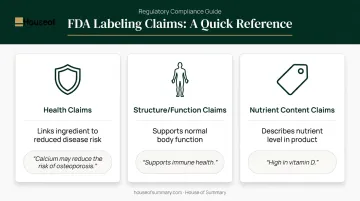
Structure/function claims are by far the most commonly used in supplement ads. They also carry a mandatory disclaimer requirement.
The Required Disclaimer
Any ad or label using a structure/function claim must include this exact language from the FDA's structure/function guidance:
"This statement has not been evaluated by the Food and Drug Administration. This product is not intended to diagnose, treat, cure, or prevent any disease."
The disclaimer must be prominent and proximate to the claim — not buried in fine print. And critically, having this disclaimer on a label doesn't automatically make an advertising claim compliant. FTC substantiation still applies separately.
Compliant vs. Non-Compliant Language
The line between acceptable and prohibited language is often one word:
- ✅ "Supports immune health" → ❌ "Prevents colds and flu"
- ✅ "Promotes relaxation" → ❌ "Treats anxiety"
- ✅ "Helps maintain healthy blood sugar levels" → ❌ "Reverses diabetes"
Real enforcement actions show how quickly brands cross this line:
- Medical Mikes, Inc. (2023) — CBD product ads claimed COVID-19 treatment potential
- Lakpura LLC (2022) — Marketed a drink as an "immune-enhancing drink for the COVID-19 virus"
- Dr. Brownstein's Holistic Medicine (2020) — Stated "we have a way to treat" COVID using vitamins
Each case shares the same failure: disease claims where structure/function language was required.
Substantiation Comes First
The FTC's Health Products Compliance Guidance sets a clear bar: claims must be supported by "competent and reliable scientific evidence." That means objective studies conducted by qualified experts using accepted methodology — and that evidence must exist before the ad runs.
Vague superlatives like "the most powerful formula ever" aren't just unconvincing; they're compliance risks. Getting the science in order before you write the copy is the only sequence that works.
Creative Strategies That Drive Supplement Ad Performance
Lead With the Problem
Supplement ads that open with a pain point consistently attract more attention than those that lead with benefits. Health message framing research confirms that loss-framed, problem-first messaging drives behavior change more effectively when the desired action addresses a felt need.
In practice: "Struggling with energy crashes every afternoon?" stops the scroll faster than "Experience all-day energy." The problem creates immediate relevance; the product becomes the logical solution.
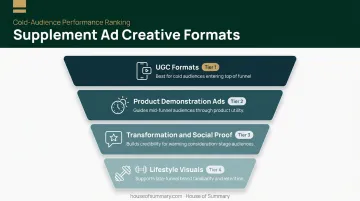
Once the hook lands, the format carrying that message matters just as much. Not all ad formats perform equally across funnel stages. A practical creative hierarchy for supplement brands:
The Creative Hierarchy
UGC (user-generated content) formats — Unpolished, peer-style videos and testimonials replicate word-of-mouth recommendations. Cold audiences respond to them because they lower perceived brand bias in a way polished studio creative simply can't replicate.
Product demonstration ads — Showing the supplement in real daily routines (morning coffee ritual, pre-workout prep, nightstand stack) builds familiarity and reduces purchase hesitation. Best for mid-funnel audiences who are aware of the category but evaluating options.
Transformation and social proof creatives — Before/after narratives, customer stories, and credible influencer endorsements work best when targeting warm audiences who already trust the brand category.
Lifestyle visuals — Gym sessions, morning routines, clean-kitchen aesthetics. These perform primarily as brand-building content rather than direct-response drivers.
Visual Branding That Signals Quality
Color and packaging design carry significant weight in supplement advertising. Ritual built much of its early growth on design differentiation: eye-catching yellow and blue packaging with transparent capsules positioned the brand as both premium and scientifically credible, separating it from the brown-bottle commodity aesthetic of legacy supplement brands.
AG1 sharpened its visual identity in 2023 with The New Company, specifically to stand out in the crowded greens supplement market.
Color carries psychological shorthand that works fast in ads:
- Blue — signals trust and scientific authority
- Green — signals natural, clean formulation
- Gold — signals premium positioning
- White/minimalist — signals clinical credibility
Consistent typography across ads and landing pages reinforces recognition across repeated exposures.
Scarcity and Urgency
A 2022 meta-analysis of 131 scarcity studies found that scarcity tactics affect consumer behavior — with demand-based scarcity most effective for utilitarian products. Supplements fit that profile.
Batch drops, limited seasonal formulas, and time-bound offers all work. Fabricated scarcity, however, creates regulatory exposure. If the inventory isn't actually limited, don't claim it is.
Copywriting and Messaging Techniques for Supplement Ads
Headlines That Convert
High-performing supplement ad headlines tend to follow a consistent structure: [Clear benefit or outcome] + [Quantifiable support or specificity] + [Emotional trigger or urgency].
Applied examples:
- Sleep: "Fall asleep faster — backed by 300mg of clinically studied magnesium. Wake up restored."
- Energy: "Replace your afternoon crash with four hours of clean focus. No jitters, no hard stop."
- Gut health: "50 billion CFUs. Shipped cold. Because most probiotics don't survive the shelf."
Each headline leads with a specific outcome, adds a credibility detail, and ends on emotional or sensory ground.
The Five-Part Video Ad Structure
For supplement video ads — whether 15-second social clips or 30-second pre-rolls — this arc consistently works:
- Hook (0–3 sec): Pattern interrupt. Unexpected visual or bold statement that stops the scroll.
- Problem (3–6 sec): Relatable struggle, stated plainly. "You're exhausted by 2pm every day."
- Solution (6–12 sec): Product introduction tied directly to the problem. No features yet — just the fix.
- Proof (12–20 sec): Social proof, ingredient credibility, or a visual result. Testimonial snippet or certification badge.
- CTA (20–30 sec): Emotional close plus offer. "Join 40,000 people who actually sleep through the night — 20% off your first month."
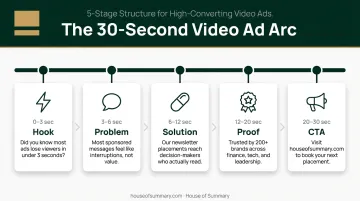
This arc applies to long-form written copy as well. The structure is the same; only the length of each beat changes.
Ingredient Language as a Trust Signal
Dry ingredient lists don't sell supplements. Sensory-rich origin language does.
"Ancient ashwagandha, revered in Ayurveda for centuries" outperforms "500mg Ashwagandha Root Extract (KSM-66)" in brand-awareness and consideration contexts, even when the underlying ingredient is identical. The narrative approach works because it creates context and signals that sourcing was a deliberate choice — not an afterthought.
To make origin language land, the framing needs to be specific:
- Name the source region or tradition when verifiable
- Reference the form or standardization (e.g., KSM-66, Sensoril) for credibility with informed buyers
- Pair sensory language with a functional outcome — not just heritage alone
One constraint: every origin or sourcing claim must be factually accurate. "Wildcrafted from the Himalayas" requires the product to actually come from there.
Subscription and Daily Ritual Framing
Ingredient messaging sets the hook — but how you frame the purchase decision determines whether someone stays a customer. For categories like probiotics, adaptogens, and vitamins, where benefits accumulate over weeks rather than hours, subscription framing is a self-reinforcing copywriting strategy.
Positioning the supplement as "your new morning ritual" or "never run out again" lowers the commitment frame — a ritual feels less transactional than a purchase, which reduces hesitation at the point of conversion. It also sets realistic expectations for results timelines.
For brands with subscription models, this framing also reduces churn among customers who might otherwise cancel when they don't see instant results.
Choosing the Right Channels for Supplement Advertising
Paid Social and Search: Reach With Restrictions
The three main paid channels — Meta, TikTok, and Google — offer scale, but each comes with supplement-specific policy constraints that require review before creative goes live:
- Meta prohibits ads promoting unsafe supplements and applies its own definition of what qualifies
- TikTok explicitly bans medical claims for supplements and has separate weight-management policies restricting unrealistic body imagery
- Google restricts unapproved substances and pharmaceuticals, requiring ingredient-level vetting before search or Shopping campaigns run
Platform policies are a separate compliance gate from FDA/FTC requirements. Brands need both reviewed simultaneously, not sequentially.
Email and Newsletter Placements: A Different Equation
Email and newsletter advertising bypasses two structural disadvantages of web-based channels.
Ad blockers operate at the browser level — they have no mechanism to filter inbox content. Blockthrough's 2022 PageFair Adblock Report estimated 290 million monthly active desktop ad-block users globally, a significant share of web display inventory that never loads at all. Newsletter placements are immune to this.
The second advantage is attention quality. Newsletter readers opted in, so when an issue arrives, they're already present — no competing feeds, no banner blindness, no algorithmic clutter pulling focus elsewhere.
For supplement brands, House of Summary offers newsletter advertising across a 500,000+ subscriber network. Key audience and format details:
- 254,866+ emails opened daily across the network
- 66% US-based readers, concentrated in New York and Los Angeles
- Audience skews toward decision-makers, executives, and high-income consumers — the demographic premium supplement brands typically target
- Format options include native editorial placements, sponsored content, display positions, and full-issue takeovers
- Sponsored content is particularly suited to clinical-evidence narratives and category education
Funnel-Stage Alignment
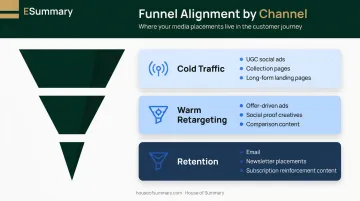
Channel selection works best when mapped to where the audience is in the purchase journey:
- Cold traffic: UGC-heavy social ads driving to collection pages or long-form landing pages
- Warm retargeting: Offer-driven ads, social proof creatives, and comparison content
- Retention: Email and newsletter placements for subscription reinforcement, educational content, and habit-building messaging
Building Credibility Through Social Proof and Branding
Supplement consumers are skeptical — and reasonably so. Social proof isn't optional in this category; it's the mechanism that bridges the gap between a marketing claim and purchase confidence.
Forms of Effective Social Proof
- Customer testimonials — Must reflect typical results under FTC Endorsement Guides (16 CFR Part 255). If a testimonial describes an outlier outcome, the typical result must be clearly disclosed.
- Paid endorsement disclosures — Any material connection between a brand and an endorser must be disclosed clearly and conspicuously. This applies to influencers, brand ambassadors, and affiliate partnerships.
- Third-party certifications — NSF certification screens supplements for 280 substances and verifies label claims against actual contents. The USP Verified Mark confirms ingredient potency and amounts match the label. Informed Sport focuses on banned-substance testing for sports supplements. Use certification badges only for the exact product and claim each certifier covers.
- Media coverage and expert endorsements — Useful as credibility signals, but require the same substantiation standards as direct product claims.
Brand Consistency and Visual Authority
Social proof builds the claim — brand presentation makes it believable. AG1's 2023 rebrand with The New Company illustrates a principle that applies across the supplement category: design consistency signals product quality. When a brand's color palette, typography, and product imagery are consistent across ads, landing pages, email campaigns, and packaging, repeated exposure builds recognition. Recognition, in turn, gets conflated with trustworthiness.
Transparency as a Competitive Advantage
In a category full of vague claims, specific transparency stands out. Brands that show their work earn lasting customer relationships. Tactics that move the needle include:
- Publishing ingredient sourcing information
- Citing clinical studies by name, not just "research suggests"
- Sharing lab testing results openly
- Being explicit about what a product does and doesn't do
Brands that rely on superlatives without substance — "the world's most advanced formula" — erode trust and attract regulatory scrutiny at the same time. Specificity is both the safer and the more persuasive path.
Frequently Asked Questions
How do you advertise a supplement?
Supplement advertising runs on two tracks: compliance (meeting FDA and FTC guidelines) and creative strategy (UGC, social proof, problem-first messaging). Effective campaigns span paid social, search, and email, with channel selection driven by funnel stage and platform policies.
What is a supplement in advertising?
In an advertising context, a dietary supplement is a product regulated under DSHEA that may be marketed using health claims, structure/function claims, or nutrient content claims. It cannot legally claim to diagnose, treat, cure, or prevent any disease — that language crosses into pharmaceutical territory.
What claims can you legally make when advertising supplements?
Three claim types are permissible: health claims, structure/function claims, and nutrient content claims. All claims must be substantiated with credible scientific evidence before the ad runs, and structure/function claims require the mandatory FDA disclaimer. Disease claims are prohibited.
What channels work best for supplement advertising?
Top-performing brands combine paid social (Meta, TikTok), search (Google), and email or newsletter placements. Social works for cold acquisition, retargeting for warm audiences, and email or newsletters for retention and subscription reinforcement.
What makes supplement ads convert?
Problem-first messaging, UGC or social proof formats, benefit-driven copy, and a clear call to action are the core drivers. Ads sustained over 90+ days typically outperform frequent creative refreshes — trust builds slowly in this category.
Can you advertise supplements on social media?
Yes, but brands must comply with each platform's health and wellness advertising policies in addition to FDA and FTC requirements. Disease claims, unsubstantiated results language, and certain before/after imagery are commonly restricted across Meta, TikTok, and Google.