The numbers back this up. According to the Art Basel and UBS Art Market Report 2025, dealer online sales to new buyers rose to 46% in 2024, up from 35% the year prior. Collectors are discovering and purchasing art through channels that didn't exist a decade ago — and galleries that haven't adapted their advertising approach are losing those buyers to competitors who have.
This guide covers the most effective advertising strategies for art galleries: from defining your audience and building your online presence, to the specific channels that drive collector interest and foot traffic.
Key Takeaways
- Define your advertising goal first — footfall, collector acquisition, and artist profile-building require completely different approaches
- Your website and local SEO are foundational; 72% of high-net-worth collectors have purchased through a dealer website without seeing work in person
- 43% of HNW collectors have purchased art through Instagram without an in-person viewing — making it a non-negotiable channel
- Email marketing delivers among the highest ROI of any channel; paid newsletter placements put your gallery in front of collectors outside your existing network
- Art-specific platforms (Artsy, Artnet, Ocula) place your gallery in front of buyers actively browsing to buy
Define Your Advertising Goals and Target Audience First
Before allocating a single dollar to advertising, answer one question: what does success look like?
Galleries that skip this step end up spreading budget across channels without momentum on any of them. The goal shapes everything — messaging, platform selection, creative format, and how you measure results.
Common gallery advertising objectives:
- Increase exhibition footfall from local visitors
- Attract new collectors, particularly high-net-worth buyers
- Raise the profile of a specific emerging artist
- Drive online sales or inquiry form submissions
- Build awareness in a new geographic market
Each objective demands a different strategy. A campaign designed to sell a $50,000 painting to an established collector looks nothing like one promoting a free public opening.
Segmenting Your Audience for Better Results
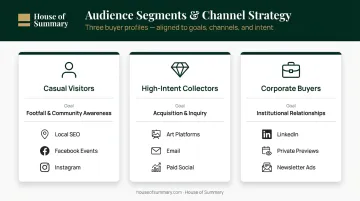
Two very different people might walk through your gallery doors: the casual visitor who enjoys art, and the collector actively considering a purchase. Your advertising budget should treat them differently.
| Audience Type | Primary Goal | Best Channels |
|---|---|---|
| Casual visitors | Footfall, community awareness | Local SEO, Facebook events, Instagram |
| High-intent collectors | Acquisition, inquiry | Art platforms, email, paid social |
| Corporate buyers | Institutional relationships | LinkedIn, private previews, newsletter ads |
Gather audience data from sources you already have:
- Website analytics (which artist pages get the most traffic?)
- Social media insights (who engages with your posts?)
- Past buyer profiles from your CRM
- Exhibition inquiry records
That data also shapes how you position the work itself. Galleries promoting emerging artists need advertising that builds credibility first, since the work isn't yet self-evident to collectors. Galleries with established names can lean on reputation and scarcity to create urgency.
Build a Strong Online Presence: Website and SEO
Your gallery's website is doing more selling than you probably realize. The Art Basel and UBS Survey of Global Collecting 2024 found that 72% of surveyed high-net-worth collectors had purchased through a dealer website or online viewing room without a physical viewing. If your site is slow, hard to navigate on mobile, or lacks quality artwork imagery, you're losing buyers before they've even contacted you.
On-Page SEO Fundamentals
Search engines need signals to surface your gallery for the right searches. The basics matter more than most galleries realize:
- Target specific keywords: artist names, medium, style, and location (e.g., "contemporary photography gallery London")
- Write descriptive alt-text for every artwork image — search engines can't see photos, but they can read your descriptions
- Update exhibition pages regularly; fresh content gives search engines a reason to re-index your site
- Craft compelling meta descriptions for artist profiles and current exhibitions
- Publish editorial content — collecting guides, artist spotlights, and exhibition recaps attract art-curious searchers and build domain authority over time
Local SEO: Often Overlooked, Highly Effective
For galleries driving in-person visits, local search delivers results that most paid campaigns can't match. Google's data shows that 76% of people who search for something nearby on a smartphone visit a related business within a day — and 28% of those searches result in a purchase.
Three actions make the biggest difference:
- Claim and fully complete your Google Business Profile — hours, address, categories, photos, and current exhibition announcements
- Actively gather Google reviews from visitors and buyers; they directly influence local ranking
- Keep your gallery's name, address, and phone number consistent across every online directory
Leverage Social Media to Showcase Your Gallery
Art gallery audiences cluster on a handful of platforms. Concentrating effort on the right three — rather than maintaining a thin presence everywhere — produces meaningfully better results.
Platform priorities:
- Instagram: The primary discovery channel for collectors. 43% of high-net-worth collectors have purchased art through Instagram without seeing the work in person first.
- LinkedIn: Reaches corporate collectors, art advisors, interior designers, and business professionals with real purchasing authority.
- Facebook: Best for community building, event promotion, and engaging local audiences around openings and exhibitions.
Content that performs well across all three:
- Professional artwork photography (consistent quality matters enormously)
- Behind-the-scenes installation and preparation content
- Artist interviews, studio visits, and process documentation
- Opening night moments and collector interactions
- User-generated content — encourage visitors to post and tag your gallery
Hashtags, artist tagging, and geolocation all expand organic reach without additional spend. When collectors share acquisition posts or visitors tag your space, that earned credibility carries more weight than any branded content you could publish.
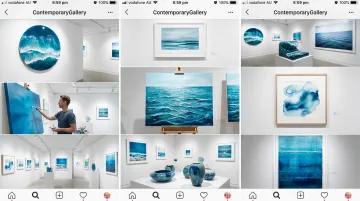
Organic reach has a ceiling, though. That's where paid social becomes the logical complement.
Paid Social Advertising for Galleries
Instagram and Facebook's ad platforms allow targeting by interest (art, luxury, investing), income bracket, location, and behavior. A single artwork or upcoming exhibition can appear directly in the feed of high-net-worth prospects with no prior exposure to your gallery.
Keep paid social creative tight:
- Lead with the artwork — clean visuals, minimal text overlay
- One clear call to action per ad (view the collection, book a private preview, attend the opening)
- Run two or three creative variations before committing budget to scale
- Pull spend from underperforming variants quickly rather than letting them run
Email and Newsletter Advertising: Reaching Collectors Directly
Email is where galleries with serious collector relationships do their most effective advertising — and it's consistently underused by galleries that focus too heavily on social.
The reason email works: it reaches people who already raised their hand. No algorithm decides whether your message appears. No ad blocker strips it out. The collector opens it because they chose to.
What Makes a Gallery Newsletter Work
Content matters more than frequency. A gallery newsletter that reads like a promotional catalog will be ignored. One that offers genuine access — first looks at new acquisitions, private preview invitations, artist features, and market insights — builds a relationship with lasting commercial value.
Key factors that determine newsletter performance:
- Segmentation — collectors interested in photography shouldn't receive the same email as buyers focused on sculpture
- Subject lines — the most important copy you'll write; specificity outperforms cleverness
- Send timing — test Tuesday through Thursday mornings for the most consistent open rates
- Exclusive framing — position content as access, not advertising
Paid Newsletter Placements: Reaching Beyond Your Own List
Your owned email list only reaches people who already know you. Paid newsletter advertising extends that reach to high-intent audiences who haven't encountered you yet.
Placing sponsored content in established newsletters that reach engaged professional and affluent audiences bypasses the limitations of web display advertising . Email-based ads aren't touched by ad blockers (which over 52% of consumers use), and they appear inside editorial reading flow rather than in sidebar slots that trained readers ignore.
House of Summary's newsletter network offers art galleries and luxury brands exactly this kind of placement. Their newsletters — Presidential Summary, Geopolitical Summary, Dubai Summary, and London Summary — reach 500,000+ subscribers across key art market cities: 66% in the USA (concentrated in New York and Los Angeles), with significant audiences in London and Dubai. The reader profile skews toward executives, decision-makers, and high-net-worth individuals: the collector profile most galleries spend heavily to reach through other channels.
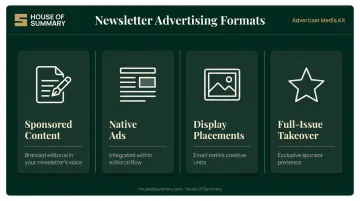
Advertising formats available include:
- Sponsored content — branded editorial written in the newsletter's voice, integrated within the issue's reading flow
- Native ads — inline placements that appear as part of the editorial rather than in separate ad slots
- Display placements — creative units that outperform web display because ad blockers don't apply to email
- Full-issue takeovers — exclusive sponsor presence across an entire newsletter issue
For galleries looking to reach HNW audiences in New York, London, or Dubai without relying on algorithmic platforms, House of Summary's newsletter network offers a direct inbox path — no algorithms, no blocked placements. Contact their team at sales@houseofsummary.com for rate cards and campaign options.
Host Events and Build Community Partnerships
A well-executed opening night earns its budget many times over. One event can simultaneously generate press coverage, social content, word of mouth, and new collector relationships — compressing weeks of outreach into a single evening.
According to the Art Basel and UBS Art Market Report 2025, art fairs were the primary new-buyer source for 31% of dealers in 2024, while in-person gallery walk-ins accounted for 23% — making in-person experiences the single largest category of new collector acquisition combined.
High-value event formats for galleries:
- Collector previews (invitation-only, before public opening)
- Artist talks and Q&A sessions
- Workshop series tied to current exhibitions
- Joint events with complementary venues (luxury hotels, design studios, auction houses)
Cross-promotional partnerships extend your reach without duplicating spend. A few pairings worth pursuing:
- Interior design firms: Their clients already spend on curated aesthetics — a natural gallery audience
- Luxury hotels: Exhibition materials placed in-room reach traveling high-net-worth guests with idle time and disposable income
- Auction houses: Co-hosted events signal credibility and attract serious collectors
Beyond the event itself, documentation multiplies its value. Professional photography, short video recaps, and post-event email follow-ups extend a single evening into weeks of digital content.
Paid Advertising Beyond Social
Google Ads
Google Search captures intent-driven traffic — people actively searching for galleries, specific artists, or art to purchase. The Arts and Entertainment category shows a relatively low average cost-per-click compared to other sectors, making it an accessible channel for galleries with modest paid budgets.
Search ads work best for high-commercial-intent terms ("buy contemporary photography London," "emerging artist gallery New York"). Display ads are better suited for retargeting people who visited your website but didn't make an inquiry.
Art-Specific Platforms
Google captures broad search intent, but art-specific platforms put your gallery in front of buyers who are actively browsing and collecting. Three channels matter most:
- Artsy — connects over 1 million available works to millions of collectors globally through partnerships with 3,000+ galleries. 70% of surveyed galleries report that online sales account for up to 25% of total sales
- Artnet — reaches 31 million annual users across 235 countries, with advertising formats including banner ads, sponsored content, and newsletter placements
- Ocula — reaches collectors, designers, curators, and art enthusiasts whose audience is 7x more likely to be interested in investing than the general web population
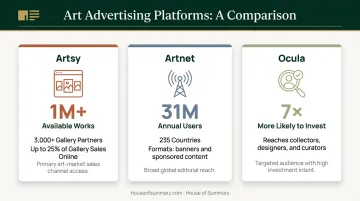
These platforms reach buyers who are already in a collecting mindset — the intent level is categorically different from a social media scroll.
Budget guidance: Track conversions by channel — inquiries, event attendance, and platform referral visits — from day one. Start with one platform, set a defined test budget (most art platforms offer entry-level packages), and evaluate cost-per-inquiry before scaling across channels.
Frequently Asked Questions
How do I advertise an art gallery?
Combine a strong website and SEO foundation with social media presence (primarily Instagram), email marketing to an owned list, paid placements on art-specific platforms like Artsy and Artnet, and community events. Ground every decision in a clearly defined target audience and a specific advertising goal.
What type of art is in high demand right now?
According to the Art Basel and UBS reports, paintings represented 49% of HNW fine-art expenditure in 2024, with prints and works on paper also performing strongly. Digital art has declined significantly from its 2022 peak.
How much should an art gallery spend on advertising?
Start by allocating to high-ROI channels first — email and targeted social — before scaling into broader paid display or print. No universal industry benchmark exists for gallery ad budgets, so track results per channel and reallocate toward what converts.
What social media platform is best for art gallery marketing?
Instagram is the clear primary platform — its visual format aligns with art discovery, and 43% of HNW collectors have purchased through it without in-person viewing. Other platforms serve distinct purposes:
- LinkedIn reaches corporate and institutional buyers
- Facebook drives event promotion and local community engagement
How can I attract more collectors to my art gallery?
Combine targeted paid social advertising with private event invitations, presence on art-specific platforms like Artsy, and personalized email outreach. Consistent, relevant communication across channels matters as much as any single campaign.
Does email marketing work for art galleries?
Yes. Email reaches opted-in audiences directly — no algorithms, no ad blockers, no competition for attention. Owned lists and sponsored placements in curated newsletters both drive strong engagement among art-interested, high-net-worth readers.