
Introduction
Private school enrollment tells two very different stories right now. Overall, private K-12 enrollment held steady at roughly 4.7 million students between 2019-20 and 2021-22 — but the number of private schools dropped 3%, from 30,490 to 29,730, according to NCES data. Smaller schools feel this most acutely: NAIS found that schools with fewer than 101 students saw median enrollment fall 9% over the same period.
Schools gaining ground are advertising deliberately. Those losing enrollment often aren't advertising at all, or they're doing it in ways that don't reach the right families.
Most private school advertising fails because it treats parents like impulse buyers. These are high-stakes decision-makers who research for months, consult spouses, visit multiple campuses, and weigh dozens of factors before contacting a single school. Generic ads don't move them. Consistent, well-timed communication that builds credibility does.
This guide covers how to build that kind of advertising system, from defining your target family to tracking what's actually driving enrollments.
Key Takeaways
- Define your parent persona before picking any channel — message relevance depends on audience clarity.
- A weak website wastes every ad dollar — it's where all traffic lands first.
- Google Search Ads, social media, and newsletter placements each target a different stage of the parent decision journey.
- Word-of-mouth and community events carry the highest trust of any channel available to schools.
- Track cost-per-inquiry by channel to know where your budget is working.
Start With a Clear Picture of Your Target Family
Build the Parent Persona First
Before selecting a single ad channel, schools need to know who they're talking to. A parent persona captures where prospective families spend their time online, who they trust for recommendations, and what outcomes they care about most — safety, academic rigor, values alignment, or something else. Without this foundation, ad spend goes to the wrong audiences. According to EdChoice's 2024 research, 50% of private school parents cited a safe environment as their top reason for choosing a private school, and 47% cited academic quality. Those two priorities should shape your messaging before anything else.
Understand How Private School Parents Research
Private school parents don't behave like typical consumers. They:
- Research extensively online before making any contact
- Read detailed content about curriculum, outcomes, and school philosophy
- Lean heavily on peer referrals from parents whose judgment they trust
- Involve multiple household decision-makers throughout the process
- Follow a long consideration cycle that can stretch six to eighteen months
Map the Decision Journey to Your Tactics
The parent decision journey runs through five stages, and different advertising tactics serve each one:
| Stage | Parent Mindset | Effective Tactic |
|---|---|---|
| Awareness | "I don't know this school exists" | Social media, community events, word-of-mouth |
| Consideration | "I'm comparing a few options" | Blog content, SEO, newsletter ads |
| Inquiry | "I'm ready to learn more" | Google Search Ads, retargeting |
| Visit | "I'm evaluating seriously" | Email follow-ups, open houses |
| Enrollment | "I'm deciding" | Personal outreach, admissions CRM |
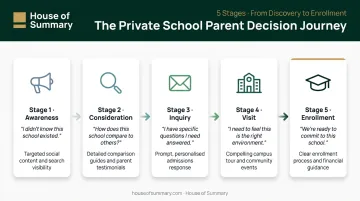
A Google Search Ad captures a parent already in consideration mode. A social media post builds awareness for a parent who doesn't know you exist yet. Running only one type leaves the rest of the funnel unaddressed.
Know What Sets You Apart — and Ask Families to Confirm It
Before writing a single ad, identify what specific program, environment, or philosophy makes your school the right fit for a particular type of family. That answer becomes the foundation of every ad, landing page, and campus tour pitch.
Then validate it: survey enrolled families to find out which channel first introduced them to the school and what ultimately convinced them to apply. That data is more useful than any industry benchmark when deciding where to allocate budget.
Build a Website and Digital Presence That Converts
What a High-Converting School Website Looks Like
Every advertising dollar — paid search, social, referrals, community events — eventually directs a prospective family to your website. If the site doesn't convert visitors into inquiries, all that spend disappears.
A high-converting school website includes:
- Mobile-first design — most parents will find you on their phones
- Fast load times — Portent's research links slower load times to measurable drops in conversion
- Prominent inquiry CTAs on every page — don't make families hunt for a contact form
- Easy access to admissions information — three clicks or fewer from the homepage
Capture Parents Already Searching With Local SEO
When a parent searches "private elementary school in [city]," appearing in Google's local map results and organic listings captures families who are already actively looking. To get there:
- Claim and fully optimize your Google Business Profile with photos, hours, and category tags
- Use the local keyword phrases parents actually type — "private K-8 school in [city]," "best independent school near [neighborhood]"
- Build local citations across school directories like Niche and GreatSchools
Build Trust Before the First Contact
Getting found is only half the battle. Once a parent lands on your site, two content investments convert browsers into inquiries:
- Blog content answering questions at each decision stage — "How to choose a private school" or "What makes a strong K-8 curriculum" — positions your school as a helpful resource before any contact is made.
- Credibility signals such as faculty bios, student outcome data, accreditation badges, and parent testimonials reduce skepticism for families comparing multiple options.
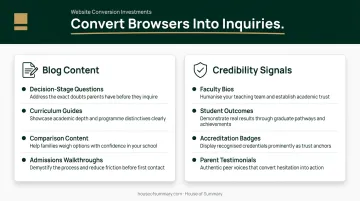
Keep the path from landing page to inquiry form short. Every extra click costs you a conversion.
Paid Advertising Channels That Reach the Right Parents
Choosing the Right Channel Mix
The right paid advertising mix depends on budget, geography, and which stage of the parent journey you're targeting. The main options:
- Google Search Ads — captures active demand
- Facebook and Instagram ads — builds awareness and enables retargeting
- Newsletter advertising — reaches opted-in professional audiences in distraction-free environments
Google Search Ads: Capture Parents Who Are Already Looking
When a parent types "private school near me" or "best K-8 school in [city]," they're in active consideration mode. Search ads appear at exactly the right moment.
Key points for school search campaigns:
- Target high-intent, local keyword phrases — not just "private school" but "private school [city]" and "independent elementary near me"
- Set up conversion tracking tied to specific goals: inquiry form submissions, tour bookings, open house registrations
- WordStream's 2024 Google Ads benchmarks report a 6.21% average CTR for the Education and Instruction category — useful for benchmarking campaign performance
Facebook and Instagram Ads: Awareness and Retargeting
Meta platforms let schools target parents by age, income bracket, parenting status, and geography — reaching families in the right life stage before they begin searching.
Retargeting works because the decision takes months: showing ads to families who already visited your website keeps the school visible throughout that window. According to Pew Research Center's 2024 data, 75% of adults aged 30-49 use Facebook and 66% use Instagram — the core private school parent demographic.
Newsletter Advertising: An Underused Channel for Professional Parents
Affluent, time-pressed professional parents are disproportionately heavy newsletter readers. Newsletter advertising has structural advantages that web display doesn't:
- No ad blockers — ads arrive directly in the inbox, bypassing the filters that block most web display
- Opted-in audiences — subscribers chose to be there, so engagement starts before the ad loads
- Distraction-free environment — no competing banners, no algorithmic feeds pushing your message out of view
House of Summary's newsletter network reaches 500,000+ subscribers with 254,866+ emails opened daily. The audience skews toward decision-makers, executives, and high-income professionals — 66% based in the US, with strong concentrations in New York and Los Angeles and additional reach in London and Dubai.
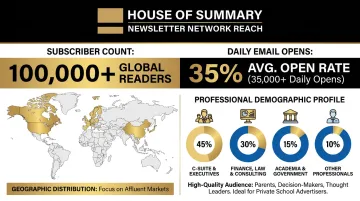
For schools targeting professional parent demographics, that audience profile is a direct match. Contact sales@houseofsummary.com for media kit details and campaign options.
Track Everything
Running ads across any of these channels only pays off if you know what's working. NAIS's 2025 State of Independent School Marketing found that only 19% of independent schools report campaign ROI. That means most schools are spending without knowing what's working.
Every campaign needs:
- UTM parameters on every ad link
- Google Analytics tracking by traffic source
- An admissions CRM that records how each family first discovered the school
Leverage Community Word-of-Mouth and Events
Formalize Parent Ambassador Programs
Word-of-mouth can be structured deliberately. Identify deeply satisfied families, equip them with talking points, and encourage them to represent the school at community events, preschool pickups, and local gatherings.
The trust argument is strong: Nielsen's research found that 88% of global respondents trust recommendations from people they know more than any other channel. Paid advertising, regardless of format or budget, rarely achieves that level of credibility.
High-Impact, Low-Cost Event Formats
These event formats reach families in the early awareness stage without the pressure of a sales pitch:
- Virtual "Coffee with the Head of School" sessions
- Q&A webinars with faculty covering curriculum and outcomes
- Community workshops co-hosted with feeder preschools or local libraries
What these formats share is direct, unscripted access to school leadership — which is exactly what families are looking for before they commit to a campus visit.
Online Reviews as Passive Advertising
A regular flow of recent, positive reviews on Google, GreatSchools, and Niche improves local search visibility and builds immediate credibility with families who discover the school online. Make review requests a standard part of your re-enrollment process each spring.
Use Content and Social Media as Ongoing Advertising
Social media functions as always-on advertising when used with intention. Authentic photos and short videos of daily school life — classroom moments, student projects, community events — build ambient trust with families who are passively evaluating options, often months before making formal contact.
A genuine classroom photo outperforms a polished graphic — every time.
Repurpose Content Across Channels
Schools with limited marketing bandwidth don't need a constant stream of new ideas. One piece of content can work across multiple touchpoints:
- A blog post becomes three social media captions
- An event recap appears in the monthly email newsletter
- A teacher spotlight gets referenced in open house materials
One asset, three placements — that's a sustainable content strategy for a lean team.
User-Generated Content Costs Nothing
Student social media takeovers, parent video testimonials, and alumni career spotlights provide authentic voices that no paid ad can replicate. According to HubSpot's 2024 State of Marketing report, 84% of marketers say video helped increase website traffic. A clip filmed on a parent's phone, speaking honestly about their child's experience, will outperform a produced brand video for the families you're actually trying to reach.
Track and Measure What Your Advertising Is Actually Doing
The Metrics That Matter
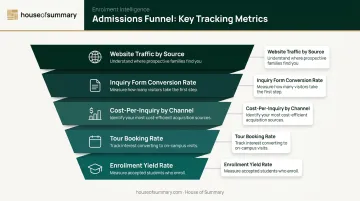
Tracking at each stage of the funnel reveals where families are dropping off. Monitor:
- Website traffic by source — organic, paid, social, direct
- Inquiry form conversion rate — what percentage of visitors submit a form
- Cost-per-inquiry by channel — compare paid channels on the same basis
- Tour booking rate — how many inquiries convert to campus visits
- Enrollment yield rate — the percentage of inquiries that result in enrolled students
The Minimal Tracking Infrastructure You Need
You don't need enterprise software — just three tools working together:
- Google Analytics — tracks website behavior and traffic sources
- UTM parameters on every ad link — ensures traffic is properly attributed
- A basic admissions CRM — records how each family first discovered the school and tracks their progress through the funnel
Once this infrastructure is in place, the admissions team can connect specific ad spend to actual enrollments and reallocate budget toward what's working. Without it, budget decisions are based on instinct rather than evidence — and that's a costly way to fill a class.
Frequently Asked Questions
How do I advertise a private school?
Start by defining your target parent persona, then build a high-converting website as the hub for all traffic. Combine organic channels (SEO, social media, content) with paid channels (Google Ads, social ads, newsletter placements) and track cost-per-inquiry to identify which channels drive actual enrollments.
What are the 5 P's of advertising?
The 5 P's are Product, Price, Place, Promotion, and People. For private schools, "Product" is the educational experience and "Place" is where parents are reached. "People" — covering both the faculty showcased and the parent audience targeted — is the most important P for admissions campaigns.
What is the best social media platform for private school advertising?
Facebook and Instagram typically deliver the best reach for parents aged 28-45, given that 75% of that cohort uses Facebook and 66% uses Instagram. LinkedIn works well for schools targeting high-income professional families, while TikTok is gaining ground for reaching younger parents in early awareness stages.
How much should a private school spend on marketing?
NAIS data shows that 54% of independent schools have annual marketing budgets above $70,000, and roughly 28% exceed $120,000. Schools with tighter budgets should lean into organic efforts like community outreach and parent ambassador programs rather than spreading limited paid spend across too many channels.
What makes private school advertising different from regular marketing?
The decision is high-stakes, emotionally driven, involves multiple family stakeholders, and follows a consideration cycle spanning many months. Ads must build trust over time — they rarely produce an immediate enrollment the way a consumer ad produces an immediate purchase.
How do I measure if my private school advertising is working?
Track how each inquiring family first discovered the school, then measure inquiry-to-tour and tour-to-enrollment conversion rates by channel. Calculate cost-per-enrolled-student for each paid channel to identify where spend is delivering returns and where it isn't.