Introduction: Why Higher Ed Content Marketing Can't Be an Afterthought
The numbers are blunt: WICHE's December 2024 projections show U.S. high school graduates peaking in 2025 at roughly 3.8–3.9 million, then declining for the next 16 years — about 13% fewer graduates by 2041. At the same time, 94% of private four-year institutions and 80% of public four-year institutions already purchase high school student name lists, meaning the same shrinking pool of prospects is being chased by nearly every competitor simultaneously.
Traditional outbound recruitment isn't disappearing, but it's becoming more expensive while delivering fewer results. Institutions that invest now in owned content assets — material that prospective students, alumni, and community stakeholders actively seek out — build a durable competitive position that strengthens year over year.
This guide covers the practical framework for getting there:
- The four content pillars that drive enrollment results
- How to build an SEO and distribution strategy that gets found
- How to segment content across very different audiences
- How to measure what enrollment leadership actually cares about
Key Takeaways
- Traditional outbound recruitment is crowded — 94% of private four-year schools buy the same student name lists
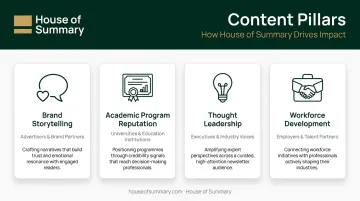
- Effective higher ed content marketing rests on four pillars: brand storytelling, academic program reputation, thought leadership, and workforce development content
- 87% of organic impressions on higher ed websites come from non-branded search — meaning content must capture students before they know your institution's name
- Each audience segment — undergrads, grad students, adult learners, alumni — requires a distinct content approach, not recycled messaging
- Measurement should tie content performance to CRM outcomes, not just page views
Why Higher Ed Institutions Need Content Marketing Now
The Shrinking Pool Problem
The competitive math is getting harder. When 94% of schools are running the same outbound playbook — purchased lists, email outreach, direct mail — differentiation through those channels becomes nearly impossible. A school that ranks organically for "is a nursing degree worth it" or "best cities for data science careers" reaches prospective students before they've heard of any specific institution. That's a different position entirely than being one of dozens of email senders in the same inbox.
Content marketing, as defined by the Content Marketing Institute, means creating and distributing valuable, relevant content to attract a clearly defined audience and drive profitable action. That's a different discipline than a university newsroom or press release operation.
The distinction matters in practice:
- A news post about your dean's award is institutional PR
- A guide to "what you can do with a public health degree in 2025" is content marketing
The Trust-Building Flywheel
Outbound recruitment is linear: you contact a prospect, pitch them, and either convert or lose them. Content marketing creates something different — a flywheel where helpful content builds trust incrementally before a student ever contacts admissions.
When a prospective student finds your institution's guide to financial aid options, reads a faculty researcher's take on climate policy, or watches an alumna explain how she transitioned into UX design, she associates your institution with reliability. By the time she's ready to apply, she's not starting from zero.
One concrete illustration: Pacific College, a California nursing school, reported +930% organic traffic and +900% organic leads after investing in SEO, content development, and link-building. The gains were amplified by a prior CMS migration, but the direction is clear: a functioning content program compounds over time in ways outbound spend simply doesn't.
The Four Content Pillars That Drive Results
High-performing institutions don't rely on a single content type. The ones with durable organic presence and consistent inquiry pipelines typically maintain balance across four distinct content pillars.
Brand Storytelling
This pillar humanizes the institution through authentic voices: student journeys, faculty origin stories, alumni career pivots, and leadership narratives. Its primary function is differentiation — when two institutions offer the same programs at comparable tuition, brand storytelling is what creates emotional distinction.
Effective execution looks like student ambassador blogs, TikTok day-in-the-life takeovers, or alumni transformation stories told in their own words. The operative word is authentic — produced content that feels like a brochure undermines the purpose.
Academic Program Reputation Content
Graduate and professional students making high-stakes enrollment decisions need proof, not promises. This pillar delivers it:
- Faculty research highlights that demonstrate intellectual rigor
- Program outcome data — graduation rates, job placement rates, salary benchmarks
- Employer testimonials validating that graduates arrive ready
- Industry partnership announcements showing real-world relevance
This content moves graduate and professional prospects from consideration to inquiry more reliably than any other pillar.
Thought Leadership and Institutional Insights
Faculty research summaries, expert commentary on industry trends, and data-backed perspectives on pressing issues serve a dual function: they position the institution as an authority rather than just a credential factory. They also generate the backlinks and media attention that organic search rewards.
That second benefit is underused. According to Orbit Media's 2025 blogging research, roughly 25% of content programs that publish original research report strong results — and most institutions already have unique, publishable data sitting unused in their research offices.
Workforce Development Content
Content connecting programs to regional economic outcomes — career placement rates, employer partnerships, apprenticeship programs — reaches the broadest simultaneous audience:
- Prospective students asking "will I get a job?"
- Employers asking "will graduates be ready?"
- Policymakers and community leaders evaluating institutional value
This pillar is particularly strong for community colleges and regional universities whose identity is tied to local workforce needs. Unlike storytelling content, it answers accountability questions directly — making it effective for audiences who need data before they commit.
Building an SEO and Distribution Strategy That Gets Found
How Prospective Students Search
Search remains the dominant discovery channel for prospective students — Carnegie Higher Ed's 2024 benchmark across 200+ higher-ed websites found organic search driving 46% of total users and 53% of engaged sessions. The more striking finding: non-branded keywords generated 87.09% of impressions versus just 12.91% branded.
That means most prospective students arrive through problem-aware queries — "how to become a cybersecurity analyst," "is an MBA worth it at 35," "nursing programs in Boston" — before they're searching for any specific institution by name. Institutions that build content around these non-branded informational queries capture top-of-funnel interest from audiences who didn't know to look for them.
The search landscape extends beyond Google. Sprout Social's 2025 survey of 2,280 social users found 41% of Gen Z turn to social platforms first for search, compared to 32% using traditional search engines.
This doesn't mean abandoning Google — the evidence suggests TikTok search has been somewhat overstated as a replacement. But video titles, Instagram captions, and platform-specific discoverability all function as SEO assets and should be treated accordingly.
Content Distribution Channels Beyond Organic Search
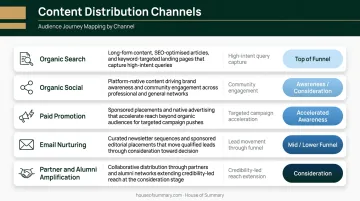
Creating strong content solves the supply problem. Distribution solves the demand problem. The main channels serve different parts of the audience journey:
| Channel | Best For | Audience Stage |
|---|---|---|
| Organic search (SEO) | Non-branded discovery | Top-of-funnel |
| Organic social media | Brand storytelling, community | Awareness/consideration |
| Paid content promotion | Amplifying high-value content | Accelerated awareness |
| Email nurturing | Converting known prospects | Mid/lower funnel |
| Partner/alumni amplification | Credibility and reach | Consideration |
One channel that sidesteps algorithm dependency entirely is the email newsletter — both institutional nurture campaigns and advertising within third-party newsletter networks. For institutions targeting graduate students, professional learners, or executive education candidates, placements within professionally curated newsletters reach decision-makers directly in the inbox, where ad blockers don't apply and social feed competition doesn't exist.
House of Summary's network of specialized newsletters — including Presidential Summary and Geopolitical Summary — reaches 500,000+ subscribers, with 254,866+ emails opened daily. The audience skews heavily executive: C-suite professionals, founders, policy experts, and senior professionals concentrated in New York, Los Angeles, and London. For MBA programs, executive education, and professional development marketing, that's a concentrated professional audience that's difficult to reach through standard display or social channels.
Targeting the Right Audiences with the Right Content
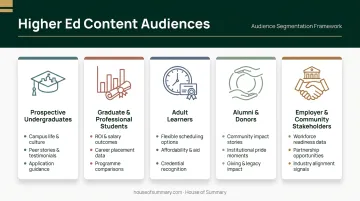
Higher ed institutions serve several audiences whose informational needs and decision timelines barely overlap:
- Prospective undergraduates — emotion-driven, peer-influenced, campus-culture-focused; they want to see themselves in the institution
- Graduate and professional students — ROI-driven and outcome-focused; they need data on careers, salaries, and program credibility
- Adult learners — concerned with flexibility, affordability, and whether a credential will be respected by employers
- Alumni and donors — motivated by community, impact, and pride in institutional growth
- Employer and community stakeholders — evaluating workforce readiness and partnership value
Content written for all of these simultaneously serves none of them well.
A Practical Segmentation Approach
Build content personas for each primary audience segment and map the specific questions they carry at different decision stages. A graduate student considering an MBA needs outcome data, cohort profiles, and ROI calculations — not campus life photos. An undergraduate applicant wants to know what current students' lives look like, not labor market analysis.
Practical tools for delivering the right content to the right person:
- Surfaces relevant program tracks through dynamic website content based on user behavior
- Triggers email workflows by inquiry type or program of interest, not a single broadcast sequence
- Delivers graduate content to working professionals and undergraduate content to high school seniors through targeted social advertising
Done well, segmentation turns traffic into inquiries. Done poorly, it means publishing content that reaches the right people at the wrong moment — or the wrong people entirely.
Measuring What Actually Matters
Page views and social followers are outputs, not outcomes. The metrics enrollment leadership cares about connect content activity to the enrollment pipeline.
Defining the Right Metrics
Before launching any content initiative, establish what success looks like:
- Inquiry starts from content-influenced traffic
- Application starts attributed to organic or newsletter-driven sessions
- Campus visit registrations from content landing pages
- Program information requests triggered by specific articles or guides
Chasing traffic without tying it to these downstream events produces dashboards that look good and inform nothing.
The Measurement Framework
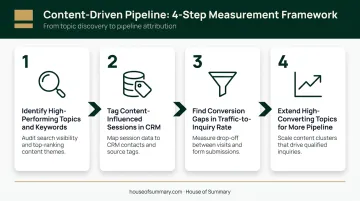
The most practical approach: connect content analytics to CRM data.
- Identify which topics, formats, and keywords drive organic traffic — then double down on what's working and cut what isn't
- Tag content-influenced sessions in your CRM so you can see which contacts engaged with specific content before submitting an inquiry or application
- Look for conversion gaps: content that drives traffic but not inquiries usually needs stronger calls-to-action or better links to relevant program pages
- Build on what converts by extending high-performing topics into related content that captures more top-of-funnel traffic
For stakeholders skeptical of content ROI, the comparison to outbound is worth making. Content programs typically generate inquiry volume at lower per-lead cost than cold outbound — though the gap varies by institution type and how mature the content operation is. The stronger case is usually the pipeline data itself: show which applicants touched content before converting.
Future-Proofing Your Higher Ed Content Strategy
The AI Search Reality
Ahrefs' April 2025 study of 300,000 keywords found that Google AI Overviews reduce top-ranking page click-through rates by 34.5% (position-one CTR fell from 0.073 in March 2024 to 0.026 in March 2025 for AI Overview-triggering queries). This doesn't make content marketing less important. It makes weak, generic content indefensible.
Institutions that produce authoritative, expert-authored, structured content — the kind that AI systems reference as trusted sources — maintain search visibility even as direct clicks decline. Google's own guidance is straightforward: helpful, reliable, people-first content with accurate structured data and strong page experience. That's the foundation — and it's also the case for building durable content assets that hold value regardless of how search interfaces evolve.
Building Evergreen Content Assets
The institutions best positioned for the future treat content as a long-term asset, not a one-cycle campaign. A comprehensive guide to "careers in biomedical engineering" published today will generate traffic and inquiries for years — with no additional spend to keep it live.
The compounding math is significant:
- Year 1: Content investment with modest returns as rankings build
- Year 2–3: Organic traffic grows, inquiry cost per lead declines
- Year 4+: Established content library generates consistent pipeline with minimal additional spend
Institutions that start building now — before enrollment pressures intensify — will have an established, high-authority content library when it matters most. Those that wait will be paying premium costs to catch up.
Frequently Asked Questions
What is the difference between content marketing and content strategy in higher education?
Content strategy is the "why" — the goals, audiences, and editorial governance behind content decisions. Content marketing is the "what and how" — the formats, channels, and tactics used to reach specific audiences and drive enrollment outcomes. Neither works without the other; publishing content without strategy produces volume without impact.
How long does it take for higher ed content marketing to show results?
SEO-driven content typically takes 6–12 months to build meaningful organic traffic; paid promotion can accelerate early visibility. Content programs generally take 3–5 years to fully compound, which makes early investment critical. Institutions building their organic library now will hold a measurable advantage when the demographic cliff hits.
What types of content work best for attracting prospective students?
Effective content maps to each decision stage: informational blog posts for early discovery, student stories and outcome data for consideration, and financial aid resources near the decision point. Video and peer-generated content perform especially well with traditional-age undergraduates.
How can smaller colleges with limited budgets approach content marketing?
Focus on a single, consistently maintained content channel — typically a blog optimized for organic search — targeting a narrow set of high-value non-branded keywords. Faculty expertise and student voices are cost-effective, authentic content sources that don't require large production budgets. Depth in one channel outperforms thin presence across many.
How do you measure the ROI of higher education content marketing?
Connect content-influenced traffic to CRM outcomes: track which content pieces were viewed by contacts who later submitted inquiries or applications. Supplementary metrics include organic traffic growth, keyword ranking improvements, and cost-per-lead comparisons against paid advertising.
Does content marketing replace paid advertising in higher ed enrollment strategy?
No — they work best together. Content builds long-term organic visibility and trust; paid promotion amplifies specific content pieces and accelerates top-of-funnel reach during key enrollment windows. As the organic content library matures, reliance on paid spend typically decreases.