This guide covers the practical side of advertising a dietitian practice: building the right foundation, choosing digital and offline channels, understanding what professional standards require, and tracking what actually works. Whether you're just starting out or trying to scale an existing client load, the strategies here apply — with honest distinctions made between free and paid approaches.
Key Takeaways
- Define your niche before spending anything on advertising — generic messaging attracts no one
- Physician referrals and allied health networks remain the highest-converting client sources
- A professional website with local SEO is non-negotiable for being found online
- Newsletter advertising puts your message in front of opted-in readers — no algorithms filtering you out, no ad blockers, no competition for attention
- Ethical advertising rules are enforceable — know what's permitted before you post
Start With Your Foundation: Niche, Brand, and Target Market
Advertising without a defined niche is expensive and ineffective. Generic messaging — "I help people eat better" — resonates with no one — and converts no one.
Dietitians who specialize find it far easier to write compelling ad copy and attract clients who are ready to book. According to a 2024 Australian private practice survey, 69% of private dietetics practices already specialize, with eating disorders (32%), disability support (23%), and weight-inclusive care (23%) among the most common niches.
How to Choose a Viable Niche
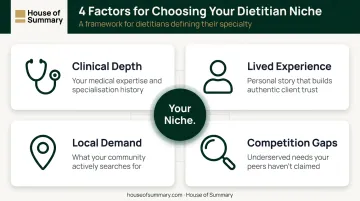
Consider four factors:
- Start with your clinical depth — the conditions or populations where your training is strongest
- Factor in lived experience, which often creates genuine credibility with specific client groups
- Check local demand for underserved populations or conditions with limited specialist coverage
- Map the competition: find gaps other local RDs aren't filling, not spaces already crowded
Your niche becomes the lens through which everything else is built — including your brand. A consistent name, visual identity, tone of voice, and messaging across your website, social profiles, and printed materials signals credibility fast. Potential clients assess your brand in seconds before deciding whether to book.
The Ideal Client Avatar
Build a specific profile of who you want to attract. That profile should include:
- Approximate age range and life stage
- Primary health goals or conditions they're managing
- Income level and willingness to pay out-of-pocket
- How they search for help (Google, Instagram, GP referrals)
- The exact words they use to describe their problem
This profile shapes every advertising decision that follows.
The most effective ads lead with outcomes, not credentials. "Manage IBS without cutting out every food you love" lands harder than "Accredited Practising Dietitian with 8 years of experience." Clients are searching for relief — your job is to show them you understand the problem before you explain why you're qualified to solve it.
Digital Advertising Channels That Actually Work for Dietitians
Website and Local SEO
Your website is often the deciding factor. Potential clients who receive a referral frequently research providers online before calling — Press Ganey's 2024 healthcare consumer survey found 83.5% of patients consult reviews at least occasionally even after receiving a referral, and consumers read an average of 4.7 reviews before making a decision.
Local SEO basics that matter most:
- Claim and fully complete your Google Business Profile
- Use location-based keywords ("dietitian + [city]" and condition-specific terms) throughout your site
- Ensure the site is mobile-optimized and loads quickly
- Keep your name, address, and phone number consistent across all directories
Social Media Advertising
Platform selection depends heavily on your niche:
| Platform | Best For |
|---|---|
| Instagram / TikTok | General wellness, weight management, younger audiences |
| Older demographics, chronic disease management, parent-focused niches | |
| Corporate wellness, professional referral development, B2B outreach |
Organic posting builds visibility over time but reaches mainly existing followers. Paid social promotion extends reach to new audiences — consider it once you have consistent content and a clear offer to promote.
Newsletter Advertising
This is an underused channel for dietitian practices, and the logic is straightforward: health-focused newsletter readers have opted in to receive content. Unlike display ads on websites or social media feeds, inbox placements can't be blocked by ad blockers and don't compete with visual noise.
House of Summary's newsletter network, for example, reaches 500,000+ subscribers with over 254,000 emails opened daily — drawing heavily from high-income professionals and health-conscious readers across major US cities. For a dietitian targeting an affluent, wellness-oriented audience, sponsored placements in curated newsletters offer focused attention that display advertising rarely delivers. Campaign formats include native editorial ads, sponsored content, and full-issue sponsorships — inquire through their sales team at sales@houseofsummary.com for placement details.
Google Ads
Pay-per-click search ads capture high-intent clients actively searching for nutrition help. Keep targeting hyper-local to avoid wasted spend on clicks from outside your service area. The average Google Ads cost-per-click across categories sits around $4.66, though healthcare niches vary. Start with a modest daily budget, test a small set of condition-specific keywords, and optimize based on actual bookings — not just clicks.
Directory Listings
List your practice on nutrition-specific directories:
- Academy of Nutrition and Dietetics' Find a Nutrition Expert tool
- Healthgrades and Zocdoc
- Telehealth platforms if you offer remote sessions
These generate passive discovery and expand reach beyond your immediate geography with minimal ongoing effort.
Build Referral Networks With Physicians and Allied Health Professionals
Referred clients arrive pre-sold on the value of nutrition counseling. Research published in the Journal of the American Dietetic Association found that meeting with physicians was rated 8.1 out of 10 for generating new patients — the highest of any marketing strategy studied among RDs in private practice.
Initiating Physician Relationships
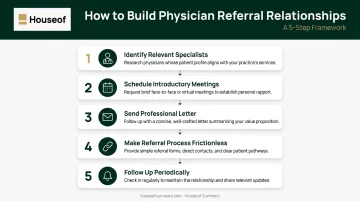
The most effective approach is direct and professional:
- Identify relevant specialists — GPs, endocrinologists, cardiologists, gastroenterologists, and pediatricians are logical starting points depending on your niche
- Schedule brief introductory meetings — a 10-minute in-person introduction beats any email
- Send a professional letter explaining your specialty, the types of clients you serve, and how referrals work
- Make the referral process frictionless — provide a simple referral form, a direct phone number, or a booking link the physician's office can share with patients
- Follow up periodically — a quarterly newsletter or update keeps you top of mind without being intrusive
Beyond Physicians
Allied health professionals are an equally valuable and often overlooked source of referrals:
- Personal trainers — clients with performance or body composition goals
- Physical therapists — injury recovery, sports nutrition, anti-inflammatory eating
- Mental health counselors — eating disorder recovery, emotional eating, stress-related nutrition
- Pharmacists — medication-nutrition interactions, diabetes management, supplement guidance
These relationships cost nothing to build. Referring clients back to them strengthens the partnership and keeps referrals flowing in both directions.
Community Networking
Broaden your reach beyond one-on-one professional relationships by engaging in your local community:
- Join local business associations and chamber of commerce groups
- Attend health-focused community events and wellness fairs
- Engage actively with professional dietetics bodies such as the Academy of Nutrition and Dietetics
Satisfied clients are also a reliable referral source — word of mouth from people who've seen results tends to bring in prospects who are already motivated to change.
Content Marketing and Ethical Advertising Rules
Content That Builds Trust Over Time
Publishing consistent, useful content keeps you visible between appointments and reinforces your expertise. The same 1995 JADA research that highlighted physician referrals also ranked newsletters among the top five most effective marketing strategies for RDs , and that finding still holds up. A potential client who has read several of your newsletters already trusts your expertise before the first consultation.
Practical formats to consider:
- Blog posts optimized for search queries your ideal clients use ("foods for managing type 2 diabetes," "meal planning for PCOS")
- Monthly email newsletter with one actionable tip — consistency matters more than volume
- Short-form video on the platform where your audience spends time
Producing relevant content consistently for the right audience matters far more than publishing volume.
That content strategy only works if your advertising stays within professional bounds. Here's what the rules actually require.
Ethical Advertising: What the Rules Require
Professional standards governing dietitian advertising are enforceable across jurisdictions. The core requirements are consistent: advertising must be truthful, evidence-based, and not misleading.
On testimonials and reviews:
- The College of Dietitians of Ontario prohibits soliciting client testimonials or linking to controlled review pages
- Dietitians Australia advises avoiding clinical testimonials and before-and-after images with personal claims
- AHPRA's National Law prohibits testimonials in regulated health-service advertising; violations can result in penalties of up to $5,000 per offence for individuals
What's acceptable: reviews about non-clinical experiences — booking convenience, location, friendly staff. What crosses the line: outcome claims, before-and-after comparisons, or anything implying guaranteed results.
On conflicts of interest:
If your advertising involves brand partnerships, affiliate links, sponsorships, or product endorsements, these must be clearly disclosed. Failure to do so can constitute professional misconduct under most regulatory frameworks. Build your marketing around credentials, scope of practice, evidence-informed care, and access rather than promises of specific outcomes.
How to Measure Whether Your Advertising Is Working
Only 40% of Australian private dietetics practices periodically evaluate business performance — and the practices that do measure show a statistically significant positive correlation with revenue.
That gap is where growth gets left behind. Fortunately, tracking doesn't need to be complicated:
- Ask every new client "How did you find us?" and record the answer
- Use UTM parameters on links in paid ads, newsletter placements, and directories so Google Analytics can show you which channels drive website visits
- Track inquiry-to-booking conversion by channel — a source driving lots of inquiries but few bookings signals a messaging problem
Realistic Timelines by Channel
Different channels operate on different timelines. Plan accordingly:
| Channel | Time to See Results |
|---|---|
| Paid ads (Google, social) | Days to weeks |
| Newsletter advertising | Weeks to months |
| Local SEO | 3–6 months for initial traction |
| Referral network building | Months, but high conversion once active |
| Content marketing | 6–12 months for compounding effect |
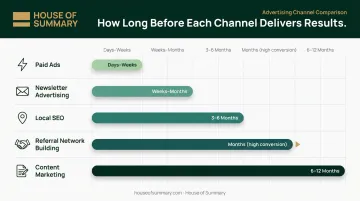
Once your tracking data shows which channels produce booked clients, allocate budget there — not toward channels that look busy but convert poorly.
Frequently Asked Questions
How much should a dietitian spend on advertising?
Most new private practice dietitians start with low- or no-cost strategies — networking, content, directory listings — and reinvest a portion of revenue into paid advertising as the practice grows. A Tebra survey of healthcare practices found 62% allocate between 1% and 5% of revenue to marketing, which is a reasonable starting benchmark.
Do dietitians need a website to attract clients?
A website is effectively non-negotiable. Clients who receive referrals routinely research providers online before booking, and a professional site builds credibility while reducing back-and-forth about services, pricing, and policies. Without one, you lose clients at the research stage.
Is social media marketing actually effective for dietitians?
Social media builds visibility and trust over time rather than delivering immediate bookings. Its value depends on niche, posting consistency, and whether paid promotion is used to extend reach beyond existing followers. Treat it as a long-term credibility tool, not a quick acquisition channel.
How do dietitians build physician referral relationships?
Direct professional outreach works best — a brief in-person introduction followed by periodic letters or updates explaining your specialty and how referrals work. Make the process frictionless for the physician's office by providing a simple referral pathway and direct contact details.
What advertising claims are not allowed for dietitians?
Avoid false or misleading claims, guaranteed outcomes, unsolicited client testimonials, manipulated before-and-after images, and any statements not supported by peer-reviewed evidence. Specific rules vary by jurisdiction, but advertising must always be honest, evidence-based, and not create unreasonable expectations.
How long does it take to build a full client base?
Timelines vary based on niche, location, advertising investment, and referral network strength. Most practitioners see meaningful growth within six to twelve months of consistent, multi-channel effort — and word-of-mouth referrals compound over time, rewarding steady builders more than sporadic ones.