The problem isn't finding an eLearning content provider. There are hundreds of them. The challenge is identifying which one actually fits your training goals, your learners, and your existing infrastructure — without wasting budget on a catalog that looks impressive but underdelivers in practice.
This article covers five of the best eLearning content providers for 2026, what makes each one worth considering, and a practical framework for evaluating them against your organization's needs.
Key Takeaways
- eLearning content providers fall into two categories: off-the-shelf course libraries and custom development studios — pick based on whether you need breadth or tailored build
- Top providers for 2026 balance strong instructional design, LMS compatibility, and content that stays current with shifting skill demands
- Course volume is a poor proxy for quality — evaluate content depth, format variety, and subject matter relevance instead
- Top picks: Coursera for Business, LinkedIn Learning, Skillsoft, Liberate (formerly EI Design), and Udemy Business
- Key selection criteria: content quality, customization depth, LMS integration, transparent pricing, and AI personalization
Overview of eLearning Content Providers
An eLearning content provider is any company or platform that creates, curates, or delivers digital learning content for organizational training. Two distinct types exist:
- Off-the-shelf content libraries — pre-built course catalogs covering common business, technical, and compliance topics, ready to deploy immediately
- Custom content development studios — specialist firms that design and build courses from scratch, tailored to your organization's specific processes, products, or regulatory requirements
Choosing between them — or blending both — depends on whether your training needs are generic enough to be met by existing content, or specific enough to require something built to spec.
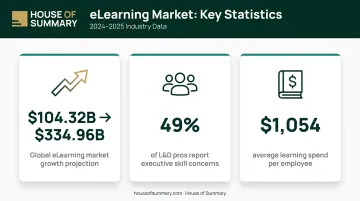
The LinkedIn 2025 Workplace Learning Report found that 49% of L&D professionals say executives worry employees lack the right skills, and 71% are already exploring or integrating AI into their learning programs. The ATD's 2025 research puts average direct learning expenditure at $1,054 per employee — meaning decisions about content providers carry real financial weight.
In 2026, catalog size alone is no longer the deciding factor. The providers that deliver measurable results combine solid instructional design with personalized learning paths, clear skills mapping, and content that stays current as job roles evolve.
Best eLearning Content Providers for 2026
Providers below were selected based on content quality, LMS compatibility, customization capability, enterprise client track record, and overall value. They span both off-the-shelf libraries and custom development to reflect different organizational needs. Use the "Best for" callouts under each provider to quickly match options to your organization's priorities.
Coursera for Business
Founded as an academic MOOC platform, Coursera for Business has evolved into a serious enterprise learning solution. Its library includes 10,600+ courses, 1,400+ specializations, 165+ Professional Certificates, and 1,500+ hands-on labs — all developed in partnership with over 350 leading universities and companies, including Google, IBM, Microsoft, and Duke University.
What sets Coursera apart is credential credibility. Learners earn certificates from recognized institutions, which matters for organizations investing in upskilling where verifiable outcomes (not just completion rates) are the measure of success. A Forrester Total Economic Impact study commissioned by Coursera reported a 327% ROI over three years for a composite enterprise organization, with payback under six months.
| Feature | Detail |
|---|---|
| Content Type | On-demand video courses, guided projects, specializations, and professional certificates co-developed with universities and major employers |
| LMS Integration | Integrates with 30+ LMS and LXP providers; supports SCORM, LTI, SSO/SAML, and skills APIs; enterprise admin analytics dashboard included |
| Pricing | Team plan: $399/user/year (up to 499 users); Enterprise (500+ users): quote-based; 14-day money-back guarantee on Team plan |
Best for: Organizations prioritizing upskilling with verifiable credentials, particularly in technology, data, leadership, and professional development.
LinkedIn Learning
LinkedIn Learning is a subscription platform offering 24,000–25,000+ courses across business, technology, and creative skills, led by industry practitioners. Its integration with the broader LinkedIn ecosystem gives it an edge no other provider can fully replicate.
Learners can display completed certifications directly on their LinkedIn profiles, tying training outcomes to real professional identity. More practically, LinkedIn's AI-powered recommendations draw on live labor market data , matching learning paths to actual job role demands rather than internal skill taxonomies alone. Organizations using LinkedIn Learning saw over 3x growth in AI skills developed year-over-year compared to those that don't use the platform, and learners using its AI coaching features spend 25% more time learning.
| Feature | Detail |
|---|---|
| Content Type | Short-form video courses led by industry practitioners, organized into learning paths by role, skill, or software |
| LMS Integration | Available through Microsoft Viva Learning in Teams; web and mobile accessible; enterprise plans are quote-based |
| Pricing | Teams plan (up to 20 licenses): $379.88/user/year; Enterprise pricing available on request |
Best for: Organizations already in the Microsoft 365 ecosystem, or those wanting learning tied to real-time labor market skills data.
Skillsoft
Skillsoft is one of the most established enterprise eLearning providers on the market. Its Percipio platform organizes content across three primary domains: Leadership & Business Skills, Compliance & Ethics, and Technology Skills — and currently serves 60% of the Fortune 1000.
Its compliance and regulatory training depth is where Skillsoft earns its reputation. For industries with strict training requirements — finance, healthcare, government — its audit-trail reporting and regulatory content updates are operationally valuable, not merely convenient.
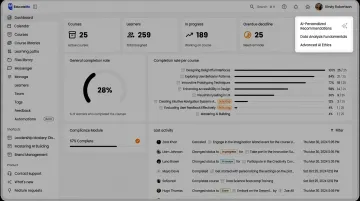
Percipio's AI personalization surfaces relevant content based on individual role and skill gaps. Its CAISY AI conversation simulator adds adaptive, personalized feedback for leadership and soft skills development, with iOS and Android mobile access included.
| Feature | Detail |
|---|---|
| Content Type | Video courses, books, audiobooks, practice labs, and compliance modules across leadership, IT, and business domains |
| LMS Integration | Supports SCORM 1.2, SCORM 2004, AICC, xAPI, and LTI; integrates with Workday, SAP SuccessFactors, Cornerstone, Oracle, Degreed, Moodle, and Microsoft Viva Learning |
| Pricing | Team Plan (5–49 users): $359/user/year; Business Plan (50–99 users): $239/user/year; Enterprise: quote-based |
Best for: Large enterprises needing compliance training depth, technical upskilling, and standards-based integration across complex LMS/LXP ecosystems.
Liberate (Formerly EI Design)
Liberate — the brand formed when EI Design, MPS Europa, and Liberate Learning united — operates differently from the three platforms above. There is no catalog to browse. Instead, Liberate designs and builds fully custom eLearning experiences from the ground up for enterprise clients across industries.
Its client portfolio spans 700+ global organizations, with documented case work including Telstra Health onboarding, Coles Learning Bites, and Department of Health infection prevention training. The output types are broad:
- Custom eLearning modules and scenario-based learning
- Microlearning and mobile-first content
- Gamified learning experiences
- Performance support tools
- Immersive and video-based learning
- LMS/LXP management services
Deliverables are compatible with SCORM, AICC, xAPI, and HTML5 formats, meaning content deploys into any major LMS without infrastructure changes. Liberate also offers learning portal development and managed learning services for organizations that need more than content production.
| Feature | Detail |
|---|---|
| Content Type | Custom-developed eLearning modules, microlearning, gamification, scenario-based learning, mobile-first content, and performance support tools |
| LMS Integration | Outputs SCORM, xAPI, and AICC-compliant content; also offers LMS/LXP management services |
| Pricing | Project-based; cost varies by interactivity level, course length, and volume — contact directly for scoping |
Best for: Organizations with training needs too specific for off-the-shelf content — product training, organization-specific compliance, complex onboarding, or technically specialized skills.
Udemy Business
Udemy Business is the enterprise arm of one of the world's largest online learning marketplaces. The Enterprise plan provides access to 30,000+ courses across technology, business, design, and productivity , all created by practitioners rather than academic institutions.
This practitioner-led model is what makes Udemy effective for technical teams. Courses on cloud computing, cybersecurity, programming, AI, and project management are authored by working professionals who update content as the field changes — keeping pace in ways static libraries can't.
Integration partners include Workday, Cornerstone OnDemand, Degreed, Docebo, Oracle Learning, SAP SuccessFactors, and SumTotal, among others.
| Feature | Detail |
|---|---|
| Content Type | On-demand video courses in technology, business, design, and productivity — created by practitioners |
| LMS Integration | Integrates with Workday, Cornerstone OnDemand, Degreed, Docebo, Oracle Learning, SAP SuccessFactors, SumTotal, 360Learning, and others |
| Pricing | Team Plan: $30/user/month, billed annually; Enterprise: quote-based; free trial available in many regions |
Best for: Tech teams and fast-moving organizations needing broad, affordable access to current practitioner-led content across in-demand technical skills.
How We Chose the Best eLearning Content Providers
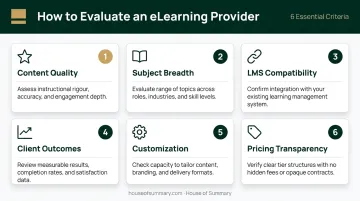
Providers were assessed across six criteria:
- Content quality and instructional design rigor — not just volume, but depth and format variety
- Breadth and relevance of subject matter — coverage of skills actually in demand
- LMS compatibility — verified standards support (SCORM, xAPI, AICC, LTI)
- Evidence of client outcomes — case studies, ROI data, or documented client results
- Customization capability — can the provider adapt to your organization's specific needs?
- Pricing transparency — are team-level prices published, and is enterprise pricing accessible through a sales process?
These six criteria filter out providers that look impressive on paper but underdeliver in practice. A catalog of 30,000 courses means little if the format doesn't suit your learners or the subject coverage misses your industry entirely. Selecting purely on brand recognition or course count is one of the most common — and costly — mistakes organizations make.
Two factors have grown critical enough to evaluate separately in 2026:
- AI personalization — does the platform adapt recommendations to individual learner roles, skill gaps, and career trajectories?
- Content currency — how frequently are courses revised to reflect new tools, regulations, or emerging practices?
The World Economic Forum's Future of Jobs Report 2025 projects that roughly 39% of workers' core skills will change by 2030. For L&D teams, that's a direct argument for vetting update cadence before signing any contract.
Conclusion
No single eLearning content provider suits every organization. The best fit depends on whether you need a ready-to-deploy content library, fully custom-built training, or a combination of both — and how well the provider's specific strengths map to your workforce development priorities.
Before committing at scale, run a structured evaluation:
- Request demos and test the learner experience on both mobile and desktop
- Review how frequently content is updated, particularly in your core skill areas
- Ask providers for case studies from organizations similar in size, industry, and training complexity
- Verify LMS compatibility through technical documentation, not just a sales conversation
Choosing the right provider is only part of the equation. Staying informed on workforce trends, talent strategy, and the business developments that shift training priorities is an ongoing effort. House of Summary's network of specialized newsletters delivers verified, human-written intelligence directly to your inbox — no algorithms, no noise. Presidential Summary, Geopolitical Summary, Dubai Summary, and London Summary cover global business, policy, and market developments that matter to L&D leaders and HR professionals.
Frequently Asked Questions
What is an eLearning content provider?
An eLearning content provider is a company that creates, curates, or delivers digital learning content for organizational training. They range from off-the-shelf course libraries (like Coursera or Udemy Business) to custom development studios (like Liberate) that build training from scratch.
What is the difference between off-the-shelf and custom eLearning content?
Off-the-shelf content consists of pre-built, ready-to-deploy courses suited to common skills like compliance basics, leadership, or software tools. Custom content is designed and built to your organization's specific processes, products, or regulatory requirements — where generic courses won't fit.
How much does it cost to work with an eLearning content provider?
Subscription library platforms typically run $239–$399 per user per year for team plans, with enterprise pricing available on request. Custom eLearning development is project-based and varies by course complexity, interactivity level, and length — request a scoped quote from any custom provider before budgeting.
Can eLearning content providers integrate with my existing LMS?
Most reputable providers support SCORM, xAPI, or AICC standards, which are compatible with all major LMS platforms. Always verify specific integration documentation before signing a contract — support varies by plan and delivery method.
How long does it take to develop custom eLearning content?
Development timelines vary by course complexity and review cycles. A basic module may take a few weeks; a scenario-based, highly interactive course can stretch to several months. Ask for a milestone-based timeline during the discovery phase.
What should I prioritize when choosing an eLearning provider for compliance training?
Prioritize regulatory expertise in your specific industry, a documented content update process tied to regulatory changes, audit-trail reporting for learner completions, and evidence of work with organizations under similar compliance requirements. Providers that specialize in your sector — healthcare, financial services, or manufacturing — will carry the most relevant content depth.