

Comparison platforms exist to solve exactly that problem. They let advertisers browse providers, filter by audience type, and evaluate pricing and engagement data before committing a dollar. But not every platform surfaces the same types of publishers or metrics, and choosing the wrong comparison tool means comparing the wrong things.
This guide covers the top platforms for comparing sponsored content providers, what to look for when evaluating them, and where independent newsletter networks fit into the picture.
Key Takeaways
- Sponsored content comparison platforms let advertisers browse, filter, and evaluate publishers before booking
- The best platforms show verified audience data, pricing, and engagement metrics in one place
- Top platforms covered: Paved, BuySellAds, SparkLoop, IZEA, and beehiiv Ad Network
- Key selection criteria: audience quality, niche relevance, pricing transparency, and verified engagement
- Premium newsletter networks like House of Summary can be approached directly for stronger engagement than most open marketplace listings
What Are Sponsored Content Provider Platforms?
A sponsored content provider platform is a marketplace or discovery tool that lets advertisers browse publishers, newsletter operators, influencers, or content creators who accept paid placements. Instead of cold-emailing a dozen publishers and waiting on media kits, advertisers can filter, compare, and often book directly through the platform.
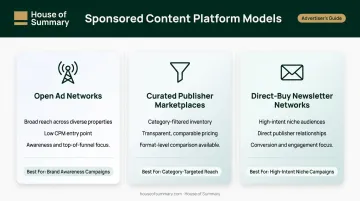
Three distinct models exist, and the difference matters for ROI:
| Type | How It Works | Best For |
|---|---|---|
| Open ad networks | Programmatic, broad reach across many sites | Scale and awareness at low CPM |
| Curated publisher marketplaces | Category-filtered, transparent pricing | Comparing options across formats |
| Direct-buy newsletter networks | High-intent, niche audiences, direct relationship | Conversion-focused placements |
The US native advertising market reached $108.83 billion in 2024, according to EMARKETER's native ad spending data, a figure driven by brands moving budget away from display toward editorial and native formats. For advertisers navigating this space, comparison platforms reduce time-to-placement considerably — provided the platform matches your channel type, whether that's programmatic display, curated publisher lists, or direct newsletter buys.
Best Platforms to Compare Sponsored Content Providers
These platforms were selected based on publisher data transparency, audience data availability, pricing clarity, and niche coverage relevant to US advertisers.
Paved
Paved is a newsletter-focused sponsorship marketplace where advertisers search and compare newsletters by category, subscriber count, open rate, and CPM. Built specifically for email placements, it gives brands access to more than 2,000 newsletters and over 253 million subscribers.
Its real advantage is verification rigor. Paved's publisher terms require proof of delivery — including unique opens, bounces, spam complaints, and tracking codes — which means the engagement data advertisers see reflects real performance, not self-reported estimates. For media buyers evaluating newsletter inventory at scale, verified delivery data removes a significant variable from campaign planning.
| Attribute | Details |
|---|---|
| Best For | Newsletter sponsorships; brands targeting niche, high-intent email audiences |
| Key Features | Category filters, verified open/click rate data, self-serve booking |
| Pricing Model | CPM-based; negotiated directly with publishers through the platform |
BuySellAds
BuySellAds is one of the longest-running publisher ad marketplaces, connecting advertisers with websites, newsletters, and podcasts across categorized niches. Its self-serve interface lets brands create and launch campaigns without extended back-and-forth with individual publishers.
The platform is particularly useful for advertisers comparing placements across multiple content formats simultaneously. You can evaluate newsletter inventory alongside web and podcast placements in the same session — useful when evaluating which format best fits your campaign objectives.
| Attribute | Details |
|---|---|
| Best For | Multi-format sponsored content across web, newsletters, and podcasts |
| Key Features | Self-serve software, multi-format inventory, geo and email-hash targeting |
| Pricing Model | Fixed CPM or flat-rate per placement; varies by publisher |
SparkLoop
SparkLoop started as a newsletter referral tool and has expanded into a paid recommendation network that connects advertisers with newsletter publishers. Its model is different from traditional ad networks: publishers recommend other newsletters to their subscribers, and advertisers pay when users subscribe.
This referral-based structure produces higher-intent impressions. Digiday reported that referred subscribers from The Hustle had double the open rate of average readers, and The Daily Pnut's referred readers hit a 51% open rate versus a 40% average. For brands where audience quality matters more than raw volume, that differential is significant.
| Attribute | Details |
|---|---|
| Best For | Brands wanting reach inside the independent newsletter ecosystem |
| Key Features | Newsletter-native placements, referral-based subscriber acquisition |
| Pricing Model | CPA or CPM models depending on campaign type |
IZEA
Founded in 2004, IZEA entered the sponsored content space when its founder began seeding content with bloggers — well before influencer marketing had a name. Today, its IZEA Flex platform gives advertisers access to a database of over 40 million creator connections across social, editorial, video, and blog formats.
Its strength is breadth. If you're comparing sponsored content options across multiple channels — not just newsletters — IZEA lets you evaluate creators and publishers in a single platform with campaign management and performance reporting built in.
| Attribute | Details |
|---|---|
| Best For | Multi-channel sponsored content including social, blog, and editorial |
| Key Features | Large creator database, campaign management tools, performance reporting |
| Pricing Model | Varies by creator and format; marketplace bidding and direct negotiation |
beehiiv Ad Network
beehiiv operates as both a newsletter publishing platform and an ad network — which is what makes it different. Because beehiiv hosts the newsletters and runs the ad network, it has direct data on subscriber growth, open rates, and readership behavior. Advertisers don't have to rely on what publishers claim about their own audiences.
That first-party data advantage is being backed by real investment: Adweek reported that beehiiv planned to double its advertising product and operations team to scale the newsletter advertising business — a signal that the platform is investing in advertiser tools and publisher depth.
| Attribute | Details |
|---|---|
| Best For | Brands targeting growing independent newsletter audiences |
| Key Features | Platform-verified audience data, category browsing, scalable placements |
| Pricing Model | CPM-based; managed through beehiiv's ad dashboard |
What to Look For When Evaluating These Platforms
Audience Verification and Transparency
The biggest risk in newsletter advertising isn't overpaying — it's paying for an audience that doesn't actually engage. Prioritize platforms that show independently verified subscriber counts, open rates, and demographic data.
Red flags to watch for:
- Open rates that seem unusually high without verification documentation
- Large subscriber counts paired with low click-through rates
- No disclosure of how performance data is collected or validated
Apple's Mail Privacy Protection has also affected open-rate reliability across the industry. Litmus notes that over 50% of opens now occur on devices with MPP activated, which inflates raw open-rate figures. Platforms that require tracking code verification and publisher proof of delivery — like Paved — give you a more defensible read on actual engagement rather than inflated open counts.
Pricing Model Alignment
Once you've validated a publisher's audience quality, the next question is whether their pricing structure fits your campaign objectives:
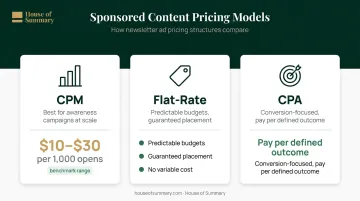
- CPM works for awareness campaigns where reach matters more than a specific conversion action
- Flat-rate placements suit brands with predictable content budgets who want guaranteed placement without variable costs
- CPA models make sense for conversion-focused campaigns where you're paying for a defined outcome
According to Paved's pricing guidance, a healthy newsletter CPM sits between $10 and $30, with primary sponsorships typically running $15–$30 per 1,000 opens. Use those benchmarks when evaluating whether a listing's pricing is reasonable.
Niche Relevance Over Raw Reach
Pricing only tells part of the story. A newsletter with 50,000 highly engaged readers in a specific vertical will almost always outperform a broad-reach network for B2B or premium brand placements. Campaign Monitor's benchmark data shows open rates ranging from 19.3% for Professional Services to 26.6% for Nonprofits — a spread that reflects how sharply niche and audience composition drive real results.
When comparing providers, filter by topic relevance before looking at size:
- A finance or geopolitics list of 20,000 will typically convert better than a 200,000-person general business audience for premium brands
- Niche audiences signal higher reader intent, which translates directly into advertiser response rates
- Vertical alignment matters more than volume for B2B placements, luxury brands, and high-consideration purchases
How We Chose These Platforms
Platforms in this list were evaluated on five criteria:
- Publisher data transparency — does the platform show verified or platform-sourced metrics?
- US-market relevance: Is the publisher pool meaningfully represented in the US?
- Advertiser usability — is there a self-serve option, or does everything require managed outreach?
- Format diversity: Does the platform cover newsletters, social, web, or podcast placements?
- Engagement metric availability — can you compare open rates or click rates before booking?
Brand size and name recognition were not selection criteria. Several well-known platforms didn't make the list because they lack transparent publisher data.
Those criteria exist because the same gaps keep tripping up advertisers. Watch out for these common mistakes:
Common mistakes advertisers make when choosing a platform:
- Defaulting to the biggest name without checking whether the publisher pool fits their niche
- Ignoring engagement-to-subscriber ratios (a large list with 8% open rates is a warning sign)
- Skipping a pilot test before scaling spend — a single test placement in one newsletter costs far less than a wasted multi-newsletter campaign
Conclusion
The right comparison platform depends on where your audience pays attention. For brands targeting executives, global professionals, or business readers, newsletter-native placements consistently outperform social and display formats — partly because newsletters reach subscribers who opted in, and partly because email ads bypass ad blockers entirely, arriving as part of content readers already want.
Platforms like Paved, BuySellAds, and beehiiv Ad Network help advertisers browse and compare providers across categories, audience sizes, and pricing structures. But for brands that need a specific audience profile — C-suite professionals, high-net-worth individuals, or policy-adjacent readers — it's worth going directly to networks built for that reader.
House of Summary is one example. Its network of specialized publications (Presidential Summary, Geopolitical Summary, Dubai Summary, and London Summary) reaches 500,000+ subscribers — 66% based in the US, 18% in the UAE, and 10% in the UK. Every issue is human-written, which means brand placements sit alongside editorial content readers trust rather than programmatic filler.
Advertisers can reach out directly at sales@houseofsummary.com for a media kit and custom rate card.
Whatever platform or network you choose, the deciding factor should be audience fit. A placement in front of 50,000 engaged, relevant readers will outperform one reaching 500,000 indifferent ones every time.
Frequently Asked Questions
What is a sponsored content provider platform?
A sponsored content provider platform is a marketplace or discovery tool that connects advertisers with publishers, newsletters, or content creators who offer paid placement opportunities. Brands use these platforms to compare pricing, audience data, and format options before committing spend.
How much does sponsored content typically cost?
Newsletter CPM rates typically run $10–$30, with primary sponsorships ranging from $15–$30 per 1,000 opens, according to Paved's pricing benchmarks. Influencer and editorial rates vary by creator reach, format, and negotiation terms.
What metrics should I use to compare sponsored content providers?
Focus on open rate, click-through rate, verified subscriber count, audience demographics, and niche relevance. These benchmarks give a more accurate picture of placement quality than raw subscriber count.
What is the difference between a sponsored content platform and a traditional ad network?
Traditional ad networks serve programmatic display ads at scale with limited editorial context. Sponsored content platforms match brands with specific publishers whose content and audience align with the brand's message, making the process more deliberate and context-aware.
Is comparative advertising legal in the US?
Yes. The FTC's policy on comparative advertising permits it when claims are truthful and non-deceptive. The Lanham Act creates civil liability for false or misleading commercial representations, so any comparative claims must be substantiated.
How do I know if a sponsored content provider has a genuinely engaged audience?
Look for open rates between 17–28% (industry standard varies by niche), consistent click-through data, and low unsubscribe rates. Platforms that require delivery proof and tracking code verification, rather than relying on self-reported publisher data, give you the most reliable signal.