This matters because email advertising (placing your brand inside someone else's newsletter) is a fundamentally different game from email marketing (sending campaigns to your own list). The former gives you access to engaged, opted-in audiences you didn't build — and in 2026, that kind of borrowed trust is increasingly hard to find elsewhere.
This guide compares 9 of the best email advertising services available, covering ad networks, newsletter marketplaces, programmatic platforms, and premium publishers. Whether you're a media buyer managing multiple placements or a brand team exploring the channel for the first time, you'll find a clear breakdown of what each service offers and who it's best suited for.
Key Takeaways
- Email advertising means paying to place your brand inside a publisher's newsletter — reaching opted-in readers you don't own
- Services range from self-serve marketplaces to programmatic RTB networks to premium direct publishers with curated sponsorships
- Engagement quality matters more than list size — a smaller, focused audience typically outperforms a passive mass list
- The 9 services here cover varied budget levels, pricing models, and audience profiles to match most campaign goals
What Are Email Advertising Services?
Email advertising services are platforms or publishers that let brands pay for sponsored placements inside newsletters sent to someone else's subscriber base. Unlike email marketing tools, you're not sending your own campaigns. You're buying space inside an existing, trusted publication.
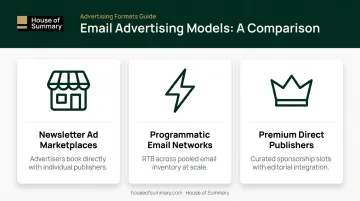
Three main models exist across the landscape:
- Newsletter ad marketplaces — connect advertisers with individual publishers; advertisers browse and book directly
- Programmatic email networks — real-time bidding across pooled email inventory, similar to display but inside the inbox
- Premium direct publishers — curated sponsorship slots sold to vetted brands, often with editorial integration
Each model shares a core channel advantage that makes email advertising worth serious attention. Email ads bypass browser-based ad blockers, which 912 million users worldwide actively deploy — costing publishers an estimated $54 billion in lost revenue in 2024 alone.
Performance holds up on the click side too. Mailchimp's 2024 benchmark data puts the industry average click rate at 2.62% — with high-quality newsletter placements regularly exceeding that benchmark.
Top 9 Best Email Advertising Services in 2026
Selection was based on audience quality, pricing transparency, targeting capabilities, campaign performance, and accessibility — from individual media buyers to enterprise teams.
1. House of Summary
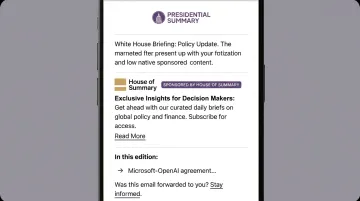
House of Summary is a premium independent newsletter network covering global news, geopolitics, international business, and city-specific publications. Its four active newsletters — Presidential Summary, Geopolitical Summary, Dubai Summary, and London Summary — publish Monday through Saturday and reach a combined base of 500,000+ subscribers, with 254,866+ emails opened daily.
The audience skews heavily toward decision-makers: executives, finance professionals, and policy-oriented readers across the US (66%), UAE (18%), and UK (10%). That profile makes it a natural fit for brands that struggle to reach senior professionals through programmatic or social, where income and seniority targeting is unreliable.
Ad formats include native sponsored content written in each newsletter's editorial voice, display placements, and full-issue takeovers. Because placements sit inside the reading flow — no algorithms, no ad blockers, no competing visual noise — attention is already present when your message appears. BSH Hausgeräte CEO Faik Serkan Ergun noted their House of Summary placement delivered click-through rates 4x higher than Google AdWords, with specific results attributed to the Dubai Summary audience quality.
| Best For | Finance, luxury, B2B, and global brand advertisers seeking high-intent professional readers |
| Pricing Model | Direct sponsorship placements; contact sales@houseofsummary.com for rates |
| Key Feature | No ad blockers, no algorithms — undivided inbox attention across specialized global newsletters |
2. Paved
Paved operates a self-serve newsletter advertising marketplace connecting brands with 3,000+ independent publishers across business, finance, tech, and lifestyle niches — with a reach of 253 million subscribers.
Its standout feature is pre-campaign transparency: advertisers can review audience demographics, estimated CTRs, and pricing before booking. The network benchmarks CTRs of 0.5%–1.5%, with CPC pricing typically ranging from $1.10–$6 per verified human click. No minimum monthly spend makes it accessible for smaller budgets testing the channel.
Paved's 2026 marketplace data shows newsletter ad campaign volume grew 40% year-over-year and advertiser reach expanded 80% — a signal that performance marketers are scaling this channel seriously.
| Best For | Performance marketers and DTC brands testing newsletter advertising across multiple publishers |
| Pricing Model | CPC and CPM options; self-serve booking with no minimum spend |
| Key Feature | Publisher marketplace with pre-campaign performance data for smarter placement decisions |
3. LiveIntent
Now part of Zeta Global following its October 2024 acquisition, LiveIntent is one of the largest programmatic email advertising networks — representing publishers who send 80% of the premium internet's email, according to its platform documentation.
The platform's core differentiator is people-based targeting using first-party identity data rather than cookies. Advertisers reach specific audience segments based on identity resolution, which matters increasingly as third-party cookies phase out. With 2,500+ companies on the platform, it's built for enterprise teams and agencies needing scale across thousands of publisher partners simultaneously.
| Best For | Enterprise advertisers and agencies seeking scalable, programmatic email ad reach |
| Pricing Model | Programmatic CPM via DSP integrations and direct partnerships |
| Key Feature | Cookie-free, people-based targeting using first-party identity data at scale |
4. beehiiv Ad Network
beehiiv's built-in ad network gives advertisers access to placements across its ecosystem of 50,000+ newsletters reaching 500 million+ unique readers monthly. Advertisers apply to run sponsored content across a curated selection of newsletters on the platform.
The performance numbers are competitive: beehiiv reports an average open rate of 39.9% and average CTR of 4.3% across its ad network — well above general email benchmarks. The network is particularly strong for brands targeting creator audiences, startup communities, and tech-forward readers.
| Best For | Brands targeting creator, startup, and entrepreneurship-focused newsletter audiences |
| Pricing Model | CPM-based placements managed through beehiiv's network application process |
| Key Feature | Access to a growing ecosystem of high-quality independent newsletters from one ad platform |
5. SparkLoop
SparkLoop operates a referral and recommendation network used by some of the most prominent independent newsletters. Rather than selling impressions, it connects advertisers with newsletters that recommend them directly to subscribers — meaning you're paying for engaged new subscribers, not just eyeballs.
Publishers in the network can earn $2–$7 per confirmed referral. For advertisers, this translates to a cost-per-subscriber model that's directly tied to measurable list growth. SparkLoop claims top partners can acquire up to 100,000 engaged subscribers per month through the network.
| Best For | Newsletter operators and brands aiming to grow their own email list through paid referral placements |
| Pricing Model | Cost-per-subscriber or cost-per-referral |
| Key Feature | Referral-based acquisition model — pay for subscribers, not just impressions |
6. Passendo
Passendo is a programmatic email advertising platform focused on the European and global premium publisher market, serving 100+ media clients across 6,000+ newsletters and 10 billion+ monthly ad impressions.
Its native-first ad formats are designed to match each newsletter's editorial aesthetic — reducing banner blindness and improving engagement. Passendo cites that native ads drive 53% higher attention and an 18% lift in purchase intent compared to standard display formats. For advertisers operating in regulated industries, Passendo's GDPR-compliant infrastructure (including SHA256 hashing rather than storing raw email addresses) is a meaningful advantage.
| Best For | European advertisers and global brands needing GDPR-compliant programmatic email placements |
| Pricing Model | Programmatic CPM with native and display format options |
| Key Feature | Native-first ad formats designed to match newsletter editorial style for higher engagement |
7. Kit Sponsor Network
Kit (formerly ConvertKit) is the email platform for creators and independent publishers, with 587 million+ subscribers served across its 13-year history. Its sponsorship capabilities — branded as Sponsorships & Kit Ads — connect brands with creator newsletters hosted on the platform.
The audience skews toward entrepreneurship, personal finance, productivity, and content creation niches. For brands in the creator economy or targeting solopreneur communities, Kit's network offers straightforward access without needing to manage individual publisher relationships.
| Best For | Brands targeting creator economy, solopreneur, and personal finance newsletter audiences |
| Pricing Model | Flat-rate sponsored placements negotiated through the network |
| Key Feature | Direct access to Kit's creator newsletter ecosystem with built-in audience targeting by niche |
8. Stacked Marketer
Stacked Marketer is a curated newsletter publishing marketing news, tech, and strategy three times a week to 100,000+ marketers. Advertisers can book direct sponsorships to reach an audience that actively influences budget and tool decisions — 50% of readers hold manager-level seniority or higher.
Performance benchmarks are strong: Stacked Marketer reports an average unique open rate above 50% and approximately 4% CTR from openers. For MarTech companies, SaaS platforms, and B2B brands, this hyper-niche audience offers targeting precision that broad ad networks can't replicate.
| Best For | MarTech, SaaS, and B2B brands targeting digital marketing decision-makers |
| Pricing Model | Direct sponsorship packages; weekly and monthly placement options |
| Key Feature | Hyper-niche readership of active marketing practitioners with direct purchasing authority |
9. Inboxads
Note: As of 2026, Inboxads has announced it is closing its service and is no longer accepting new advertisers. It is included here for historical context only.
Inboxads previously operated as a programmatic email monetization platform delivering dynamic, personalized ad content inside transactional and newsletter emails using behavioral targeting. Its closure reflects the competitive pressure on mid-market programmatic email networks as larger players consolidate inventory.
How We Selected These Email Advertising Services
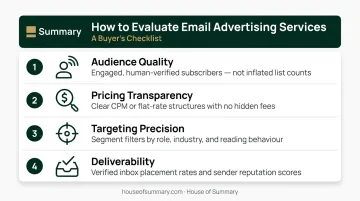
Every service in this list was assessed on four criteria:
- Audience quality — Are subscribers genuinely opted-in and actively engaged, or just passively subscribed?
- Pricing transparency — Can advertisers estimate ROI before committing, or is it a black box?
- Targeting precision — Can you reach a specific audience segment, or only broad demographics?
- Deliverability — Do ads consistently land in the inbox rather than spam or promotions folders?
One mistake advertisers consistently make is selecting services based on raw subscriber volume. A newsletter with 50,000 deeply engaged readers in your target vertical will typically outperform a list of 500,000 passive subscribers who rarely open.
House of Summary's analytics approach reflects this. The team tracks loyal readers — those who open multiple times monthly — as a distinct quality metric alongside total reach, and monitors monthly ad clicks as a direct revenue signal rather than just impressions.
Apply the same scrutiny to every service you evaluate. Request open rate data, CTR benchmarks, and audience composition before committing budget. Average newsletter CPMs run $15–$30 per 1,000 opens, with CPC typically $1–$5. Premium, high-engagement placements often command more — and they tend to justify it through conversion performance.
Conclusion
Email advertising in 2026 spans a wide range of formats and models — programmatic networks for scale, newsletter marketplaces for flexibility, and premium direct publishers for audience quality and editorial alignment. The right fit depends on your audience, your budget, and what you actually need to move.
Before committing to any service, request verified performance data, test with a defined tracking framework (UTM parameters, dedicated landing pages), and measure against business outcomes — not just impressions.
If your criteria include verified audiences, no ad-blocker risk, and editorial context that reinforces your brand, a direct newsletter partnership fits the bill. House of Summary offers sponsorships across Presidential Summary, Geopolitical Summary, Dubai Summary, and London Summary — reaching 500,000+ subscribers who open, read, and act. Reach the team at sales@houseofsummary.com to explore placement options and request the media kit.
Frequently Asked Questions
What is the difference between email advertising and email marketing?
Email marketing involves sending campaigns to your own subscriber list using platforms like Mailchimp or Kit. Email advertising means paying to place sponsored content inside another publisher's newsletter — giving you access to their opted-in audience without building one yourself. The two serve different goals and use entirely different tools.
How much does it cost to advertise in a newsletter?
Pricing varies by model and audience quality. Average newsletter CPMs run $15–$30 per 1,000 opens, with CPC typically $1–$5. Smaller niche newsletters with high engagement often command higher rates than general-audience networks — and frequently deliver better ROI. Contact each service directly for current rate cards.
Why do email ads typically outperform display ads in click-through rates?
Email ads land inside the inbox without ad blockers, reach readers who already opted in and trust the publisher, and appear in a distraction-free environment rather than a banner-cluttered webpage. That combination of guaranteed visibility and existing reader trust drives higher intent and higher CTR.
How do I measure the ROI of an email advertising campaign?
Track click-through rate, conversion rate, cost-per-click or cost-per-acquisition, and revenue attributed to the campaign. Use UTM parameters on all links and send traffic to dedicated landing pages to isolate results from your newsletter placements accurately.
What types of brands benefit most from email newsletter advertising?
Finance, B2B SaaS, luxury goods, executive education, and premium consumer products consistently perform well. Newsletter audiences skew toward higher-income professionals and decision-makers, making them especially valuable for products that require trust or a considered purchase.
Are email newsletter ads blocked by ad blockers?
No. Email ads are delivered inside the email body itself — not served through browser-based ad networks — so browser ad blockers can't block them. This makes email advertising one of the few digital channels that guarantees the ad actually reaches the reader.