Introduction
Email inboxes are shrinking as a reliable channel — and the B2B tech companies losing ground are the ones still treating newsletters like broadcast tools. Social feeds are algorithm-dependent, displaying your content only when platforms decide it serves their interests. Web ads get blocked by 30–37% of users globally, with US mobile ad blocking hitting 37% in 2024. Meanwhile, email inboxes remain the last reliable direct channel where your message lands exactly where you intend — without algorithmic filters, ad blockers, or visual clutter competing for attention.
Most B2B tech marketers already know newsletters matter. What trips them up is execution — specifically, which content formats actually drive results with professional audiences.
CTOs, IT decision-makers, and technical buyers don't tolerate vague content or promotional noise. They expect utility, clarity, and respect for their time. Miss that bar, and they unsubscribe permanently.
Key Takeaways
- Lead with utility: data, curated insights, and clarity outperform promotional content every time
- Five formats consistently win: news digests, original data snapshots, thought leadership columns, use case spotlights, and sponsored native content
- Match format to funnel goal — awareness, trust-building, or lead generation — before you write a word
- B2B tech readers have high standards; waste their time once and you won't get a second chance
Why Newsletters Are a High-Impact Channel for B2B Tech Companies
The newsletter channel works differently from every other digital marketing medium. No algorithms filter your reach, ad blockers can't intercept your message, and there's no visual clutter competing for attention. When a subscriber opens your newsletter, they're actively choosing to engage — that's a fundamentally different starting point than a social scroll.
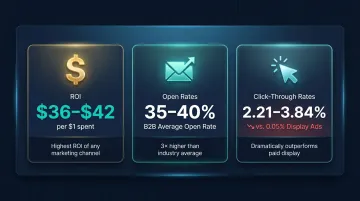
The numbers make a strong case. Key benchmarks for B2B newsletters:
- ROI: Email marketing returns $36-$42 per $1 spent — 4-5x more than other digital channels
- Open rates: 35-40% for B2B, with HubSpot reporting 39.48% for B2B services and GetResponse finding 40.08% across 4.4 billion messages
- Click-through rates: 2.21-3.84% on average, versus 0.05% for display ads
For B2B tech specifically, newsletter readers tend to be high-intent professionals—CTOs, IT decision-makers, and buyers consuming content for work-related purposes. House of Summary's network reaches over 500,000 of these decision-makers, with 254,866 emails opened daily and click-through rates four times higher than Google AdWords. This audience quality makes newsletters categorically more valuable than passive social scrollers who may never convert.
The Most Effective Content Formats for B2B Tech Newsletters
Not all content formats work in the inbox. B2B tech audiences are time-constrained and skeptical of marketing — the formats that consistently outperform share one trait: they give readers something worth stopping for.
| Format | Best Use Case | Typical Length |
|---|---|---|
| Curated News Digest | Habitual opens, trusted source positioning | 5-7 items, 2-3 lines each |
| Original Data Snapshot | Market authority, gated asset gateway | 1 chart or stat + 2-3 lines of context |
| Thought Leadership Column | Trust-building, differentiation | 200-400 words |
| Use Case Spotlight | Purchase consideration, social proof | 150-250 words |
| Sponsored Native Content | Advertiser revenue, non-disruptive monetization | 75-150 words |
Curated News Digests
Curated news digests are editorially filtered selections of the most relevant tech and industry news, summarized clearly for time-pressed professionals. The value isn't creation—it's curation. Decision-makers don't have time to monitor dozens of sources, so a well-curated digest becomes their trusted single source of what matters.
This format works because it builds habitual open behavior. When readers know exactly what they'll get—relevant insights delivered consistently—they prioritize opening your newsletter. TLDR Tech, which reaches 7.8 million tech professionals daily, reports open rates of 44-46% across its nine editions, exceeding most B2B benchmarks. Morning Brew scaled this model into B2B verticals like Marketing Brew and HR Brew, proving curated digests work across specialized audiences.
Good execution requires:
- Consistent structure: Headline + 2-3 line summary + source link
- Editorial voice: Add a point of view rather than just repeating headlines
- Reliable schedule: Daily or weekly, never sporadic
- Tight curation: 5-7 items maximum, not 20
Original Data and Research Snapshots
Original data snapshots present proprietary or aggregated data as a brief insight—a single chart, a key finding, or a statistic with editorial context. This isn't a whitepaper; it's a one-section data moment that readers can consume in 30 seconds.
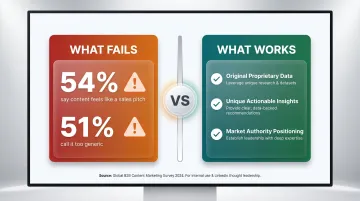
B2B tech buyers trust data more than opinion. 54% say content feels too much like a sales pitch, and 51% call it too generic. Original research positions you as a market authority, not just a content distributor. Gong built credibility through Gong Labs, analyzing 300 million+ sales calls to publish insights competitors couldn't replicate. The strategy attracted VPs of Sales and CROs because the data was unique and actionable.
Execution tips:
- Keep it to one key insight per issue
- Provide brief context on what the data means for the reader's business
- Use it as a gateway to longer-form gated assets
- Make the visual (chart or graph) simple and scannable
Thought Leadership Columns
Thought leadership columns are short, opinionated essays (200-400 words) written by a named expert—an internal executive, guest contributor, or industry specialist—offering a distinct point of view on a relevant tech trend or challenge.
As AI-generated content floods B2B inboxes — 95% of B2B organizations now use AI for content — genuine human perspective has become the scarce resource. 73% of B2B buyers trust thought leadership over traditional marketing materials, and 75% researched a product they weren't previously considering after consuming it.
Only 4% of marketers report high trust in AI outputs. That trust gap is exactly what expert-authored columns fill.
Effective execution requires:
- The author must have real expertise (not just a title)
- The opinion must be genuinely differentiated from common takes
- It should end with a practical implication for the reader
- Avoid hedging—state your position clearly
Product-Led Use Case Spotlights
Product-led use case spotlights are brief stories (150-250 words) showing how a real customer used a product or solution to solve a specific problem—framed around the problem and outcome, not product features.
Complex technology purchases require proof, not promises. 56% of B2B buyers consult existing product users before purchasing, rising to 71% for enterprise purchases. Case studies and customer stories are rated the most effective B2B content type by the Content Marketing Institute. A concise story that shows a relatable challenge and measurable result accelerates trust and consideration.
Execution best practices:
- Lead with the business problem the customer faced
- Make the outcome specific and quantifiable (percentages, time saved, revenue impact)
- Keep the product mention secondary to the story
- Avoid marketing language—use the customer's words
Sponsored Native Content
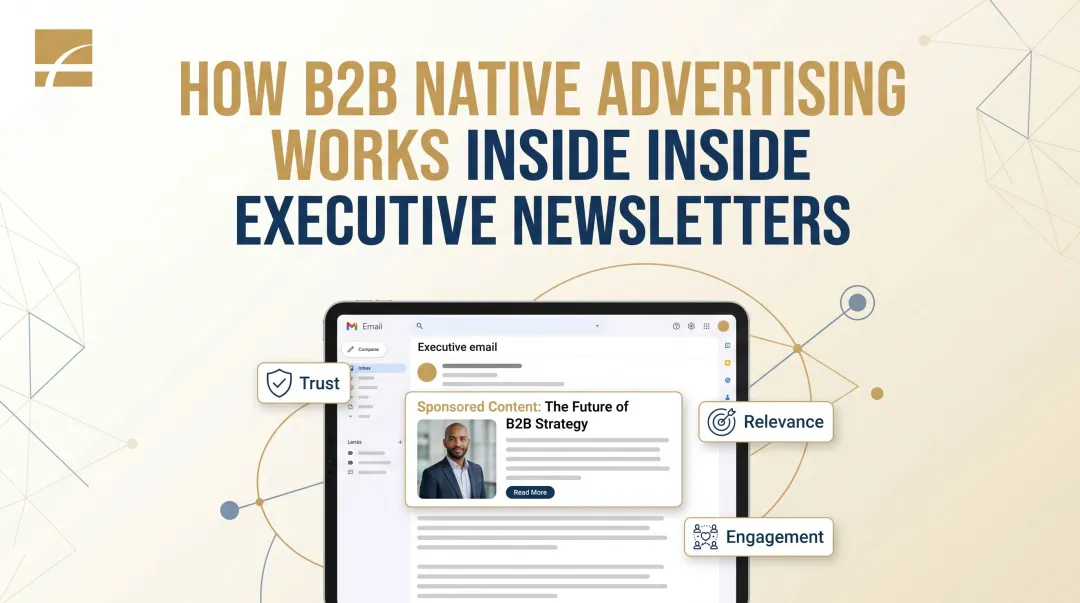
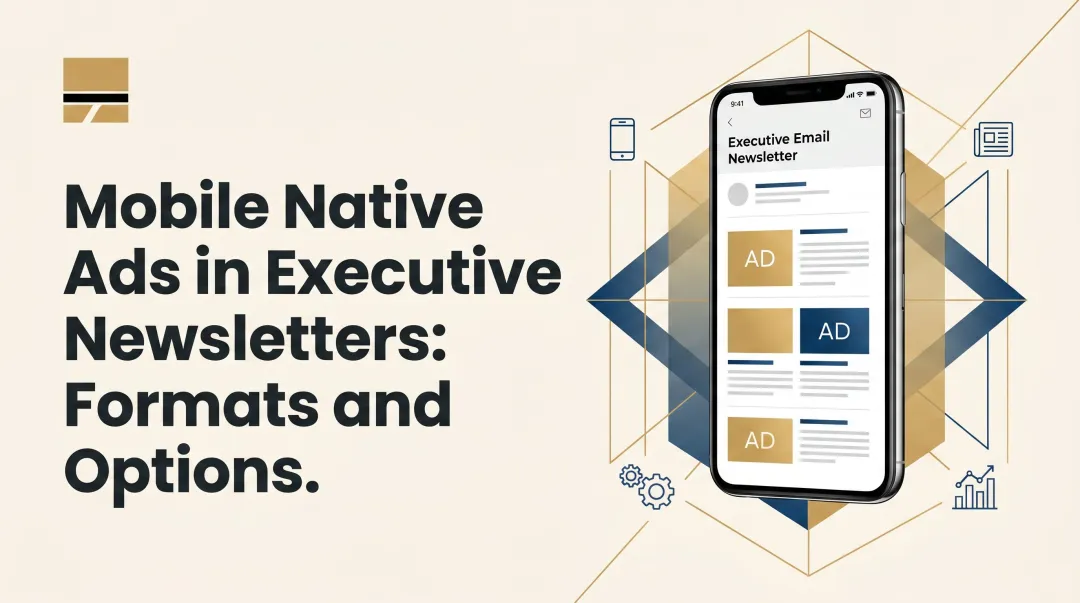
Sponsored native content is advertiser-funded content that matches the editorial tone and format of the newsletter—a brief sponsored insight, curated tool recommendation, or data point—rather than a banner ad or promotional blast.
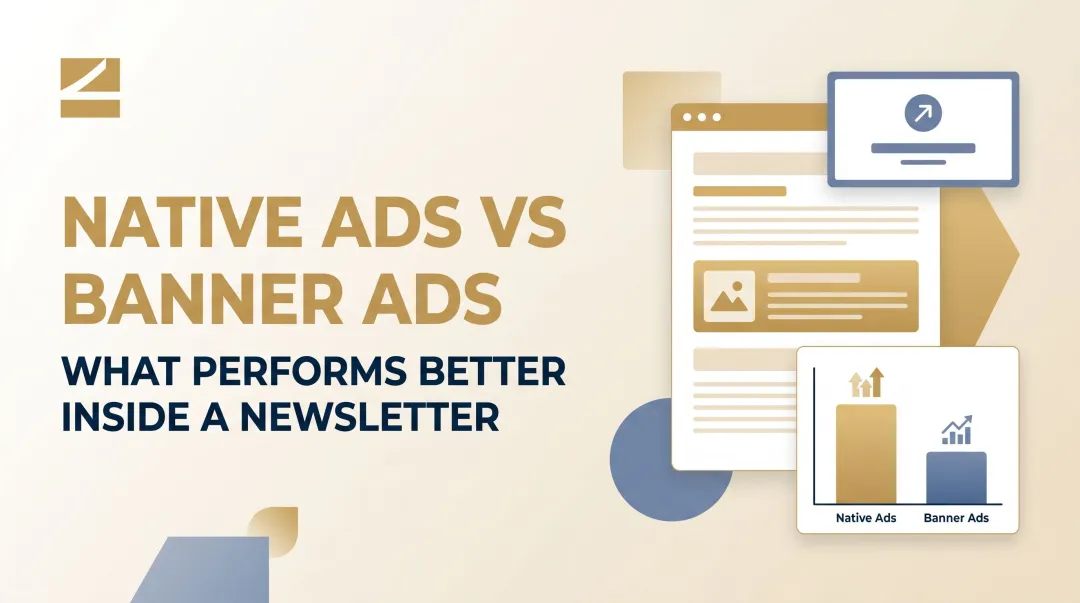
Native content avoids ad fatigue because it provides value rather than interrupting the reading experience. Native ad CTRs average 0.2% versus 0.05% for display ads—a 4x performance difference. Consumers view native ads 53% more frequently than banners because they integrate visually with editorial content.
The format also bypasses ad blockers entirely. With 30-37% of web users blocking display ads, newsletter-native placements reach audiences other channels can't.
What separates effective native content from poor native content:
- Alignment with the newsletter's subject matter
- Clear but non-aggressive CTA
- Transparency that it's sponsored — without making it feel like a legal disclaimer
- Value delivery (insight, data, recommendation) rather than pure promotion
For example, House of Summary writes sponsored placements in the same editorial voice as Presidential Summary and Geopolitical Summary — so readers receive value, and advertisers get attention that doesn't feel bought.
What Makes a Newsletter Content Format Actually Work
Format matters — but it can't rescue weak content. The core mistake B2B tech companies make is treating newsletters as a repurposing channel for blog posts and press releases, rather than as a primary channel with its own logic.
Three principles separate newsletters that get read from ones that get deleted:
- Editorial clarity: B2B tech readers are professionals with no patience for vague content. Lead with the key point, use plain language, and give each section a single purpose. If readers have to hunt for the point, they'll stop opening.
- Cadence consistency: Irregular newsletters lose trust — readers forget why they subscribed. Formats that shift every issue create friction. TLDR Tech built 7 million subscribers on daily structural consistency alone.
- Audience specificity: CTOs and growth marketers read differently. Generic content fails both. The best newsletters define one reader profile and write every section for that person.
Audience specificity is where most B2B tech newsletters fall short. House of Summary illustrates the alternative: Presidential Summary targets global executives, Geopolitical Summary serves policy professionals, and Dubai Summary speaks directly to UAE business leaders. Each publication targets a distinct reader with distinct needs — and that precision is what drives engagement.
How to Match Content Formats to Your Newsletter Goals
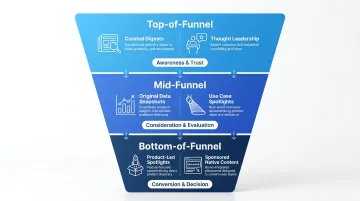
Map your formats to funnel stage for maximum impact:
Top-of-funnel (awareness and trust-building):
- Curated digests establish you as a reliable information source
- Thought leadership columns build brand recognition and authority
- 89% of B2B buyers consume self-discovered content at this stage
Mid-funnel (consideration and evaluation):
- Original data snapshots position you as a market expert
- Thought leadership pieces drive 75% of buyers to research products they weren't previously considering
- Use case spotlights show proof without overtly selling
Bottom-of-funnel (conversion and decision):
- Product-led use case spotlights provide peer validation
- Sponsored native content with clear CTAs drives action
- 56-71% of buyers consult existing users before purchasing
The common mistake: Mixing formats randomly. A newsletter that tries to do everything in a single issue dilutes impact. Start with one or two core formats and test before expanding.
Beyond format selection, how you send matters just as much. Subject line personalization delivers 18-26% open rate lift, and fewer, targeted sends yield 30% higher open rates and 50% higher CTR than high-volume programs.
The best-performing B2B tech newsletters refine based on engagement signals—open rates, click-throughs on specific sections, and subscriber replies—rather than guessing. Track which formats drive the most measurable engagement, then restructure future issues around those patterns.
Conclusion
The newsletter channel offers B2B tech companies a direct line to professional readers that no other digital channel can match—but only if the content formats chosen are built for that medium, not repurposed from elsewhere. Email bypasses ad blockers, avoids algorithmic filtering, and delivers measurable ROI of $36-$42 per dollar spent. Curated digests, original data, expert commentary, use case stories, and native sponsored content consistently outperform because they respect time, deliver value, and drive action.
For brands that want to put these formats in front of an audience that already reads this way, House of Summary's newsletter network offers direct inbox access to 500,000+ engaged subscribers — with click-through rates four times higher than Google AdWords and zero algorithmic interference.
Contact the sales team at sales@houseofsummary.com to explore tailored advertising placements.
Frequently Asked Questions
What are the 5 C's of content?
The 5 C's framework includes clarity, conciseness, consistency, credibility, and calls to action. For B2B tech newsletter content specifically, clarity (easy-to-understand messaging) and credibility (data-backed insights) are especially critical because professional readers quickly abandon content that wastes their time or lacks authority.
What type of content works best in B2B tech newsletters?
Content built for utility—curated industry insights, original data snapshots, and expert commentary—consistently outperforms purely promotional content. 54% of B2B buyers say content feels too much like a sales pitch, and 51% call it too generic, so formats that prioritize value over promotion drive significantly higher engagement.
How long should a B2B technology newsletter be?
Aim for 300-600 words for the editorial section, though length matters less than value density per word. Professional readers will engage with longer newsletters if every sentence delivers actionable insight. TLDR Tech's daily digests prove concise formats work; detailed thought leadership can run longer when every section earns its place.
How often should B2B tech companies send newsletters?
Weekly or biweekly works best for most B2B tech newsletters, though daily formats like TLDR Tech succeed with tightly curated digests. Consistency matters more than frequency. Irregular sends erode trust because readers forget why they subscribed — so pick a cadence you can sustain and stick to it.
What is the difference between a B2B newsletter and email marketing?
Newsletters are ongoing, editorial publications that readers subscribe to for information and insights. Email marketing is campaign-driven, promotional, and typically tied to a specific CTA or offer (product launch, webinar registration). Newsletters build long-term trust; email marketing drives short-term conversions.
How do B2B tech companies measure newsletter content performance?
Track open rate, click-through rate by content section, subscriber growth, and downstream conversions. Click-through rate is now more reliable than open rate — Apple Mail Privacy Protection inflates open metrics by roughly 18 points, making it a misleading primary benchmark.