This guide covers the advertising channels that deliver real results for SaaS companies, what makes SaaS ad creative work, how to structure a strategy, and which metrics tell you whether it's working. One thing to establish upfront: SaaS advertising isn't just about driving signups. It's about building a system that acquires, converts, and retains users at every stage of the funnel.
Key Takeaways
- The average B2B software buyer journey involves 88 touchpoints across 4 channels — single-channel campaigns won't cut it
- Google PPC captures intent but costs more in SaaS: average $15.36 CPC vs. $5.58 for general business services
- LinkedIn dominates B2B targeting — Meta and Instagram offer cheaper CPLs for product-led growth (PLG) tools
- Newsletter advertising reaches decision-makers directly in their inbox — no algorithms, no ad blockers, no competing visuals
- Median SaaS marketing spend is 8% of ARR, not the 15–25% often cited
What Sets SaaS Advertising Apart
SaaS companies aren't selling a physical product with a one-time transaction. They're selling ongoing value — which means every ad impression needs to begin building trust, not just generate a click.
The buyer journey reflects this. Dreamdata's 2026 B2B benchmark, based on 66M+ sessions and 3.5M+ customer journeys, found an average of 88 touchpoints, 4 channels, and 10 stakeholders before a deal closes. A buyer might first see a LinkedIn ad, ignore it, later Google a competitor comparison, find a review on G2, and finally convert after seeing a retargeted ad paired with a customer testimonial. No single channel owns that journey.
The self-service shift compounds this. Gartner's 2025 survey of 632 B2B buyers found 61% prefer a rep-free buying experience, and G2 data shows 69% engage sales only after a decision is already forming. Your ads and landing pages now carry the persuasion work that sales reps used to handle.
SaaS advertising also extends well past acquisition. High Alpha's 2025 SaaS Benchmarks report found expansion revenue accounts for 60% of new ARR for companies above $50M in revenue. Re-engagement campaigns, feature announcements, upsell ads, and win-back messaging are all part of the advertising mix — built into the strategy from day one.
Three dynamics define what makes SaaS advertising structurally different from other categories:
- Multi-stakeholder journeys requiring consistent messaging across channels over months, not days
- Self-service buyers who research and decide before ever talking to your team
- Post-acquisition revenue that depends on ongoing ad engagement, not just new-customer conversion
The Most Effective SaaS Advertising Channels for 2026
No single channel wins. Effective SaaS advertising layers top-of-funnel awareness with mid- and bottom-funnel conversion channels — matched to buyer stage and product price point.
Paid Search (PPC)
Google Ads works best for high-intent, bottom-of-funnel queries: "[competitor] alternative," "best [category] software," or feature-specific searches. These buyers are already in decision mode.
The cost, however, is significant. Firebrand's 2024 B2B tech data puts SaaS Google Search at:
- $15.36 average CPC
- 1.89% conversion rate
- $1,267 average cost per conversion
That's nearly 3x the $5.58 CPC seen in general business services. PPC only justifies these costs when paired with high-converting landing pages built specifically for each query type — generic homepages routinely cut conversion rates in half.
Paid Social (LinkedIn, Meta, Reddit)
LinkedIn remains the primary B2B SaaS channel for account-based targeting — job title, company size, industry, and seniority. The trade-off is cost. Metadata.io's 2024 benchmark data shows:
| Platform | CTR | CPC | CPL |
|---|---|---|---|
| 0.96% | $7.26 | $201.03 | |
| 0.66% | $1.84 | $101.54 | |
| 0.46% | $3.42 | $61.95 |
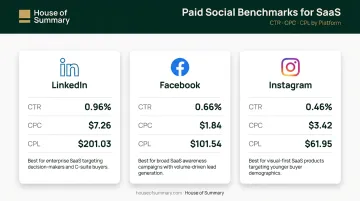
LinkedIn makes sense for high-ACV B2B SaaS where targeting precision justifies the CPL. Meta and Instagram work better for PLG products or lower-ACV SaaS where audience volume matters more than account-fit precision. Across both platforms, campaign objectives matter: awareness and content promotion consistently outperform direct "sign up now" conversion campaigns at this stage of the funnel.
Newsletter Advertising
Newsletter ads reach readers in a reading-first format — no algorithm deciding whether to surface your message, no ad blockers stripping it out. For SaaS brands targeting executives, finance professionals, and senior decision-makers, this matters.
House of Summary's network of specialized newsletters — covering global news, geopolitics, Dubai, and London — reaches 500,000+ subscribers with 254,866+ emails opened daily. The readership skews heavily executive: C-suite, founders, policy professionals, and high-net-worth individuals concentrated in New York, Los Angeles, London, and Dubai. BSH Hausgeräte's CEO reported click-through rates 4x higher than Google AdWords when advertising through Dubai Summary, citing alignment between the editorial tone and high-intent readers.
For SaaS brands targeting senior professionals or finance-sector decision-makers, newsletter placements — native ads, sponsored features, or full-issue takeovers — offer a channel that operates outside the typical paid media noise.
Retargeting Ads
Most prospects won't convert on first exposure. Retargeting keeps your brand visible to users who visited your site, engaged with content, or started a trial but didn't complete setup.
The journey data supports this: Dreamdata found an average of 281 days from first ad impression to revenue in B2B datasets. Retargeting isn't just re-exposure — it should use sequential creative that moves prospects forward. A user who read a blog post gets a case study ad next; a free trial dropout gets a feature-benefit reminder with a direct reactivation CTA.
Review and Comparison Platforms
G2, Capterra, and GetApp influence buying decisions at the decision stage. G2's 2024 buyer behavior report found 31% of B2B software buyers consult public review sites, up from 13% in 2021. Capterra's 2025 research adds that successful buyers are 50% more likely to use comparison sites, while regretful buyers rely more on social media.
Invest in sponsored listings, actively collect reviews, and maintain complete, current profiles. This is high-intent territory — buyers here are validating a shortlist, not browsing.
What Makes a SaaS Ad Creative Work
The most common mistake in SaaS ad creative: leading with features instead of outcomes. Nobody buys software for the features. They buy for what their workflow or business looks like after using it.
Five Ad Formats That Consistently Perform
- Comparison ads target users actively evaluating alternatives by positioning directly against a named competitor
- Testimonial ads use customer quotes with measurable outcomes ("We reduced onboarding time by 60%") — not generic praise
- Question ads pose the exact pain point the product solves, making the prospect feel immediately understood
- Benefit-focused ads lead with a single ROI stat or time-saving claim — one number beats a paragraph
- Product demo ads show the actual interface, reducing fear of complexity and lowering the psychological cost of trying
CTA Strategy by Funnel Stage
Vague CTAs underperform. "Learn more" is the worst offender. Specificity drives action — but the CTA must match where the buyer actually is:
- Cold audience: Low-commitment offers work best — "Download the guide" or "See how it works" give value before asking for anything
- Warm audience (engaged with content): They know you. "Start your free trial" or "See it in action" fits their readiness
- Hot audience (trial user or pricing page visitor): Push for direct contact — "Get a personalized demo" or "Talk to our team"
A cold audience won't book a demo. Don't ask them to.
A/B Testing Framework
Every SaaS ad should run with a structured test plan. Test one variable at a time and let campaigns accumulate statistically meaningful data before drawing conclusions. Variables to test, in order of impact:
- Headline — your biggest lever for CTR; small wording changes here move the needle more than anything else
- CTA copy — different framings of the same offer ("Try free" vs. "See a demo") reveal what stage most of your audience is actually in
- Visual or creative format — image vs. video, product screenshot vs. lifestyle
- Audience segment — job title vs. industry vs. intent signal; this test often exposes who's actually converting vs. who's just clicking
- Landing page — headline alignment, form length, social proof placement
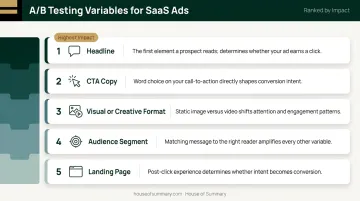
Kill underperformers only after they've had at least 1,000 impressions or 7 days of run time. Premature optimization based on 50 clicks produces noise, not insight.
How to Build Your SaaS Advertising Strategy
Define Your ICP and Funnel Stage First
Before selecting channels or writing copy, get precise about who you're targeting and where they are in the buying process. A strategy targeting cold audiences needs different channels, creative, and CTAs than one designed to convert free-trial users into paid subscribers.
Define your ICP by:
- Job title and seniority level
- Company size (employee count and revenue range)
- Industry vertical
- Specific pain point your product addresses
- Current stage: unaware, evaluating, trialing, or lapsed
Set Goals Tied to Business Metrics
SaaS advertising goals should connect to pipeline and revenue, not impressions or clicks. Establish KPIs that trace spending to outcomes:
- Cost per trial signup: the most direct conversion metric for PLG products
- Cost per qualified lead (CPL): for demo-driven, high-ACV products
- Trial-to-paid conversion rate: tells you whether acquired users are the right fit
- Customer acquisition cost (CAC): total marketing and sales spend divided by new customers
For SaaS PPC specifically, Firebrand's data puts the average cost per conversion at $1,267 for SaaS search. That's your baseline for evaluating whether a campaign is over- or under-performing.
Allocate Budget Across Funnel Stages
A practical allocation framework:
- Top-of-funnel (awareness): Newsletter ads, LinkedIn content promotion, and social demand gen build the pipeline of warm prospects
- Mid-funnel (consideration): Retargeting, review platform sponsorships, comparison content ads
- Bottom-of-funnel (conversion): PPC for high-intent queries, retargeting with trial or demo CTAs
High-ACV products should invest more heavily in targeted B2B channels like LinkedIn and newsletter placements, where engaged, high-intent audiences justify the higher CPL. PLG products prioritize volume and lower CPC through Meta or Instagram.
Budget benchmarks tell a different story than the commonly cited figures. SaaS Capital's 2025 survey of 1,000+ private B2B SaaS companies found median marketing spend of 8% of ARR — not the 15–25% range often repeated, which reflects aggressive growth-stage scenarios. Higher-growth companies do spend roughly 40% more on marketing than slower-growth peers, but that's a deliberate strategic bet, not a baseline.
Align Advertising with the Full Customer Lifecycle
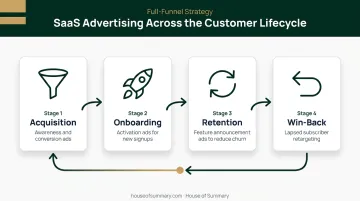
The best SaaS advertising strategies extend beyond acquisition:
- Onboarding-phase ads activate new signups before they disengage from the product
- Feature announcement ads reduce churn by surfacing capabilities existing users haven't discovered
- Win-back ads target lapsed subscribers with updated positioning or a time-sensitive offer
Metrics That Tell You If Your SaaS Ads Are Working
Top-of-Funnel Metrics
- Impressions and reach — confirm your targeting is broad enough to build awareness
- CTR — for SaaS Google Search, Firebrand's 2024 benchmark is 7.45%; LinkedIn averages 0.96%
- CPC — SaaS search averages $15.36; watch for costs trending well above benchmark
- Traffic quality — bounce rate and time-on-site signal whether you're attracting the right audience
Conversion and Pipeline Metrics
- CPL — LinkedIn B2B SaaS averages $201; Facebook averages $101
- Cost per trial signup — your most direct signal of campaign efficiency for PLG products
- Trial-to-paid conversion rate — top-performing PLG companies typically see 20–30% activation rates
- Customer acquisition cost (CAC) — calculate from closed-won ARR against total acquisition spend, not just ad spend
Retention and Downstream Metrics
Pipeline metrics only capture part of the picture. Downstream retention signals reveal whether your ad spend is actually building a sustainable customer base:
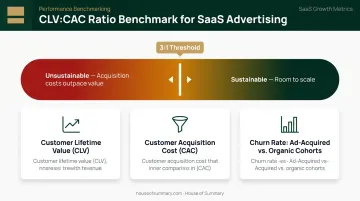
- Customer lifetime value (CLV) — the denominator in your CLV:CAC ratio
- Churn rate among ad-acquired customers — compare against organic cohorts to identify channel quality issues
- CLV:CAC ratio — a ratio below 3:1 typically signals an advertising strategy that isn't generating sustainable returns; above 3:1 means you have room to scale
ChartMogul's analysis of 2,500+ SaaS businesses found companies with net revenue retention (NRR) below 60% average churn rates of 7% — twice the rate of companies above 100% NRR. If ad-acquired cohorts churn faster than organic, the problem is usually audience fit, not creative.
Frequently Asked Questions
What is SaaS advertising?
SaaS advertising refers to the use of paid and targeted channels — search, social, newsletter placements, retargeting, and review platforms — to promote cloud-based subscription software. The goal is driving trials, demos, and signups while building brand awareness across the full customer lifecycle.
What is the T2D3 rule in SaaS?
T2D3 is a SaaS growth framework introduced by Battery Ventures' Neeraj Agrawal in 2015. It describes a revenue trajectory of "triple, triple, double, double, double" — tripling ARR for two years, then doubling it three times — used as a VC benchmark for growth and investment decisions, not an advertising framework.
What channels work best for SaaS advertising in 2026?
LinkedIn for B2B SaaS targeting precision, Google PPC for high-intent searches, newsletter advertising for engaged executive audiences, and retargeting across channels to re-engage warm leads. The best mix depends on your product's ACV and whether you're running a sales-led or product-led motion.
How much should a SaaS company spend on advertising?
SaaS Capital's 2025 survey puts median marketing spend at 8% of ARR across 1,000+ private B2B SaaS companies. The 15–25% range applies to aggressive growth-stage scenarios. Budget allocation should be calibrated against your target CAC and CLV:CAC ratio rather than an industry percentage alone.
How do you measure the ROI of SaaS advertising?
Track the full chain: ad click to trial, trial to paid conversion, paid customer to lifetime value. The CLV:CAC ratio is the most important long-term indicator — above 3:1 signals sustainable returns; below it, acquisition costs are outpacing customer value.