
Introduction
Native advertising has earned its place as a reliable paid traffic channel for affiliate marketers — not because it's easier, but because it sidesteps the volatility that plagues social platforms. Algorithm changes, account bans, and ad fatigue have pushed serious affiliates toward native, where ads blend into editorial content and reach readers in a receptive, curiosity-driven mindset.
The friction is real, though. Native requires upfront discipline that social ads don't demand. Your offer selection, tracking configuration, and creative testing all need to work in sequence — or you're flying blind. Skip one step and you're burning budget on data you can't use.
This guide walks through each step in sequence — from choosing the right offer to scaling what actually converts — so you can build a native campaign that holds up beyond the first test.
Key Takeaways
- Native ads fit "curiosity-first" funnels — they're not built for hard-sell approaches
- Only run offers with payout margins wide enough to absorb CPC costs
- Set up conversion tracking before spending a dollar; you can't optimize blind
- Start with broad targeting and let your creative do the filtering
- Winning campaigns are built on systematic creative iteration, not gut feel
When Should You Use Native Ads for Affiliate Marketing?
Native advertising works best when readers encounter your ad while already consuming editorial content. That context — a health news article, a finance explainer, a self-improvement piece — puts readers in an information-seeking mindset, not a shopping mindset. Products that require some explanation before purchase perform far better than anything requiring a snap decision.
Verticals with strong native compatibility include:
- Health and wellness (supplements, fitness programs, longevity products)
- Personal finance (insurance, credit, wealth management tools)
- Self-improvement and e-learning
- Travel
- Technology products requiring some explanation
According to MGID's affiliate vertical research, e-commerce, health, finance, travel, and technology represent the major affiliate verticals on native platforms — a finding consistent with Taboola's AdCombo case study, which highlighted healthcare and finance as key native performers.
That said, native isn't the right fit for every campaign or affiliate setup.
When Native Is the Wrong Choice
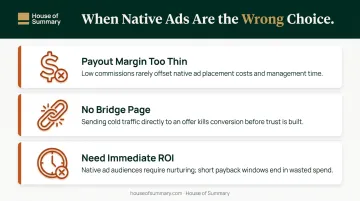
Three situations consistently produce wasted spend on native:
- If your payout doesn't leave margin after CPC costs, the math won't work regardless of how good your creative is
- Sending native traffic directly to a vendor sales page skips the content layer readers need to shift from browsing to buying — a bridge page isn't optional here
- Native campaigns require a data-gathering phase before optimization kicks in; affiliates who need immediate ROI will burn budget before results appear
What You Need Before Launching a Native Ad Campaign
Most native affiliate campaigns fail in the first week — not from bad creatives, but from missing groundwork. Get these four prerequisites in place before your first impression runs.
A Qualifying Affiliate Offer
Research the offer's earnings-per-click (EPC), average payout value, and conversion rate before committing to native traffic. ClickBank's May 2026 top products report shows the range in practice: VIN Checkup had a $0.44 EPC with a 4.90% conversion rate, while NewEra Protect showed a $0.75 EPC against a $162.86 average payout. Higher-payout offers give you more margin to absorb CPC costs during the testing phase.
ClickBank specifically identified offers like Purisaki Berberine Patches, PrimeBiome, and Synaptigen as converting well on native traffic — a useful shortlist when deciding where to start.
A Pre-Sell Landing Page
Native readers arrive through editorial content. They're reading, not shopping. A bridge page — an advertorial, a quiz, or a content-style intermediate page — transitions them from information-seeking to purchase consideration.
Skipping this step and routing traffic directly to a vendor sales page is the most structurally damaging mistake in native affiliate campaigns.
Conversion Tracking Configured
Before a single impression runs, your postback URL or tracking pixel must be connected between the native ad platform and your affiliate network. Without verified conversion signals, the platform's algorithm cannot learn which placements convert, and you lose the ability to make any informed bidding decisions.
Baseline Paid Traffic Knowledge
Affiliates new to paid channels should be comfortable with three fundamentals before launching:
- CPC bidding mechanics — how bids affect delivery volume and placement costs
- CTR analysis — reading click-through data to identify which creatives pull
- Basic CPA math — knowing your break-even cost-per-acquisition before you scale
Native platforms are not fully self-managing at the start. These skills determine whether your test budget generates signal or just disappears.
How to Run a Native Ad Campaign Step-by-Step
Native ad campaigns follow a defined sequence — and the sequence matters. Skip offer vetting, skip tracking setup, or rush past creative testing, and you'll burn budget with nothing to optimize against.
Step 1: Pick Your Affiliate Offer
Evaluate for native compatibility across three dimensions:
- Niche appeal — broad, information-seeking audiences (health, finance, insurance, self-help) convert better than niche products with small target pools
- Payout math — your EPC from the offer must exceed your average CPC plus margin; if it doesn't, the campaign cannot scale profitably regardless of creative quality
- Offer fit — products that benefit from explanation and context outperform those that require no education
Step 2: Set Up Tracking Before You Launch
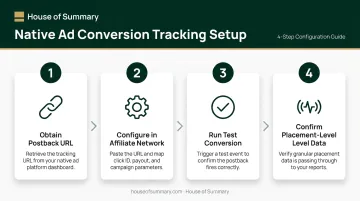
The tracking setup flow on most native platforms:
- Obtain the postback URL from the native platform (Taboola, MGID, Outbrain, etc.)
- Configure it in your affiliate network with the correct parameters
- Run a test conversion to verify both ends are communicating
- Confirm placement-level data is passing through before purchasing traffic
Incorrectly configured tracking is the single most common reason native campaigns fail to optimize. The platform needs conversion signals to improve its targeting — without them, it has no basis for bidding decisions and your spend produces no learnable data.
Step 3: Build Your Campaign Structure
Keep the initial structure clean:
- Separate desktop/tablet and mobile into distinct campaigns — they have different CPC costs and conversion behaviors
- Start with semi-automatic or conversion-based bidding rather than fully manual; Taboola recommends setting your daily budget at a minimum of $50 or 10x your CPA goal
- Go broad on audience settings — no interest layers, demographic restrictions, or publisher blocklists at launch; adding these too early starves the algorithm of the data it needs
For campaigns targeting conversions on Taboola specifically, the Maximize Conversions daily cap should be 10-15x your expected CPA, or at least $50 if your expected CPA is below $5.
Step 4: Write Headlines and Choose Visuals That Earn the Click
The native ad creative formula has one job: sell the click, not the product.
Headlines that work:
- Spark curiosity without over-promising
- Front-load the main point
- Use audience call-outs ("Are you over 50?", "New York homeowners are...")
- Ask direct questions or use specific numbers
- Stay within 35-45 characters for Taboola (60 character maximum); Outbrain recommends no more than 60 characters
Images that work:
- Authentic, situational photos consistently outperform polished stock images in native contexts
- Single visual focus — avoid cluttered compositions
- Image should reinforce the headline's promise, not contradict it
- Taboola feed images require a minimum of 1000 x 600px; MGID recommends at least 492 x 328px (600 x 400px preferred)
Step 5: Optimize Based on Real Data
The first week is a data collection phase. Don't make major optimization decisions until you have statistically meaningful conversion volume.
Three primary optimization levers:
| Lever | Action |
|---|---|
| Creatives | Pause ads when CPA hits 3x your target (Taboola's "Parachute Rule" applies after $5,000 spend) |
| Publisher/section bids | Bid up on converting placements, bid down on non-converting ones using CPC multipliers |
| Bid strategy | Taboola's tCPA requires 50 conversions over 7 consecutive days before activating |
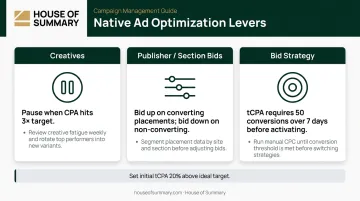
Set your initial tCPA approximately 20% above your ideal target — this gives the algorithm room to find conversions before you tighten the constraint.
When scaling, increase budgets in 20-30% increments to avoid destabilizing the platform's optimization. Never change budget or tCPA by more than 50% at one time.
Where Native Ads Work Best for Affiliates
Affiliates use native traffic across three primary funnel structures, each with different cost profiles and timelines to profitability:
- Bridge page funnel — Traffic drives to a pre-sell/advertorial page that warms the reader before forwarding to the offer. Fastest path to conversion data. Most commonly used.
- Email opt-in funnel — Traffic drives to a list-building page; affiliate offers are promoted via email sequences. Higher upfront cost, longer payback period, but list has residual value.
- Content + retargeting funnel — Traffic drives to an article; readers are retargeted with offer-specific ads. Requires larger budget and patience, but warms cold audiences effectively.
Publisher Quality Matters
Native ads placed on premium editorial sites perform differently from content-farm inventory. Vetting publisher quality affects both conversion rate and brand safety. Most platforms allow placement-level reporting and blocklisting — use it.
Newsletter Placements as a Native Channel
That quality standard applies to a format most affiliates underuse: sponsored content in niche newsletters. Unlike display ads, newsletter placements reach subscribers directly in their inboxes — no ad blockers, no algorithmic feed filters between the content and the reader. For affiliates targeting business professionals, finance readers, or global news audiences, this format delivers engaged traffic in a low-distraction environment where reader attention is already present.
House of Summary is one example of this channel done well. Their network spans Presidential Summary, Geopolitical Summary, Dubai Summary, and London Summary, reaching 500,000+ subscribers with 254,866+ emails opened daily. The audience skews toward executives, decision-makers, and high-income professionals — relevant for finance, professional services, and premium consumer offers.
Key details for affiliates considering this placement:
- Tracking links and UTM parameters are fully supported
- Audience demographics skew toward high-income, high-intent readers
- Placements appear as editorial content, not display ads, reducing reader friction
Best Practices to Maximize Your Native Ad ROI
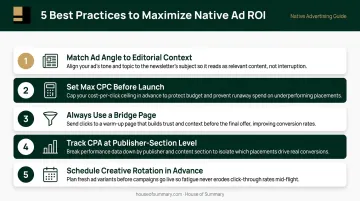
Most native affiliate campaigns underperform not because the offer is wrong, but because the execution misses on fundamentals. These five practices separate campaigns that scale from ones that stall.
- Match your ad angle to editorial context. An ad on a health news site should open with a health insight, not a discount. Misaligned placements generate clicks that don't convert — the reader's frame doesn't match the offer.
- Set your max CPC before you launch. Use
Max CPC = EPC − desired margin. If your offer pays $50 at a 2% conversion rate, your EPC is $1.00. At a 30% margin target, your ceiling is $0.70 — any spend above that can't be profitable at scale. - Never send native traffic straight to a vendor sales page. Native readers arrive in an editorial mindset. Without a transitional layer — bridge page, advertorial, or quiz — they hit the offer before they're ready, and conversion rates reflect it.
- Track CPA at the publisher-section level, not just campaign level. Aggregate numbers can hide a few profitable placements subsidizing many losing ones. Section-level reporting shows which inventory is actually earning.
- Schedule creative rotation before performance drops. Native ad fatigue sets in as the same audience sees the same headline and image repeatedly. Treat refresh cycles as a standing calendar item, not a reaction to declining metrics.
Frequently Asked Questions
Can you make $10,000 a month with affiliate marketing?
ClickBank's 2026 income guide classifies $10,000/month as the upper boundary of intermediate affiliate earnings and the entry point for advanced. It's achievable, but requires a profitable campaign baseline first — which takes testing budget, time, and offer selection discipline. Native ads can scale to that level once a winning campaign is established.
What niches work best for native advertising in affiliate marketing?
Health and wellness, personal finance, insurance, self-help, e-learning, travel, and technology consistently perform on native platforms. These categories match the editorial content-consumption mindset native readers bring — they're already looking for information, which makes educate-then-sell offers a natural fit.
How much budget do I need to start with native advertising?
Taboola recommends a daily minimum of $50 or 10x your CPA goal, but their own scaling documentation notes that most lead-gen and e-commerce campaigns need $300/day to exit the machine learning phase. At $50-$100/day, campaigns rarely generate enough signal to optimize effectively.
What is the difference between native ads and display ads for affiliates?
Native ads integrate into editorial content and engage readers in a lower-resistance context. Display ads appear in dedicated ad slots that readers have learned to ignore — and that ad blockers frequently remove. Native typically requires a content-first funnel; display can support more direct offers but carries much higher ad blindness rates.
How do I track conversions from a native ad campaign?
Obtain the postback URL from your native platform, configure it in your affiliate network with matching parameters, and run a test conversion before purchasing traffic. Verify both ends are communicating correctly before your campaign goes live.
What is a good CTR for native advertising?
CTR benchmarks vary significantly by device and platform, and no single authoritative figure applies universally. More importantly, CTR is not the primary success metric — a high-CTR ad that doesn't convert is a liability. CPA relative to your offer payout determines profitability; CTR is only meaningful as a creative comparison tool within the same campaign.