
Introduction
Banner ads get ignored. Ad blockers kill reach. Social feeds are so cluttered that even well-funded campaigns disappear without a trace. For many digital advertisers, the returns are shrinking while the spend stays the same.
Native advertising offers a different approach: paid content that matches the look and feel of the editorial environment around it. There's no jarring interruption, no obvious pitch — content earns attention because it's genuinely useful, not because it's forced in front of someone.
Native advertising isn't equally effective across every industry. Some sectors consistently outperform others based on how their audiences research, decide, and buy. According to EMARKETER, US native display ad spend reached $108.83 billion in 2024 — 63.1% of total US display ad spend.
That scale reflects where serious advertising budgets are moving. This article breaks down which industries are best positioned to benefit from native strategies, and why.
Key Takeaways
- Native advertising works best for purchases that require research, trust-building, or a longer decision cycle before conversion
- Finance, healthcare, B2B technology, travel, education, and luxury consistently deliver the strongest native results
- These audiences are skeptical of overt ads — they respond to content that informs before it sells
- Newsletter-based native placements bypass ad blockers entirely and reach readers during focused, voluntary reading sessions
- Platform fit matters as much as industry fit: placing an ad in the right editorial context lends it credibility by association
What Makes an Industry Well-Suited for Native Advertising
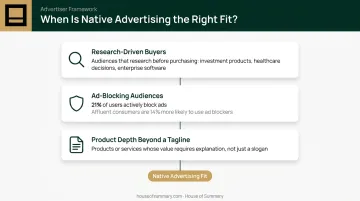
Not every product category benefits equally from native. Three conditions tend to separate high-performing native verticals from industries where standard display or search still dominates.
The three core conditions:
- Buyers research before committing — through comparison, education, or emotional processing. Think investment accounts, healthcare choices, or enterprise software.
- The target audience actively avoids traditional advertising. GWI data shows 21% of internet users block ads regularly, with affluent consumers 14% more likely than average to use blockers. For industries targeting high-income professionals, that's a structural problem — not a fringe one.
- The product has depth a tagline can't capture. Native content gives brands the space to explain, demonstrate, and build a case.
The Trust Transfer Effect
There's a specific mechanism that makes native advertising work beyond just avoiding blockers. When a brand's content appears alongside editorial content that a reader chose to read — in a respected publication, a specialized newsletter, or a trusted news source — that editorial credibility transfers to the brand.
Placement context matters as much as the content itself. A sponsored explainer on wealth protection strategies reads differently in a curated financial newsletter than it does as a web pop-up. The audience is already in an information-seeking mindset — the brand arrives as part of that experience, not as an interruption to it.
The Six Industries That Get the Most from Native Advertising
These industries share a common trait: their audiences are information-hungry, skeptical of overt advertising, and respond better to content that teaches or inspires before it sells.
Financial Services and Fintech
Finance is one of native advertising's strongest verticals, and the reason is straightforward: financial decisions are high-stakes. Whether someone is choosing an investment platform, reviewing insurance options, or evaluating a wealth management firm, they want information before they act — not a sales pitch.
This creates a natural fit for native content formats like:
- Explainer articles on policy changes or market shifts
- "How to protect your wealth in a volatile market" guides
- Step-by-step breakdowns of financial products and their trade-offs
- Investment strategy overviews that position the brand as a knowledgeable resource
The ad-blocker problem compounds this for finance brands specifically. Affluent consumers — the primary target for financial services advertising — over-index significantly on ad-blocking behavior. A finance brand running standard display campaigns is structurally locked out of a disproportionate share of its best prospects.
Newsletter-based native placements solve this directly. House of Summary's network — which reaches 500,000+ subscribers including C-suite executives, founders, HNWIs, and policy professionals across New York, London, and Dubai — delivers sponsored financial content directly to the inbox. No algorithms, no ad blockers, no competition with 15 other ads on the same page.
The audience profile maps directly to what financial services and fintech advertisers need: decision-empowered professionals who consume news because their work requires it.
Healthcare and Wellness
Healthcare presents a unique challenge: it's a high-sensitivity category where audiences are simultaneously skeptical of advertising and actively seeking information. Healthcare presents a unique challenge: it's a high-sensitivity category where audiences are simultaneously skeptical of advertising and actively seeking information. KFF tracking data shows trust in major health institutions has declined — FDA trust dropped from 65% in June 2023 to 53% by January 2025 — while individual doctors remain the most trusted source.
That erosion of institutional trust makes education-first native content the default approach. Audiences want credible explanations, not promotional claims.
Effective healthcare native content typically looks like:
- Sponsored articles explaining treatment options or ACA changes
- Wellness research summaries that provide genuine clinical context
- Condition education pieces that help patients or caregivers understand their options
- Telehealth or platform explainers that address reader questions before raising brand awareness
Regulatory constraints reinforce this approach. The FDA's own research on prescription drug promotion in editorial-style formats explicitly examines how sponsorship prominence and risk disclosure affect reader response — meaning the industry's regulators are already thinking about native as a format that requires careful, education-first execution.
B2B Technology and SaaS
B2B technology buyers are among the most ad-resistant audiences in digital marketing. CTOs, CFOs, and operations leaders conduct extensive research before any significant purchase — and Forrester's 2024 research confirms the scale of this: 86% of B2B purchases stall, an average of 13 people are involved in the buying decision, and 89% of purchases span two or more departments.
A single display impression or one sponsored post doesn't move a committee. Native advertising, placed across multiple touchpoints in trade publications and business newsletters over weeks or months, builds the brand familiarity that eventually earns a seat in the vendor shortlist.
What works in B2B tech native advertising:
- Industry benchmark reports or data studies shared as editorial content
- Workflow insight articles that demonstrate expertise rather than features
- Thought leadership pieces placed in publications the buying committee already reads
- Use case narratives that help one stakeholder make the internal case to others
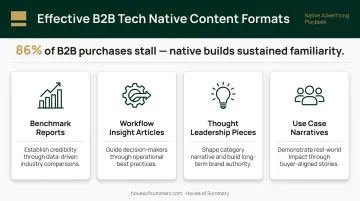
The long sales cycle is actually an advantage here. Native advertising's strength is sustained brand-building across multiple touchpoints — exactly what B2B tech requires.
Travel and Hospitality
Travel is one of the few consumer categories where the aspiration is the product. People don't just research a destination — they want to feel it before they book. Native advertising's format advantage over display is clearest here: a rich editorial piece can immerse a reader in a destination's atmosphere in ways that a banner ad or 15-second pre-roll simply cannot.
Taboola's travel vertical analysis — covering 8 billion+ impressions — found that 57% of travel marketers using native advertising cite lead generation as their primary goal, with travel content driving meaningful engagement at scale globally. That performance reflects how well native's storytelling format aligns with travel's discovery-driven buying journey.
Effective travel native content:
- Destination narrative pieces that blend practical information with atmosphere
- "Best of" editorial features that showcase hotel or airline experiences through reader-relevant context
- Itinerary-style content that positions a brand within a travel plan rather than above it
- Partnership features in respected lifestyle publications that extend reach beyond a brand's own follower base
Education and EdTech
Prospective students and their parents are deeply skeptical of advertising — but they're actively researching. Native advertising bridges that gap by meeting them where the research is already happening.
Educational brands that place rich, informative content in trusted editorial environments arrive when readers are already in a learning mindset. In that context, readers treat sponsored editorial as useful information rather than an ad. Native content can highlight outcomes, student voices, curriculum depth, and campus life in ways that feel informative rather than promotional.
The format advantage for education native:
- Sponsored editorial pieces feel categorically different from banner ads to a skeptical parent or prospective student
- Placement in credible news or lifestyle publications extends reach beyond the institution's own channels
- Long-form content supports the extended research journey that higher education decisions involve
- Content can address real questions (employability outcomes, campus culture, financial aid options) rather than generic brand claims
Luxury and Consumer Lifestyle
Luxury buyers respond to narrative and exclusivity — not discount codes or aggressive calls to action. A luxury brand appearing in a carefully curated, premium editorial environment inherits some of the authority of that context. The same ad in a low-quality programmatic placement does the opposite — it cheapens the brand by proximity.
This is why high-end hospitality, fashion, and lifestyle brands consistently favor sponsored editorial placements over open-exchange display. The audience quality argument is equally important: luxury buyers aren't motivated by discount codes or aggressive calls to action. They respond to narrative, exclusivity, and identification.
Nativo's research on luxury brand native advertising found that a luxury resort increased site traffic by 124% through branded content placements — a result that reflects what happens when aspirational storytelling reaches the right audience in the right context.
House of Summary's editorial network reaches HNWI and UHNWI audiences in New York, London, and Dubai — three of the world's most concentrated luxury spending markets. For brands in this category, that kind of audience access in a human-written, editorially controlled environment is genuinely difficult to replicate through programmatic channels.
BSH Hausgeräte's CEO noted after running campaigns on Dubai Summary: "One of the smartest ad buys we made this year. The editorial tone aligned with high-intent readers, and the audience quality of Dubai Summary is good. We saw click-through rates 4x higher than Google AdWords."
How to Evaluate If Native Advertising Is Right for Your Industry
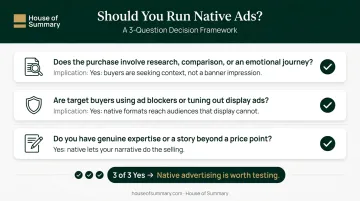
Before committing budget to native advertising, answer three diagnostic questions honestly:
- Does my customer's purchase involve research, comparison, or an emotional journey? If the answer is yes, native content can participate in that process rather than interrupt it.
- Are my target buyers using ad blockers or tuning out display and social? If affluent or professional audiences are a priority, the structural ad-avoidance problem makes non-interruptive formats a necessity, not a preference.
- Do I have genuine expertise or a story worth telling beyond a price point? Native advertising requires real content. Thin promotional copy dressed up as an article will underperform every time.
Common Mistakes That Kill Native Campaigns
- Repurpose display ad copy into native placements and the editorial contract breaks immediately — aggressive CTAs and promotional headlines signal "ad" the moment a reader encounters them
- Skipping or softening disclosure labels violates FTC guidelines: "Sponsored," "Ad," and "Paid Advertisement" are acceptable; "Promoted" alone is not. Content needs to earn engagement even after readers see the label
- Select platforms based on audience fit, not price. Open-web widgets, social in-feed units, and newsletter placements each reach readers in different attention states — newsletter readers are in focused, voluntary reading sessions, not passive scrolling, which is why dwell time runs higher
Conclusion
The industries that extract the most value from native advertising — finance, healthcare, B2B technology, travel, education, and luxury — all share the same buyer behavior: audiences who research heavily before committing and who tune out interruptive ad formats almost entirely.
Channel selection matters as much as industry fit. Native advertising in credible, specialized editorial environments outperforms open-web placements not just on reach, but on the quality of attention it captures. House of Summary's newsletter network is a practical example of that principle in action.
For brands targeting decision-makers in business, finance, and global affairs, sponsored placements across Presidential Summary, Geopolitical Summary, Dubai Summary, and London Summary reach 500,000+ subscribers — with 254,866+ emails opened daily. The audience concentrates among executives, HNWIs, and policy professionals across New York, London, and Dubai. Every placement lands directly in the inbox, bypassing ad blockers entirely.
To explore advertising opportunities, contact sales@houseofsummary.com.
Frequently Asked Questions
Which industries spend the most on advertising?
Automotive, financial services, retail, technology, and healthcare consistently dominate digital ad spend. High spend doesn't guarantee high performance, though — native advertising allows mid-size brands in these verticals to compete on content quality rather than raw budget scale.
What best describes native advertising?
Native advertising is paid content designed to match the look, feel, and function of the editorial environment where it appears. It's clearly labeled as sponsored or an ad, but blends into the surrounding content rather than interrupting it — unlike display advertising, which occupies separate, predefined ad slots outside the editorial flow.
Is native advertising effective for B2B industries?
B2B is one of native's strongest use cases. Business buyers conduct extensive research before purchasing, are highly resistant to interruption-based ads, and respond well to thought leadership content placed in trusted trade or business publications.
How do I know if native advertising is right for my industry?
Ask three questions: Does the purchase involve research or trust-building? Does your audience use ad blockers or ignore display ads? Does your brand have genuine expertise worth sharing beyond a promotional message? If all three answers are yes, native advertising is worth testing.
What are best practices when using native advertising?
A few principles that hold across formats:
- Lead with genuine value — educate, inform, or inspire before selling
- Match the tone and format of the host publication
- Include clear sponsorship disclosure
- Measure success by engagement depth (time on page, scroll depth) rather than clicks alone
What makes newsletter native advertising different from other native ad formats?
Newsletter placements reach readers during voluntary, focused reading sessions rather than passive browsing — resulting in higher attention and dwell time. Critically, newsletters bypass ad blockers entirely since they're delivered directly to the inbox, making them especially effective for reaching professional and high-income audiences who over-index on ad-blocking behavior.