Introduction
Banner blindness renders creative invisible. Ad blockers kill delivery before it starts. Platform restrictions quietly reject health, finance, and lifestyle campaigns with no explanation. These aren't edge cases — according to Backlinko research, approximately 1.77 billion internet users worldwide use ad blockers, representing nearly 30% of all internet users globally.
Native advertising sidesteps these obstacles. Rather than interrupting the browsing experience with visually distinct banners or pop-ups, native ads blend into the editorial content people are already reading — appearing as "recommended articles," "sponsored content," or "you might also like" placements. They feel like recommendations, not intrusions. That's why the IAB Europe Guide to Native Advertising reports native ads deliver click-through rates 8.8x higher than banner ads.
This article covers how native ads and affiliate marketing work individually, why they're effective in combination, and what a practical campaign looks like from start to finish: platform selection, bridge page structure, tracking setup, and scaling strategy.
Key Takeaways
- Native ads blend into editorial content, appearing as recommendations rather than interruptions—making them consistently outperform traditional banner ads on engagement and click-through
- Affiliate marketing pays publishers or marketers a commission for each sale or lead generated through their promotional efforts
- The combination works because native ads send content-primed readers to bridge pages that ease them into affiliate offers—no hard sell required
- The full funnel: editorial-style ad → bridge page → affiliate offer → conversion → commission
- Success depends on offer selection, creative quality, bridge page structure, and conversion tracking
What Are Native Ads in Affiliate Marketing?
Native advertising is paid content that mirrors the format, tone, and style of the platform it appears on. According to the IAB Native Advertising Playbook 2.0, native ads are "so cohesive with the page content, assimilated into the design, and consistent with the platform behavior that the viewer feels the ads belong there."
These placements appear as "recommended articles," "sponsored content," or "you might also like" widgets rather than banners or pop-ups. The only visible distinction is a small "sponsored" or "ad" label.
That label is the only thing separating a native ad from editorial content — which is exactly what makes the format work for affiliate marketers.
Main Native Ad Formats for Affiliate Marketers
Each format drives readers to a landing page you control before introducing the affiliate offer:
- In-feed ads sit inside news or social feeds, integrated between editorial posts
- Content recommendation widgets appear at the bottom of articles as "you might also like" suggestions
- Sponsored content posts are full editorial-style pieces published on third-party sites
How Native Ads Compare to Other Paid Formats
| Format | Primary Challenge | Typical CTR Performance |
|---|---|---|
| Banner Ads | Banner blindness, low attention | Baseline (1x) |
| Facebook Ads | Category restrictions, account bans | Varies by compliance |
| Google Ads | High CPC, competitive keywords | Intent-driven but costly |
| Native Ads | Requires bridge pages | 8.8x higher CTR than banners |
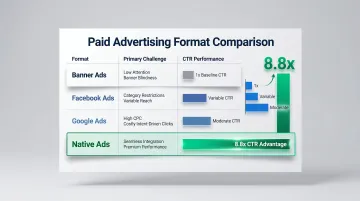
The 8.8x CTR advantage is documented in the IAB Europe Guide to Native Advertising (2021), which also notes that native ads increase purchase intent by 18%. Separately, Sharethrough research found native ads receive 53% more views than display ads — a gap that directly translates to more top-of-funnel traffic for affiliate campaigns.
Why Native Ads and Affiliate Marketing Are a Natural Fit
Content Mindset Advantage
Native ads appear on news sites, blogs, and editorial platforms where users are already reading and discovering information. Someone reading a personal finance article is already primed to receive a financial product recommendation—this contextual alignment increases receptivity in ways that search or social ads cannot replicate.
Research from The Harris Poll (March 2022) found that 79% of UK consumers report greater comfort with contextual ads than behavioral targeting. An Outbrain study with Lumen found native ads on premium publisher sites are 21% more likely to be clicked, 44% more likely to be trusted, and 24% more likely to lead to future purchases compared to social media placements.
Scalability Over Organic Channels
Unlike SEO or newsletter growth, native ad campaigns can be scaled by increasing daily budget proportionally once a profitable creative-audience-offer combination is found. Affiliate marketers who build organic content can use native ads to amplify that same content to cold audiences immediately—without waiting months for search rankings to improve.
Reduced Platform Restrictions
Most major native ad networks are more permissive than Facebook or Google when it comes to affiliate verticals including health, finance, and lifestyle. This makes native particularly attractive for affiliates in categories that frequently encounter disapproval on social platforms.
Native Ads Bypass Ad Blockers
Because native placements are embedded into editorial page architecture rather than served as separate ad units, ad-blocking software identifies them less reliably. This advantage extends to inbox-based native formats: newsletter advertising reaches subscribers directly in the inbox, where there are no algorithms, no ad blockers, and no visual clutter competing for attention.
Premium newsletter networks like House of Summary deliver ads to high-intent, verified readers with click-through rates that run 4x higher than Google AdWords—putting affiliate offers in front of audiences already disposed to act.
A Mainstream, Growing Channel
According to eMarketer's December 2025 forecast, US native display ad spending is expected to reach $147.98 billion in 2026, growing 13.1% year-over-year. Native formats now account for approximately 60% of total US display ad spending, per Mordor Intelligence (January 2026). Those numbers reflect a channel with serious advertiser confidence behind it—and consistent returns across verticals.
How the Native Ad Affiliate Funnel Works
Step 1: The Native Ad Creative
The affiliate marketer creates an editorial-style headline and image that generates curiosity without sounding promotional. For example: "The Surprising Reason You're Always Tired" or "Why Most People Never Lose the Last 10 Pounds."
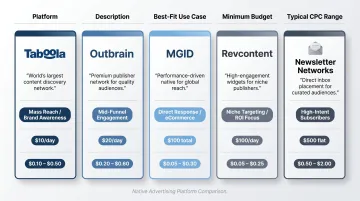
The ad is submitted to a native ad platform—Taboola, Outbrain, MGID, Revcontent, or a newsletter network—and distributed across relevant publisher sites or inboxes. Advertisers pay on a cost-per-click (CPC) model, only paying when a user clicks.
Choosing the Right Native Ad Platform
| Platform | Best For | Minimum Budget | Typical CPC |
|---|---|---|---|
| Taboola | Premium publisher placements | 30x your bid (~$15) | $0.30-$0.60 |
| Outbrain | Strong analytics, premium reach | $20/day | $0.40-$1.00 |
| MGID | Beginners, international reach | Lower entry | Varies by geo |
| Revcontent | Testing new verticals | Not documented | Varies |
| Newsletter Networks | High-intent inbox audiences | Custom pricing | Premium CPM |
Newsletter ad networks offer a distinct inbox-native alternative with real audience quality advantages—particularly for finance, business, and executive audiences. Unlike web-based placements, newsletter ads reach subscribers who have opted in directly, with no ad blockers, no competing visual clutter, and no algorithmic filtering between the ad and the reader. For affiliate marketers targeting high-intent professionals, that direct inbox access can meaningfully improve funnel performance from the first click.
Step 2: The Bridge Page (Advertorial)
Native ad traffic is almost never sent directly to an affiliate offer page. The bridge page is an intermediate content asset—a review, an educational article, or a personal story—that builds context and trust before the reader is invited to click through to the affiliate offer.
This step increases conversion rates significantly and is required by most native platforms. Outbrain's affiliate guide explicitly advises against directing users to product pages — and most practitioners find that skipping the bridge page reduces conversions and risks platform rejection.
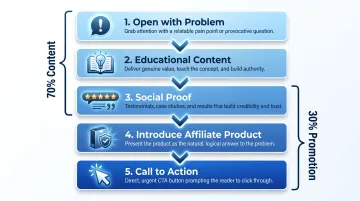
The 70/30 Structure
- 70% valuable content addressing the problem raised in the headline
- 30% promotional content introducing the product as a natural solution
MGID's bridge page guide identifies five high-converting formats: advertorials, online quizzes, calculators, educational articles, and chatbot flows.
Step 3: The Affiliate Offer and Commission
That bridge page click lands the reader on the merchant's product or offer page via the affiliate link. If they convert—purchase, sign up, or complete a form—the affiliate earns a commission.
Commission structures vary across networks and verticals:
| Model | Structure | Typical Range |
|---|---|---|
| Flat CPA | Fixed amount per conversion | $5–$500+ depending on vertical |
| Revenue share | Percentage of sale value | 10–50% of transaction |
| Hybrid | Base payment + performance bonus | Varies by program |
Profitability depends on the gap between cost per click (what you pay the platform) and earnings per conversion (what the affiliate network pays).
Step 4: Tracking and Attribution
Conversion tracking is what turns ad spend into actionable data — without it, there's no way to know which creative, placement, or audience is actually driving commissions. The standard setup includes:
- UTM parameters from the native ad platform
- Third-party tracker (Voluum, RedTrack, BeMob) that ties clicks to affiliate conversions
- Integrated dashboards that give a unified view of ROI per campaign
Some tracking tools integrate directly with both native platforms and affiliate networks, eliminating manual data matching.
Key Strategies for Running a Native Ad Affiliate Campaign
Choosing the Right Affiliate Offer for Native
Not every affiliate product suits native advertising. The best-performing offers have:
- Broad audience appeal
- A clear problem-solution narrative
- Low barrier to entry for conversions
Top-performing verticals:
- Health and wellness (supplements, fitness, weight loss)
- Personal finance (credit cards, loans, insurance)
- Insurance (auto, home, life comparisons)
- Home improvement
- Lifestyle products (beauty, anti-aging)
Offers that require significant technical explanation or target a very narrow audience tend to underperform because native traffic is interest-based rather than intent-driven. Always confirm the offer explicitly allows native ad traffic—some CPA networks restrict traffic sources.
Creating Editorial-Style Ad Creatives
Native ad creatives consist of two components: headline and image.
Headlines should:
- Read like editorial teasers that create curiosity or address a pain point
- Example: "Why Most People Never Lose the Last 10 Pounds"
- Never sound promotional: "Buy This Amazing Supplement Today"
According to Taboola's Creative Best Practices 2025, optimal headline length is 35-45 characters (60 max). Use the "Expert Framework" (for example, "Makeup Expert: If You're Over 40...") and include numbers and time references.
Strong headlines bring the click. The image determines whether readers stop scrolling in the first place.
Images should:
- Feel authentic and contextual rather than stock-photo polished
- Feature real people and close-up product visuals over generic imagery
- Avoid excessive polish — unpolished visuals tend to build more trust
Launch 3-5 headline and image variations per campaign and let platform data identify top performers before cutting underperformers.
Building a High-Converting Bridge Page
The 5-part bridge page structure:
- Open with the problem mirrored from the headline
- Provide educational content that builds context and credibility
- Incorporate social proof such as testimonials or study citations
- Introduce the affiliate product as the natural solution
- Close with a direct call to action linked through the affiliate URL
FTC-required affiliate disclosure must appear clearly at the top of the page—and doing so actually builds trust rather than undermining it.
Budget, Timeline, and Scaling Expectations
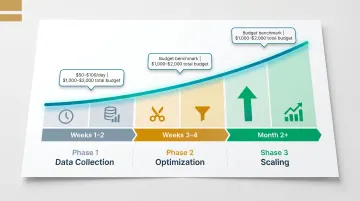
Realistic benchmarks:
- Starting daily budget: $50-$100
- Testing phase: 2-4 weeks for data collection
- Total initial investment: $1,000-$2,000 before finding consistent profitability
- Profitability timeline: Most campaigns require 4-8 weeks to reach consistent profitability
Timeline breakdown:
- Weeks 1-2: Data collection
- Weeks 3-4: Optimization (cutting underperformers, scaling winners)
- Month 2: Budget increases become defensible
Early spend buys data points, not results — that distinction matters when evaluating what's working. Scale incrementally: increase daily budget in small steps, then check CTR, conversion rate, and EPC before going further.
Common Mistakes That Kill Native Ad Affiliate Campaigns
Sending Traffic Directly to the Affiliate Offer
This is the single most damaging mistake. Sending traffic directly to the affiliate offer page without a bridge page reduces conversion rates (cold traffic has no context or trust) and often leads to platform rejection, since most native networks require an intermediate content page between the ad and the merchant.
Running Campaigns Without Conversion Tracking
Without knowing which placements, creatives, and audiences are generating commissions, every optimization decision is a guess. Tracking must be set up before the first dollar is spent, not retrofitted later once data has already been lost.
Quitting Too Early (or Persisting on the Wrong Offer)
Many affiliates quit before collecting enough data to optimize. The opposite problem is just as costly: continuing to promote an offer that requires too much explanation or targets too narrow an audience for the volume native traffic provides.
The fix is the same in both cases. Pick one platform, one offer, and one audience. Prove profitability before expanding.
Frequently Asked Questions
What are native ads for affiliate marketing?
Native ads are paid placements that match the editorial style of the page or platform they appear on. In affiliate marketing, they drive traffic from content-style ads through bridge pages to affiliate offers, earning a commission on each conversion.
Can you make $100 a day with affiliate marketing?
Yes, $100/day is achievable, but it typically requires several weeks of testing before campaigns become consistently profitable. Earnings depend on offer type, commission rate, and conversion rate—treat early ad spend as a testing budget, not an income expectation.
How much are affiliate commissions?
Commissions vary widely: flat CPA payouts run from a few dollars for basic leads to hundreds for high-ticket products, while revenue share in finance or SaaS typically falls between 10% and 50%. Always weigh the commission structure against your cost per click to confirm campaign viability.
What is the 80/20 rule in affiliate marketing?
The 80/20 rule (Pareto Principle) means roughly 80% of commissions tend to come from 20% of campaigns, creatives, or placements. This makes it critical to identify top performers and scale them while cutting underperformers once you have enough data to act with confidence.
What types of affiliate offers work best with native ads?
Broad-appeal verticals are the strongest fit—health, personal finance, insurance, home improvement, and lifestyle products—because native traffic is interest-primed rather than intent-driven. Emotionally resonant problem-solution offers far outperform niche or highly technical products.
How does newsletter advertising compare to traditional native advertising?
Newsletter advertising is a premium form of native placement. Ads appear within editorial content that subscribers have opted into, reaching a captive inbox audience with no ad blockers or competing visual clutter. Because there's no algorithm filtering delivery and no banner blindness, newsletter placements consistently produce higher engagement rates than web-based native ads—making them a direct line to readers who are already paying attention.